

Household Plastic Basin and Bucket Injection Mould: Precision, Durability, and Efficient Production
Admin 2026-10-08Household basins and buckets are among the most frequently used plastic products in homes, commercial cleaning operations, bathrooms, utility rooms, and service businesses. Although these products appear simple, producing them consistently requires carefully engineered tooling. A basin or bucket must withstand repeated impact, bending, lifting, washing, stacking, and exposure to water or household chemicals. It must also maintain an attractive appearance, stable dimensions, comfortable handling, and a smooth surface that is easy to clean.
The Household Plastic Basin and Bucket Injection Mould is designed to meet these practical manufacturing requirements. It supports the production of washing basins, cleaning buckets, bathroom water containers, and utility storage buckets made primarily from polypropylene or polyethylene. The mould focuses on structural strength, balanced wall thickness, integrated handle solutions, efficient cooling, and dependable production performance.
For manufacturers seeking a practical alternative to low-cost tooling with limited service life, this mould offers a more balanced solution. Its design combines durable mould steel, optimized cavity configuration, controlled cooling, adaptable runner options, and customization capability. These features help manufacturers reduce deformation, improve product consistency, simplify maintenance, and achieve more stable injection moulding cycles.

Household Plastic Basin and Bucket Injection Mould
1. The Role of High-Quality Tooling in Basin and Bucket Production
Plastic basins and buckets are often regarded as basic household products, but their moulds must solve several technical problems at the same time. The products need sufficient rigidity without excessive material consumption. They require an even appearance over broad surfaces. Their rims must remain stable, their handles must be securely formed, and their bottoms must resist warping when the product is filled, carried, or placed on an uneven surface.
Large household products also present challenges during injection moulding. The mould cavity covers a comparatively wide area, and plastic must flow through the cavity in a controlled manner. If the filling balance is poor, the finished article may show weld lines, sink marks, short shots, uneven shrinkage, or visible distortion. If cooling is not properly designed, the product may be ejected before it has developed adequate rigidity, resulting in deformation during handling or storage.
A professional basin and bucket mould therefore requires more than a simple cavity and core. It requires a coordinated design that considers product geometry, plastic flow, wall thickness, gate position, ejection, cooling channels, parting lines, draft angles, handle structure, and expected production volume. The Household Plastic Basin and Bucket Injection Mould is developed around these factors to support reliable production of durable daily-use articles.
Good tooling also contributes to the final product’s commercial value. Consumers commonly judge a basin or bucket by its surface quality, shape, rim strength, handle comfort, and general feeling of sturdiness. Retail buyers and distributors, meanwhile, require consistent dimensions and colors across large batches. A stable mould helps manufacturers satisfy both requirements while reducing rejects and unnecessary post-processing.
2. Main Product Applications
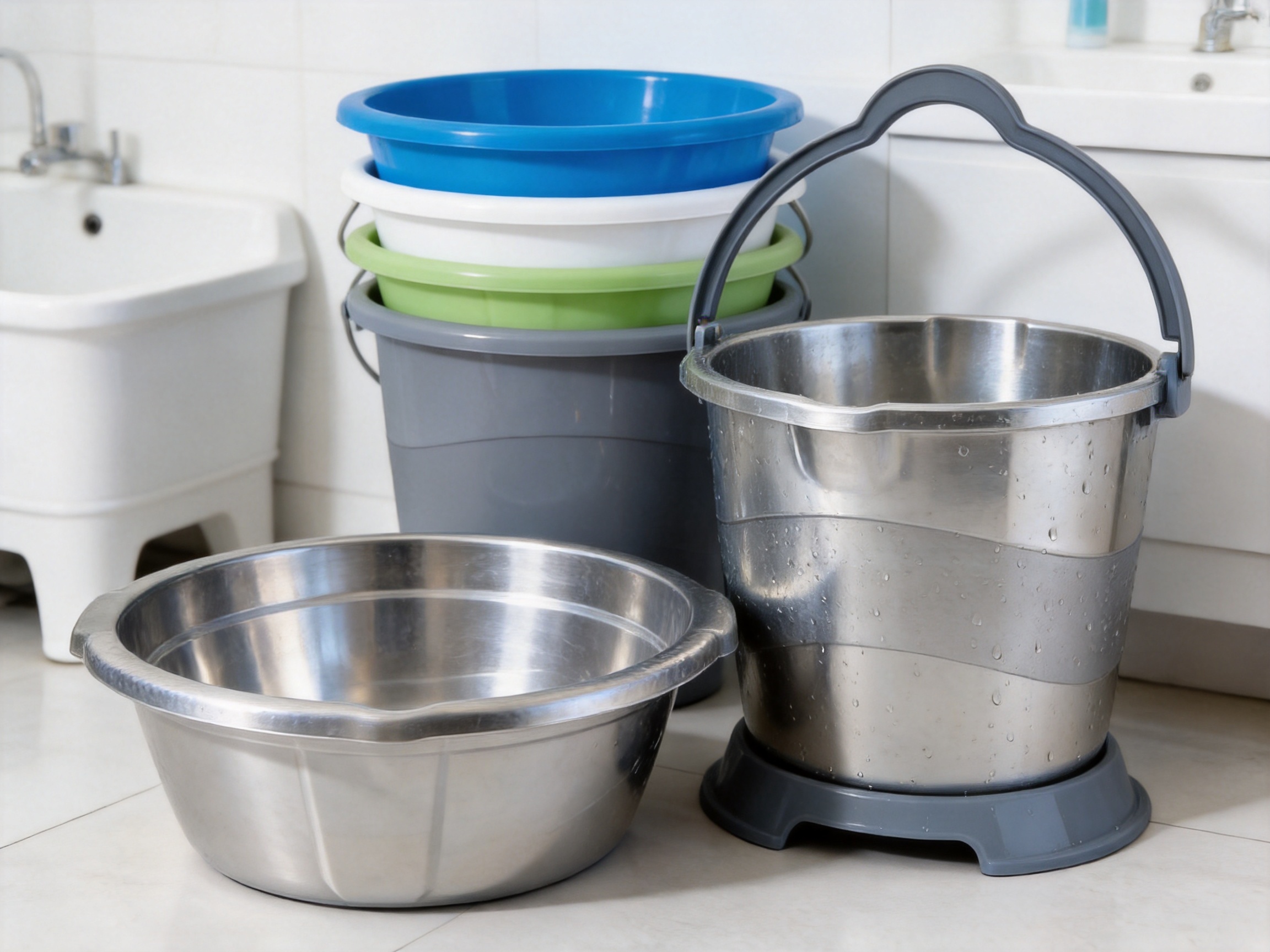
The mould can be customized for different styles and sizes of household basins and buckets. Its application range includes traditional washing basins, deep utility basins, bathroom containers, cleaning buckets, storage buckets, and other open-top plastic containers used in daily life.
Household Washing Basins
Washing basins typically require a broad opening, a stable rim, a smooth interior, and sufficient depth for water or clothing. The cavity can be designed with rounded corners and smooth transitions to make the finished product easier to clean. A properly formed rim also improves handling and reduces the risk of sharp or uncomfortable edges.
For household use, visual quality is important. Large, uninterrupted surfaces can reveal moulding defects more easily than small technical parts. The mould therefore supports polished or matte surface treatments according to the desired product style. A polished finish can provide a clean and reflective appearance, while a matte finish can reduce the visibility of minor handling marks and create a softer visual effect.
Cleaning Buckets
Cleaning buckets are repeatedly lifted while filled with water, detergents, or cleaning solutions. They need a strong upper structure and reliable handle integration. The mould can incorporate an opening or mounting structure for the handle directly into the product design, helping manufacturers create a strong and consistent connection.
The lower body of a cleaning bucket also needs adequate stiffness. If the base is too thin or the wall thickness is poorly balanced, the bucket may flex excessively or become unstable when placed on the floor. A carefully engineered cavity and core help distribute the material more evenly throughout the product.
Bathroom Water Containers
Bathroom containers are commonly exposed to moisture, temperature changes, soaps, and cleaning agents. Their surfaces should be smooth and easy to rinse. The mould design supports clean internal surfaces and rounded transitions that reduce dirt accumulation in corners.
Depending on the customer’s requirements, the container can be designed with a compact form for small bathrooms or a larger capacity for commercial and family use. Handle design, rim profile, bottom geometry, and overall height can be modified to suit a particular market.
Utility Storage Buckets
Utility buckets may be used for tools, household supplies, gardening materials, laundry, or general storage. These products often need a thicker structure and increased resistance to impact. A customized mould can accommodate a reinforced rim, stronger bottom, molded grip sections, or stacking features where appropriate.
The broad application range makes this mould suitable for manufacturers serving different customer groups. Instead of investing in an entirely new mould concept for each related product, a manufacturer can work with a configurable design approach and modify the cavity, handle, dimensions, and surface details according to the required product family.
3. Engineering Features of the Mould
Balanced Wall Thickness
Balanced wall thickness is one of the most important design considerations for a basin or bucket. Excessive thickness increases material consumption, cooling time, product weight, and production cost. Insufficient thickness may cause weak areas, deformation, poor impact resistance, or an unstable base.
The mould design is developed to support an appropriate distribution of plastic throughout the product. Balanced sections help reduce uneven shrinkage and improve dimensional stability. They also support a more predictable filling process, which is especially important for broad cavity surfaces.
Wall thickness must be considered together with corners, ribs, the rim, the base, and handle mounting areas. A uniform nominal wall is not always sufficient because some regions require local reinforcement. The mould can therefore be adjusted to provide strength where loading is concentrated while avoiding unnecessary material in low-stress areas.
Strong Rim Structures
The rim is a high-use area of a basin or bucket. It is touched during carrying, stacking, cleaning, and pouring. A weak or poorly supported rim can bend, become permanently deformed, or create an uncomfortable edge. The mould emphasizes a strong rim structure to help the finished product maintain its shape during repeated use.
A stable rim also contributes to stacking performance. When multiple basins or buckets are stored together, dimensional variation around the upper opening can make stacking difficult. Consistent moulding helps improve the alignment of nested products and reduces unnecessary storage space.
Handle Integration
Handle design can be incorporated directly into the mould configuration. This provides manufacturers with flexibility in selecting a fixed molded handle, a handle mounting structure, or a design prepared for an additional handle component.
The handle area requires careful attention because it transfers load from the filled container to the user’s hand. The connection must be strong enough for the intended capacity and use conditions. Smooth transitions and suitable reinforcement can help distribute stress and reduce concentrated loads around the mounting points.
Handle geometry can also be adapted for comfort. A larger opening may be useful for gloved users or commercial cleaning work, while a compact grip may be preferable for household products. The mould can be modified to support different handle widths, shapes, orientations, and attachment arrangements.
Rounded Corners and Easy-Clean Surfaces
Basins and buckets are commonly used with water, soap, detergents, and other materials that may leave residue. Smooth interior surfaces make cleaning easier and help reduce the accumulation of dirt. Rounded transitions between the sidewall and bottom are particularly useful because they minimize sharp corners that are difficult to reach.
The mould surface can be finished as polished or matte according to the customer’s product concept. Polishing can produce a bright, smooth appearance, while a controlled matte texture can create a practical finish with a different tactile character. Surface treatment also influences how the product releases from the mould, so it must be considered together with draft angles and ejection design.
Optimized Cooling for Large Plastic Parts
Cooling is a critical factor in the production of large injection-molded household products. The plastic must cool sufficiently before ejection, but excessive cooling time reduces output. Cooling channels must therefore be positioned to remove heat efficiently from the cavity and core without compromising mould strength.
The mould cooling system is optimized for large plastic parts to support stable molding cycles. Efficient heat removal can reduce cycle variation, improve dimensional consistency, and lower the likelihood of deformation after ejection. Stable cooling also helps manufacturers plan production more accurately because cycle times are less affected by changing mould temperatures.
Cooling performance depends on more than the number of channels. Channel diameter, location, circuit balance, water flow, steel thickness, and areas of concentrated material all influence results. A professional mould design evaluates these elements as part of the overall tooling structure.
4. Material Compatibility
The standard product material options for this mould are polypropylene and polyethylene. Both materials are widely used in household plastic products because they provide a useful combination of low density, chemical resistance, processability, and affordability.
Polypropylene
Polypropylene is suitable for many basins and buckets because it offers good stiffness, low weight, and resistance to a broad range of household substances. It can produce attractive surfaces and is available in many colors. Its relatively low density also helps manufacturers control product weight and transportation costs.
When polypropylene is selected, the moulding process should be adjusted according to the specific grade, melt flow characteristics, shrinkage behavior, pigment system, and intended product strength. Gate design and cooling control are important because large polypropylene parts can be sensitive to warpage if filling and temperature distribution are not balanced.
Polyethylene
Polyethylene can provide flexibility and impact resistance, making it useful for products expected to experience repeated handling or occasional impact. Different polyethylene grades offer different levels of stiffness, toughness, and processability. The appropriate grade depends on product dimensions, expected loading, temperature conditions, and target cost.
Because polyethylene and polypropylene have different shrinkage and flow behavior, the moulding parameters must be selected accordingly. The cavity design, cooling arrangement, and ejection system should all be validated against the chosen material grade rather than treated as completely interchangeable.
Material Selection Support
Material selection should be based on actual use rather than price alone. A small bathroom basin may prioritize appearance and low weight, while a commercial cleaning bucket may require greater impact resistance and handle strength. The manufacturer can review the intended application and adjust the mould and product design accordingly.
| Design Consideration | Recommended Focus |
| Household washing basin | Balanced wall thickness, smooth internal surface, stable rim, attractive finish |
| Cleaning bucket | Handle strength, impact resistance, reinforced upper structure |
| Bathroom container | Easy-clean geometry, compact dimensions, moisture-resistant material selection |
| Utility storage bucket | Durability, stacking stability, base strength, optional reinforcement |
5. Mould Steel and Service Life
The standard mould steel options are P20 and H13. These materials are commonly selected for injection tooling because they can provide the required combination of machinability, strength, wear resistance, and service performance when properly processed and maintained.
P20 Steel
P20 is widely used for general-purpose injection mould components. It offers good machinability and is suitable for many household product moulds. It can provide a practical balance between tooling cost and expected service life, particularly when the product material is not highly abrasive and the production requirements are moderate to substantial.
P20 is often considered when the customer requires dependable performance while maintaining a competitive initial mould investment. Its suitability depends on the specific mould structure, production volume, plastic grade, surface requirements, and maintenance program.
H13 Steel
H13 is a hot-work tool steel known for higher heat resistance and strong mechanical performance. It may be selected for applications requiring increased durability, greater resistance to thermal cycling, or more demanding production conditions.
Although H13 may involve a higher tooling investment, the additional performance can be valuable for long production programs or products exposed to more severe processing conditions. The final steel choice should be determined through a technical review of expected shots, material type, cycle conditions, surface requirements, and budget.
Expected Mould Life
The stated mould life is up to 700,000 shots under suitable operating, maintenance, and material conditions. Actual service life depends on numerous factors, including injection pressure, cycle frequency, cooling water quality, material additives, abrasive fillers, cleaning procedures, storage conditions, and preventive maintenance.
A mould should not be judged only by the number of theoretical shots. Long-term value also depends on dimensional stability, ease of maintenance, replacement part availability, consistency between production batches, and the ability to make controlled modifications. A well-managed mould can provide better total operating value than a lower-cost tool that requires frequent repair or produces inconsistent parts.
6. Runner and Cavity Configuration
Hot Runner and Cold Runner Options
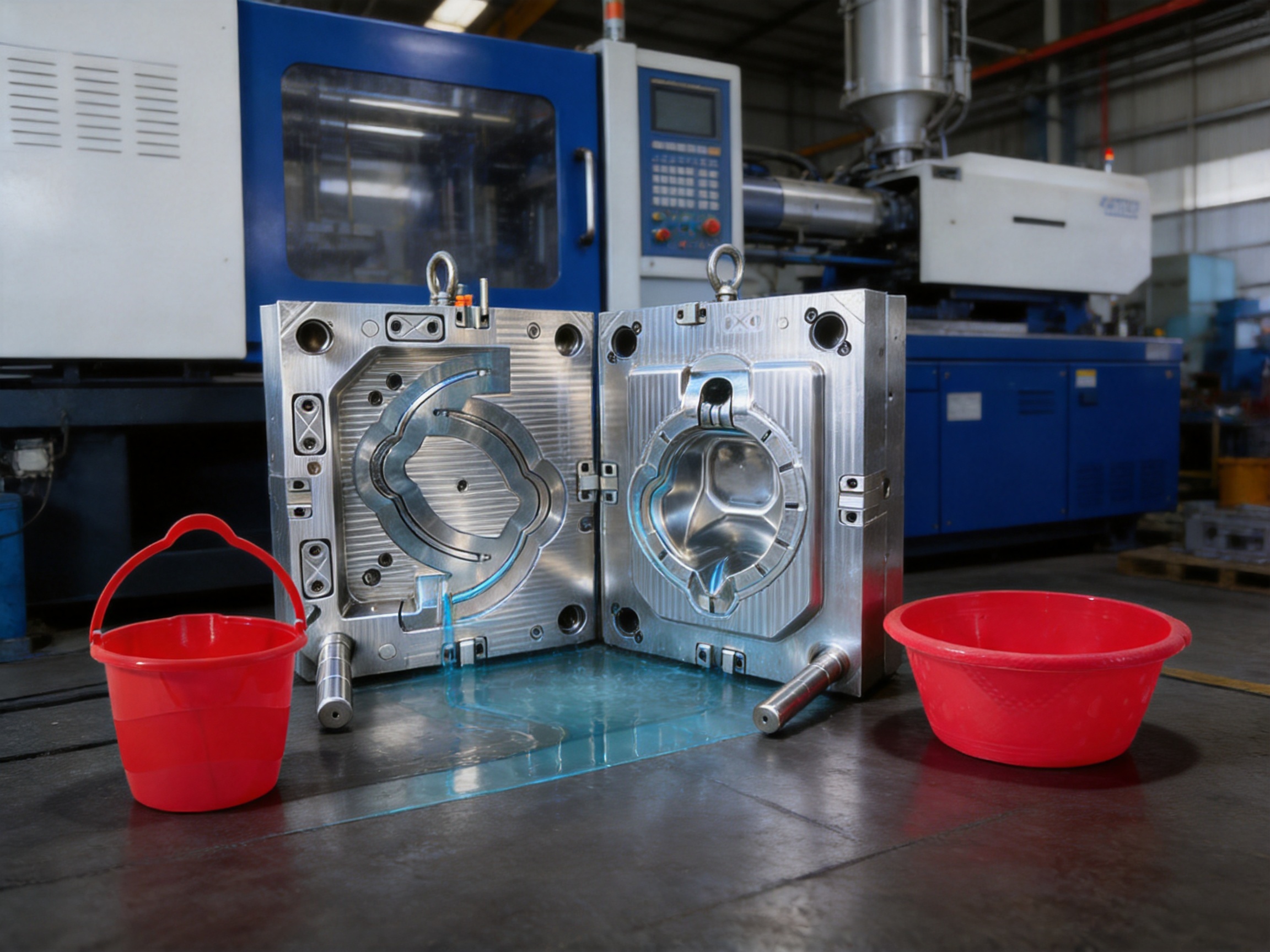
The mould can be configured with either a hot runner or a cold runner system. Each option has practical advantages, and the correct selection depends on product size, production volume, material, machine capability, automation requirements, and investment expectations.
A hot runner system can reduce or eliminate the need to recycle large runners. It may support faster production, reduce material waste, and provide more direct control over the injection process. For large-volume manufacturing, the reduction in runner waste can be commercially valuable. Hot runner systems may also allow greater flexibility in gate placement and improved automation.
A cold runner system is generally simpler and may have lower initial tooling cost. It can be a suitable choice for moderate production volumes, products with straightforward filling requirements, or manufacturers who prefer a simpler maintenance structure. The runner can be separated from the product and recycled where permitted by the material and product quality requirements.
The selection should be made after evaluating the complete production system. A hot runner is not automatically better for every product, just as a cold runner is not automatically more economical. The most appropriate solution depends on the customer’s actual production plan and quality objectives.
One- and Two-Cavity Options
The standard cavity range is one to two cavities. A one-cavity mould may be appropriate for large products, specialized designs, lower output requirements, or manufacturers who want a simpler tool. It can also allow greater flexibility during product development and early market introduction.
A two-cavity configuration can increase output when the injection machine has adequate capacity and the product design allows balanced filling. Higher output may reduce the effective tooling cost per product, but the mould must be designed with appropriate runner balance, cooling balance, ejection coordination, and machine compatibility.
Cavity selection should consider the product’s projected annual demand, available machine tonnage, shot size, cycle time, material cost, labor structure, and future expansion plans. A technically correct cavity count helps prevent both underutilized tooling and excessive complexity.
7. Manufacturing Process and Quality Control
Advanced mould manufacturing depends on a controlled process from initial design through final testing. Haiquan Mould operates as a high-tech enterprise specializing in the research, development, and manufacturing of precision injection moulds. Its production approach combines professional design capability with a scientific production management system.
Product and Mould Design
The manufacturing process begins with understanding the intended product. Engineers review the basin or bucket dimensions, capacity, wall thickness, rim profile, handle arrangement, material, surface finish, stacking requirements, and expected production volume.
The mould design must also account for draft angles, parting lines, ejection locations, gate positions, cooling circuits, mold-base dimensions, and machine installation requirements. Early design review helps identify potential problems before steel is cut. It also makes future product modifications easier to control.
For a household container, the engineer must pay particular attention to large flat or curved surfaces. These surfaces are more likely to show warpage, sink marks, flow lines, or uneven texture. The design process therefore considers how plastic will enter and fill the cavity, how heat will be removed, and how the part will be supported during ejection.
Steel Preparation and Component Manufacturing
After design approval, the selected mould steel is prepared and processed into the mould base, cavity, core, inserts, sliders where required, and other functional components. The use of appropriate steel and controlled machining processes helps establish dimensional accuracy and mechanical stability.
Critical components require close attention because small dimensional errors can affect product fit, sealing, handle alignment, or surface appearance. Machining methods may include computer-controlled milling, precision drilling, electrical discharge machining, grinding, and other processes selected according to the geometry and tolerance requirements.
Surface Treatment
The final surface of the mould influences the appearance and release behavior of the finished product. Polished surfaces may be specified for a smooth, bright appearance. Matte or textured surfaces may be selected for visual differentiation, grip, or reduced visibility of minor marks.
Surface treatment must be applied consistently across the intended product areas. Uneven polishing or uncontrolled texture transitions can create visible differences between cavity sections. Professional inspection helps confirm that the finish corresponds with the approved product sample or technical specification.
Assembly and Fitting
Once individual components are machined, the mould is assembled and fitted. The cavity, core, ejector system, guide components, cooling circuits, runner system, and other elements must operate together smoothly.
Fitting work is especially important for large household product moulds. The mould must close evenly, maintain alignment under injection pressure, and provide reliable ejection without damaging the product. The handle area, rim, base, and other critical features receive particular attention during assembly.
Trial Moulding
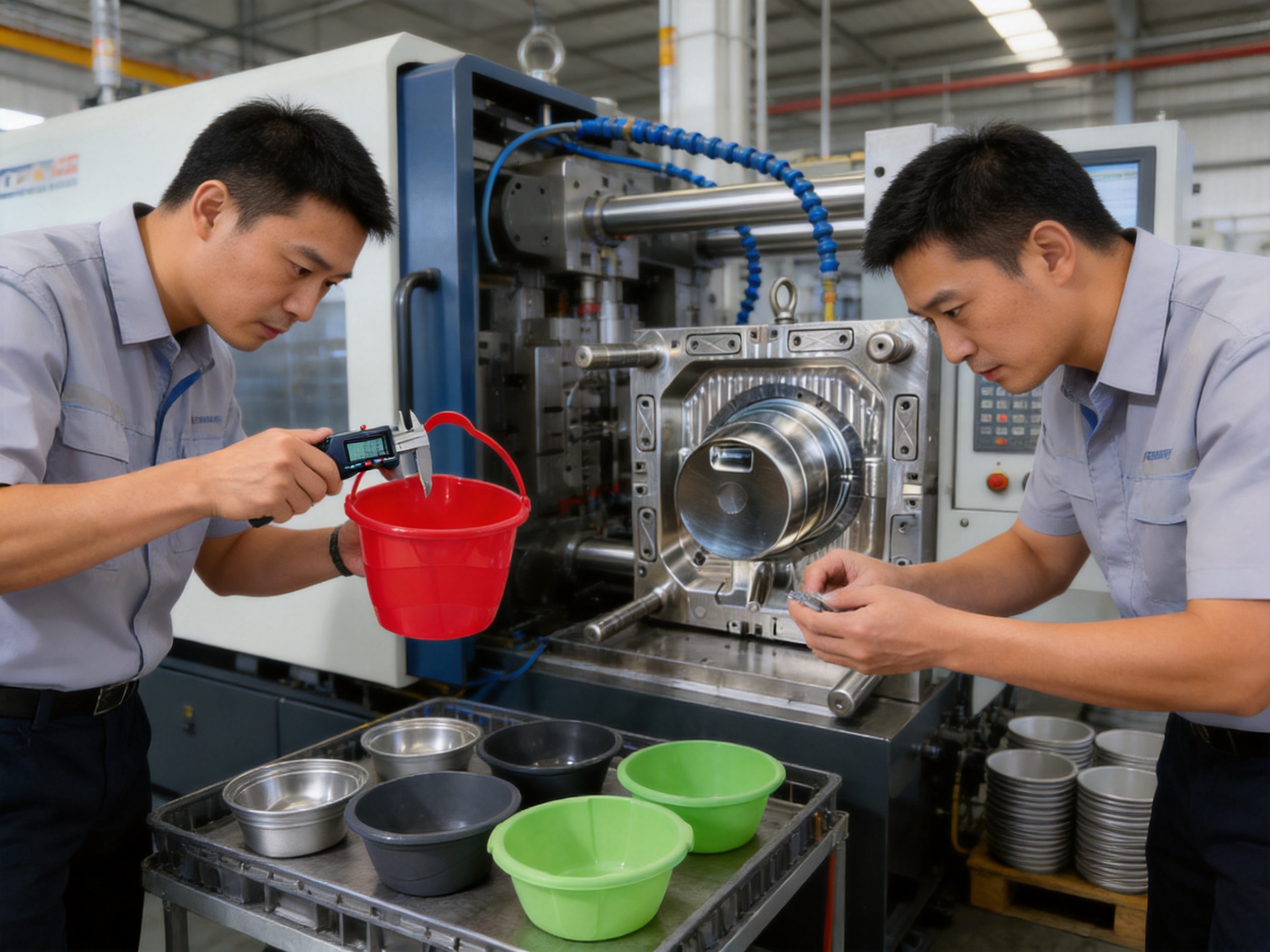
Trial moulding verifies whether the mould performs as expected on an injection machine. Engineers evaluate filling behavior, product dimensions, weight, appearance, ejection, cooling, cycle time, and potential defects.
Trial results may lead to controlled adjustments to the gate, venting, cooling balance, ejection timing, processing parameters, or surface treatment. This stage is important because actual moulding conditions provide information that cannot always be obtained from design calculations alone.
Sample products can be reviewed by the customer for approval. If modifications are required, they can be addressed before shipment or before the mould enters regular production. This structured approach helps reduce the risk of costly changes after installation at the customer’s factory.
8. Advantages Compared with Basic Competitor Tooling
Many low-cost basin and bucket moulds compete primarily on initial price. While a low purchase price may appear attractive, the total manufacturing cost can increase if the mould produces inconsistent parts, requires frequent repairs, has inefficient cooling, or cannot accommodate future product changes.
The Household Plastic Basin and Bucket Injection Mould offers several practical advantages over basic tooling alternatives.
Greater Structural Reliability
The focus on strong rims, balanced wall thickness, and handle integration helps improve the structural reliability of the finished product. This is particularly important for buckets that are repeatedly lifted when filled. Competitor moulds with poorly reinforced areas may produce articles that flex excessively or develop deformation after repeated use.
More Stable Dimensional Quality
Balanced cooling and controlled mould construction support more consistent dimensions across production batches. Stable dimensions improve stacking, packaging, handle alignment, and customer satisfaction. Reduced variation also makes downstream inspection and packing more efficient.
Reduced Material and Process Waste
Appropriate wall thickness design prevents unnecessary overuse of plastic. The choice between hot and cold runner systems allows the production plan to be matched with the most suitable material management strategy. By reviewing the product and process together, manufacturers can avoid treating material waste as an unavoidable cost.
Better Surface Appearance
Polished or matte mould finishes provide greater control over the final product appearance. A carefully prepared surface can help manufacturers offer differentiated products for different market segments. Smooth internal surfaces also support easier cleaning, which is a meaningful advantage for household and bathroom applications.
Flexible Customization
The mould can be customized according to basin size, handle design, cavity configuration, product geometry, material, and surface finish. This flexibility is valuable for importers, distributors, household product brands, and manufacturers that serve multiple markets.
Instead of accepting a standard product that may not match local preferences, customers can request changes to capacity, height, opening size, handle shape, bottom structure, color compatibility, and surface treatment. Customization also allows manufacturers to develop product families with shared design characteristics.
Long-Term Service Value
A mould designed for up to 700,000 shots can support substantial production requirements when properly operated and maintained. Long service life helps spread the tooling investment over a larger number of products and reduces the disruption caused by premature mould replacement.
Long-term value is further supported by the company’s integrated service approach, which covers design, production, trial support, and after-sales assistance. This is an advantage compared with suppliers that provide only a basic steel tool without sufficient technical guidance.
9. Customization Options
Customization is available for basin size, handle design, and cavity configuration. Additional product details can also be reviewed during the engineering stage to ensure the mould matches the customer’s market and production system.
Size and Capacity
The overall diameter, length, width, height, and depth can be adjusted to achieve the desired capacity. Size changes must be evaluated in relation to machine dimensions, injection volume, cooling time, product weight, and packaging requirements.
Handle Design
Handle options may include different grip openings, mounting positions, thicknesses, curves, and reinforcement structures. The design can be adjusted for household carrying, commercial cleaning, bathroom use, or utility storage.
Cavity Configuration
The customer can select a one- or two-cavity configuration according to production demand. Runner balance, machine capacity, cycle time, and automation requirements should be evaluated before confirming the final arrangement.
Surface Finish
A polished finish can create a clean and bright appearance, while a matte finish may provide a more practical or contemporary visual effect. The selected finish should be specified clearly on the product drawing and confirmed through trial samples.
Material and Color
PP and PE are the standard material choices, but the specific grade should be selected according to the product’s expected loading, flexibility, impact conditions, and appearance requirements. Color masterbatch compatibility and dispersion should also be considered during trial production.
10. Production Efficiency and Cost Considerations
Tooling cost is only one part of the total cost of producing a basin or bucket. Manufacturers should also consider material usage, cycle time, reject rate, labor, energy, maintenance, packaging, and machine utilization.
An optimized cooling system can contribute to shorter and more consistent cycles. Even a modest reduction in cycle time can create a significant output increase over a long production program. Stable cooling also reduces the risk of parts being removed while still too soft, which can lead to deformation and product rejection.
Balanced wall thickness helps control material consumption. Because household basins and buckets are produced in large quantities, small savings in product weight can have a substantial effect on annual material costs. However, weight reduction must not compromise rim strength, handle safety, base stability, or impact resistance.
The runner choice also affects cost. A hot runner may reduce runner waste and support automated production, while a cold runner may offer a lower initial tooling cost and simpler maintenance. The best choice should be based on total cost over the expected production life rather than the price of the mould alone.
High-quality mould construction can reduce downtime caused by alignment problems, premature wear, cooling leaks, difficult ejection, or repeated repairs. Consistent tooling also simplifies production planning because operators can rely on predictable cycle behavior and product dimensions.
11. Installation, Operation, and Maintenance
Proper operation and maintenance are essential for achieving the expected service life of any injection mould. Before installation, the customer should confirm that the injection machine has adequate clamping force, shot capacity, platen dimensions, water connections, and ejection compatibility.
During operation, cooling water should be managed carefully. Contaminated or corrosive water can reduce cooling performance and damage internal channels. Regular inspection of water flow, temperature, pressure, and leakage helps maintain stable production.
The mould should be cleaned after production, especially when pigments, additives, or deposits may accumulate around the cavity, core, gate, vents, and parting line. Operators should use suitable cleaning methods that do not damage polished areas or textured surfaces.
Ejector pins, guide components, slides, and other moving parts should be inspected and lubricated according to the mould maintenance schedule. Excessive lubricant should be avoided because it can contaminate the product or collect dust.
At the end of a production run, the mould should be dried and protected before storage. Cooling channels should be managed to reduce the risk of corrosion, and the mould should be stored in a clean, dry environment. A maintenance record can help track shot counts, repairs, dimensional checks, and replacement components.
12. Company Manufacturing Strengths
Taizhou Huangyan Haiquan Plastic Mold Co., Ltd. specializes in the research and manufacturing of precision injection moulds. The company serves daily necessities, home appliances, automotive parts, and industrial equipment markets. This sector diversity gives its engineering team experience with different product structures, material requirements, dimensional standards, and production challenges.
The company follows a quality-first and sustainable-development philosophy. Its professional design team and scientific production management system support integrated services from product and mould design through manufacturing, trial production, delivery, and after-sales support.
This integrated approach is important for household mould projects because the product, mould, machine, material, and production conditions are closely connected. A change in basin size may influence cooling. A change in material may affect shrinkage. A new handle may require a modified ejection or reinforcement structure. Coordinating these details through one technical process helps reduce communication gaps and improves project control.
Haiquan serves customers in Europe, the Middle East, Southeast Asia, and South America. Its international customer base requires attention to delivery reliability, communication, packaging, technical documentation, and quality consistency. Experience with overseas customers also supports the company’s ability to understand different market preferences and product specifications.
The company’s product range includes moulds for daily necessities, cleaning products, crates, chairs and stools, air coolers, rainwater harvesting tanks, pet dryers, and other plastic products. Experience in these related categories contributes to a broader understanding of large-part moulding, household product ergonomics, structural reinforcement, and production efficiency.
13. Selecting the Right Configuration for Different Buyers
A small or medium-sized manufacturer entering the household products market may prefer a one-cavity cold runner mould because it offers a relatively straightforward production system and manageable initial investment. This configuration can be appropriate for market testing, regional distribution, or products with moderate demand.
A high-volume producer may benefit from a two-cavity tool and a hot runner system. The higher output potential and reduced runner waste can improve production economics when the machine and automation systems are properly matched.
A manufacturer supplying commercial cleaning products may prioritize H13 steel, a reinforced handle area, strong rim geometry, and high-impact material. A manufacturer focused on retail bathroom products may place greater emphasis on surface finish, color appearance, compact packaging, and easy-clean internal geometry.
Before ordering, the buyer should provide product drawings or samples, intended material, annual output estimate, preferred machine information, cavity target, handle requirements, surface finish, and any packaging or stacking needs. Clear information at the beginning helps the tooling supplier recommend a suitable structure rather than relying on assumptions.
14. Recommended Technical Specification
| Item | Specification |
| Product | Household plastic basin and bucket |
| Application | Washing basin, cleaning bucket, bathroom container, utility storage bucket |
| Product material | PP / PE |
| Mould steel | P20 / H13 |
| Runner system | Hot runner or cold runner |
| Cavity configuration | 1–2 cavities |
| Expected mould life | Up to 700,000 shots under suitable conditions |
| Surface finish | Polished or matte |
| Customization | Basin size, handle design, cavity configuration, product details |
| Cooling design | Optimized for large plastic parts and stable moulding cycles |
15. Frequently Asked Questions
Q1: What products can be made with this mould?
The mould is designed for household washing basins, cleaning buckets, bathroom water containers, utility storage buckets, and related open-top plastic containers. The final product shape, capacity, handle design, and surface finish can be customized.
Q2: Which plastic materials are recommended?
Polypropylene and polyethylene are the standard material options. The final grade should be selected according to the required stiffness, flexibility, impact resistance, chemical exposure, product weight, color, and operating environment.
Q3: Can the handle be molded as part of the product?
Yes. Handle integration can be included in the mould design. The handle shape, opening, mounting structure, thickness, and reinforcement can be adjusted according to the intended load and user requirements.
Q4: Is the mould suitable for high-volume manufacturing?
Yes. The mould is designed for reliable production and can be configured with one or two cavities and either a hot or cold runner system. The expected output should be reviewed together with machine capacity, product size, cycle time, and material selection.
Q5: What is the expected service life?
The stated service life is up to 700,000 shots under suitable processing and maintenance conditions. Actual life depends on mould steel, plastic grade, additives, injection pressure, cooling water quality, operating practices, and preventive maintenance.
Q6: What is the difference between P20 and H13 steel?
P20 provides a practical solution for many general-purpose household moulds and offers good machinability. H13 provides higher heat resistance and may be preferred for more demanding production conditions. The correct selection depends on product requirements, expected volume, material, cycle conditions, and budget.
Q7: Should a hot runner or cold runner be selected?
A hot runner may reduce runner waste and support high-volume automated production. A cold runner may provide a simpler structure and lower initial tooling cost. The choice should be based on production volume, material usage, machine configuration, maintenance capability, and total operating cost.
Q8: Can the mould produce products with a polished surface?
Yes. The mould can be prepared with a polished or matte surface finish. The desired finish should be confirmed during design and verified through trial samples because surface treatment influences product appearance and release performance.
Q9: How does the mould reduce product deformation?
Balanced wall thickness, strong rim geometry, suitable draft angles, and optimized cooling all help reduce deformation. Correct injection parameters and adequate cooling time are also necessary for consistent production results.
Q10: Can the mould be modified for a different basin size?
Yes. Basin size, height, depth, opening dimensions, handle design, and cavity configuration can be reviewed for customization. The effect of any change on machine capacity, cooling, product weight, and cycle time should be evaluated before final approval.
Q11: What information should be provided when requesting a quotation?
The buyer should provide product drawings or samples, target dimensions, material, estimated annual quantity, cavity preference, machine specifications, handle requirements, surface finish, packaging needs, and delivery expectations. More complete information allows the supplier to prepare a more accurate technical and commercial proposal.
Q12: Does the supplier provide support after mould delivery?
The company provides integrated services covering design, manufacturing, trial support, and after-sales assistance. Customers can discuss installation, moulding conditions, maintenance, and possible product modifications with the technical team.
16. Conclusion
The Household Plastic Basin and Bucket Injection Mould is developed for manufacturers that require dependable tooling for durable daily-use products. Its main strengths include strong rim structures, balanced wall thickness, handle integration, smooth cleanable surfaces, optimized cooling, flexible runner systems, and one- or two-cavity configurations.
The mould supports PP and PE materials, P20 or H13 steel, polished or matte finishes, and customization of basin size, handle design, and cavity arrangement. With an expected service life of up to 700,000 shots under suitable conditions, it can support long-term production while helping control material waste, cycle variation, product deformation, and maintenance costs.
Compared with basic competitor tooling, the mould provides greater attention to structural performance, production stability, surface quality, customization, and total operating value. These advantages are supported by Haiquan Mould’s professional design team, scientific production management system, precision manufacturing capabilities, international service experience, and integrated after-sales support.
For household product manufacturers, importers, and distributors seeking a reliable solution for basins and buckets, the mould offers a practical foundation for producing consistent, durable, and market-ready plastic products.
References
1. General principles of thermoplastic injection mould design and engineering practice.
2. Technical guidance for polypropylene and polyethylene processing in household plastic products.
3. Industrial practice for P20 and H13 tool steels used in injection mould manufacturing.
4. Recommended methods for cooling-system design in large-part injection moulding.
5. Quality-control practices for dimensional inspection, surface evaluation, and trial production of plastic injection moulds.
6. Product and technical information supplied for the Household Plastic Basin and Bucket Injection Mould.
Product: Household Plastic Basin and Bucket Injection Mould

For exclusive deals and latest offers, sign up by entering your email address below.











 +86-18657672567
 sales@tzhqmould.com
celin@tzhqmould.com
 No. 17 Houshi Road, Beicheng Industrial Zone, Huangyan District, Taizhou City, Zhejiang Province, China
Copyright © Taizhou Huangyan Haiquan Plastic Mold Co., Ltd. All Rights Reserved
Injection Plastic Mould Maker

