

Large Capacity Thick Plastic Water Jug Mould with Lid: Design, Manufacturing, and Production Advantages
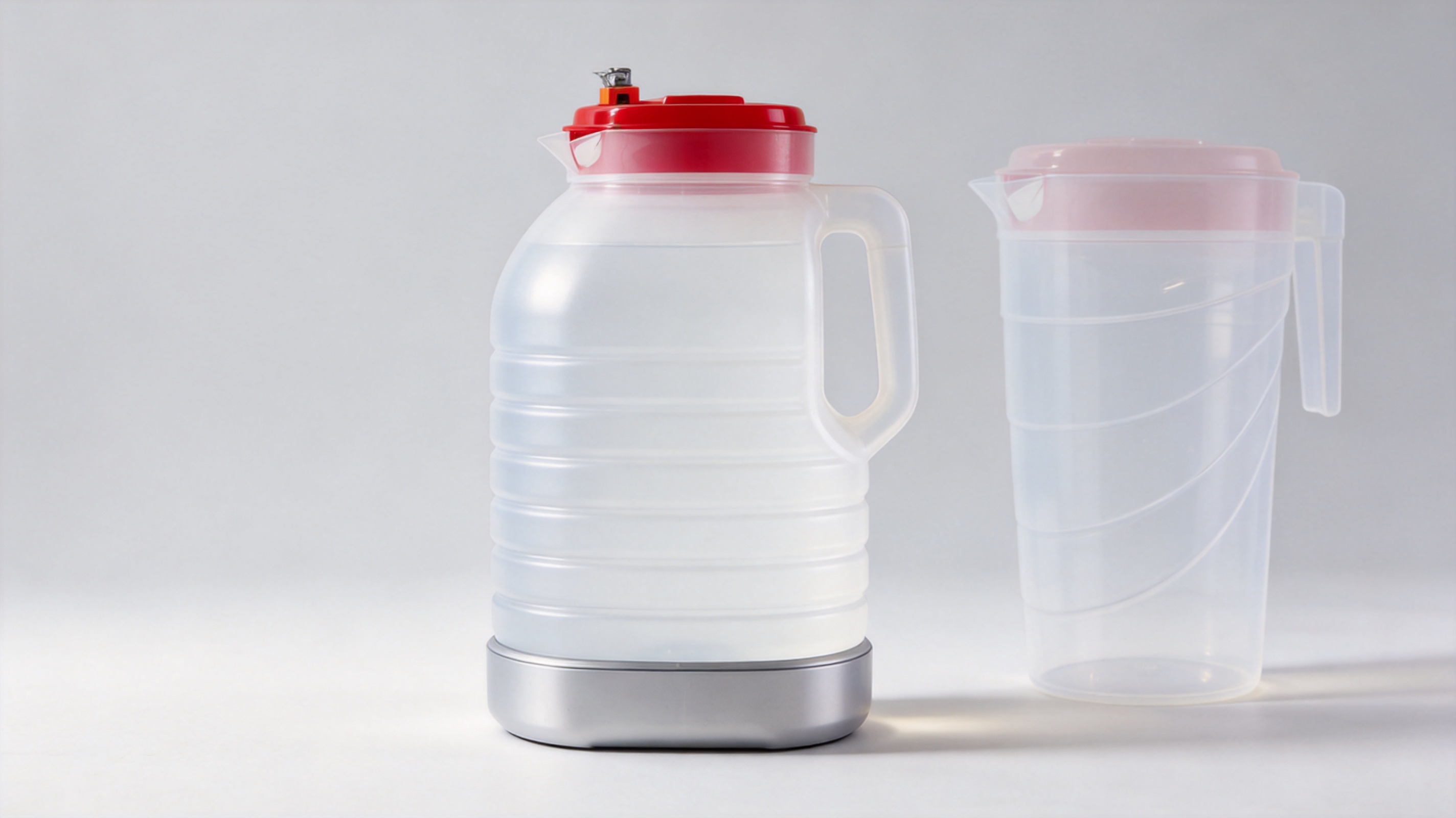
Admin 2026-09-12Large-capacity plastic water jugs are widely used in homes, offices, outdoor activities, commercial facilities, emergency preparedness, and beverage storage. Although the finished product may appear simple, manufacturing a thick-walled jug with an integrated lid and handle requires carefully engineered tooling. The mould must support stable material flow, reliable cooling, accurate dimensional control, smooth demoulding, and consistent production over long operating cycles.
The Large Capacity Thick Plastic Water Jug Mould with Lid is designed for manufacturers that require dependable production of strong, reusable plastic water containers. It is suitable for products made from polypropylene (PP) or high-density polyethylene (HDPE), with possible capacities ranging from approximately 2 litres to 20 litres depending on the final product design. The tooling can be customized according to product drawings, samples, capacity requirements, surface textures, branding needs, and lid or handle configurations.
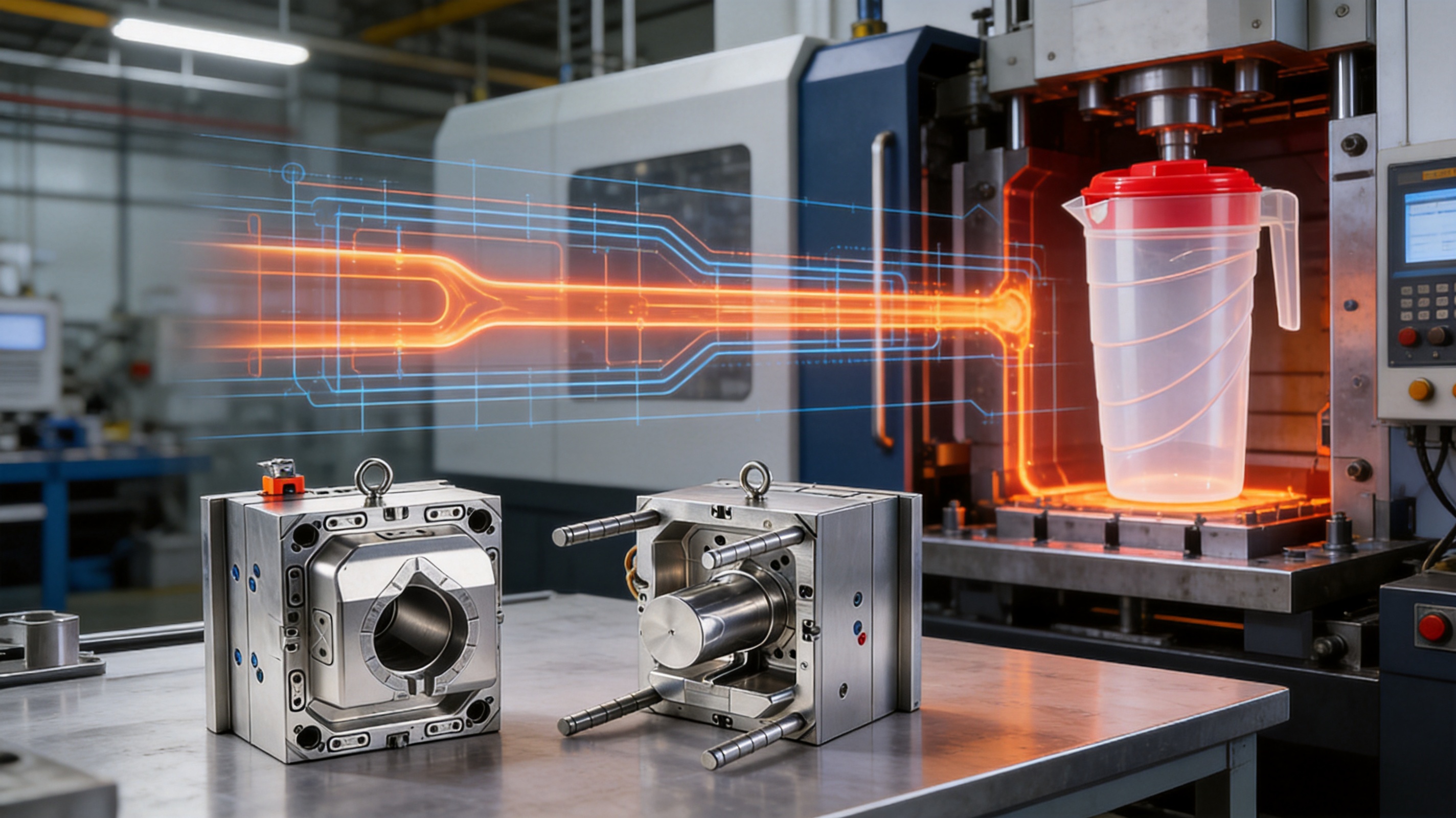
Unlike basic container tooling, this mould is developed specifically for thick plastic products. Its optimized gate arrangement helps promote balanced filling and reduces the possibility of sink marks, uneven wall thickness, weld-line weakness, and visible surface defects. A carefully planned cooling system helps control shrinkage and deformation, while the reinforced mould structure supports stable operation during extended production cycles.
Taizhou Huangyan Haiquan Plastic Mold Co., Ltd. provides mould design, manufacturing, testing, customization, and after-sales support for customers requiring practical injection moulding solutions. With experience in daily necessities, home appliances, automotive parts, and industrial equipment, the company combines engineering design capability with systematic production management to serve domestic and international customers.

Large Capacity Thick Plastic Water Jug Mould with Lid
1. Why Thick Plastic Water Jugs Require Specialized Mould Design
Thick plastic containers present different technical challenges from thin-wall packaging products. The larger amount of plastic material takes longer to cool, and the interior and exterior surfaces may cool at different rates. If the mould is not designed correctly, the finished jug can suffer from shrinkage, warpage, sink marks, inconsistent wall thickness, and dimensional instability.
A water jug must also withstand repeated handling, filling, transport, and storage. The body needs sufficient rigidity to resist impact and deformation, while the handle and lid must remain functional after repeated use. The opening must seal properly, and the base must provide stable support on different surfaces. These requirements place significant demands on the injection mould and its manufacturing accuracy.
Material flow is another important consideration. When molten PP or HDPE enters a large container cavity, it must reach all areas evenly before solidifying. Poor flow balance may create air traps, short shots, excessive weld lines, or variations in wall thickness. For this reason, the gate position, runner system, cavity layout, venting, and cooling channels must be considered together rather than designed independently.
The mould must also be compatible with the customer’s injection moulding machine. Its overall dimensions, locating ring, ejector system, water connections, injection point, and clamping requirements should be matched to the available equipment. A well-engineered mould allows the customer to establish a stable production process more quickly and minimizes unnecessary adjustments during commissioning.
1.1 Managing Wall Thickness
Uniform wall thickness is one of the most important quality requirements for a large plastic water jug. Excessively thin areas may reduce impact resistance, while excessively thick areas may cause sink marks, long cooling times, and higher material consumption. A balanced wall design provides the necessary strength without creating avoidable production costs.
During the design stage, the engineering team evaluates the body profile, corners, bottom structure, shoulder transition, neck area, handle connection, and lid interface. Smooth transitions help the material flow more naturally and reduce sudden changes in cooling behavior. Reinforcing ribs can be introduced where additional strength is necessary, provided that they are proportioned carefully to avoid surface depression on the opposite side of the wall.
1.2 Controlling Shrinkage and Deformation
Plastic shrinkage is influenced by material type, wall thickness, mould temperature, injection pressure, packing pressure, cooling time, and product geometry. Thick plastic products are particularly sensitive because the core of the material remains hot for a longer period after the outside surface has solidified.
The mould cooling system is therefore designed to remove heat in a balanced and controlled manner. Cooling channels are positioned to support the main body, base, shoulder, neck, lid, and handle areas. The exact layout depends on the product geometry and the customer’s production requirements. Balanced cooling reduces the risk of one section contracting more rapidly than another, helping the jug maintain its intended shape.
Proper shrinkage compensation is also included in the mould design. The dimensions of the cavity and core are adjusted according to the expected behavior of the selected plastic material. Trial moulding and measurement allow the engineering team to verify critical dimensions and make appropriate corrections before final delivery.
2. Product Applications and Market Value
The water jug mould can be used to manufacture a broad range of reusable plastic containers. Its design flexibility enables customers to develop products for different market segments without investing in completely different tooling concepts for every application.
- Household water containers for daily drinking and storage
- Outdoor camping and travel water jugs
- Beverage storage containers for offices and commercial environments
- Emergency water storage products
- Large refillable containers for events and hospitality locations
- Utility containers for gardening, workshops, and general household use
- Customized branded water storage products
Large containers are often selected by customers who want to reduce the frequency of refilling. In households, an easy-to-carry jug can provide convenient water storage. In outdoor environments, a durable container must withstand transportation, temperature changes, and repeated handling. In emergency applications, the product should be strong, stable, and capable of maintaining its shape during long-term storage.
The same mould concept may also be adapted for related products, including non-food liquid containers, depending on the selected material, product design, regulatory requirements, and production environment. Customers should confirm the intended application and compliance requirements before finalizing the mould specification.
2.1 Household and Office Use
For household and office applications, appearance and ease of use are often as important as structural strength. The jug may require a comfortable handle, a smooth body surface, a secure lid, and a stable base. The mould can incorporate a polished finish, matte texture, anti-slip surface, or customized decorative details according to the product concept.
The lid may be designed for simple opening and closing, controlled pouring, or improved sealing. The interface between the jug neck and lid must be dimensionally consistent so that the finished product performs reliably throughout its service life. If a handle is integrated into the body design, the connection area should be reinforced to distribute lifting forces more effectively.
2.2 Outdoor and Emergency Storage
Outdoor and emergency water containers normally require additional impact resistance and dependable handling. The product may need thicker structural areas around the bottom, handle, neck, or corners. An anti-slip texture can help users grip the container in wet or difficult conditions.
The mould can be adapted for different capacities, from compact containers suitable for short trips to larger jugs intended for extended storage. The product shape may also be optimized for stacking, transportation, and efficient use of storage space. These details can be reviewed during the initial design stage so that the mould supports both product performance and logistics efficiency.
3. Core Advantages of the Water Jug Mould
The Large Capacity Thick Plastic Water Jug Mould with Lid offers several advantages over less specialized or poorly balanced container moulds. These advantages are related to product quality, production stability, service life, customization, and long-term operating cost.
3.1 Optimized Gate Positioning
The gate location has a direct effect on filling balance, weld-line position, packing effectiveness, and surface quality. For a large thick-walled jug, the gate must be selected according to the product’s flow length, wall distribution, handle structure, and appearance requirements.
Optimized gate positioning helps distribute molten plastic more evenly through the cavity. It can reduce the probability of sink marks in visually important areas and support more consistent packing around the bottom, shoulder, and sidewall regions. It also helps the moulding team establish a more stable injection process during production.
Compared with a basic gate arrangement selected only for convenience, an engineered gate system can improve repeatability and reduce the amount of trial-and-error adjustment required on the injection machine. This contributes to lower scrap rates and more consistent production output.
3.2 Balanced Cooling Performance
Cooling performance is especially important for thick plastic products. If the cooling system is insufficient or uneven, the jug may leave the mould with internal stress or may deform after ejection. The mould cooling design is developed to support stable heat removal from the major product sections.
Balanced cooling can shorten the time required for the product to reach a suitable ejection temperature. It can also help maintain dimensional consistency between production cycles. Although the final cycle time depends on the machine, material, product thickness, and process settings, a well-designed cooling system provides a strong foundation for efficient production.
3.3 Reinforced Mould Structure
Large products and thick-walled containers can generate considerable injection pressure and clamping force. The mould structure must resist deflection while maintaining accurate alignment between the cavity and core. A reinforced mould base, correctly sized plates, reliable guide components, and suitable locking arrangements help maintain stability during repeated operation.
Structural stability protects the mould from premature wear and helps preserve the accuracy of the finished product. It also reduces the likelihood of flash caused by parting-line movement or insufficient support. For customers planning long production runs, these structural considerations can have a significant effect on maintenance cost and operating reliability.
3.4 Flexible Capacity and Product Customization
The mould concept supports different jug capacities, generally within an approximate range of 2 litres to 20 litres, subject to detailed product design and machine conditions. Customers may provide a three-dimensional drawing, two-dimensional drawing, physical sample, or preliminary product concept for evaluation.
Customization options may include:
- Different container capacities and overall dimensions
- Alternative lid structures and sealing arrangements
- Integrated or separate handle designs
- Anti-slip surface textures
- Logo engraving and branding details
- Transparent, translucent, or opaque product concepts
- Different base structures for improved stability
- Customized neck openings and pouring features
- Decorative surface patterns and visual textures
Customization allows the finished product to be differentiated from standard market containers. It also enables manufacturers to develop product families using a consistent design language while changing capacity, color, surface finish, or branding details.
3.5 Long Service Life
Depending on the selected steel, mould design, maintenance program, production conditions, and material characteristics, the mould can be engineered for a service life of up to approximately 1,000,000 shots. This figure is a design target rather than a universal guarantee, because actual service life depends on the customer’s operating environment.
Correct mould maintenance is essential for achieving long-term performance. Cooling channels should be kept free from scale and contamination, moving components should be lubricated as recommended, and the parting surface should be cleaned regularly. Proper machine setup and avoidance of excessive injection or clamping pressure also help protect the tool.
4. Recommended Materials and Mould Steel Options
The water jug is generally suitable for PP or HDPE. Both materials are widely used for durable plastic containers, but their processing behavior and performance characteristics differ.
| Item | Recommended Specification | Production Consideration |
|---|---|---|
| Mould steel | P20, 718, or NAK80 | Selection depends on product requirements, surface finish, production volume, and budget. |
| Mould base | LKM or HASCO standard | Standard components support compatibility, maintenance, and replacement convenience. |
| Runner system | Hot runner recommended | Supports material savings and stable filling for suitable product designs. |
| Product material | PP or HDPE | Material selection depends on toughness, stiffness, chemical resistance, and application. |
| Cavity number | One to two cavities | Selected according to output requirements, machine capacity, and product size. |
| Potential mould life | Up to approximately 1,000,000 shots | Actual life depends on maintenance, process control, steel selection, and operating conditions. |
4.1 P20 Steel
P20 is commonly used for general-purpose injection moulds and offers a practical balance between machinability, strength, and cost. It can be suitable for products with moderate production requirements and standard surface finishes. With appropriate treatment and maintenance, P20 can provide reliable service for many daily-use plastic products.
4.2 718 Steel
718 mould steel is often selected when improved mechanical performance and surface quality are required. It can be a suitable option for larger or more demanding moulds where stable machining and dependable service are important. The final steel selection should be based on expected production volume, product appearance, maintenance plans, and the customer’s budget.
4.3 NAK80 Steel
NAK80 is associated with good polishability, dimensional stability, and suitability for products requiring a high-quality surface finish. It may be considered for branded water jugs where appearance, logo clarity, and surface uniformity are key commercial requirements.
4.4 PP and HDPE Product Materials
PP is valued for its balance of light weight, chemical resistance, stiffness, and practical processing characteristics. HDPE is known for toughness, impact resistance, and reliable performance in many container applications. The decision between PP and HDPE should consider the product’s intended use, required flexibility, impact performance, temperature conditions, appearance, and regulatory needs.
The mould design may need to be adjusted according to the selected material. Different plastics have different shrinkage rates, flow behavior, cooling requirements, and processing windows. Confirming the material early helps the engineering team design the cavity dimensions, gate system, cooling layout, and ejection arrangement more accurately.
5. Hot Runner and Runner System Considerations
A hot runner system is recommended for many large water jug designs because it can help reduce cold runner waste and maintain a more direct flow path into the cavity. This may be particularly beneficial when the product requires a large amount of material or when the gate must be carefully positioned for balanced filling.
Hot runner systems can support faster cycle development and reduce the need to recycle runner material. They may also help maintain a more consistent melt temperature when correctly designed and controlled. However, the system must be selected according to the product material, injection pressure, gate type, production volume, and customer maintenance capabilities.
A cold runner system may still be appropriate for certain product designs, lower production volumes, or specific cost requirements. The decision should be made after reviewing the product drawing and production plan. The mould manufacturer can evaluate the advantages and limitations of each option before final design approval.
5.1 Gate and Weld-Line Management
Every injection-moulded product contains flow fronts that meet at different points in the cavity. Where these flow fronts meet, a weld line may form. The location and strength of the weld line depend on gate position, temperature, injection speed, venting, material properties, and product geometry.
For a water jug, weld lines should be managed carefully around the handle, neck, base, and other load-bearing features. A strong mould design aims to place unavoidable weld lines in less critical areas or uses process and geometry adjustments to improve their strength and appearance.
5.2 Venting
Air trapped inside the cavity can cause burn marks, short shots, silver streaks, weak weld lines, and filling instability. Proper venting allows displaced air and gases to escape as the molten material fills the mould.
Vents must be designed carefully. They should be deep enough to release air but controlled sufficiently to prevent excessive flash. The venting arrangement depends on the product shape, filling direction, material, and expected injection conditions. During mould trials, the engineering team can assess whether additional venting or process adjustment is required.
6. Lid, Handle, and Ergonomic Design
The lid and handle are essential functional components of a large water jug. They affect user convenience, product safety, perceived quality, and the structural demands placed on the mould.
6.1 Lid Integration
The lid may be designed as a separate injection-moulded component or as part of a coordinated product system. The neck and lid interface must provide a suitable fit, whether the closure uses threads, a snap connection, a press fit, or another mechanism.
Dimensional accuracy is particularly important around the sealing area. Excessive clearance may cause leakage, while insufficient clearance can make the lid difficult to open or close. The mould design should account for material shrinkage, assembly tolerance, product wall thickness, and expected temperature conditions.
Branding, embossed instructions, symbols, and logo details can also be incorporated into the lid or jug body. The chosen steel and surface treatment influence the clarity and durability of these details.
6.2 Handle Strength
A large water jug can become heavy when filled, placing significant load on the handle and its connection points. The product design should distribute this force through a sufficiently strong structure. The mould may include reinforced areas, rounded transitions, and carefully designed support geometry to reduce stress concentration.
The handle should also be comfortable for the intended user. Its opening, thickness, edge radius, and position relative to the jug center of gravity all affect carrying performance. A well-balanced design reduces twisting and improves control when pouring.
6.3 Anti-Slip Texture
An anti-slip texture can be applied to selected areas of the jug body or handle. This feature may improve grip when the product is wet or when the user is wearing gloves. Textures can also add visual differentiation and help conceal minor handling marks during normal use.
The texture must be considered during mould machining and release design. Deep or complex textures may increase ejection resistance, so suitable draft angles, surface treatment, and ejection support should be included in the mould design.
7. Engineering and Manufacturing Process
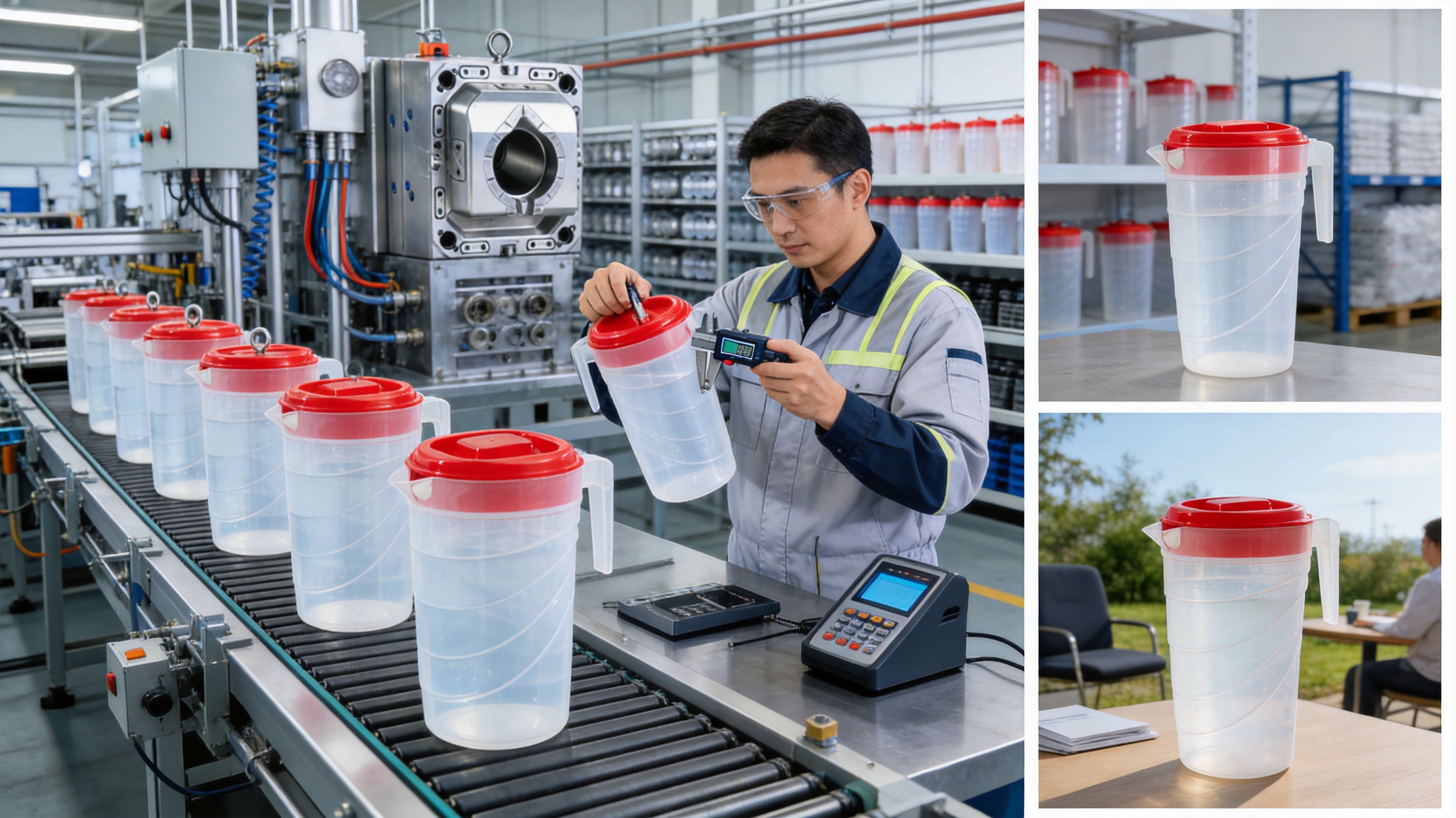
A reliable plastic mould is created through a sequence of engineering and manufacturing stages. Each stage contributes to the final performance of the tool and the consistency of the finished water jug.
7.1 Product Drawing Review
The process begins with an evaluation of the customer’s product drawing, three-dimensional file, physical sample, or initial concept. The engineering team reviews wall thickness, draft angles, parting lines, handle design, lid connection, surface finish, logo placement, and ejection requirements.
At this stage, potential manufacturing problems can be identified before steel is cut. The customer may receive recommendations concerning wall uniformity, corner radii, draft angles, gate position, cooling access, or product strength. Early design optimization can prevent expensive modifications later in the project.
7.2 Mould Flow and Filling Analysis
Where appropriate, filling analysis can be used to study the expected material flow, pressure distribution, weld-line locations, air traps, and filling balance. This information supports decisions regarding the gate, runner, venting, and cooling system.
Simulation is a design aid rather than a replacement for engineering judgment. The final mould must still be verified through machining accuracy, assembly inspection, and actual trial moulding. Combining digital analysis with practical testing provides a more reliable development process.
7.3 Three-Dimensional Mould Design
After the product design is approved, the mould structure is developed in three-dimensional design software. The design normally includes the cavity, core, parting surface, mould base, guide system, ejector system, cooling channels, runner system, inserts, and standard components.
The design team considers how the mould will be assembled, operated, maintained, and repaired. Replaceable inserts may be used in areas that are more likely to wear or require future modification. Standardized components can simplify maintenance and reduce replacement lead time.
7.4 CNC Machining and Precision Processing
High-quality mould manufacturing depends on accurate machining of the cavity, core, inserts, and mould base. CNC machining is used to produce complex surfaces and maintain dimensional consistency. Additional processes may include high-speed milling, drilling, wire cutting, electrical discharge machining, grinding, polishing, and texturing.
The selected processing method depends on the geometry, steel type, surface requirement, and tolerance. Areas involving logos, sealing interfaces, slide mechanisms, or textured surfaces may require special attention and additional inspection.
7.5 Assembly and Fitting
After machining, the mould components are cleaned, inspected, and assembled. The fitting process confirms the alignment of the cavity and core, the operation of the guide system, the movement of ejectors and slides, the integrity of cooling channels, and the accuracy of the parting line.
Good fitting practice is essential for preventing flash, premature wear, sticking, and uneven product dimensions. Moving components should operate smoothly without excessive looseness. Cooling connections and sealing points should also be checked before the mould enters trial production.
7.6 Trial Moulding and Correction
Trial moulding verifies whether the mould can produce a stable part under practical conditions. Engineers examine the filling pattern, surface appearance, dimensions, ejection behavior, lid fit, handle integrity, wall thickness, and signs of warpage or sink marks.
If corrections are needed, the mould may undergo controlled modifications. These may involve polishing, vent adjustment, gate refinement, dimensional correction, cooling improvement, or process parameter optimization. The goal is to achieve a reliable balance between product quality and production efficiency before shipment.
7.7 Final Inspection and Delivery
Before delivery, the mould is inspected for dimensions, component operation, cooling passage condition, parting-line quality, surface finish, ejector movement, and overall assembly. Documentation may include mould drawings, spare-part information, test records, and recommended operating or maintenance instructions.
Clear documentation helps the customer install the mould correctly and reduces the time required for production setup. It also provides useful information for future maintenance and replacement of wear components.
8. Quality Control and Production Management
Haiquan Mould operates as a high-tech enterprise specializing in the research, development, and manufacture of precision injection moulds. Its product coverage includes daily necessities, home appliances, automotive parts, and industrial equipment. This sector diversity provides experience with different materials, product geometries, performance requirements, and production volumes.
The company’s production management approach is based on coordinated design, machining, assembly, testing, and after-sales support. A systematic workflow helps reduce communication gaps between departments and allows technical issues to be addressed earlier in the project.
8.1 Dimensional Control
Dimensional control is important for the jug body, lid interface, handle connection, base, and other functional areas. Inspection equipment and measurement procedures can be used to verify critical dimensions against approved drawings and customer requirements.
For customized products, the approved sample or reference drawing becomes the basis for confirming the final mould condition. This helps ensure that the delivered tooling is aligned with the customer’s expected product design rather than only with a general mould concept.
8.2 Surface Finish Control
Surface appearance influences the commercial value of a water jug. Polished surfaces, matte finishes, textures, and logos must be reproduced accurately across the cavity. Inconsistent finishing may result in visible differences between production parts.
Surface treatment is selected according to the customer’s design. It may involve polishing, etching, texturing, or other finishing methods. The engineering team evaluates the relationship between surface finish and product release to ensure that appearance improvements do not create unnecessary demoulding problems.
8.3 Process Documentation
Production records and technical documentation support traceability. Information relating to steel selection, component processing, inspection, trial moulding, and corrections can help the manufacturer and customer understand the mould’s development history.
Documented processes are also useful when the customer orders a similar mould in the future. Product families can benefit from consistent design standards, component specifications, and maintenance practices.
9. Advantages Compared with Basic Competitor Tooling
Customers comparing mould suppliers should evaluate more than the initial quotation. A lower purchase price may not represent a lower total cost if the mould produces excessive scrap, requires frequent correction, or has limited service life.
9.1 Better Control of Thick-Wall Defects
Basic container moulds may not adequately address sink marks, internal stress, or uneven cooling in thick-walled products. The optimized gate and cooling concepts used for this water jug mould are intended to provide better control of these common problems.
Improved defect control can reduce rejected products and minimize the time spent adjusting injection parameters. It can also improve the consistency of the finished product across different production batches.
9.2 More Reliable Long-Run Operation
Reinforced mould construction and carefully fitted moving components support stable long-term production. This is particularly important for manufacturers supplying supermarkets, distributors, hospitality businesses, or institutional buyers, where consistent delivery is essential.
A mould that remains stable over a long run can reduce unplanned downtime and maintenance interruptions. It also helps protect the customer’s investment in injection machinery, labor, packaging, and inventory planning.
9.3 Greater Customization Capability
Some mould suppliers focus primarily on standardized products, which may limit a manufacturer’s ability to create a differentiated water jug. This mould solution supports adjustments to capacity, handle design, lid structure, texture, logo engraving, and other product features.
Customization makes it possible to create private-label products, promotional containers, outdoor equipment, emergency storage products, and specialized utility jugs. The customer can develop a design that matches a specific market rather than competing only through price.
9.4 Integrated Technical Support
Successful mould production requires cooperation among the product designer, mould engineer, injection moulding operator, quality team, and purchasing department. A supplier capable of providing integrated support can help identify problems earlier and improve communication throughout the project.
Haiquan provides services covering design, production, testing, and after-sales assistance. Its experience serving Europe, the Middle East, Southeast Asia, and South America also supports communication with customers operating under different commercial and technical expectations.
10. Production Efficiency and Cost Considerations
The total cost of a plastic water jug includes the mould, plastic material, machine time, labor, energy, packaging, quality control, maintenance, and logistics. Mould design influences many of these costs indirectly.
A balanced filling system may reduce scrap. An efficient cooling arrangement may reduce cycle time. A suitable cavity number may improve output without exceeding machine capacity. A hot runner system may reduce runner waste. Durable steel and replaceable components may reduce long-term repair costs.
However, the most expensive option is not automatically the most economical one. The correct mould specification depends on annual demand, expected product life, machine availability, target selling price, quality requirements, and future product plans.
10.1 One-Cavity and Two-Cavity Options
A one-cavity mould may be appropriate for large jugs, lower production volumes, product development, or customers with smaller injection machines. It generally offers a simpler filling and cooling arrangement and may reduce initial tooling complexity.
A two-cavity mould can increase output when the machine has sufficient shot capacity, clamping force, and cycle stability. The two cavities must be balanced carefully so that both products receive comparable filling, packing, and cooling conditions.
The choice between one and two cavities should be made after calculating expected demand and reviewing the available equipment. Producing more cavities than the machine can support may create unstable operation rather than real productivity gains.
10.2 Reducing Material Waste
Material efficiency depends on product wall design, gate selection, runner arrangement, process control, and recycling policy. A hot runner may help reduce cold runner waste, while a well-balanced wall design can avoid unnecessary material thickness.
Manufacturers should also evaluate whether regrind material is appropriate for the intended product. For products used with drinking water, material selection and recycled-content decisions must comply with the customer’s applicable safety and regulatory requirements.
11. Maintenance and Service Recommendations
Regular maintenance helps preserve mould accuracy and extend service life. After production, the mould should be cleaned to remove plastic residue, moisture, and contaminants. The parting surface should be checked for damage, and moving components should be lubricated according to the manufacturer’s recommendations.
Cooling channels should be monitored for reduced flow or temperature imbalance. Mineral deposits, rust, and contamination can reduce cooling efficiency and contribute to product deformation. Water treatment and routine inspection are useful for maintaining stable mould temperature control.
Ejector pins, guide pillars, bushings, slides, lifters, and other moving components should be inspected for wear. Early replacement of a worn component can prevent damage to more expensive mould sections. The customer should also avoid excessive clamping force, incorrect ejection settings, and improper mould installation.
When the mould is stored for an extended period, the cavity and core surfaces should be dried and protected against corrosion. Cooling passages should be drained where appropriate. Storage in a clean, dry environment helps ensure that the mould is ready for the next production cycle.
12. Customization Procedure for New Projects
A successful customization project begins with complete technical information. Customers are encouraged to provide the product drawing, three-dimensional model, sample, target material, annual production estimate, injection machine information, surface requirements, and packaging or application details.
The engineering team can then review the product and identify possible improvements. These may include adjusting draft angles, strengthening the handle, relocating the gate, improving the lid interface, modifying the base, or changing a surface texture.
After the design is reviewed, the mould structure and quotation can be prepared. The customer confirms the product design, material, steel, cavity number, runner system, mould standard, delivery requirements, and inspection expectations before manufacturing begins.
During trial production, the customer may evaluate samples for appearance, dimensions, sealing, handle performance, impact resistance, and general usability. Feedback from this stage can be incorporated into the final mould adjustments.
12.1 Branding and Logo Engraving
Logo engraving can be incorporated into the jug body, lid, handle, or other visible surfaces. The design should consider logo size, depth, line width, draft, orientation, and product release. Simple, well-proportioned artwork generally provides clearer results in mass production.
Branding details must also be positioned where they will not interfere with grip, sealing, labeling, or structural performance. The customer should approve the final artwork and location before machining begins.
12.2 Surface Texture Selection
Customers may select a smooth polished finish, fine matte texture, coarse anti-slip pattern, decorative pattern, or a combination of finishes. The surface treatment affects appearance, tactile performance, scratch visibility, and demoulding behavior.
Texture depth and direction should be evaluated in relation to draft angles. If the texture is too deep or the draft is insufficient, the product may resist ejection or show scuffing. Early consultation helps achieve the desired appearance without compromising production reliability.
13. Questions and Answers
Q1: What materials can be used to manufacture the water jug?
The mould is generally suitable for PP and HDPE. The final choice depends on the required stiffness, toughness, impact resistance, chemical resistance, appearance, and intended use. Material confirmation should take place before the mould design is finalized because shrinkage and flow characteristics affect cavity dimensions and processing conditions.
Q2: What capacities can be produced?
The mould concept can support different jug capacities, generally from approximately 2 litres to 20 litres, depending on the final product structure, machine capability, and customer requirements. The precise capacity, dimensions, and wall thickness should be confirmed through an approved product drawing or sample.
Q3: Can the lid and handle be customized?
Yes. The lid structure, sealing method, handle shape, handle position, and connection area can be customized. The design should be evaluated for ease of use, strength, assembly tolerance, and mould release before production.
Q4: Is a hot runner system required?
A hot runner system is recommended for many large water jug designs because it can reduce runner waste and support stable filling. However, a cold runner may be suitable for some applications. The best choice depends on the product design, material, production volume, machine, and maintenance preference.
Q5: How many cavities can the mould have?
The standard specification supports one to two cavities. One cavity may be suitable for large products or lower output requirements, while two cavities may improve productivity when the injection machine can support the required shot size and clamping force.
Q6: What mould steel is available?
Common options include P20, 718, and NAK80. The choice depends on the required surface finish, production volume, dimensional stability, expected service life, and budget. The engineering team can recommend a suitable grade after reviewing the product and production plan.
Q7: Can the jug include a logo or anti-slip texture?
Yes. Logo engraving, embossed details, decorative patterns, and anti-slip textures can be incorporated into the mould. Artwork, texture depth, location, and draft requirements should be approved before machining.
Q8: What helps prevent sink marks and deformation?
Balanced wall thickness, suitable gate positioning, correct packing conditions, effective venting, and a balanced cooling system all contribute to defect prevention. The final result also depends on material selection, machine settings, mould temperature, injection speed, and cooling time.
Q9: What is the expected mould service life?
Depending on the steel, design, maintenance program, and operating conditions, the mould can be engineered for up to approximately 1,000,000 shots. Actual service life may vary, so regular inspection and maintenance are important.
Q10: What information should a customer provide for a quotation?
The customer should ideally provide a product drawing or sample, capacity, material, dimensions, surface requirements, logo information, expected production quantity, injection machine details, cavity preference, and delivery requirements. More complete information allows a more accurate technical evaluation and quotation.
14. Why Choose an Experienced Mould Manufacturing Partner
Choosing a mould supplier is a strategic decision because the tool influences product quality for many years. An experienced partner can contribute more than machining capability. It can help improve the product design, select appropriate materials, balance production cost and performance, manage trial moulding, and provide technical support after delivery.
Taizhou Huangyan Haiquan Plastic Mold Co., Ltd. focuses on precision injection mould development and manufacturing for daily necessities, home appliances, automotive parts, and industrial equipment. Its professional design team and scientific production management system support integrated service from product evaluation and mould design to production, testing, delivery, and after-sales assistance.
The company’s international customer base includes markets in Europe, the Middle East, Southeast Asia, and South America. This international experience supports practical communication regarding drawings, quality expectations, packaging, delivery, and technical documentation.
For the Large Capacity Thick Plastic Water Jug Mould with Lid, the main value lies in combining product-specific engineering with manufacturing discipline. The mould is not simply a cavity for forming plastic. It is a production system designed to manage thick-wall flow, cooling, ejection, surface appearance, lid fit, handle strength, and long-term repeatability.
15. Conclusion
The Large Capacity Thick Plastic Water Jug Mould with Lid is a practical solution for manufacturers producing durable reusable water containers. Its key benefits include optimized gate positioning, balanced cooling, reinforced mould construction, flexible capacity options, compatibility with PP and HDPE, and support for customized lids, handles, textures, and branding.
Compared with basic competitor tooling, a specialized mould can provide better control over sink marks, shrinkage, warpage, wall thickness, and long-run stability. The use of suitable mould steel, standard mould bases, carefully selected runner systems, and controlled manufacturing processes further supports dependable production.
The mould can serve household, office, outdoor, beverage storage, emergency preparedness, and utility markets. By adapting the design to different capacities and user requirements, manufacturers can develop products that combine strength, convenience, appearance, and commercial differentiation.
A successful project depends on early communication, accurate product information, appropriate material selection, thoughtful mould design, careful machining, trial moulding, and regular maintenance. With professional engineering support and systematic production management, the water jug mould can help manufacturers achieve consistent product quality, efficient production, and lower long-term tooling risk.
References
1. Injection mould design principles for thick-wall plastic containers and reusable packaging products.
2. General technical guidance for processing polypropylene and high-density polyethylene by injection moulding.
3. Standard practices for mould steel selection, cavity machining, polishing, texturing, and maintenance.
4. Industrial guidelines for cooling-channel design, shrinkage control, warpage reduction, and dimensional inspection.
5. General recommendations for hot runner selection, gate positioning, venting, and runner balance.
6. Product development principles for ergonomic handles, sealing lids, anti-slip textures, and reusable water storage containers.
7. Technical information provided for the Large Capacity Thick Plastic Water Jug Mould with Lid and its recommended production specifications.
Product: Large Capacity Thick Plastic Water Jug Mould with Lid

For exclusive deals and latest offers, sign up by entering your email address below.












 +86-18657672567
 sales@tzhqmould.com
celin@tzhqmould.com
 No. 17 Houshi Road, Beicheng Industrial Zone, Huangyan District, Taizhou City, Zhejiang Province, China
Copyright © Taizhou Huangyan Haiquan Plastic Mold Co., Ltd. All Rights Reserved
Injection Plastic Mould Maker

