

Large-Capacity Thick Plastic Water Jug Mould with Lid
Admin 2026-09-08Large-capacity water jugs are widely used in homes, offices, outdoor activities, beverage storage, emergency preparedness, and commercial water-handling applications. Although the finished product may appear simple, manufacturing a thick-walled plastic jug with an integrated lid requires careful engineering at every stage. The mould must control material flow, manage heat effectively, maintain dimensional accuracy, and withstand repeated production cycles without unnecessary downtime.
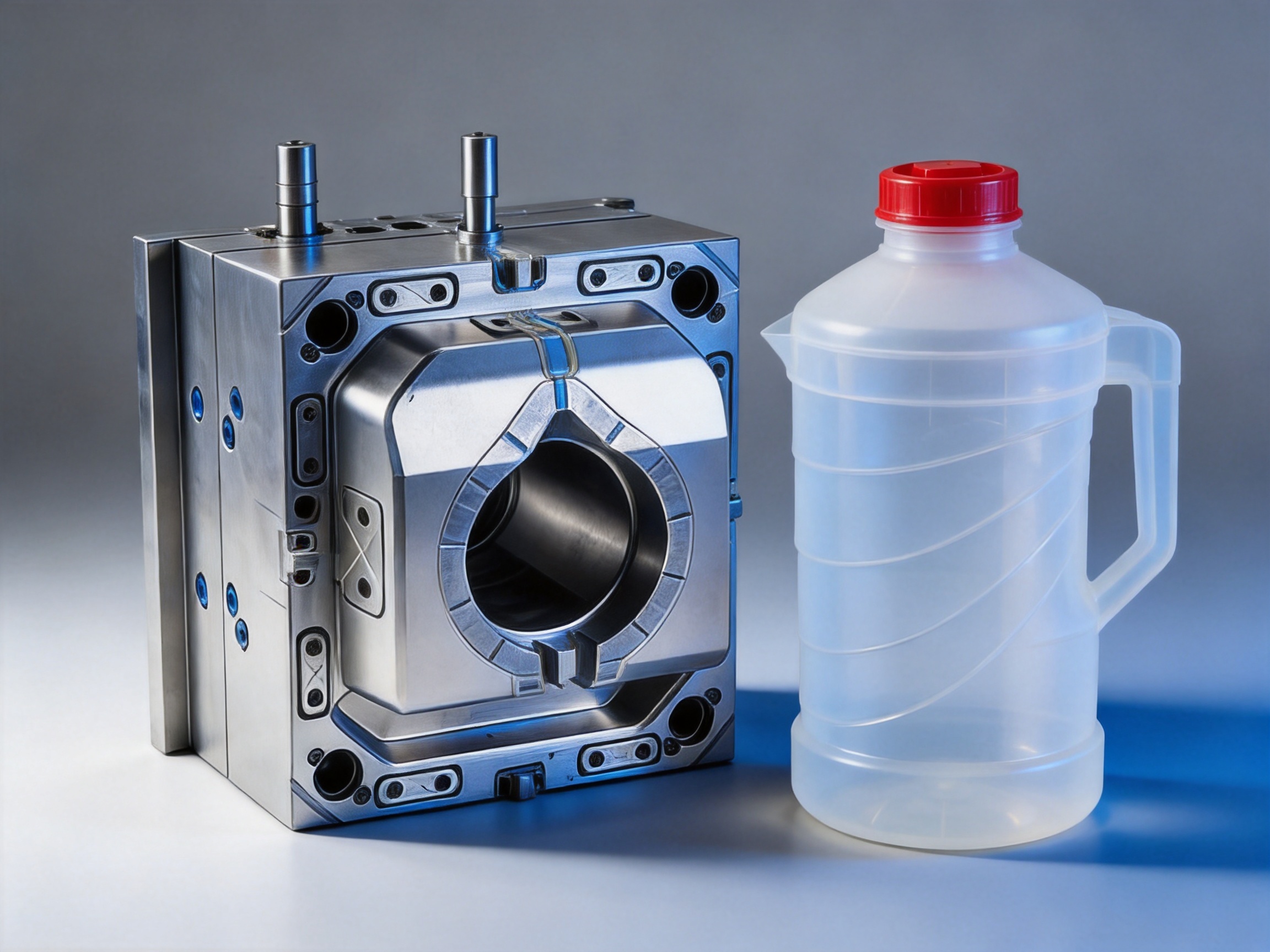
The Large Capacity Thick Plastic Water Jug Mould with Lid is designed for manufacturers that need reliable injection moulding performance, stable product quality, and flexibility across multiple jug sizes. It supports the production of durable containers made from commonly used materials such as polypropylene and high-density polyethylene. Depending on the product design, the mould can be configured for different capacities, handle structures, lid arrangements, textures, and branding requirements.
Unlike a basic container mould, this solution is developed around the specific challenges of thick plastic products. Thick walls can create uneven cooling, sink marks, shrinkage, warpage, and long cycle times if the mould is not correctly designed. The mould therefore uses optimized gate positioning, a balanced material-flow layout, reinforced construction, and a dedicated cooling system to improve consistency during extended production.
Manufactured by Taizhou Huangyan Haiquan Plastic Mold Co., Ltd., the mould reflects the company’s experience in precision injection mould development for daily necessities, home appliances, automotive components, and industrial equipment. The company provides integrated support from product design and mould engineering to manufacturing, testing, delivery, and after-sales service.

Large Capacity Thick Plastic Water Jug Mould with Lid
Product Overview
The Large Capacity Thick Plastic Water Jug Mould with Lid is an injection moulding tool used to manufacture robust plastic water containers. It is suitable for products designed for household storage, outdoor use, beverage handling, and emergency water reserves. The structure can be customized according to a customer’s product drawings, three-dimensional files, or physical samples.
The mould is intended for thick plastic jug designs in capacities ranging from approximately 2 liters to 20 liters. This capacity range allows manufacturers to serve different market segments without being limited to one standard container format. Smaller models can be used for personal or household applications, while larger models may be suitable for camping, emergency storage, workplace use, or commercial distribution.
The product design may include a separate or integrated lid and handle structure. A strong handle is especially important for large-capacity jugs because the filled container can become substantially heavier than the empty product. The mould can therefore be engineered to support appropriate handle thickness, reinforcement ribs, grip geometry, and connection points.
Additional product features may include anti-slip surface textures, recessed grip areas, logo engraving, measurement markings, and customized visual details. These options allow customers to develop a container that is not only functional but also recognizable in a competitive market.
Why Thick-Walled Water Jugs Require Specialized Mould Engineering
Thin containers and thick containers behave differently during injection moulding. In a thin-walled product, molten plastic generally fills the cavity quickly and cools in a relatively short period. A thick-walled jug contains more material, which increases the amount of heat that must be removed before the product can be ejected.
If cooling is uneven, the outer surface may solidify while the internal material remains hot. As the inside cools and contracts, it can pull the surface inward and form sink marks. Differences in cooling speed across the body can also create deformation or dimensional variation. These defects may affect the jug’s appearance, stability, stacking performance, and sealing function.
Material flow is another significant concern. The plastic must travel through the cavity without creating excessive weld lines, air traps, hesitation marks, or areas of insufficient packing. A poorly positioned gate may cause one side of the jug to fill earlier than the other, resulting in unbalanced pressure and inconsistent wall thickness.
The mould must also tolerate the pressure and mechanical stress associated with repeated cycles. Large products often require a substantial mould base, precise guiding components, strong support structures, and reliable ejection. Any weakness in these areas can lead to premature wear, flash, alignment problems, or costly interruptions in production.
The design of this water jug mould addresses these challenges through coordinated flow analysis, gate optimization, cooling planning, robust mould construction, and attention to production conditions. These features help manufacturers achieve a more stable process than would normally be possible with an incorrectly adapted general-purpose container mould.
Key Product Advantages
Optimized Gate Positioning
Gate location has a direct effect on filling behavior, packing pressure, weld-line position, and product appearance. For a thick plastic jug, the gate must be positioned to encourage balanced filling and effective pressure transmission into the body, base, handle area, or other critical sections.
The mould uses optimized gate positioning to help reduce the risk of sink marks and uneven wall thickness. Proper gate design also helps the moulding machine maintain consistent packing during the critical stage when the cavity is almost full. This is particularly important around the bottom of the jug, the shoulder, and the connection between the body and handle.
Depending on the final product design, the runner and gate arrangement may be adjusted to support hot runner operation. A hot runner system can reduce cold runner waste and help maintain a more stable melt temperature. It may also improve production efficiency when the product is manufactured in significant volumes.
Uniform Wall Thickness
Uniform wall thickness is essential for both product strength and appearance. If one section is too thin, it may become weak or fail under handling stress. If another section is excessively thick, it may cool slowly, develop sink marks, or increase material consumption and cycle time.
The mould is designed to support a balanced cavity geometry based on the customer’s product requirements. During the engineering stage, the design team can evaluate the body, base, shoulder, neck, lid, and handle areas to reduce unnecessary variation. The result is a more predictable injection process and a finished jug with consistent structural performance.
Uniformity also helps downstream operations. A stable wall structure improves the reliability of trimming, labeling, printing, assembly, stacking, and packaging. When the container is intended for repeated use, consistent thickness contributes to a better user experience and a more dependable service life.
Dedicated Cooling Design
Cooling is one of the most important factors in the production of thick plastic containers. The mould cooling system is specially arranged to remove heat from areas that are most likely to retain it, including thick base sections, corners, shoulder transitions, and areas near the handle or neck.
A well-planned cooling layout helps control shrinkage and reduces the risk of deformation during ejection. It can also contribute to shorter and more consistent cycle times. While the final cycle depends on the plastic material, product geometry, machine settings, and cooling-water conditions, an efficient cooling system gives the manufacturer a stronger foundation for process optimization.
Cooling channels must be designed with appropriate spacing, flow direction, and accessibility. The design should avoid creating large temperature differences between opposite sides of the cavity. Balanced cooling is particularly valuable for a large jug because even minor distortion can affect whether the container stands upright or whether the lid seals correctly.
Reinforced Mould Structure
Large-capacity jug moulds are exposed to significant injection pressure and repeated mechanical loads. A reinforced mould structure helps maintain alignment between the cavity and core, supports stable operation, and reduces the possibility of movement or deflection during production.
The mould base can be supplied according to LKM or HASCO standards. Standardized mould-base systems make it easier to coordinate with established manufacturing practices, tooling components, machine interfaces, and maintenance procedures. They also support more efficient procurement and replacement of compatible standard parts.
Guiding systems, support elements, ejector components, and locking surfaces must work together accurately. Correct alignment protects the moulding surfaces and helps prevent flash along the parting line. It also improves repeatability when the mould is opened and closed over a long production run.
Flexible Cavity Configuration
The mould can be configured with one or two cavities, depending on the required production output, product size, machine capacity, and project budget. A single-cavity design may be suitable for large products, new product development, moderate production volumes, or customers who prioritize lower initial tooling investment.
A two-cavity configuration can increase output when the injection machine has adequate clamping force, shot capacity, and available mould space. The final choice should be made after reviewing product dimensions, annual demand, production scheduling, and the customer’s investment plan.
The cavity arrangement is not treated as an isolated decision. It must be matched with runner balance, cooling capacity, ejection layout, machine performance, and the required cycle time. This integrated approach helps prevent a situation in which additional cavities create imbalance or reduce overall process stability.
Long Service Life
The mould can be manufactured with P20, 718, or NAK80 steel, depending on the project’s performance, polish, durability, and budget requirements. These steel options are commonly selected for plastic injection mould applications and can be processed to meet different levels of surface finish and production demand.
With appropriate material selection, heat treatment where required, precision machining, regular maintenance, and suitable operating conditions, the mould is designed for a service life of up to 1,000,000 shots. Actual service life depends on factors such as resin type, additives, moulding pressure, cycle frequency, maintenance quality, cooling-water management, and the use of abrasive or corrosive materials.
Long mould life reduces the cost of ownership over the entire product program. It also supports consistent supply for customers who need to produce the same jug design for many years. A durable tool minimizes the need for frequent repairs, replacement inserts, or unexpected production stops.
Applications of the Finished Water Jug
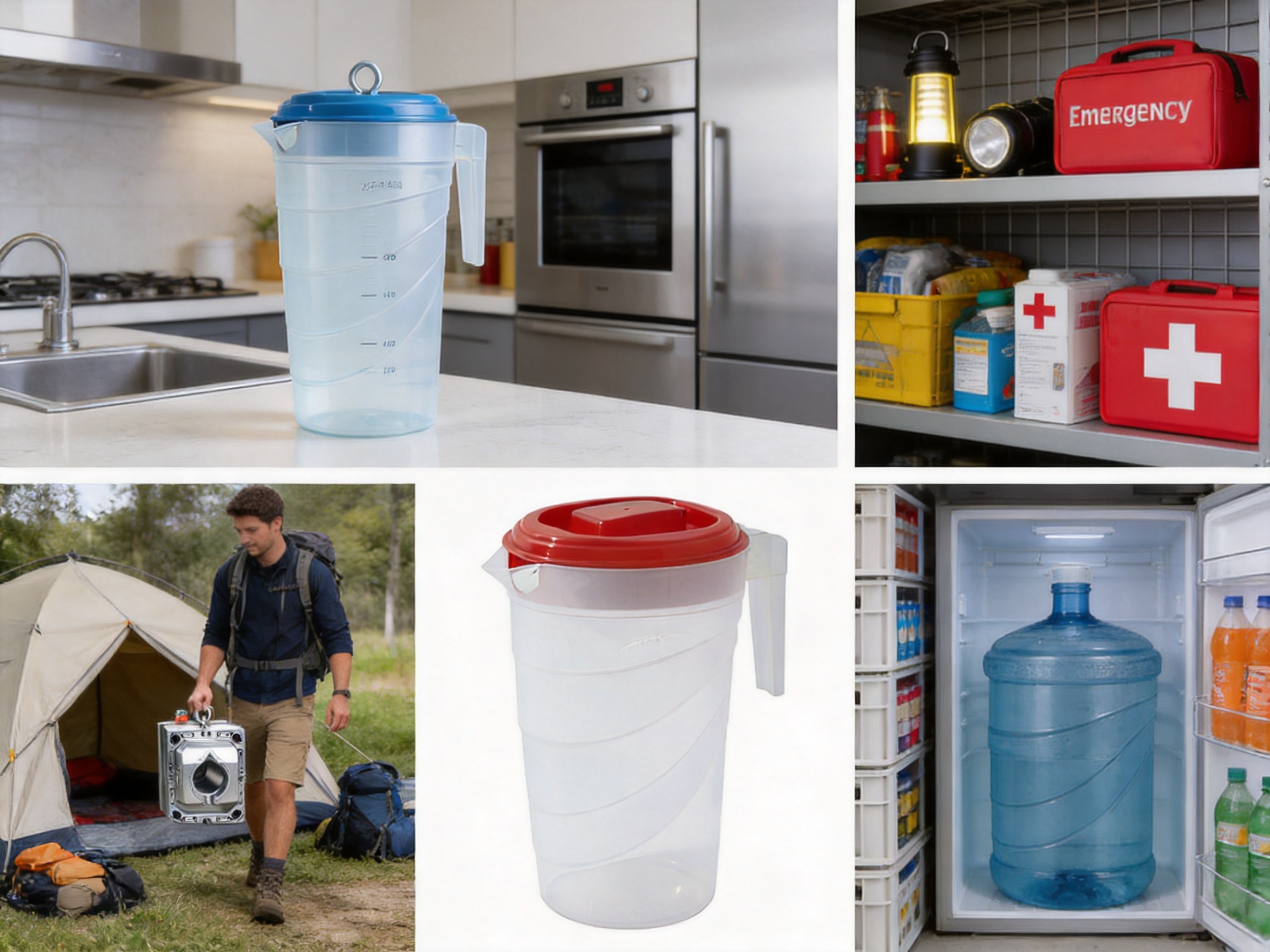
Household Water Containers
Water jugs for household use must be easy to carry, stable on a flat surface, and sufficiently strong for routine handling. A thick plastic body provides a solid feel and can resist the minor impacts associated with kitchen, garage, balcony, or utility-room use.
The lid may be designed to reduce contamination during storage and transportation. Depending on the customer’s requirements, the opening can be optimized for pouring, refilling, cleaning, or connection with an accessory. A customized handle can improve comfort when the jug is full.
Outdoor Camping Water Storage
Camping and outdoor users often need containers that can withstand movement, uneven surfaces, and repeated loading into vehicles or storage compartments. The jug can be customized with reinforced corners, anti-slip textures, durable handles, and a stable base to meet outdoor handling requirements.
Large capacities from approximately 5 liters to 20 liters may be useful for group camping, travel, field work, and outdoor events. The mould can be adapted to create a product that balances capacity with portability rather than simply increasing volume without considering ergonomics.
Beverage Storage Containers
Plastic jugs are also used for storing and transporting beverages in homes, workplaces, catering environments, and recreational settings. The product design can incorporate visual branding, measurement indicators, and a lid that supports the intended storage method.
When a jug is designed for beverage-related applications, the manufacturer should select a suitable resin grade and confirm all regulatory and food-contact requirements for the target market. The mould itself can support the required shape and surface finish, while material compliance must be verified separately according to the customer’s application and local regulations.
Emergency Water Storage
Emergency storage containers must be dependable, space-efficient, and easy to identify. A sturdy thick-walled jug can provide a practical solution for households, offices, vehicles, relief organizations, and remote facilities.
Customized markings may help users identify capacity, filling level, ownership, or intended use. The lid and neck design can be developed to support secure closure and repeated handling. The product can also be designed for efficient stacking or placement in limited storage areas.
Customization Possibilities
Capacity and Overall Dimensions
The mould can be developed for different jug capacities, generally within the 2-liter to 20-liter range. Capacity changes involve more than scaling the height of the product. The body width, base footprint, neck position, handle geometry, center of gravity, and mould cooling layout must all be reviewed.
A taller jug may require additional support to prevent tipping. A wider jug may need a larger grip opening or reinforced side walls. A product designed for vehicle storage may need to fit a particular compartment. By considering the final application at the beginning of the project, the mould can be made more practical and economical.
Lid and Handle Integration
The lid is a critical functional component because it affects protection, sealing, pouring, and user convenience. Customers may request a screw lid, snap-fit cover, tethered cap, hinged structure, or another customized arrangement. The mould can be engineered for the selected design and its required tolerance relationships.
Handle design must consider load capacity, grip comfort, hand clearance, and connection strength. A handle that is too narrow may be uncomfortable, while one that is too large can consume unnecessary material and reduce packaging efficiency. Reinforcement ribs may be added to improve strength without creating excessively thick sections.
Anti-Slip Texture
An anti-slip texture can improve grip when the jug is wet or when the user is wearing gloves. Texture can be applied to selected areas such as the side panels, handle, base, or grip recesses. The pattern may be subtle for a refined appearance or more pronounced for demanding outdoor use.
Texture selection also influences mould manufacturing. Fine textures, deep textures, polished zones, and textured transitions require different surface-processing methods and must be considered in relation to draft angles and ejection. A well-planned texture design reduces the risk of scuffing or sticking during mould opening.
Logo Engraving and Branding
Branding can be incorporated into the mould through engraved logos, raised lettering, capacity markings, recycling symbols, product codes, or other identification features. Mould-integrated branding provides a durable result because the mark is formed directly during injection rather than added as a separate label.
Before machining, the customer should confirm the artwork, dimensions, orientation, depth, and position of the logo. Small changes at this stage can prevent costly modifications after the mould has been completed. The engineering team can review whether the selected location affects filling, ejection, appearance, or cleaning.
Materials and Mould Steel Options
Polypropylene and high-density polyethylene are identified as suitable product materials for this mould. Both materials are widely used in plastic container production, but they have different shrinkage behavior, stiffness, impact performance, chemical resistance, and processing conditions.
Polypropylene can provide a useful balance of light weight, chemical resistance, and flexibility. It is often selected for reusable household products, storage containers, and components that require a practical combination of strength and cost efficiency.
High-density polyethylene is valued for toughness, impact resistance, and suitability for many storage applications. It can be an appropriate choice for containers that may experience outdoor handling or repeated transportation. The specific resin grade should be selected according to the required performance, regulatory standards, color, additives, and processing equipment.
P20 steel can be considered for general-purpose production requirements where a balance between cost, machinability, and service performance is important. 718 steel may be selected when improved polishability and more demanding mould performance are required. NAK80 can be suitable for applications requiring high-quality surface finishing and stable precision.
Steel selection should be based on expected production volume, product surface requirements, resin characteristics, maintenance planning, and the customer’s investment objectives. There is no single steel grade that is ideal for every project. The mould manufacturer can recommend the most appropriate option after reviewing the complete product specification.
| Item | Available or Recommended Specification | Production Consideration |
|---|---|---|
| Mould Steel | P20 / 718 / NAK80 | Selected according to service life, surface finish, precision, and budget |
| Mould Base | LKM / HASCO Standard | Supports standardized tooling and compatible components |
| Runner System | Hot Runner Recommended | Can improve material efficiency and melt-flow stability |
| Product Material | PP / HDPE | Final resin grade should match the product application |
| Cavity Number | 1–2 Cavities | Determined by output, machine capacity, and investment plan |
| Expected Mould Life | Up to 1,000,000 Shots | Depends on operation, material, maintenance, and production conditions |
Advanced Manufacturing Process
Product Design Review
The mould project begins with a review of the product design. Engineers examine the customer’s drawings, three-dimensional data, or physical sample to understand the intended capacity, wall thickness, handle structure, lid connection, surface finish, draft angles, and dimensional tolerances.
This review is important because many moulding problems originate in the product design rather than in the machining process. Sharp internal corners, abrupt thickness changes, insufficient draft, and difficult undercuts can make the mould more expensive and reduce production reliability. Early engineering feedback allows these issues to be addressed before steel is cut.
Flow and Filling Analysis
For a large thick-walled jug, engineers must consider how molten plastic will enter and spread through the cavity. Gate position, runner balance, injection direction, packing behavior, and air evacuation are evaluated to reduce the likelihood of short shots, weld lines, burn marks, sink marks, and excessive pressure requirements.
Flow analysis can also help identify areas where the wall thickness should be adjusted. If the product requires a strong base or reinforced handle, the design must avoid creating isolated thick masses that cool significantly slower than the rest of the container.
Mould Structure Development
After the product design is confirmed, the mould structure is developed. The engineering team determines the parting line, cavity and core arrangement, mould-base dimensions, runner configuration, cooling-channel layout, ejection method, guiding components, and maintenance access.
The parting line should be positioned to support reliable sealing and minimize visible flash. It should also allow the product to be removed without damaging the handle, lid interface, texture, or other sensitive features. When undercuts are present, the design may require slides, lifters, collapsible components, or alternative geometry.
Precision CNC Machining
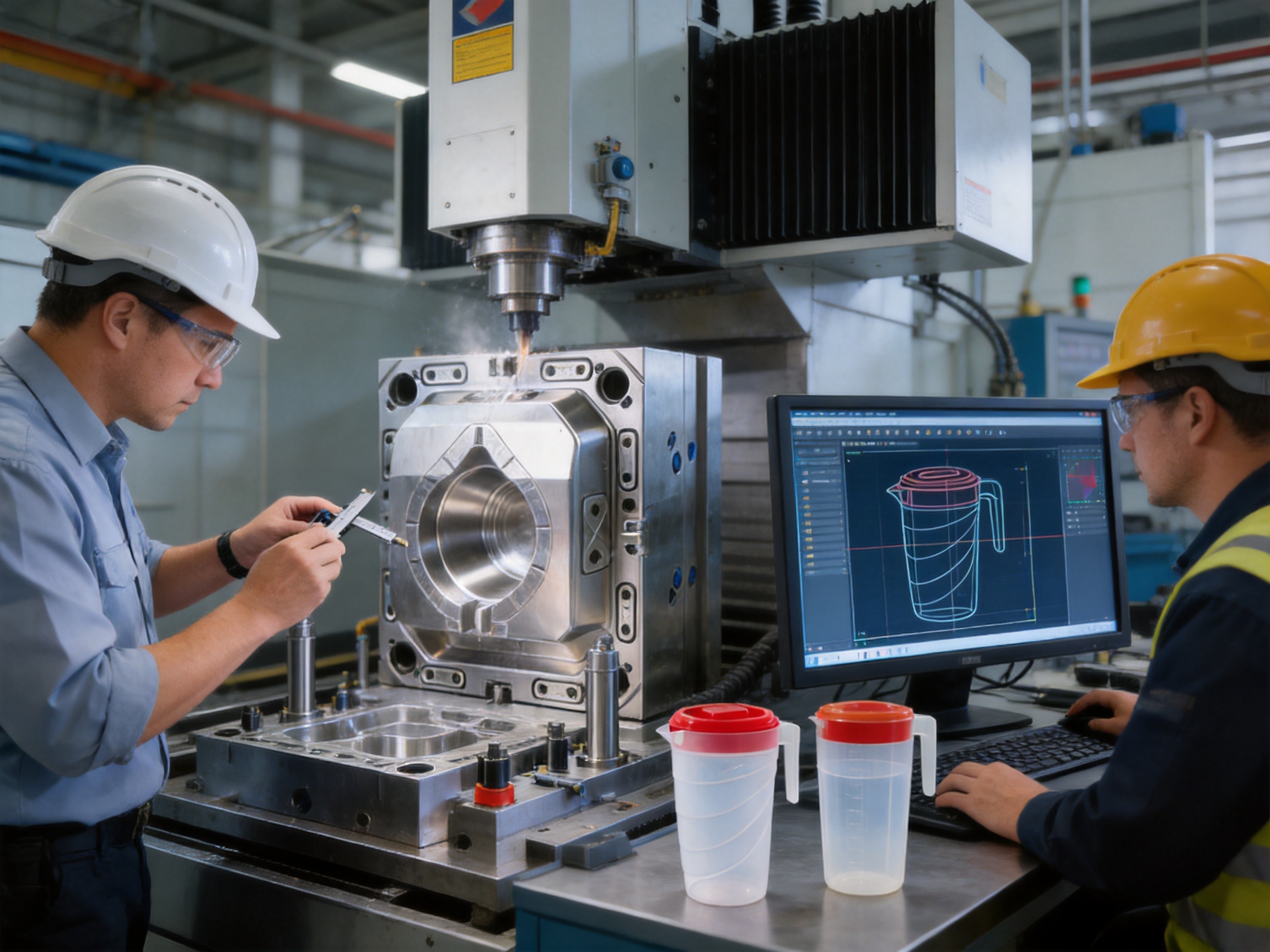
Modern mould manufacturing combines computer-aided design, computer-aided manufacturing, CNC machining, electrical discharge machining, drilling, grinding, polishing, and careful manual fitting. Each operation contributes to the final performance of the tool.
CNC machining creates the primary cavity and core geometry with controlled dimensional accuracy. EDM can be used for complex details, narrow slots, sharp features, or areas that are difficult to machine with conventional cutting tools. Grinding and polishing improve the accuracy and surface quality of critical areas.
Because the jug may contain visible exterior surfaces, the mould finish must be selected according to the desired appearance. A polished container can require a different finishing process from one with a matte or textured exterior. Transition zones must be handled carefully to prevent visible defects on the finished product.
Cooling Channel Production
Cooling channels are manufactured according to the planned thermal layout. Their position must provide effective heat transfer without weakening the mould structure or approaching the cavity surface too closely. Channels should also allow practical connection to the customer’s temperature-control equipment.
Before final assembly, the cooling circuits can be checked for blockage, leakage, and correct flow direction. Reliable cooling connections are important because a small leak or restricted passage can influence product quality and create unnecessary maintenance problems.
Assembly and Fitting
Once the individual components are machined and finished, the mould is assembled and fitted. Engineers check the alignment of the cavity, core, inserts, slides, ejector system, guide pillars, and locking surfaces.
Proper fitting reduces the risk of flash, mismatch, uneven wear, and difficult mould opening. Moving components must operate smoothly without excessive looseness. Fixed components must remain secure under repeated injection pressure and thermal cycling.
Trial Moulding and Validation
Trial moulding is used to verify whether the mould performs as intended under practical operating conditions. The trial process evaluates filling, ejection, cooling, surface quality, dimensions, lid fit, handle strength, wall uniformity, and visible defects.
When adjustments are required, the engineering team can modify process parameters or refine specific mould details. The objective is to deliver a tool that is not merely complete in appearance but ready for stable production. Trial results also provide useful information for the customer’s moulding operators and quality personnel.
Production Benefits Compared with Basic Competitor Tooling
One of the principal advantages of this mould is its focus on thick-product stability. A basic container mould may reproduce the general shape of a jug, but it may not adequately address the thermal and flow challenges created by thick walls. The present solution is developed specifically with those challenges in mind.
Balanced filling can reduce material-flow variation between different regions of the jug. This may help improve appearance and reduce the number of parts rejected for sink marks, uneven walls, or incomplete filling. Consistent cooling can help reduce deformation and make the production process easier to control.
The reinforced mould structure is another important advantage. Large products place greater demands on the mould than small lightweight components. Strong support and accurate guiding help maintain the relationship between the mould halves, protecting product quality during long production cycles.
The availability of one- or two-cavity configurations provides greater flexibility than a fixed tooling concept. Customers can select a solution that matches their present demand while considering future expansion. The mould can also be customized for different capacities, handle structures, textures, and branding details.
Standard LKM or HASCO mould-base compatibility can simplify coordination with established tooling practices. A hot runner system is recommended to support efficient material use and stable flow where the project conditions justify it. Together, these options help customers create a mould that is more closely matched to their equipment, product strategy, and production objectives.
Another competitive benefit is the company’s ability to provide an integrated service. Instead of treating product design, mould construction, trial production, and after-sales assistance as disconnected activities, Haiquan organizes them as stages of one engineering process. This can improve communication and reduce the risk of inconsistent information between suppliers.
Quality Control and Production Reliability
Quality control begins before machining. The product design, steel selection, mould structure, and cooling plan must be reviewed against the customer’s requirements. Clear documentation helps ensure that the final mould corresponds to the approved design rather than an incomplete or outdated version.
During machining, dimensional checks are important for cavity surfaces, inserts, locating features, parting lines, and moving components. Surface finish must also be controlled, especially where the finished jug will have a visible polished area or a defined texture.
Assembly inspection verifies that the mould opens, closes, guides, ejects, and cools correctly. Water-channel testing helps identify leakage or obstruction. Trial parts are assessed for dimensional consistency, wall thickness, sink marks, warpage, flash, appearance, and function.
Quality control is not limited to the first trial. A well-designed mould should be maintainable throughout its working life. Replaceable wear components, accessible cooling connections, standardized parts, and clear maintenance procedures can reduce downtime and help preserve performance.
Maintenance Recommendations
Regular cleaning is necessary because dust, resin residue, oil, and moisture can affect mould operation. After production, the cavity and core surfaces should be cleaned using methods compatible with the steel and surface finish. Abrasive tools should be avoided unless specifically approved for the area being cleaned.
Moving components such as slides, lifters, ejector pins, and guide systems should be inspected and lubricated according to an established maintenance schedule. Excessive lubricant can contaminate the product or attract dust, so the correct amount and type should be used.
Cooling channels should be monitored for scale, rust, blockage, and reduced flow. Poor water quality can gradually reduce heat-transfer performance and cause temperature differences across the mould. Filtration, water treatment, and periodic circuit cleaning can help maintain stable cooling.
The parting line should be checked for flash, impact marks, and trapped material. If abnormal flash appears, the mould should not simply be forced into continued operation. The cause may involve alignment, pressure, wear, contamination, or an incorrect process setting. Early investigation can prevent more serious damage.
Maintenance records should include production shots, repairs, replaced components, lubrication dates, cooling checks, and trial results. Such records help the manufacturer and customer identify wear patterns and plan preventive service before a failure interrupts production.
Ordering and Project Development Process
Step One: Submit Product Information
The customer provides product drawings, three-dimensional files, physical samples, capacity requirements, resin information, target weight, surface-finish expectations, annual production volume, and available injection-machine specifications. If some information is not yet available, the engineering team can help identify the missing data.
Step Two: Confirm Technical Requirements
The customer and mould manufacturer review the product structure, lid arrangement, handle design, parting line, draft angles, wall thickness, cavity number, runner system, steel grade, and expected service life. This stage establishes a clear technical foundation before detailed mould design begins.
Step Three: Complete Mould Design
The mould design includes the cavity and core structure, cooling channels, ejection system, guiding components, runner layout, inserts, and maintenance features. Special attention is given to areas that influence sink marks, shrinkage, handle strength, lid fit, and product appearance.
Step Four: Manufacture and Assemble the Tool
After the design is approved, steel preparation, CNC machining, EDM, drilling, grinding, polishing, texturing, assembly, and fitting are performed. The manufacturing process is coordinated through a scientific production-management system intended to support reliable delivery and consistent quality.
Step Five: Conduct Trial Production
Trial moulding confirms whether the mould can produce acceptable parts under practical conditions. The sample product is reviewed for shape, dimensions, wall thickness, surface quality, ejection, and functional details such as handle strength and lid engagement.
Step Six: Final Approval and Delivery
After adjustments and approval, the mould is prepared for delivery. Relevant technical information, operating guidance, and maintenance recommendations can be provided to help the customer install and use the tool effectively.
Company Manufacturing Strengths
Taizhou Huangyan Haiquan Plastic Mold Co., Ltd. is a high-tech enterprise specializing in the research, development, and manufacturing of precision injection moulds. Its product coverage includes daily necessities, home appliances, automotive parts, and industrial equipment.
This sector diversity gives the company experience with different product sizes, materials, surface requirements, structural challenges, and production expectations. Knowledge gained from one application area can support engineering decisions in another, particularly in areas such as mould strength, cooling design, parting-line control, ejection, and production durability.
The company operates with a professional design team and a scientific production-management system. Its services cover product and mould design, manufacturing, testing, delivery, and after-sales support. This integrated model can be valuable for international customers that require one technical contact throughout the project.
Haiquan serves customers in Europe, the Middle East, Southeast Asia, and South America. International experience requires attention to communication, technical documentation, delivery coordination, production expectations, and different market requirements. The company’s export activity reflects its ability to support customers beyond the local market.
The company follows the working philosophy of “Quality First, Sustainable Development.” In practical terms, this approach is reflected in the emphasis on durable tooling, stable production, responsible material use, maintainability, and long-term customer cooperation.
Practical Considerations for Buyers
Buyers should evaluate more than the initial mould quotation. The total value of a mould includes its expected life, production stability, cycle-time potential, maintenance requirements, compatibility with available equipment, and ability to support future product variations.
For a thick plastic jug, buyers should ask how the supplier plans to control sink marks, wall-thickness variation, cooling imbalance, handle strength, and lid fit. They should also confirm the proposed steel grade, cavity number, runner system, cooling method, ejection arrangement, and trial-moulding procedure.
Product drawings should identify critical dimensions and functional requirements. If the jug must stand upright when filled, the base flatness and center of gravity should be controlled. If the lid must seal reliably, the neck and lid interface require appropriate tolerances. If the product will be stacked, the base and upper profile should be evaluated for load stability.
Customers should also confirm the intended resin grade. PP and HDPE can behave differently during filling, cooling, shrinkage, and ejection. The selected moulding parameters should be developed using the actual material or a technically comparable grade.
Finally, buyers should establish a clear acceptance standard for trial samples. This may include appearance, weight, dimensions, wall thickness, leakage performance, handle load, lid engagement, opening force, and packaging requirements. Clear standards help both parties complete the project efficiently.
Frequently Asked Questions
What products can this mould manufacture?
The mould is designed for large-capacity thick plastic water jugs with lids. Depending on the confirmed design, the finished products may be used as household water containers, camping storage jugs, beverage storage containers, or emergency water storage products.
What capacities are available?
The mould can support customized jug capacities from approximately 2 liters to 20 liters. The exact capacity, dimensions, handle structure, and lid arrangement are determined by the customer’s drawings, samples, and application requirements.
Which plastic materials can be used?
The listed product materials are polypropylene and high-density polyethylene. The final resin grade should be selected according to the product’s required strength, flexibility, impact resistance, appearance, regulatory status, and operating environment.
Why is a hot runner system recommended?
A hot runner system can help maintain melt temperature and reduce cold runner waste. It may also support more stable filling for a large thick-walled product. The final runner choice should be based on product geometry, production volume, machine conditions, material, and project budget.
How many cavities can the mould have?
The mould can be configured with one or two cavities. A single cavity may be suitable for a large product, moderate output, or lower initial investment. Two cavities may improve output when the available machine has adequate clamping force, shot capacity, and mould-space allowance.
What mould steels are available?
The available steel options include P20, 718, and NAK80. The best choice depends on expected production volume, surface finish, precision, resin characteristics, service-life expectations, and budget.
How does the mould reduce sink marks?
Sink marks are addressed through a combination of balanced product geometry, optimized gate positioning, suitable packing conditions, and effective cooling. Thick sections must be designed and cooled carefully because they retain heat and shrink more slowly than thin sections.
Can the handle and lid be customized?
Yes. The mould can be developed for customized lid and handle structures. Customers may provide product drawings or samples showing the desired grip shape, opening, closure method, connection structure, and functional requirements.
Can an anti-slip texture be added?
Yes. Anti-slip textures can be incorporated into selected areas such as the handle, side panels, or base. The pattern, depth, location, and finish should be confirmed before mould machining because texture affects draft, ejection, and surface processing.
Can a company logo be engraved in the mould?
Yes. Logo engraving, raised lettering, capacity markings, and other identification details can be integrated into the mould. The customer should approve the artwork, size, orientation, depth, and location before production begins.
What is the expected mould life?
The mould is designed for a service life of up to 1,000,000 shots. Actual life depends on steel selection, resin characteristics, injection pressure, cycle frequency, maintenance, cooling-water quality, operating conditions, and repair practices.
Does the company provide mould trials?
Trial moulding is part of the engineering and validation process. Trial production is used to check filling, cooling, ejection, appearance, dimensions, lid fit, handle structure, and other requirements before final approval and delivery.
What information should be supplied for a quotation?
Useful information includes product drawings or three-dimensional files, physical samples if available, target capacity, material, product weight, annual volume, preferred cavity number, surface finish, lid and handle requirements, available machine specifications, and destination market requirements.
Where does the manufacturer serve customers?
The company exports to Europe, the Middle East, Southeast Asia, and South America. Its services are intended for customers seeking precision injection moulds and integrated support from design through after-sales service.
Conclusion
The Large Capacity Thick Plastic Water Jug Mould with Lid is designed for manufacturers that need more than a basic container tool. Its engineering focuses on the central challenges of thick-wall injection moulding: balanced filling, uniform wall thickness, sink-mark reduction, controlled cooling, deformation prevention, structural strength, and long-term production stability.
Support for PP and HDPE materials, one- or two-cavity configurations, standardized LKM or HASCO mould bases, and a recommended hot runner system gives customers flexibility when developing their production program. Capacity, lid design, handle structure, anti-slip texture, and branding can also be customized for different markets and applications.
Taizhou Huangyan Haiquan Plastic Mold Co., Ltd. strengthens the product with an integrated manufacturing process covering engineering review, mould design, precision machining, assembly, trial moulding, delivery, and after-sales support. Its experience across daily necessities, home appliances, automotive parts, and industrial equipment contributes to a broad technical foundation.
For buyers comparing injection mould suppliers, the most important advantages are not limited to the mould’s appearance or initial price. Stable production, maintainable construction, appropriate material selection, reliable cooling, accurate fitting, and responsive technical support all influence the long-term cost and performance of the finished tooling. With these factors considered together, this water jug mould provides a practical platform for producing durable, consistent, and customizable large-capacity plastic containers.
References
1. Injection Mould Design Principles for Thick-Walled Plastic Containers.
2. General Guidelines for Polypropylene and High-Density Polyethylene Injection Moulding.
3. Standard Practices for Plastic Injection Mould Cooling-System Design.
4. Mould Steel Selection Guide for Precision Injection Tooling.
5. Industrial Recommendations for Injection Mould Maintenance and Service-Life Management.
6. Product and technical information supplied for the Large Capacity Thick Plastic Water Jug Mould with Lid.
Product: Large Capacity Thick Plastic Water Jug Mould with Lid

For exclusive deals and latest offers, sign up by entering your email address below.












 +86-18657672567
 sales@tzhqmould.com
celin@tzhqmould.com
 No. 17 Houshi Road, Beicheng Industrial Zone, Huangyan District, Taizhou City, Zhejiang Province, China
Copyright © Taizhou Huangyan Haiquan Plastic Mold Co., Ltd. All Rights Reserved
Injection Plastic Mould Maker

