

Top-Lid Household Plastic Trash Bin Injection Mould: Durable, Efficient, and Customizable Tooling for Modern Waste Containers
Admin 2026-10-04Household waste containers may appear simple, but producing a reliable plastic trash bin requires careful product engineering, accurate mould design, stable processing, and disciplined quality control. A bin must maintain its shape during daily use, support the weight of waste, resist impact, fit securely with its lid, and present a clean appearance on visible surfaces. When the product is manufactured in large quantities, the injection mould must also deliver consistent dimensions, efficient cycle performance, and a service life that supports long-term production.
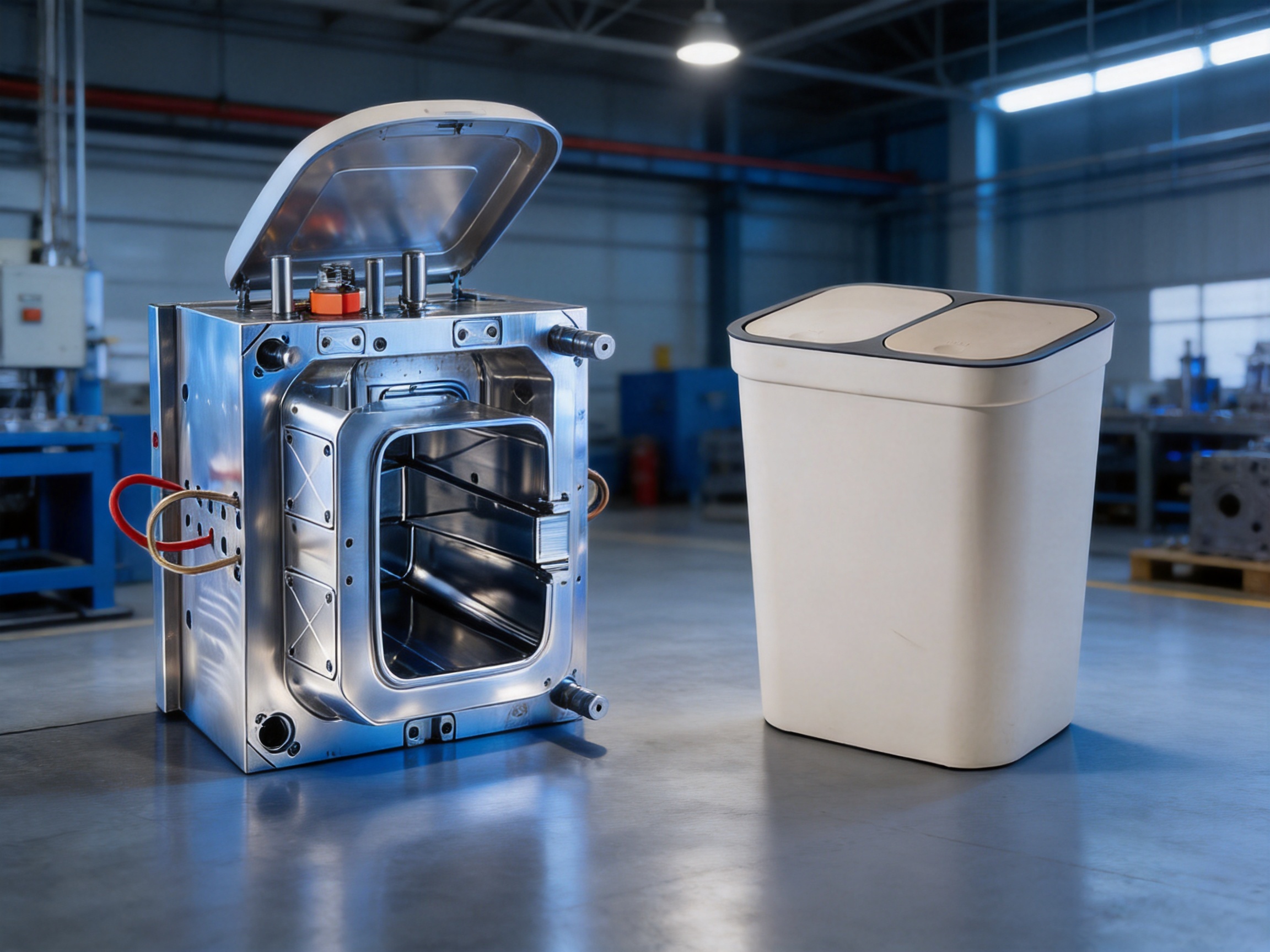
The Top-Lid Household Plastic Trash Bin Injection Mould is developed for the production of practical waste bins used in homes, offices, bathrooms, commercial buildings, and public facilities. Its design supports integrated lid structures and reinforced bucket bodies, helping manufacturers create containers that combine functionality, durability, and visual quality. The tooling is suitable for PP and HDPE materials and uses a hot runner system to support controlled filling of the large product cavity.
Manufactured by Taizhou Huangyan Haiquan Plastic Mold Co., Ltd., the mould reflects an approach centered on precision engineering, production stability, and application-focused customization. The company specializes in injection moulds for daily necessities, home appliances, automotive parts, and industrial equipment. Its technical capabilities cover product development, mould design, machining, assembly, testing, delivery, and after-sales service.
This article examines the structure, performance, manufacturing process, application value, and competitive advantages of the Top-Lid Household Plastic Trash Bin Injection Mould. It also explains how mould steel selection, gate design, cooling, ejection, and quality management influence the final plastic product.

Top-Lid Household Plastic Trash Bin Injection Mould
Product Overview
The Top-Lid Household Plastic Trash Bin Injection Mould is a one-cavity injection mould designed to produce a large plastic waste bin with a top-mounted lid structure. The product configuration can be adapted according to the required capacity, lid style, body geometry, and appearance specifications. The mould is suitable for manufacturers seeking a dependable solution for household and light commercial waste containers.
A plastic trash bin is a relatively large injection-moulded product. Large visible surfaces make defects such as sink marks, weld lines, warpage, flow marks, and uneven gloss easier to notice. At the same time, the bin body must include sufficient reinforcement to withstand handling, loading, lifting, and repeated opening and closing. These requirements make the tooling design more demanding than that of a small, simple plastic container.
The mould addresses these needs through several coordinated design features:
- Support for integrated top-lid structures.
- Reinforced bucket-body geometry for improved durability.
- Optimized gate design for better filling and reduced sink marks.
- Cooling arrangements intended to improve dimensional stability.
- Compatibility with PP and HDPE product materials.
- A hot runner system for controlled material delivery.
- A one-cavity layout suitable for large-format products.
- A target mould life of approximately 600,000 shots.
These features are not isolated specifications. They work together to provide a balanced tooling solution. Gate placement affects filling and surface quality. Cooling affects cycle consistency and product dimensions. Steel selection influences wear resistance, polishability, maintenance, and expected service life. Ejection design affects the appearance and release of the bin body. A successful mould therefore depends on the integration of all these elements.
Technical Specification
The following table summarizes the principal specifications provided for the mould.
| Item | Specification |
|---|---|
| Product | Top-Lid Household Plastic Trash Bin |
| Product Category | Cleaning Products Mould |
| Mould Steel | P20 / 718 |
| Product Material | PP / HDPE |
| Runner System | Hot Runner |
| Cavity | 1 Cavity |
| Expected Mould Life | 600,000 Shots |
| Primary Applications | Household trash bins, office waste containers, bathroom garbage bins |
| Customization Scope | Bin capacity and lid structure |
The final mould configuration may be adjusted after reviewing the customer’s product drawings, 3D data, resin selection, injection machine parameters, annual production volume, and appearance requirements. Early technical communication is important because wall thickness, draft angles, reinforcement ribs, handle structures, and lid tolerances all influence the mould architecture.
Design Requirements for a High-Quality Plastic Trash Bin Mould
Large Product Surface Management
Large plastic products require careful control of filling, cooling, and shrinkage. A trash bin body generally contains broad side walls, a base, a rim, and sometimes a handle or reinforcement features. If the molten plastic does not fill the cavity evenly, the finished product may show flow hesitation, visible weld lines, uneven texture, or local deformation.
The mould design must provide a suitable flow path from the injection point to the entire cavity. The gate location should support balanced filling while minimizing cosmetic defects in prominent areas. For a visible household product, the surface finish is especially important because consumers often judge quality through appearance before using the bin.
Reinforced Bucket Body
The body of a waste bin must resist impact and deformation. It can be lifted while full, moved across floors, placed against walls, or subjected to accidental knocks. A reinforced body helps maintain the intended geometry during these operations.
Reinforcement may be achieved through carefully designed wall transitions, ribs, base structures, rim sections, and corner geometry. However, reinforcement must be balanced. Excessively thick sections can increase material consumption, extend cooling time, and create sink marks. The mould therefore needs to support a product design that combines adequate mechanical strength with controlled wall thickness.
The Top-Lid Household Plastic Trash Bin Injection Mould is designed around this balance. Its structure supports reinforced bucket bodies while the gate and cooling design help manage the risks associated with larger and thicker moulded sections.
Integrated Lid Structure
A top lid improves the usability and appearance of a trash bin. It can conceal waste, limit odors, and create a cleaner appearance in domestic and workplace environments. The lid may also include a hinge, pivot, snap-fit, or other opening mechanism depending on the customer’s product design.
An integrated lid structure requires accurate alignment between the lid and the bin body. The mould must accommodate the required clearances and contact surfaces so that the lid opens smoothly and closes securely. If the fit is too tight, the lid may be difficult to operate. If it is too loose, the product may appear poorly assembled or fail to contain waste effectively.
Because lid structure is included within the basic customization scope, customers can discuss different capacities and opening arrangements with the manufacturer. The final solution can be developed around the intended market, product size, resin, appearance, and assembly requirements.
Advantages of the Hot Runner System
The mould uses a hot runner system to deliver molten plastic to the cavity. In comparison with a conventional cold runner, a hot runner can reduce runner waste and provide more direct control over material flow. This is especially valuable for large products manufactured in significant quantities.
A hot runner system may offer several practical benefits:
- Reduced cold-runner scrap and lower material waste.
- More consistent material delivery to the cavity.
- Potentially shorter cycle times by reducing the need to cool a large runner system.
- Improved process stability when temperature control is properly managed.
- Better suitability for repeated production of large plastic products.
Hot runner performance depends on correct nozzle selection, temperature control, sealing, maintenance, and compatibility with the selected resin. PP and HDPE both require appropriate processing conditions, and the mould must be matched to the customer’s injection machine and production process.
The use of a hot runner does not automatically guarantee a defect-free product. Its value is realized when it is integrated with suitable gate positioning, flow analysis, cooling design, and process parameters. Haiquan’s mould development process considers these elements as part of a complete tooling system rather than treating the runner system as an independent component.
Gate Design and Surface Appearance
Gate design is one of the most influential factors in the production of a large visible plastic bin. The gate controls the entry of molten resin into the cavity and affects filling speed, pressure distribution, weld-line location, packing behavior, and surface quality.
The Top-Lid Household Plastic Trash Bin Injection Mould uses an optimized gate design intended to prevent sink marks on visible surfaces. Sink marks are depressions that may occur when thicker sections cool and shrink more than surrounding areas. They can affect both product appearance and the perceived quality of the finished bin.
Preventing sink marks requires more than gate placement alone. Product wall thickness, rib dimensions, packing pressure, cooling efficiency, and material behavior all contribute to the result. The mould design supports the customer’s product geometry by providing an appropriate filling and packing arrangement. During production, the injection processor can further optimize holding pressure, holding time, melt temperature, mould temperature, and cooling time.
A well-planned gate system can also help reduce short shots and incomplete filling. Large containers often require stable flow across a broad cavity. If the resin cools too quickly before reaching remote areas, the product may become incomplete or show inconsistent texture. An optimized gate arrangement helps maintain a more predictable filling pattern.
Cooling System and Dimensional Stability
Cooling is critical for large injection-moulded products. After the plastic fills the cavity, it must cool and solidify sufficiently before ejection. Uneven cooling can cause warpage, shrinkage variation, deformation, and inconsistent assembly dimensions.
The mould cooling system is designed to support dimensional stability for the large bin product. Properly arranged cooling channels help remove heat from the cavity and core in a controlled manner. This supports repeatable cycle conditions and helps the product retain its intended form.
Cooling design should consider:
- The overall dimensions of the bin body.
- Areas with increased wall thickness or reinforcement.
- The base and rim, which may cool differently from the side walls.
- The location of gates and hot runner components.
- Potential shrinkage differences between corners and flat surfaces.
- The required production cycle time.
- The thermal properties of PP or HDPE.
For a large bin, dimensional stability is important for both appearance and usability. A warped body may rock on a flat floor, while a deformed rim may prevent the lid from closing correctly. A stable cooling system helps reduce these risks and supports consistent product quality from one shot to the next.
Cooling also influences production efficiency. If the cooling time is too short, the product may deform during ejection. If it is excessively long, output may be reduced. The goal is to achieve a balanced cycle in which the bin is sufficiently solid for release without unnecessary delay.
Material Compatibility: PP and HDPE
Polypropylene
Polypropylene is widely used for household plastic products because it offers a useful combination of low density, chemical resistance, fatigue resistance, and cost efficiency. It can be suitable for trash bins that require a relatively light body and repeated handling.
PP can also support a broad range of colors and surface finishes. Its processing characteristics must be considered when setting mould temperatures, injection speeds, packing conditions, and cooling times. Shrinkage behavior can affect the final dimensions of the bin, lid, rim, and hinge areas.
High-Density Polyethylene
HDPE is known for toughness, impact resistance, chemical resistance, and suitability for many domestic and commercial containers. It can be a practical choice when the bin needs to tolerate rough handling or contact with varied household waste.
HDPE also requires careful attention to shrinkage and cooling. Product and mould design should account for the resin’s behavior so that the body and lid retain suitable dimensions after demoulding. The mould’s cooling arrangements and gate design support this requirement, while final production settings are established according to the selected grade and machine.
Resin Selection and Mould Design
Although PP and HDPE are both polyolefins, they do not behave identically in every processing situation. Their melt flow, shrinkage, impact properties, and cooling response may vary by grade. Customers should provide the intended resin grade whenever possible so that the mould design and process recommendations can be aligned with actual production conditions.
Material selection also affects product weight, flexibility, surface appearance, color consistency, and resistance to household chemicals. Haiquan can review the application requirements and help coordinate the mould structure with the chosen material.
Mould Steel Selection: P20 and 718
The mould specification includes P20 and 718 steel options. These grades are commonly considered for injection mould components where a balance of machinability, durability, surface quality, and cost is required.
P20 Steel
P20 is frequently used in injection mould construction because it offers good machinability and is suitable for many medium- to high-volume applications. It can support the manufacture of large mould components and provide a practical balance between production performance and tooling investment.
When properly selected, machined, polished, and maintained, P20 can provide reliable service for household plastic products. It is particularly relevant where the product design, resin, production volume, and maintenance plan do not require a more specialized steel grade.
718 Steel
718 steel is another practical option for injection moulds. It can offer good polishability and mechanical performance, making it suitable for mould surfaces where a clean appearance is required. The choice between P20 and 718 depends on factors such as product finish, expected production volume, customer budget, resin characteristics, and required mould life.
Steel selection should be confirmed during the engineering stage rather than treated as a fixed decision independent of the product. Haiquan can evaluate the customer’s technical requirements and recommend an appropriate material configuration for the cavity, core, inserts, mould base, and wear-related components.
One-Cavity Configuration for Large Products
The mould is specified as a one-cavity tool. For a large trash bin, a one-cavity arrangement can offer important practical benefits. It allows the mould to focus on one complete product while controlling the filling pattern, cooling balance, and ejection system.
A one-cavity mould may be advantageous when:
- The product has large dimensions.
- The customer requires a stable and manageable production process.
- The injection machine has limited available capacity for a multi-cavity tool.
- The initial tooling investment needs to be controlled.
- The product design is still being introduced to the market.
- Quality consistency is more important than maximum parts-per-cycle output.
Multi-cavity moulds can increase output in some applications, but they also introduce additional requirements for cavity balancing, mould size, machine capacity, cooling control, and maintenance. For a large waste bin, a one-cavity solution can provide a straightforward and dependable manufacturing platform.
The most suitable cavity configuration depends on annual demand and production planning. If demand increases substantially, the customer can discuss future tooling strategies, including additional moulds, product family moulds, or revised cavity arrangements.
Expected Mould Life and Production Value
The stated mould life is 600,000 shots. This target indicates that the tool is intended for sustained production rather than short-term sampling only. For a one-cavity mould, the number of shots corresponds to approximately 600,000 moulded products, subject to actual operating conditions, maintenance, resin selection, injection settings, and component wear.
Actual service life can be influenced by several factors:
- The type and grade of plastic resin used.
- Whether the material contains glass fiber, mineral filler, or abrasive additives.
- Injection pressure and speed.
- Production cycle frequency.
- Cooling-water quality and temperature control.
- Lubrication and maintenance practices.
- Cleaning frequency and storage conditions.
- Handling of the mould during installation and removal.
A mould with a long service target can reduce the average tooling cost per product over the production program. It can also reduce the disruption associated with frequent mould replacement or major refurbishment. However, long life depends on a cooperative approach between the mould manufacturer and the production team. Regular inspection of parting surfaces, ejector components, hot runner elements, cooling channels, and wear areas is essential.
Manufacturing Process at Haiquan Mould
Product Review and Engineering Communication
The manufacturing process begins with a review of the customer’s product concept, drawings, or three-dimensional data. Engineers examine the bin capacity, lid structure, wall thickness, draft angles, reinforcement ribs, handle areas, parting lines, gate locations, ejection requirements, and expected material.
This stage is important because many mould problems can be prevented before steel cutting begins. If the product has insufficient draft, the part may be difficult to release. If ribs are too thick, sink marks may appear. If the lid clearance is not appropriate, the finished assembly may not operate smoothly. Early design communication allows these issues to be addressed efficiently.
Three-Dimensional Mould Design
After the product requirements are confirmed, the mould structure is developed in three-dimensional design software. The design typically includes the mould base, cavity, core, inserts, hot runner, cooling channels, ejector system, guide components, locking elements, and standard parts.
Design engineers must account for resin shrinkage when determining cavity and core dimensions. They also consider mould opening direction, parting-line visibility, ejection forces, machine mounting requirements, and access for maintenance.
For a top-lid bin, special attention is given to the relationship between the lid and body. The design must maintain functional clearances while preserving the appearance of the finished product. If the product includes hinge or snap-fit features, these are reviewed for strength, release, and repeatability.
Flow and Filling Considerations
Large plastic products benefit from a systematic review of resin flow. Gate location, runner geometry, filling time, pressure distribution, and potential weld-line locations are considered during the engineering process. The objective is to create a filling pattern that supports complete mould filling and minimizes visible defects.
Flow analysis, where appropriate, can help identify possible short shots, air traps, hesitation areas, excessive pressure, and weld lines before machining. The findings can guide modifications to gate locations, venting, wall transitions, and cooling arrangements.
CNC Machining and Precision Manufacturing
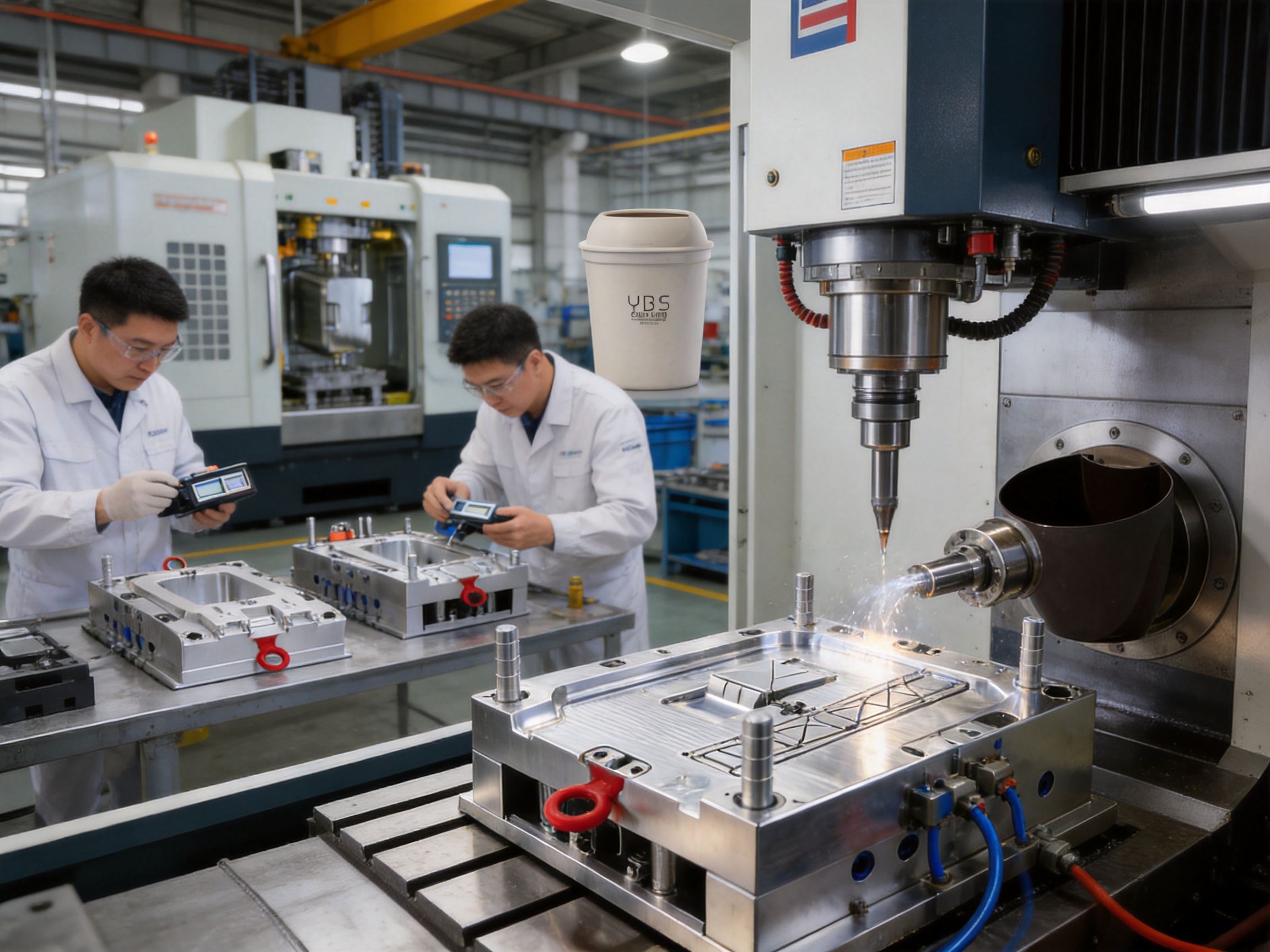
Once the design is approved, the mould components are manufactured using precision machining processes. CNC milling is used to create cavity and core surfaces, while drilling and other machining operations produce cooling channels, ejector holes, guide holes, and component interfaces.
Large mould components require careful control of alignment and machining sequence. Improper machining can lead to mismatch, uneven parting lines, incorrect wall thickness, or difficulty during assembly. A professional manufacturing process uses suitable fixtures, measurement methods, and machining plans to maintain consistency.
Fine finishing and polishing are applied according to the product’s appearance requirements. Visible bin surfaces may require a specific texture, matte finish, or polished appearance. The selected finish must be compatible with the product concept and the intended consumer market.
Assembly and Fitting
After machining, the mould components are assembled and fitted. The cavity, core, inserts, hot runner components, ejector system, guide pillars, guide bushes, and locking elements are checked for correct interaction.
Fitting work is especially important for large moulds because minor alignment errors can become visible across broad product surfaces. The parting line must close evenly, the ejectors must move smoothly, and the mould must open and close without abnormal resistance.
Trial Moulding
Trial moulding is used to verify the tool under practical injection conditions. The trial process checks filling, part release, surface appearance, dimensions, lid fit, cooling behavior, and cycle performance.
Trial samples can reveal issues that are difficult to identify through design review alone. Engineers may adjust processing conditions or make controlled mould modifications to improve the result. The trial stage is also an opportunity to confirm whether the selected PP or HDPE grade performs as expected.
Inspection and Delivery
Before delivery, the mould is inspected for dimensions, operation, component completeness, surface condition, cooling passage performance, and general assembly quality. Documentation may include mould drawings, spare-part information, operating recommendations, and maintenance guidance according to the project arrangement.
Haiquan provides integrated services covering design, production, and after-sales support. This helps customers coordinate technical questions with one mould supplier rather than managing unrelated design and manufacturing sources.
Competitive Advantages of the Mould
1. Application-Specific Product Development
The mould is designed specifically for household plastic trash bins rather than being a generic container tool. This application focus allows attention to be directed toward the practical requirements of waste containers, including lid operation, body reinforcement, visual surfaces, cleaning convenience, and repeated handling.
2. Better Control of Visible Surface Quality
Trash bins are consumer-facing products. Large side walls and top rims are easily seen, so surface defects can affect brand perception and customer acceptance. The optimized gate design and planned cooling system help address sink marks and dimensional variation, providing a stronger foundation for attractive products.
3. Support for Two Common Resin Options
Compatibility with PP and HDPE gives manufacturers flexibility in product development. These materials cover many household and commercial container applications and allow customers to balance toughness, weight, chemical resistance, cost, and product feel.
4. Reduced Runner Waste Through Hot Runner Technology
The hot runner system can reduce cold-runner waste and support more efficient material use. This may be particularly valuable for high-volume production, where even a small reduction in material waste can contribute to meaningful operating savings.
5. Durable Tooling for Long Production Programs
The stated 600,000-shot mould life supports sustained manufacturing programs. The use of P20 or 718 steel provides options for balancing durability, surface quality, machining requirements, and project cost.
6. Customizable Capacity and Lid Structure
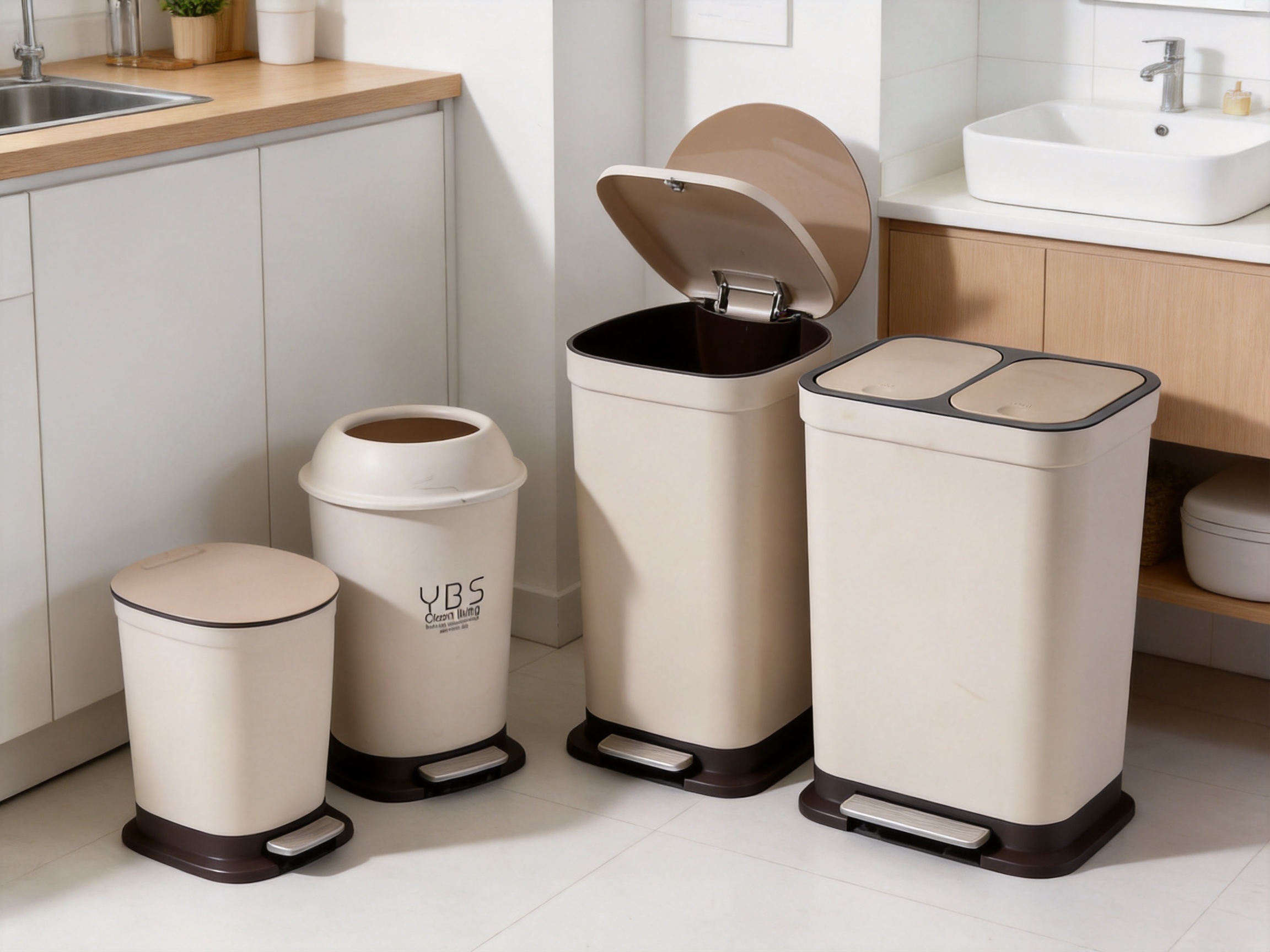
Customers can discuss different bin capacities and lid structures. This makes the tool more adaptable to market requirements. A compact bathroom bin, a medium household container, and an office waste bin may share certain design principles while requiring different dimensions and opening arrangements.
7. Integrated Technical and Production Support
Haiquan’s services cover research and development, mould design, manufacturing, testing, delivery, and after-sales support. This integrated structure can reduce communication gaps and improve accountability throughout the project.
Applications of the Finished Plastic Products
Household Trash Bins
In homes, the bin may be used in kitchens, bedrooms, living rooms, laundry areas, or general-purpose spaces. A top lid helps conceal waste and can provide a more orderly appearance. PP or HDPE construction supports lightweight handling and practical cleaning.
Office Waste Containers
Offices require waste containers that look clean and professional while remaining easy to empty. A reinforced body and reliable lid structure can support repeated daily use in workspaces, meeting rooms, reception areas, and administrative departments.
Bathroom Garbage Bins
Bathroom bins are often exposed to moisture, cleaning agents, and frequent emptying. Plastic construction offers resistance to many common environmental conditions, while the top lid helps maintain a neat appearance. Dimensions and lid operation can be adjusted for the intended bathroom layout.
Commercial and Public Facilities
Although the supplied application information emphasizes household, office, and bathroom bins, the same general product platform may be adapted for suitable commercial environments. Before selecting the mould for public or heavy-duty applications, customers should confirm the required capacity, impact resistance, usage frequency, and compliance requirements.
Customization Options
Basic customization includes bin capacity and lid structure. These two elements have a direct influence on the mould design and should be confirmed at the beginning of the project.
Bin Capacity
Capacity is affected by the height, width, depth, wall angle, base design, and usable internal volume. A larger capacity may require greater mould dimensions, higher injection volume, increased clamping force, and different cooling arrangements. The machine selected for production must be suitable for the finished mould and resin quantity.
Lid Structure
The lid may be designed as a simple removable cover, hinged top, snap-fit structure, or another opening arrangement. The selected design influences mould parting, side actions, inserts, assembly, and tolerance requirements. Customers should clarify whether the lid is moulded as part of the bin, produced separately, or connected through an assembly process.
Surface Finish and Color
Surface texture can influence the visual quality, scratch visibility, grip, and ease of cleaning. Color is normally established through the selected resin or masterbatch. The mould surface should be finished in a way that supports the intended appearance.
Branding and Identification
Where required, the product may include raised or recessed identification, recycling symbols, capacity markings, or other moulded-in details. These features must be reviewed carefully because they can affect filling, demoulding, polish, and local wall thickness.
Quality Control Considerations
Quality control for a large plastic trash bin should evaluate both the mould and the moulded product. Mould inspection may include dimensional checks, cavity and core alignment, component movement, cooling-channel condition, hot runner operation, and surface finish.
Finished product inspection may include:
- Overall length, width, height, and capacity.
- Body wall thickness and base thickness.
- Rim flatness and lid fit.
- Opening and closing operation.
- Surface appearance and color consistency.
- Presence of sink marks, weld lines, short shots, flash, or warpage.
- Resistance to basic handling and impact requirements.
- Stability when placed on a flat surface.
Inspection criteria should be agreed upon before production. A customer may prioritize cosmetic appearance for retail products, while another may prioritize impact strength and cost for institutional use. Clear standards help ensure that the mould and process are evaluated according to the actual application.
Maintenance Recommendations
Regular maintenance is essential for achieving the intended mould life. After production, the mould should be cleaned and dried, especially around the parting line, ejector system, vent areas, and cooling connections. Residual resin, dust, or moisture can affect operation and surface quality.
Maintenance activities may include:
- Checking the parting surfaces for damage or contamination.
- Inspecting ejector pins and return components.
- Lubricating suitable moving components.
- Checking guide pillars and guide bushes for wear.
- Inspecting hot runner connections and temperature-control elements.
- Flushing or treating cooling channels when water quality causes deposits.
- Checking cavity and core surfaces for scratches or corrosion.
- Recording production shots and maintenance actions.
When the mould is removed from the machine for storage, exposed steel surfaces should be protected against corrosion. The mould should be stored in a dry and controlled environment, with moving components positioned safely and water lines managed according to the manufacturer’s instructions.
Why Choose an Experienced Mould Manufacturing Company?
The performance of an injection mould depends not only on the final steel components but also on the engineering decisions made before manufacturing. An experienced mould manufacturer can identify potential issues involving draft, shrinkage, gate position, cooling, ejection, and product assembly before they become expensive production problems.
Taizhou Huangyan Haiquan Plastic Mold Co., Ltd. is a high-tech enterprise specializing in precision injection mould research and manufacturing. Its business covers daily necessities, home appliances, automotive parts, and industrial equipment. This broad sector experience can provide useful insight into different resin behaviors, product structures, appearance requirements, and production conditions.
The company emphasizes a professional design team and a scientific production management system. These strengths support a structured workflow from initial product review to final mould delivery. The company also serves international customers in Europe, the Middle East, Southeast Asia, and South America, giving it experience with cross-border project communication and delivery requirements.
For customers looking for a Plastic Molding Die Maker, Plastic Moulding Die Maker, injection plastic parts tooling supplier, or custom mould manufacturing company, the ability to provide integrated technical support is an important consideration. A reliable supplier should be able to discuss product feasibility, recommend tooling solutions, manage manufacturing, support trials, and respond to maintenance or modification needs after delivery.
Recommended Project Workflow for Customers
A successful trash bin mould project benefits from clear information and timely decisions. Customers should provide product drawings or 3D data, target capacity, resin grade, annual production estimate, color and surface requirements, injection machine information, lid structure, and packaging or assembly expectations.
The project can then proceed through the following general stages:
- Product requirement review.
- Technical discussion and feasibility analysis.
- Quotation and tooling specification confirmation.
- Three-dimensional mould design.
- Design review and customer approval.
- Steel preparation and component machining.
- Assembly, fitting, and initial inspection.
- Trial moulding and sample evaluation.
- Necessary adjustment or correction.
- Final inspection and mould delivery.
- Production support and after-sales service.
Early confirmation of product details can reduce later modifications. Changes to the lid, capacity, wall thickness, or gate position after machining may require additional time and cost. For this reason, product engineering should be treated as an essential part of the mould project rather than a preliminary formality.
Economic and Operational Benefits
A well-designed mould creates value beyond the initial tooling purchase. Stable filling can reduce rejected parts. Effective cooling can support predictable cycle times. A suitable hot runner can reduce runner waste. Reliable ejection can reduce damage during demoulding. Accurate lid dimensions can reduce assembly problems and customer complaints.
These benefits contribute to the total cost of ownership. A cheaper mould that produces inconsistent bins may generate higher costs through scrap, rework, machine downtime, and maintenance. A properly engineered mould may require a higher initial investment while delivering better production stability over a longer manufacturing program.
The one-cavity configuration also makes production planning more straightforward. It allows the customer to calculate output according to one product per shot and adjust operating hours, shift arrangements, and mould maintenance intervals accordingly. For moderate production volumes, this can be a practical alternative to a more complex multi-cavity system.
Environmental and Material Efficiency Considerations
Plastic product manufacturers increasingly consider material efficiency and waste reduction. The hot runner system can help reduce cold-runner scrap, while balanced product design can minimize unnecessary wall thickness. Proper cooling and process control can reduce rejected parts caused by warpage or dimensional instability.
PP and HDPE may also be selected for their practical recyclability characteristics, depending on local collection systems, product design, labeling, and regulatory requirements. Customers should confirm the appropriate material and recycling strategy for their target market.
Designing for material efficiency does not mean reducing strength below acceptable levels. The objective is to use material where it contributes to performance, such as the rim, base, lifting areas, and hinge supports, while avoiding excessive thickness that can increase weight and cause sink marks.
Q&A
What product is this injection mould designed to manufacture?
It is designed to manufacture top-lid household plastic trash bins. The finished bins may be used in homes, offices, bathrooms, and other suitable environments.
Which plastic materials are compatible with the mould?
The specified product materials are polypropylene and high-density polyethylene. The final resin grade should be confirmed during the engineering stage because different grades may have different flow and shrinkage characteristics.
Why does the mould use a hot runner system?
The hot runner system delivers molten plastic to the cavity while reducing the need for a cooled runner. It can reduce material waste and support stable filling when correctly designed, heated, and maintained.
How many cavities does the mould have?
The mould is specified as a one-cavity tool. This configuration is suitable for the large bin product and allows the filling, cooling, and ejection systems to focus on one complete product per shot.
What mould life is expected?
The stated target is approximately 600,000 shots. Actual service life depends on resin type, operating conditions, maintenance, production frequency, and the handling of the mould.
Can the bin capacity be customized?
Yes. Basic customization includes bin capacity. Changes to capacity affect product dimensions, injection volume, cooling, mould size, and machine requirements, so they should be finalized before the mould design is approved.
Can the lid structure be customized?
Yes. The lid structure is included in the basic customization scope. Customers can discuss hinged, removable, snap-fit, or other suitable top-lid concepts according to product requirements.
How does the mould help reduce sink marks?
The mould uses an optimized gate design intended to improve filling and packing behavior on visible surfaces. Product wall thickness, rib design, holding pressure, cooling, and resin selection must also be controlled to achieve the best result.
Why is cooling important for a plastic trash bin?
A trash bin has large surfaces that can warp or shrink unevenly if cooling is not controlled. The mould cooling system supports dimensional stability and helps maintain the shape of the body, base, rim, and lid-related areas.
Which steel options are available?
The specified steel options are P20 and 718. The best choice depends on the product finish, expected production volume, resin, tooling budget, and service requirements.
What information should a customer provide before requesting a quotation?
The customer should provide product drawings or 3D data, target bin capacity, lid design, material and resin grade, surface finish, color, estimated annual production, injection machine information, and any special dimensional or appearance requirements.
Does the manufacturer provide support after mould delivery?
Haiquan provides integrated services from design and production to after-sales support. Specific support arrangements should be confirmed for each project, including trial assistance, documentation, maintenance guidance, and possible modifications.
Conclusion
The Top-Lid Household Plastic Trash Bin Injection Mould is a practical tooling solution for manufacturers producing durable and attractive plastic waste containers. Its design combines a reinforced bucket body, integrated lid support, optimized gate arrangement, controlled cooling, hot runner technology, and compatibility with PP and HDPE materials.
The one-cavity structure is well suited to a large-format product, while the P20 or 718 steel options provide flexibility in balancing mould performance, surface quality, durability, and investment. The stated 600,000-shot service target supports long-term production planning, provided that the tool is operated and maintained correctly.
Compared with basic or poorly optimized tooling, this mould offers advantages in surface-quality management, dimensional stability, material efficiency, product customization, and production support. Its value is strengthened by the manufacturing capabilities of Taizhou Huangyan Haiquan Plastic Mold Co., Ltd., including precision design, structured production management, international project experience, and integrated after-sales service.
For companies seeking a reliable Plastic Molding Die Maker, Plastic Moulding Die Maker, or experienced plastic mould manufacturing company, this tooling solution provides a strong foundation for producing household trash bins, office waste containers, and bathroom garbage bins. With proper product engineering and process control, it can support consistent quality, efficient production, and dependable performance across an extended manufacturing program.
References
1. Injection Molding Handbook, general principles of thermoplastic mould design, runner systems, cooling, and process control.
2. Plastics Materials Engineering References, technical guidance on polypropylene and high-density polyethylene processing behavior.
3. Standard Practices for Plastic Injection Mould Design, guidance on gate placement, ejection, venting, shrinkage, and dimensional control.
4. Mould Steel Selection and Heat Treatment References, comparative information on P20 and 718 mould steels.
5. Industrial Quality Management Principles for Injection Mould Manufacturing, practices for design review, machining inspection, trial moulding, and maintenance.
6. Product information supplied for the Top-Lid Household Plastic Trash Bin Injection Mould by Taizhou Huangyan Haiquan Plastic Mold Co., Ltd.
Product: Top-Lid Household Plastic Trash Bin Injection Mould

For exclusive deals and latest offers, sign up by entering your email address below.











 +86-18657672567
 sales@tzhqmould.com
celin@tzhqmould.com
 No. 17 Houshi Road, Beicheng Industrial Zone, Huangyan District, Taizhou City, Zhejiang Province, China
Copyright © Taizhou Huangyan Haiquan Plastic Mold Co., Ltd. All Rights Reserved
Injection Plastic Mould Maker

