

Custom PC Plastic Cup Injection Mould in Various Sizes
Admin 2026-08-23
Plastic cups are simple-looking products, but producing them consistently at commercial scale requires carefully engineered tooling. A cup must be transparent or visually clean, dimensionally stable, comfortable to hold, resistant to cracking, easy to stack, and suitable for efficient high-volume production. These requirements become even more demanding when the product is made from polycarbonate (PC), Tritan, or another high-performance transparent material. The Custom PC Plastic Cup Injection Mould in Various Sizes is designed to address these challenges through precision tooling, controlled material flow, balanced cooling, and flexible cavity configurations.
This injection mould solution is intended for manufacturers of reusable drinkware, restaurant beverage cups, juice and smoothie containers, outdoor drinking products, travel cups, and other transparent or semi-transparent plastic vessels. It can be customized according to cup capacity, wall thickness, cavity quantity, product geometry, surface treatment, and branding requirements. The mould is also suitable for thin-wall injection, helping reduce material use while preserving the strength and usability expected from a dependable cup.
Taizhou Huangyan Haiquan Plastic Mold Co., Ltd. develops and manufactures precision injection moulds for daily necessities, home appliances, automotive parts, and industrial equipment. Its production philosophy combines professional design, structured manufacturing management, quality control, and after-sales support. For plastic cup projects, this integrated approach helps customers move from product concepts and engineering review to mould production, trial injection, optimization, and stable manufacturing.
Why Plastic Cup Tooling Requires Precision Engineering
A plastic cup is often produced with a relatively thin wall, a smooth internal surface, and a rim that must remain round and comfortable. Small variations in wall thickness can affect transparency, weight, stacking performance, and cooling time. A slight mismatch between cavities may result in cups with different dimensions, different gloss levels, or inconsistent filling behavior. For this reason, cup injection moulds should be designed as complete production systems rather than as simple negative forms of the final product.
Material selection is one of the first considerations. PC offers high impact resistance, good dimensional stability, and attractive transparency. Tritan is also widely used in reusable drinkware where clarity, durability, and a premium appearance are important. Each material has different processing characteristics, including melt temperature, filling behavior, shrinkage, and cooling requirements. The mould must therefore be adapted to the selected resin and the intended production cycle.
The product geometry also affects the mould design. A tall cup, a tapered cup, a straight-sided cup, and a cup with a reinforced rim each require different approaches to parting lines, draft angles, gates, cooling layouts, and ejection. If the cup is intended to be stacked, the design must provide enough clearance between nested products without making the cup unstable. If it includes a logo or decorative surface, the mould must reproduce the branding accurately without creating visible defects.
Transparent products are particularly demanding because defects that might be hidden on an opaque product become immediately visible. Flow marks, weld lines, air traps, burn marks, sink marks, scratches, and uneven polishing can reduce the perceived quality of the cup. A high-quality plastic cup mould therefore needs excellent steel preparation, accurate machining, carefully planned gating, controlled venting, and a polished cavity surface.
Product Overview
The Custom PC Plastic Cup Injection Mould is a production mould for manufacturing cups in different sizes and configurations. It is designed around high-polish mould steel and can use S136 or NAK80 according to the project requirements. The mould supports PC and Tritan materials, a hot runner system, two to eight cavities, mirror polishing, and a target service life of up to 1,000,000 shots when properly operated and maintained.
Its configuration is not limited to one standard cup. Customers can specify the nominal capacity, overall height, mouth diameter, base design, wall thickness, taper angle, logo position, and other functional or aesthetic details. The cavity number can be selected according to the required output, available injection machine capacity, product cycle, and investment plan.
A two-cavity mould may be suitable for initial commercial production, specialized products, or customers who want a lower initial tooling investment. Four-, six-, or eight-cavity arrangements can provide greater output for high-volume applications. The appropriate configuration depends on the required annual volume, machine size, resin consumption, expected cycle time, and production schedule.
| Feature | Available Configuration or Specification | Production Benefit |
| Mould steel | S136 / NAK80 | Suitable for precision tooling, polishing, and durable production use |
| Product material | PC / Tritan | Supports clear, durable, and reusable drinkware applications |
| Runner system | Hot runner | Helps reduce runner waste and supports balanced filling |
| Cavity quantity | 2–8 cavities | Allows output to be matched to production demand |
| Surface finish | Mirror polish | Supports glossy, transparent, and visually attractive cup surfaces |
| Expected mould life | Up to 1,000,000 shots | Provides a long-term production platform when maintained correctly |
| Customization | Capacity, logo, cavity layout, and geometry | Allows the mould to match product and branding requirements |
Advantages of the Custom Plastic Cup Mould
High Optical and Surface Quality
One of the most important advantages of this plastic injection cup mould is its focus on surface quality. The cavity surfaces are prepared and polished to support a clear, glossy appearance. For PC and Tritan cups, the external surface is part of the product’s value. Consumers commonly associate a smooth, bright, transparent finish with cleanliness, durability, and premium manufacturing.
High-polish steel such as S136 or NAK80 can be selected for applications where surface appearance and dimensional performance are important. S136 is widely recognized for corrosion resistance and polishing capability, while NAK80 is often used for precision mould components requiring good machinability and a stable polished surface. The final steel choice can be considered according to product requirements, production environment, surface finish, and expected service conditions.
A properly polished cavity also helps reduce surface friction during demoulding. This is especially useful for cup designs with transparent walls, narrow draft angles, or close dimensional tolerances. The objective is not simply to make the cavity look smooth; it is to create a mould surface that can reproduce the desired appearance repeatedly while minimizing marks during production.
Controlled Filling Through Hot Runner Technology
The mould uses a hot runner system to deliver molten plastic to the cavities. Compared with a conventional cold runner arrangement, a hot runner can reduce solidified runner waste and support more efficient use of resin. This is valuable for PC and other engineering materials, especially when the cup is produced in large quantities and material costs represent a significant part of the total manufacturing budget.
The gating arrangement is developed to promote stable filling and minimize visible defects. Transparent cups require careful attention to the location, size, and type of gate. Poor gate design may create flow hesitation, visible jetting, excessive shear, weld lines, or uneven filling. By considering the cup’s bottom, side wall, rim, and overall flow length, the mould designer can create a filling pattern that supports better appearance and more consistent cavity balance.
A balanced hot runner layout is particularly important for multi-cavity production. Each cavity should receive a similar volume of material at a similar pressure and temperature. When the runner system is properly balanced, cavity-to-cavity differences can be reduced, making it easier for the injection machine to maintain a stable process window.
Uniform Cooling for Dimensional Consistency
Cooling is one of the most influential factors in injection moulding cycle performance and product quality. Plastic cups have curved walls, a base, a rim, and sometimes a tapered nesting structure. If one part of the product cools faster than another, the cup may warp, shrink unevenly, become oval, or develop stress that affects transparency and durability.
The mould incorporates uniform cooling channels to support more even heat removal from the core and cavity. A stable cooling design helps maintain cup dimensions from one cycle to the next and reduces the possibility of deformation during ejection. It can also contribute to shorter and more predictable cycle times because the product can be released when it has reached sufficient stiffness.
For multi-cavity moulds, cooling balance is as important as filling balance. Each cavity should operate under comparable thermal conditions. Otherwise, one cavity may produce a cup with a slightly different weight or shrinkage behavior from another. A well-planned cooling system improves production repeatability and makes quality inspection more straightforward.
Support for Thin-Wall Cup Production
Many modern drinkware products are designed with thinner walls to reduce resin consumption, product weight, and transport costs. Thin-wall injection, however, requires faster and more controlled filling because the molten plastic has less space to flow before it begins to cool. The mould must therefore provide efficient material delivery, accurate cavity dimensions, suitable venting, and reliable temperature control.
This plastic cup mould supports thin-wall applications while maintaining the structural strength required for normal use. The exact wall thickness depends on the cup material, diameter, height, capacity, design, and intended application. Through engineering review, the wall can be optimized to balance stiffness, impact resistance, weight, filling performance, and cooling time.
Thin-wall capability can provide several commercial advantages. Less material may reduce the unit cost, while a lighter product may improve shipping efficiency. Faster filling and cooling can increase output when the machine and auxiliary equipment are correctly matched. At the same time, the cup must still resist deformation when filled, handled, washed, transported, or stacked.
Flexible Cavity Quantity
Different customers have different production objectives. A start-up drinkware brand may need a moderate output and prefer a two-cavity mould. An established packaging manufacturer may require a six- or eight-cavity mould to meet large orders. Supporting two to eight cavities allows the project to be planned around actual demand instead of forcing every customer into one fixed production model.
Cavity quantity affects the injection machine size, mould dimensions, cooling requirements, hot runner layout, cycle economics, and maintenance workload. Higher cavity counts can increase output per cycle, but they also require a larger initial investment and more demanding process balance. A professional mould supplier can review the expected annual volume and recommend a configuration that balances productivity and total cost of ownership.
Multi-cavity production also requires consistency. The cavities should be manufactured to matching dimensions, and the mould should include a runner, cooling, and ejection design that operates evenly. Consistent cavity performance helps reduce sorting, rework, and customer complaints.
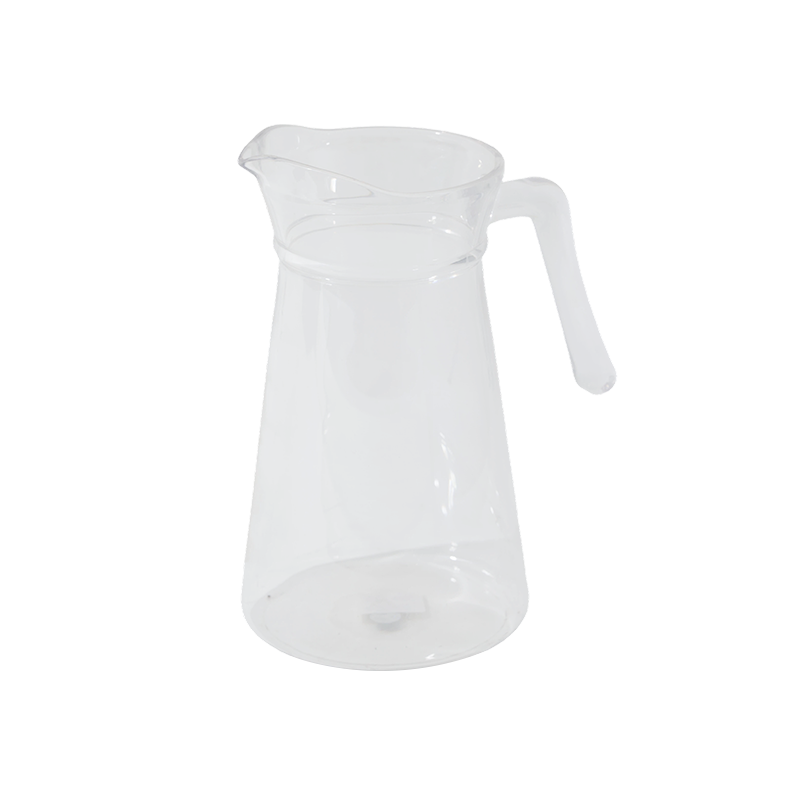
Custom PC Plastic Cup Injection Mould in Various Sizes
Materials for Transparent Plastic Cups
Polycarbonate
Polycarbonate is widely selected for reusable cups that require transparency and impact resistance. It can provide a clear appearance similar to glass while offering lower breakage risk in many service environments. PC cups may be used in restaurants, catering, outdoor activities, hospitality, events, and travel applications.
When processing PC, the resin must be handled carefully. Moisture in the material can contribute to cosmetic defects and reduced performance, so proper drying and material storage are important. The mould design should support suitable melt flow, effective venting, and stable cooling. The injection process must also be optimized to avoid excessive internal stress, which can affect product appearance and long-term durability.
Tritan and Similar Transparent Copolyesters
Tritan is another material used for reusable transparent drinkware. It is valued for clarity, toughness, and a modern appearance. Depending on the specific grade and application, it may provide an attractive alternative to traditional transparent plastics. The mould can be adapted to the processing requirements of the selected grade.
Although PC and Tritan may both be used for clear cups, they should not automatically be processed under identical conditions. Melt temperature, drying conditions, shrinkage, filling speed, holding pressure, and cooling time can vary. Process parameters should be established through material data, mould trials, and production validation.
Material Selection and Product Requirements
The correct material depends on the product’s intended use. A cup used in outdoor activities may need impact resistance and light weight. A restaurant cup may prioritize clarity, stackability, washing durability, and a consistent appearance. A promotional cup may require a logo, color effect, special texture, or a specific capacity. These requirements should be defined before finalizing the mould structure.
Material selection should also consider regulatory and market requirements. If the cup is intended for food or beverage contact, the resin grade, additives, colorants, and manufacturing process should be reviewed against the regulations applicable to the target market. The mould itself should be cleanable and manufactured from materials suitable for the intended production environment.
Applications for the Cup Injection Mould
Reusable Drink Cups
Reusable drink cups are increasingly used in homes, offices, schools, restaurants, cafés, and outdoor environments. A PC or Tritan cup can offer the appearance of glass with improved resistance to breakage in many situations. Product designers can specify different sizes for water, coffee-based cold drinks, juice, tea, smoothies, or mixed beverages.
Restaurant and Catering Beverage Cups
Commercial food-service operations need cups that are consistent, stackable, visually attractive, and suitable for repeated handling. A cup mould with controlled dimensions can help products nest properly and occupy less storage space. A reinforced rim can improve user comfort and reduce the risk of damage during normal handling.
Juice and Smoothie Cups
Transparent cups are useful for presenting colorful beverages. Clarity and gloss allow customers to see the drink, ice, fruit, or layered ingredients. For this application, the mould must reproduce the surface without excessive flow marks or cloudy regions. Different capacities and mouth diameters can be developed according to beverage style and filling equipment.
Outdoor and Travel Drinkware
Outdoor cups and travel drinkware are exposed to handling, transport, temperature changes, and occasional impact. A durable transparent material combined with a carefully designed cup geometry can provide a practical balance between appearance and service performance. The mould can also be adapted for products that work with lids, sleeves, handles, or other accessories.
Customization Options
Customization begins with the product concept. Customers can provide a drawing, three-dimensional model, physical sample, or basic dimensional specification. The mould engineering team can then review the design for draft, wall thickness, shrinkage, parting line location, gate position, ejection, cooling, and manufacturability.
Capacity and Dimensions
The cup capacity can be adjusted for different markets and applications. Common design variables include nominal volume, overflow volume, height, top diameter, base diameter, taper angle, rim thickness, and bottom shape. The relationship between these dimensions affects how the cup feels in the hand, how it stacks, and how it fits with lids or packaging.
Surface Logos and Branding
Surface logos can be incorporated into the mould to create a permanent raised or recessed mark. Logo placement should be reviewed carefully because it can influence filling, polishing, demoulding, and cleaning. A logo on a flat or gently curved area may be easier to reproduce consistently than one located near a sharp transition or thin wall.
For customers who want greater flexibility, labels, in-mould decoration, printing, or secondary marking may be considered instead of a permanent mould engraving. The appropriate method depends on the required appearance, production volume, product material, and branding strategy.
Number of Cavities
The available two- to eight-cavity range allows production planning to remain flexible. Cavity quantity can be matched to machine capacity and market demand. A customer may also choose to begin with fewer cavities and develop additional tooling later when order volume increases.
Surface Finish
Mirror polish is suitable for cups that require a glossy and transparent appearance. Other surface treatments may be considered for selected zones, including fine textures, matte areas, grip patterns, or decorative effects. Any surface treatment must be balanced with the transparency and aesthetic requirements of the final cup.
Advanced Mould Manufacturing Process
Product and Feasibility Review
The manufacturing process begins with a review of the cup design and production objectives. Engineers examine the product model, material, expected output, machine information, cavity quantity, and quality requirements. Potential problems such as insufficient draft, uneven wall thickness, difficult ejection, poor gate location, or inadequate cooling space can be identified before steel cutting begins.
This early review is important because many mould problems are less expensive to correct during design than after machining. A well-planned project can reduce engineering changes, shorten trial periods, and create a more reliable path to mass production.
Flow and Filling Analysis
For transparent cups and thin-wall products, filling analysis can help evaluate the proposed gate and runner arrangement. The objective is to predict how the melt will travel through the cavity, where air may become trapped, and whether the filling pattern is balanced between cavities. The analysis can support decisions about gate position, venting, injection speed, holding pressure, and cooling.
Simulation is a design aid rather than a substitute for practical validation. Actual results also depend on the selected resin grade, machine condition, drying, processing parameters, mould temperature, and production environment. Combining engineering analysis with mould trials provides a stronger basis for optimization.
Precision Machining
After the design is approved, mould components are produced using precision machining equipment. Core, cavity, inserts, slides, plates, cooling channels, and hot runner components must be manufactured according to the approved drawings and tolerance requirements. The cup’s circularity, rim geometry, bottom detail, and wall profile require particular attention because these features affect both product function and appearance.
Machining quality also influences polishing. A surface with excessive tool marks, incorrect allowance, or geometric distortion may require additional correction before it can achieve the desired finish. Accurate machining reduces polishing time and helps preserve the intended product dimensions.
Polishing and Surface Preparation
Transparent cup moulds require careful polishing of the cavity and core surfaces. The process is controlled progressively, beginning with the removal of machining marks and continuing through finer finishing stages. The goal is to achieve a uniform mirror surface without waves, scratches, rounded edges, or unwanted changes to the geometry.
Polishing must be handled carefully around parting lines, ribs, logos, corners, and transitions. Excessive polishing can change dimensions or reduce the sharpness of a detail. Professional surface preparation therefore combines visual inspection, dimensional checking, and controlled workmanship.
Assembly and Functional Inspection
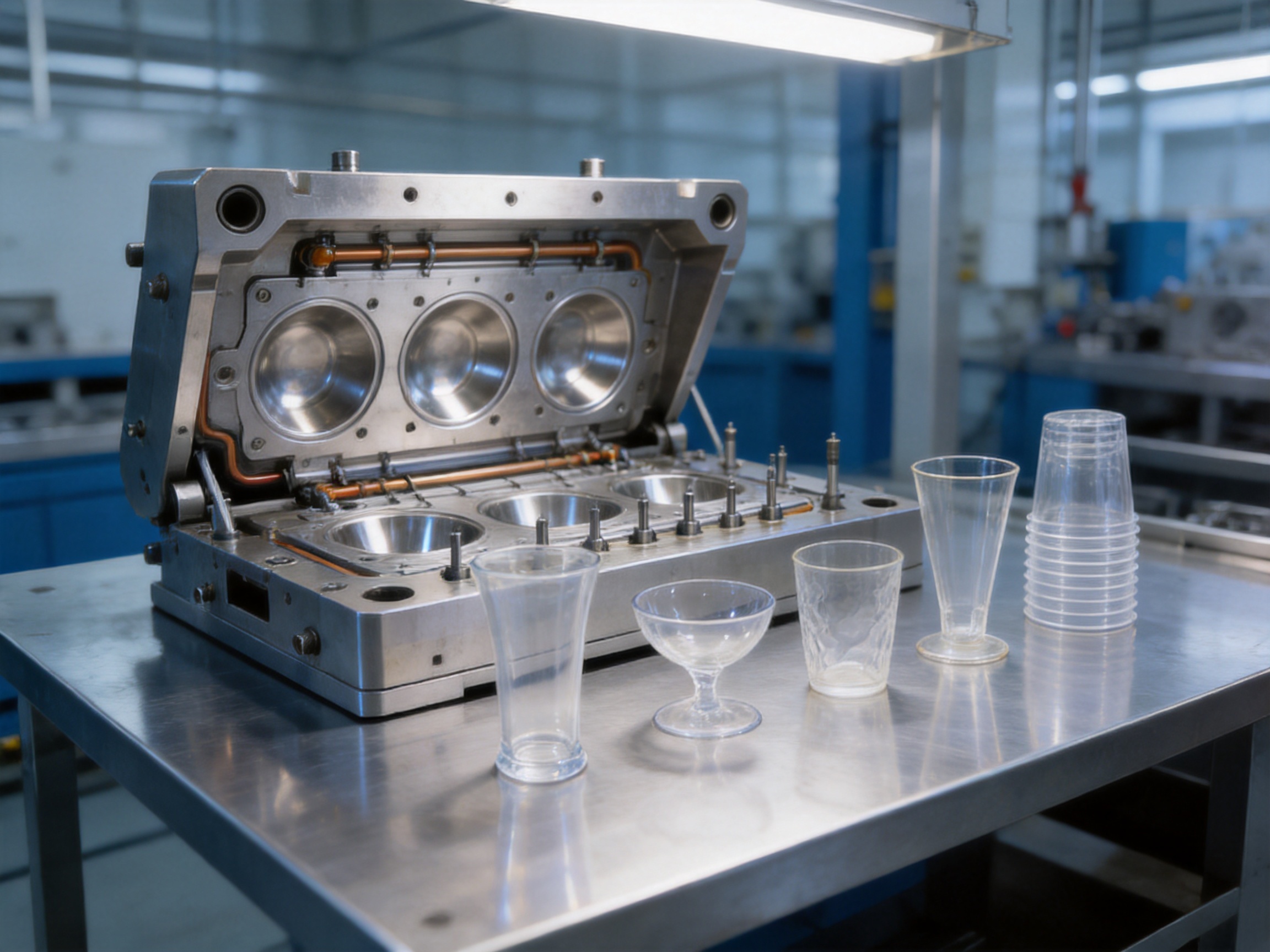
When individual components are completed, the mould is assembled and checked. Engineers inspect the alignment of the core and cavity, the operation of the ejection system, the fit of inserts, the connection of hot runner components, and the accessibility of cooling channels. The mould should open and close smoothly, and the parting surfaces should contact correctly.
Inspection may include dimensional measurement, steel hardness verification where applicable, cooling circuit checks, electrical checks for hot runner components, and review of the mould’s surface condition. These steps help identify issues before the mould is installed on an injection machine.
Trial Injection and Optimization
Trial injection is used to verify filling, appearance, dimensions, ejection, cooling, and cavity balance. For a clear cup, engineers inspect transparency, gloss, flow patterns, weld lines, air marks, gate appearance, rim quality, and deformation. Samples from each cavity are compared to determine whether any cavity behaves differently.
If improvements are needed, the mould or process can be adjusted. Possible actions include modifying injection speed, changing holding pressure, adjusting mould temperature, improving venting, optimizing cooling, refining the gate, or correcting a dimensional feature. The objective is to establish a stable process rather than simply produce one acceptable sample.
Manufacturing Strengths and Quality Management
Taizhou Huangyan Haiquan Plastic Mold Co., Ltd. is a high-tech enterprise specializing in research, development, and manufacturing of precision injection moulds. Its experience covers daily necessities, home appliances, automotive parts, and industrial equipment. This broad sector knowledge is valuable because it exposes the engineering team to different materials, product geometries, quality standards, and production challenges.
The company emphasizes a professional design team and a scientific production management system. For a plastic cup project, this means the product design, mould structure, machining plan, assembly process, trial injection, and delivery schedule can be coordinated through a unified workflow. Customers benefit from having technical communication and project follow-up organized around the complete tooling process.
A structured production system can also improve traceability. Drawings, revision records, material information, inspection results, trial samples, and modification notes can be managed as part of the project history. This is useful when a customer needs a repeat mould, a product revision, an additional cavity set, or future tooling for related cup sizes.
Quality begins with the correct interpretation of customer requirements. Before production, important questions should be clarified, including the chosen plastic material, cup capacity, annual quantity, machine model, cavity number, logo method, surface appearance, expected mould life, and destination market. Clear requirements reduce ambiguity and allow the mould to be designed for actual use conditions.
Quality continues through manufacturing. Steel selection, machining accuracy, polishing, component matching, cooling inspection, hot runner testing, and trial injection all influence the final result. A mould that looks acceptable during assembly may still require optimization during production trials. Careful validation is therefore essential for achieving stable performance.
The company serves customers in Europe, the Middle East, Southeast Asia, South America, and other international markets. Experience with overseas customers can support communication across different specifications, packaging requirements, shipping arrangements, and project schedules. Reliable delivery is particularly important for mould projects because delays in tooling can postpone product launches and production contracts.
Comparison with Basic or Lower-Performance Cup Moulds
Not all plastic cup moulds provide the same level of performance. A basic mould may be capable of producing a cup, but it may not offer the surface quality, cavity consistency, process stability, or service life required for demanding commercial applications. The advantages of the described mould become clearer when compared with common limitations in less-developed tooling.
| Production Consideration | Basic Tooling Limitation | Custom PC Plastic Cup Mould Advantage |
| Transparent surface | Visible polishing marks or uneven gloss | High-polish steel and mirror finishing support a clearer appearance |
| Material delivery | Unbalanced cold runner or excessive waste | Hot runner design supports efficient and balanced filling |
| Thin-wall production | Short shots, weld lines, or inconsistent walls | Gate, venting, and cooling are considered for thin-wall performance |
| Multi-cavity output | Cavity-to-cavity variation | Balanced filling and cooling support more consistent products |
| Stackability | Variable dimensions and nesting problems | Uniform cooling and accurate machining improve dimensional control |
| Customization | Limited capacity or branding options | Capacity, logos, cavities, and geometry can be tailored |
| Long-term production | Premature wear or frequent maintenance | Suitable steel choices and robust construction support extended service |
These advantages do not mean that tooling alone can eliminate every production issue. Resin preparation, machine capability, operator skill, mould maintenance, and process control remain important. However, a professionally engineered mould provides a stronger foundation for achieving high-quality results and reducing avoidable production variation.
Production Efficiency and Total Cost of Ownership
The purchase price of a mould is only one part of its economic value. A lower-cost mould may require more manual correction, produce more rejected cups, consume more material, or need earlier refurbishment. A mould with better filling balance, cooling performance, surface finish, and service life can provide lower total cost over the full production period.
The hot runner system may reduce runner waste, which is especially relevant when using engineering plastics or when the product is produced in large volumes. Reduced waste can also simplify recycling and material handling. The actual savings depend on the product weight, runner volume, resin price, cycle time, and operating conditions.
Thin-wall capability can further improve production economics by reducing product weight. However, the design should not be made thinner than the material and application can support. The best result is an optimized wall that provides adequate strength while avoiding unnecessary material use.
Higher cavity counts can increase output per cycle and reduce the number of machine cycles required for a given order. This may improve labor utilization and machine productivity. At the same time, the mould investment and machine requirements increase with cavity quantity. A detailed production calculation should be completed before choosing between two, four, six, or eight cavities.
Long mould life is also important. The stated service life can reach up to 1,000,000 shots when the mould is correctly operated, lubricated, cleaned, stored, and maintained. Actual life depends on the resin, additives, processing conditions, production volume, maintenance schedule, and replacement of wear components. Preventive maintenance is more economical than waiting for a failure that interrupts production.
Recommended Injection Moulding Practices
Before production, PC or Tritan resin should be stored and dried according to the supplier’s technical instructions. Moisture control is particularly important for transparent products. Material contamination, inconsistent drying, or mixing incompatible grades can lead to bubbles, streaks, discoloration, or reduced mechanical performance.
The injection machine should be selected according to the total shot weight, projected area, required clamping force, mould dimensions, hot runner requirements, and product cycle. A machine that is too small may struggle with filling or clamping, while an unnecessarily large machine may reduce energy efficiency and process sensitivity.
Process parameters should be established systematically. Injection speed, melt temperature, mould temperature, holding pressure, holding time, cooling time, and screw recovery should be adjusted according to the selected resin and product design. Operators should avoid changing multiple variables at once because it becomes difficult to identify the cause of an improvement or defect.
Transparent cups should be inspected under suitable lighting. Important checks include appearance, weight, wall thickness, height, mouth diameter, base diameter, ovality, rim quality, logo detail, and nesting performance. For multi-cavity moulds, samples from every cavity should be identified and compared.
After production, the mould should be cleaned and dried. Resin residue should be removed from the cavity, core, gate, and parting surfaces without scratching the polished areas. Cooling circuits and hot runner components should be checked according to the maintenance schedule. Before long-term storage, the mould should be protected against corrosion and stored in a dry, controlled environment.
Project Development Process for Customers
Step One: Requirement Confirmation
The customer provides the product drawings or samples together with the expected material, capacity, annual volume, machine information, cavity preference, logo requirements, and quality standards. If the customer does not yet have a complete product drawing, the design can be reviewed from a concept or reference sample.
Step Two: Engineering Proposal
The mould team evaluates the cup structure and proposes the parting line, gate location, ejection method, cooling layout, steel grade, cavity arrangement, and estimated production approach. Any design risks should be discussed before the mould enters detailed manufacturing.
Step Three: Design Approval
Detailed mould drawings and product data are reviewed and approved. This stage is important for confirming dimensions, logo orientation, cavity quantity, surface finish, and compatibility with the customer’s injection machine.
Step Four: Mould Manufacturing
After approval, steel preparation, rough machining, precision machining, heat treatment where required, polishing, component assembly, and inspection are carried out according to the production plan. Changes should be documented so that the project remains traceable.
Step Five: Trial and Sample Approval
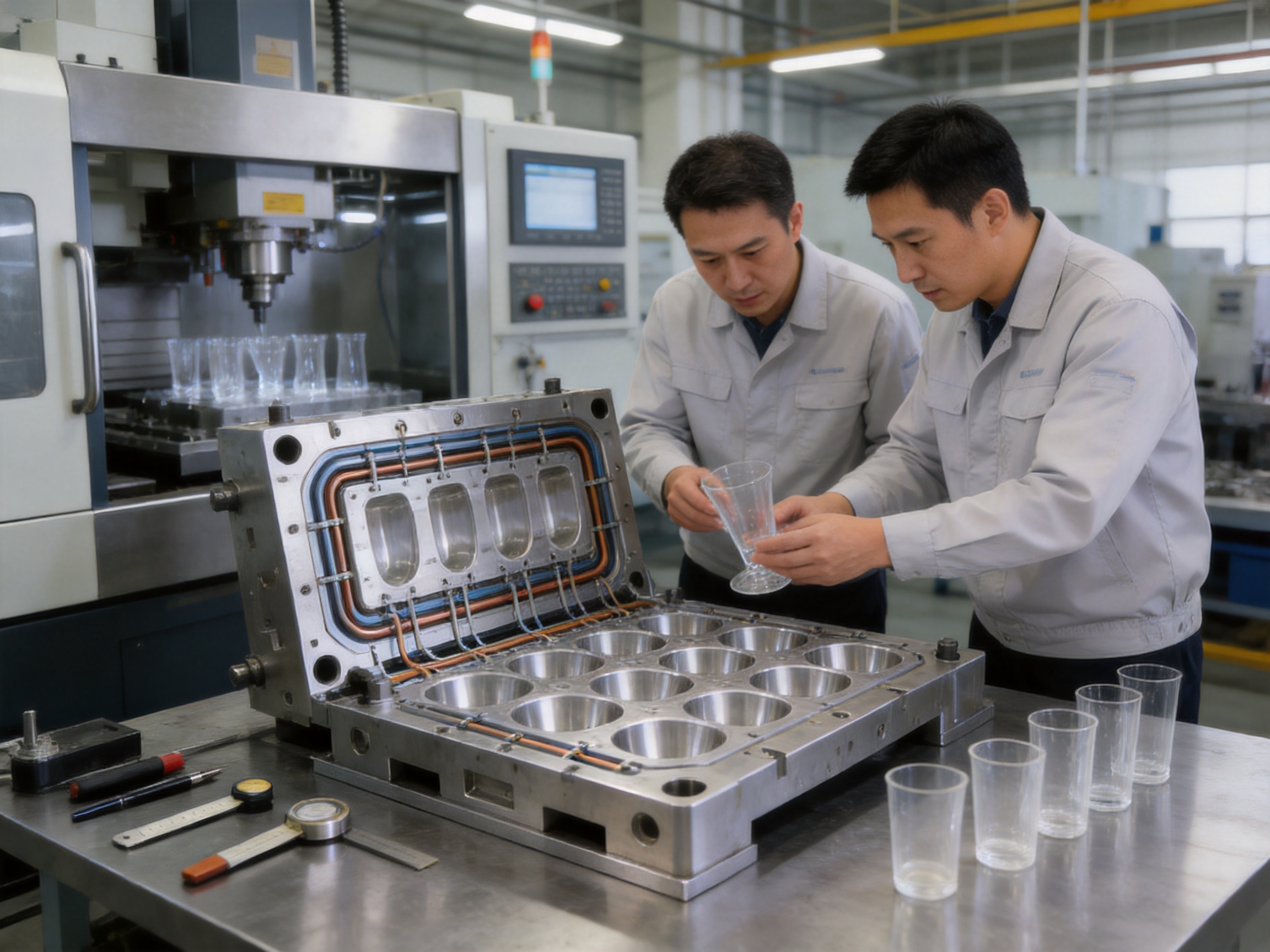
The mould is tested through injection trials. Samples are evaluated for appearance, dimensions, weight, ejection, cavity balance, and stackability. If necessary, engineering adjustments are completed before final acceptance.
Step Six: Delivery and After-Sales Support
Once the mould meets the agreed requirements, it is prepared for delivery. Technical documentation, spare parts information, maintenance recommendations, and trial sample records can help the customer begin production more smoothly. Continued communication is useful when the customer later changes the resin, adds a cup size, or requires a related product mould.
Frequently Asked Questions
What materials can be used with this plastic cup mould?
The mould is designed to support polycarbonate and Tritan applications. The final processing conditions should be established according to the specific resin grade, product design, and injection machine. Other materials may require an engineering review before being considered.
Can the mould produce cups in different capacities?
Yes. The cup capacity and dimensions can be customized according to customer requirements. Height, diameter, taper, wall thickness, rim structure, bottom design, and other features should be confirmed during the design stage.
How many cavities are available?
The standard customization range is two to eight cavities. The most suitable number depends on required output, machine capacity, product cycle, investment budget, and the customer’s long-term production plan.
Why is a hot runner useful for plastic cup production?
A hot runner can reduce solidified runner waste and support more direct delivery of molten resin to the cavities. It can also help create a balanced filling system for multi-cavity tooling. The final performance depends on proper hot runner selection, temperature control, and process setup.
Is the mould suitable for transparent products?
Yes. The use of high-polish steel, mirror finishing, special gating, and controlled cooling is intended to support transparent and glossy cups. Resin drying, mould cleanliness, machine settings, and production environment also have a major influence on transparency.
Can a logo be added to the cup?
Yes. Surface logos can be incorporated into the mould according to the customer’s artwork and placement requirements. The logo structure should be reviewed for readability, demoulding, polishing, and visual consistency.
Can the mould produce thin-wall cups?
The mould supports thin-wall injection applications. The achievable wall thickness depends on the cup dimensions, material, flow length, gate design, injection machine, and process parameters. Thin-wall designs should be validated through engineering analysis and trial injection.
What does a mould life of up to 1,000,000 shots mean?
It indicates the potential production life of the mould under suitable operating and maintenance conditions. Actual service life can vary according to resin abrasiveness, additives, cycle conditions, cleaning, lubrication, wear-part replacement, and preventive maintenance.
How can cavity-to-cavity consistency be maintained?
Consistency depends on accurate cavity machining, balanced hot runner filling, uniform cooling, controlled ejection, stable machine settings, and regular inspection. Samples from every cavity should be measured and compared during trial and mass production.
What information should be supplied for a quotation?
Useful information includes a product drawing or sample, material, cup capacity, dimensions, expected annual quantity, cavity preference, injection machine details, logo requirements, surface finish, destination market, and any required certifications or inspection standards.
Can the supplier develop related drinkware moulds?
The company specializes in precision injection moulds for daily necessities and other industrial sectors. Related products such as different cup sizes, lids, containers, or complementary drinkware components can be reviewed as separate tooling projects.
Why Choose an Experienced Mould Manufacturing Partner
Choosing a mould supplier is a long-term manufacturing decision. The tool determines how efficiently the product can be made, how much material is consumed, how consistently the product meets specifications, and how easily future changes can be implemented. A supplier with experience in precision injection moulds can identify production risks before they become expensive problems.
Haiquan combines design capability with mould manufacturing and production support. Its product range covers daily necessities moulds, cleaning product moulds, crate moulds, chair and stool moulds, air cooler moulds, rainwater harvest tank moulds, pet dryer moulds, and tooling for other sectors. This range demonstrates familiarity with both household products and larger industrial components.
The company’s focus on quality-first development supports a methodical approach to engineering and production. Rather than treating the mould as an isolated component, the project can be considered in relation to the customer’s product design, machine, material, output target, inspection requirements, and after-sales needs.
International customers also benefit from direct project communication. Clear technical information, organized approvals, documented trial results, and timely feedback are essential when the customer and mould factory are located in different countries. Reliable communication can reduce misunderstandings and help ensure that the finished tool matches the intended product.
Conclusion
The Custom PC Plastic Cup Injection Mould in Various Sizes is designed for manufacturers seeking reliable, high-quality tooling for transparent and reusable drinkware. Its high-polish steel construction, mirror-finished surfaces, hot runner system, balanced cooling, flexible cavity options, and support for thin-wall injection provide a strong foundation for commercial production.
The mould can be customized for different cup capacities, dimensions, logos, surface requirements, and output levels. It is suitable for reusable drink cups, restaurant beverage cups, juice and smoothie containers, outdoor drinkware, and travel products. By combining precise tooling with suitable PC or Tritan materials and a carefully controlled injection process, manufacturers can achieve attractive appearance, dimensional stability, stackability, and repeatable production performance.
Taizhou Huangyan Haiquan Plastic Mold Co., Ltd. adds value through its professional design team, structured production management, precision mould manufacturing capability, broad industry experience, export service, and after-sales support. From initial product review to final trial and delivery, the company provides an integrated approach intended to reduce project risk and support long-term manufacturing success.
For customers developing a new transparent cup or upgrading an existing production tool, the most effective next step is to share the product drawing, material, required capacity, annual volume, machine information, cavity target, branding requirements, and quality expectations. These details allow the mould design to be developed around the actual application and provide a foundation for an efficient, durable, and competitive plastic cup production solution.
References
1. Injection Molding Handbook, technical principles of polymer flow, mould cooling, cavity balance, and process control.
2. Plastics Engineering Materials Reference, general properties and processing considerations for polycarbonate and transparent copolyester materials.
3. Design for Injection Molding Guidelines, recommendations for draft angles, wall thickness, parting lines, gates, vents, ejection, and shrinkage compensation.
4. Mould Steel Selection and Surface Finishing Practices, general guidance on S136, NAK80, polishing, corrosion resistance, and production tooling maintenance.
5. Industrial Plastic Product Quality Control Principles, methods for dimensional inspection, appearance evaluation, cavity comparison, and production validation.
6. Preventive Maintenance Practices for Injection Moulds, recommendations for cleaning, lubrication, cooling circuit inspection, storage, and wear-part management.
Product: Custom PC Plastic Cup Injection Mould in Various Sizes

For exclusive deals and latest offers, sign up by entering your email address below.












 +86-18657672567
 sales@tzhqmould.com
celin@tzhqmould.com
 No. 17 Houshi Road, Beicheng Industrial Zone, Huangyan District, Taizhou City, Zhejiang Province, China
Copyright © Taizhou Huangyan Haiquan Plastic Mold Co., Ltd. All Rights Reserved
Injection Plastic Mould Maker

