

Plastic Logistics Turnover Crate Injection Mould for Reliable Supply Chain Packaging
Admin 2026-11-09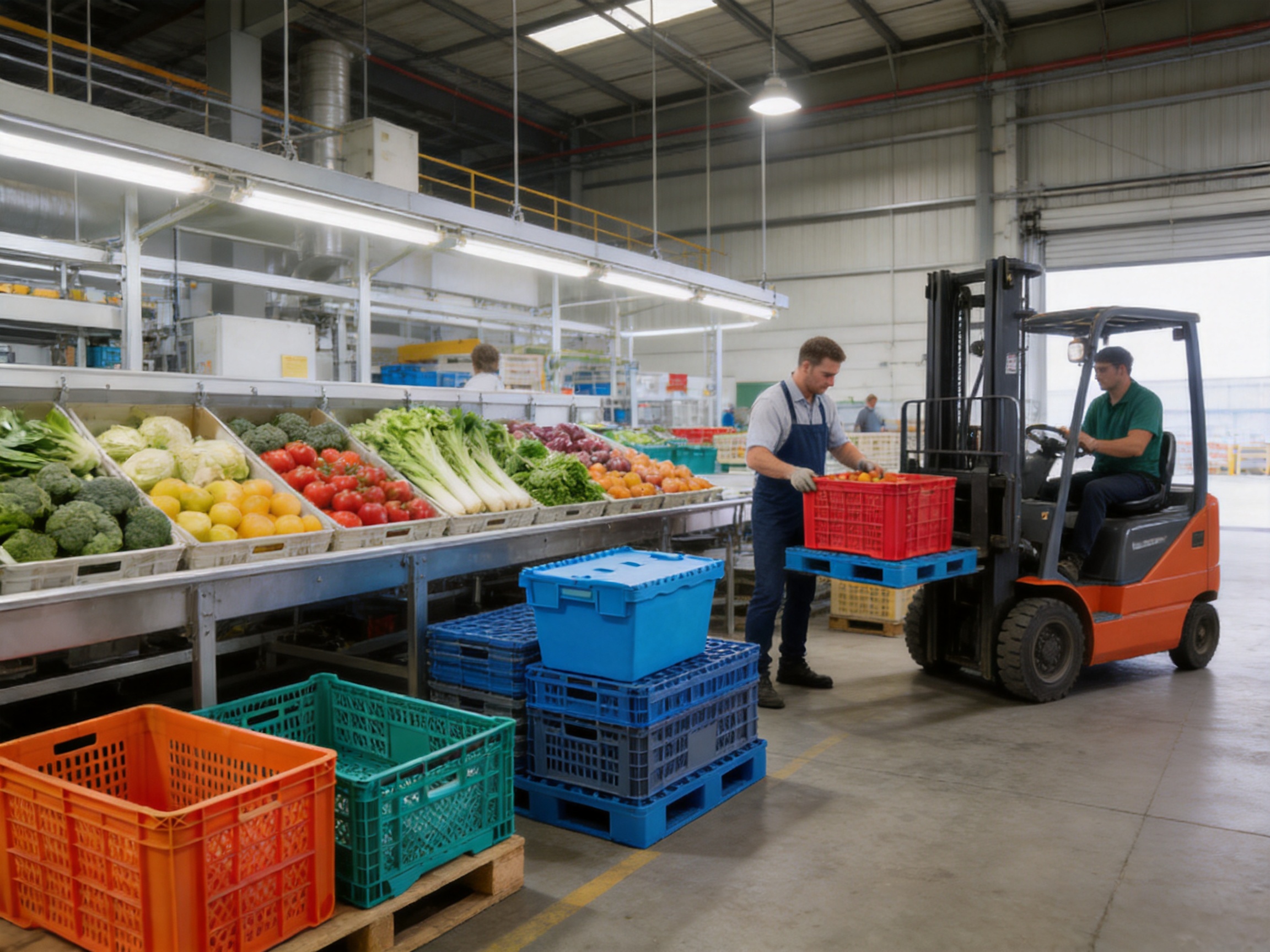
Plastic logistics turnover crates are essential tools in modern warehousing, transportation, agriculture, food distribution, and manufacturing. Unlike disposable packaging, a reusable crate can circulate through many handling cycles, helping companies reduce packaging waste, improve product protection, and standardize material movement. The quality of the injection mould used to manufacture each crate has a direct influence on its strength, dimensional stability, appearance, stacking performance, and service life.
The Plastic Logistics Turnover Crate Injection Mould is designed for producing durable plastic crates used in warehouses, distribution centers, factories, farms, food-processing facilities, and supply chains. It supports the manufacture of crates with reinforced ribs, ventilation openings, stable walls, and practical handling features. The mould is suitable for HDPE and PP materials and can be configured for different crate dimensions, structural layouts, branding requirements, and application conditions.
Taizhou Huangyan Haiquan Plastic Mold Co., Ltd. develops and manufactures injection moulds for daily necessities, home appliances, automotive components, and industrial equipment. With a professional design team, scientific production management system, and export experience across Europe, the Middle East, Southeast Asia, and South America, the company provides integrated services covering product design, mould development, machining, assembly, testing, production support, and after-sales service.
For buyers seeking a plastic crate mould manufacturer, the value of a project is not determined only by the initial quotation. Mould structure, steel selection, cooling efficiency, ejection reliability, machining precision, maintenance convenience, and long-term production stability all affect the total cost of ownership. A carefully engineered turnover crate mould can help reduce production interruptions, control rejection rates, and maintain consistent crate quality over hundreds of thousands of cycles.
1. The Role of a Turnover Crate in Modern Logistics
A turnover crate is a reusable container designed to move repeatedly between suppliers, warehouses, retailers, processors, and end users. The same crate may be loaded, stacked, transported, emptied, cleaned, and returned to circulation many times. This repeated use places greater demands on the product than those placed on ordinary one-way packaging.
In warehouse operations, crates must maintain their shape when filled with products and stacked with other units. During transportation, they may be exposed to vibration, impacts, temperature variations, moisture, and rough handling. In agricultural applications, crates often carry fruits, vegetables, fish, bread, or other products that require ventilation and quick handling. In industrial environments, crates may be used for components, tools, semi-finished goods, or returnable packaging systems.
The performance of each crate begins with the mould. If the mould does not control wall thickness properly, the finished product may warp, crack, or become difficult to stack. If the ribs are not balanced, the crate may have weak corners or uneven load distribution. If the ventilation openings are poorly designed, they may create stress concentration or reduce the structural strength of the sidewalls. If the ejection system is not well coordinated, production may cause deformation, scratches, or sticking.
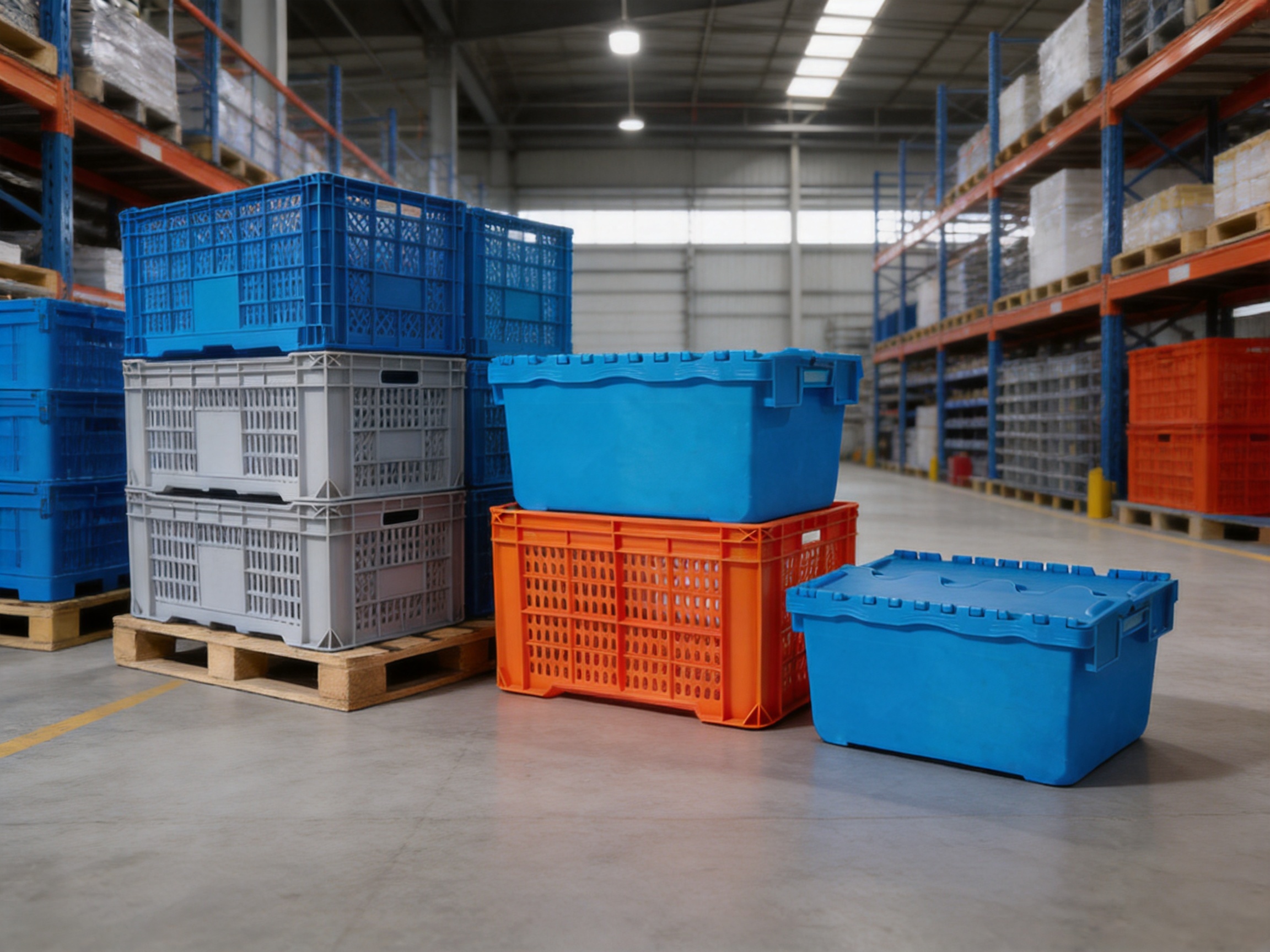
For these reasons, a logistics crate injection mould must combine structural engineering with practical manufacturing experience. It must create a product that is light enough for efficient handling while strong enough for repeated use. It must also support stable cycle times and consistent production on the customer’s injection moulding machine.
2. Product Design Features of the Plastic Logistics Turnover Crate Mould
2.1 Reinforced Rib Structures
Reinforced ribs are one of the most important features in a reusable plastic crate. Ribs increase stiffness without requiring the entire product to have excessively thick walls. This allows the crate to achieve a practical balance between strength, weight, material consumption, and cooling time.
The rib layout can be designed around the expected loading conditions. Vertical ribs may support stacking pressure and prevent sidewall buckling. Horizontal ribs can improve resistance to impact and help maintain the shape of the upper and lower sections. Additional reinforcement can be applied around handles, corners, base supports, and stacking interfaces, where stress is often concentrated.
A well-designed rib structure can improve load capacity and stacking stability while reducing the risk of sink marks, warpage, and uneven shrinkage. The engineering objective is not simply to add more ribs. Excessive or poorly positioned reinforcement can make mould filling difficult, increase material usage, and create visible defects. Instead, the ribs should be positioned according to product function, material flow, cooling conditions, and demoulding requirements.
2.2 Ventilation Openings
Ventilation holes help reduce product weight and allow air to circulate through the crate. This is particularly useful for bread, fruit, vegetables, seafood, and other products that may require airflow during storage or transport.
The shape, size, spacing, and arrangement of ventilation openings must be considered carefully. Openings that are too large may weaken the crate, while openings that are too small may not provide sufficient airflow. Sharp transitions around the openings can also create stress concentration. Mould engineering can incorporate suitable radii, balanced wall sections, and reinforcement around the hole boundaries to support both ventilation and strength.
Ventilation patterns may be customized according to the application. A crate for agricultural produce may require more open sidewalls, while a crate for industrial components may need greater protection and fewer openings. The mould can be developed around the customer’s product dimensions, loading method, cleaning requirements, and stacking system.
2.3 Stable Stacking Geometry
Efficient logistics depends on the ability to stack crates securely. Stable stacking reduces the risk of collapse, improves warehouse space utilization, and makes transportation safer. The mould therefore needs to reproduce accurate stacking edges, support feet, locating features, and interlocking surfaces.
Small dimensional variations in stacking features can become significant when many crates are placed together. A mould with insufficient precision may produce crates that lean, shift, or fail to nest correctly. Through careful design and machining, the mould can help maintain uniform stacking interfaces across production batches.
When required, the product design can include nesting or stacking functions. Nestable crates reduce empty return volume, while stackable crates provide strong support when filled. The preferred design depends on the intended logistics process, and the mould structure must be matched to the final crate geometry.
2.4 Handling and Ergonomic Considerations
Turnover crates are frequently lifted by hand or moved with material-handling equipment. Handles must therefore be strong, comfortable, and free from sharp edges. Handle openings, gripping areas, and surrounding reinforcements can be incorporated into the product design and accurately formed by the injection mould.
An effective crate mould supports consistent handle thickness and smooth transitions between the handle and sidewall. This helps reduce the risk of cracking when the crate is lifted while fully loaded. It also improves operator comfort during repeated handling operations.
2.5 Custom Dimensions and Reinforcement Structures
Different industries require different crate sizes and configurations. A food distributor may need a shallow ventilated crate, while a manufacturing plant may require a deep container for heavier parts. Agricultural users may need a broad base and open sidewalls, whereas warehouse users may prioritize compatibility with pallets, shelving, and conveyor systems.
The Plastic Logistics Turnover Crate Injection Mould can be customized according to the required length, width, height, wall design, rib arrangement, ventilation pattern, stacking system, handle shape, surface texture, and identification features. Customer logos, product codes, recycling marks, and other moulded-in details can also be considered during the design stage.

Plastic Logistics Turnover Crate Injection Mould
3. Materials Used for Crate Production
The mould is designed for processing HDPE and PP, two widely used thermoplastics for reusable logistics containers. The final material selection depends on the required impact resistance, stiffness, chemical exposure, operating temperature, product weight, and cost target.
3.1 High-Density Polyethylene
HDPE is commonly selected for crates that require toughness, impact resistance, and reliable performance in demanding handling environments. It offers a useful combination of durability, low moisture absorption, and resistance to many chemicals. HDPE crates are suitable for warehouse use, agricultural transport, fish handling, and other applications where impact and repeated use are important.
During mould development, the shrinkage behavior and flow characteristics of the selected HDPE grade should be considered. These factors affect part dimensions, corner accuracy, rib filling, and warpage control. Gate locations, cooling channels, and ejection design should be coordinated with the material specification.
3.2 Polypropylene
PP is valued for its relatively low density, good stiffness, chemical resistance, and broad processing window. It can be used for lightweight turnover crates and containers where efficient material usage and easy handling are important.
Different PP grades can have different shrinkage rates and impact properties. The mould design should therefore be based on the actual grade or an agreed material range. Correct process conditions and suitable mould temperature control help maintain the intended product dimensions and appearance.
3.3 Material and Product Design Coordination
The best mould results come from coordinating material selection and product geometry at the beginning of the project. A thin-wall crate may require a material with suitable flow performance, while a heavy-duty crate may need a grade with higher impact strength. The rib dimensions, corner radii, gate arrangement, and cooling layout should be evaluated in relation to the material.
Haiquan Mould can support discussions regarding material selection, product structure, and mould feasibility. Early technical communication helps identify possible issues before steel cutting and can reduce later changes to the mould.
4. Technical Specifications
The following specifications describe the standard configuration of the Plastic Logistics Turnover Crate Injection Mould. Final specifications may be adjusted according to the customer’s product design, injection machine, resin, production target, and expected service conditions.
| Application | Reusable logistics, warehouse, agricultural, and transport crates |
| Product Material | HDPE / PP |
| Mould Steel | 718 / H13 |
| Cavity Configuration | 1 cavity |
| Expected Mould Life | Approximately 800,000 shots |
| Structural Features | Reinforced ribs, ventilation openings, stable stacking interfaces |
| Customization | Crate dimensions, reinforcement structure, openings, handles, and identification details |
| Typical Applications | Warehouse storage, logistics transport, agricultural produce handling |
A one-cavity configuration is often selected for large crate moulds because the product size requires substantial injection volume and moulding-machine capacity. It can also simplify balancing, reduce mould complexity, and provide a practical solution for projects with moderate or growing production requirements. The final cavity arrangement should be determined after reviewing annual volume, machine specifications, product size, cycle time, and investment expectations.
5. Mould Steel Selection and Service Life
Steel selection influences mould strength, wear resistance, corrosion behavior, polishing performance, dimensional stability, and maintenance requirements. For this crate mould, 718 and H13 are specified as suitable steel options depending on the customer’s production requirements and project configuration.
5.1 718 Mould Steel
718 steel is commonly used for injection mould components that require good machinability, reliable toughness, and a suitable surface finish. It can be used for mould bases, inserts, and other structural areas after appropriate heat treatment and preparation. Its performance makes it suitable for many general-purpose plastic products, including logistics crates.
The final steel condition, hardness, treatment process, and use location should be selected according to the mould structure. Areas exposed to greater wear or demanding production conditions may require enhanced treatment or alternative steel solutions.
5.2 H13 Tool Steel
H13 is a hot-work tool steel known for its toughness, thermal fatigue resistance, and stability under repeated processing conditions. It can be considered for inserts or components exposed to higher mechanical or thermal stress. In appropriate applications, H13 may help extend service performance and maintain critical dimensions over a long production period.
Using a suitable steel does not eliminate the need for correct mould design and maintenance. Cooling, ejection, venting, processing parameters, and cleaning practices all influence mould life. A high-quality steel mould that is poorly maintained may not achieve its expected service performance.
5.3 Long-Term Production Value
The stated mould life of approximately 800,000 shots provides a basis for long-term production planning. Actual service life depends on resin grade, additives, cycle conditions, machine operation, cleaning procedures, maintenance frequency, and product design. Abrasive materials, excessive injection pressure, poor cooling-water quality, and inadequate lubrication can accelerate wear.
When the mould is designed, manufactured, tested, and maintained as an integrated system, it can provide stable production over an extended period. This is especially important for reusable crate programs, where product demand may continue for many years.
6. Advanced Product and Mould Engineering
6.1 Three-Dimensional Product Analysis
Before manufacturing begins, the product geometry should be reviewed in three dimensions. Engineers examine wall thickness, rib intersections, corner transitions, draft angles, ventilation openings, handle structures, and possible undercuts. This analysis helps determine whether the product can fill correctly, cool evenly, and release from the mould without deformation.
Large crates can present challenges related to flow length and shrinkage. A suitable gate strategy should distribute molten material efficiently and reduce the risk of short shots, weld-line weakness, air entrapment, and excessive pressure. Mould-flow analysis may be used when the product structure or resin specification requires additional validation.
6.2 Draft and Demoulding Design
Draft angles are essential for reliable release from the mould. Crate sidewalls, ribs, handles, and internal features must be designed so that the product can move away from the core and cavity without excessive friction. Insufficient draft may cause sticking, drag marks, deformation, or accelerated wear.
Where the product geometry requires deeper ribs or complex features, the mould may use suitable inserts, lifters, slides, or other mechanisms. These components must be positioned to support safe demoulding while maintaining the intended crate appearance.
6.3 Gate and Runner Design
The gate and runner system controls how molten plastic enters and fills the cavity. For a large crate, the design must consider material flow distance, filling balance, weld-line locations, injection pressure, and gate vestige requirements.
A well-planned system can help fill the product more evenly and reduce localized stress. Gate locations should avoid critical visual surfaces when possible and should be positioned to support the strength of handles, corners, and rib structures. The final choice may include cold runner or hot runner technology depending on project volume, product design, resin, and customer preference.
6.4 Venting Design
Air trapped inside a large mould cavity can cause burn marks, incomplete filling, surface defects, or variations in product quality. Venting channels and parting-line vents allow displaced air to escape during injection. Venting is especially important around the end of flow, deep ribs, corners, and complex openings.
Vents must be designed carefully. They should release air without allowing excessive plastic flash. During testing, engineers can inspect areas where burning, hesitation, or short filling appears and adjust the venting or process parameters as needed.
6.5 Cooling System Design
Cooling has a major effect on cycle time, dimensional stability, and warpage. Large crate surfaces and reinforced ribs can cool at different rates. If one area remains hot while another solidifies quickly, internal stress and deformation may occur.
Cooling channels should be arranged to provide practical coverage around the product. The design should consider the thickness of sidewalls, corners, base features, and core components. Water flow, channel diameter, connection location, and accessibility for cleaning are also important. Efficient cooling can shorten the moulding cycle and improve production economy while helping the crate maintain stable dimensions.
7. Manufacturing Process for the Injection Mould
7.1 Design Review and Technical Confirmation
The manufacturing process begins with technical communication. The customer provides the product drawing, three-dimensional model, sample, or performance requirements. Engineers then review the crate dimensions, material, expected output, injection machine, moulding conditions, surface requirements, and special functions.
At this stage, potential issues are identified before production. These may include insufficient draft, thin sections, unbalanced ribs, difficult undercuts, unsuitable gate locations, inadequate cooling space, or interference with the customer’s machine. A design review can reduce modification work and help establish a clear production plan.
7.2 Mould Structure Design
After product confirmation, the mould structure is developed. The design includes the mould base, cavity, core, inserts, parting line, runner system, gates, cooling channels, ejection system, guide components, locating features, and any required slides or lifters.
The mould structure must be strong enough for repeated clamping and injection pressure. It should also allow convenient maintenance. Wear components, replaceable inserts, water connections, and ejection parts should be accessible when possible. Practical maintenance design can reduce downtime when service is required.
7.3 Steel Preparation and Rough Machining
After the design is approved, suitable steel is prepared and inspected. Material certificates and initial dimensions can be recorded for project documentation. Rough machining removes excess material and establishes the basic geometry of the mould components.
Machining allowances are maintained for subsequent semi-finishing and finishing operations. Correct sequencing is important because the mould must retain enough material for precision machining after heat treatment or stress relief.
7.4 CNC Machining and Precision Manufacturing
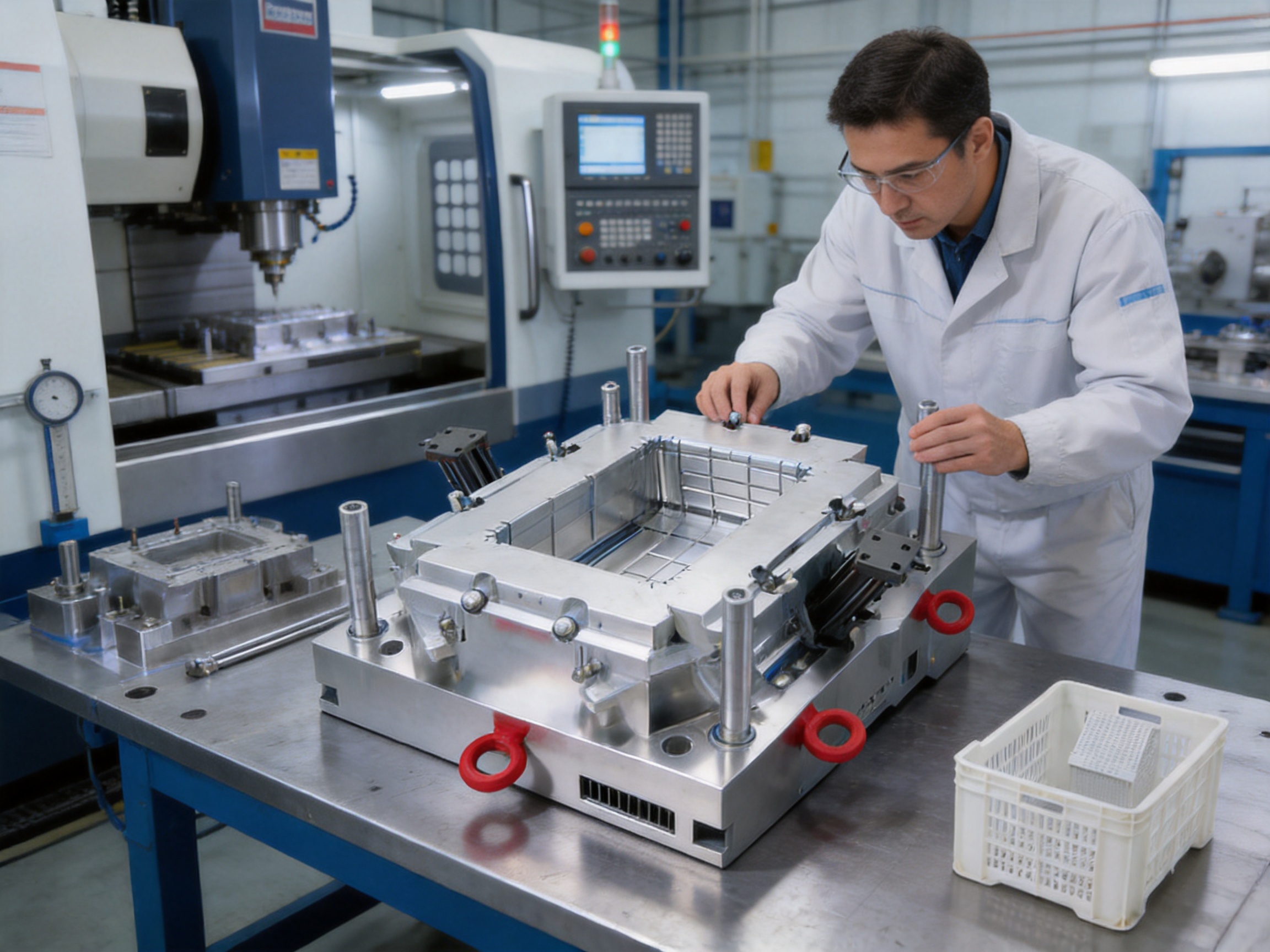
CNC machining is used to produce the cavity, core, inserts, ribs, openings, and other detailed features. Large crate moulds require attention to dimensional consistency across broad surfaces. Tool selection, cutting strategy, fixturing, and machining sequence all affect the final result.
Fine features such as ventilation openings and rib intersections may require additional machining processes. EDM can be used where complex details or narrow slots cannot be produced efficiently by conventional cutting. Grinding, polishing, and fitting operations then refine the mould surfaces and interfaces.
7.5 Heat Treatment and Surface Preparation
Where required, mould components undergo heat treatment to achieve the specified hardness and stability. Heat treatment must be controlled to limit distortion. After treatment, components may require grinding, correction, or additional precision machining.
The final surface condition depends on product requirements. Some crate applications use a practical textured finish, while others require smoother surfaces for cleaning, appearance, or product release. Surface treatment and polishing should be matched to the intended crate design rather than applied as a general-purpose solution.
7.6 Assembly and Fitting
During assembly, mould components are carefully fitted and checked. The core and cavity must align correctly, the parting surface must close uniformly, and the ejection system must move smoothly. Guide pillars, bushes, inserts, slides, cooling connectors, and fasteners are inspected as part of the assembly process.
Correct fitting is particularly important for large moulds. Even small alignment errors can create flash, uneven wall sections, premature wear, or difficulty during machine installation. Assembly technicians use measurement tools and practical experience to verify the interaction of the mould components.
7.7 Mould Testing and Sample Evaluation
Before shipment, the mould is tested through trial production. The test checks mould opening and closing, injection filling, cooling, ejection, product dimensions, appearance, and cycle performance. Samples are evaluated for warpage, short shots, flash, sink marks, weld lines, burn marks, and other potential defects.
If adjustments are needed, the mould may be modified and tested again. This process helps confirm that the crate can be produced with stable quality and that the mould is compatible with the customer’s intended production conditions. Trial samples also allow the customer to verify fit, stacking, handling, and application performance.
8. Quality Control and Production Management
Consistent quality requires control throughout the mould manufacturing process, not only at the final inspection stage. Haiquan Mould uses a professional design team and a scientific production management system to coordinate project information, machining, assembly, testing, and delivery.
8.1 Design Quality Control
Design reviews help ensure that product requirements are translated into practical mould features. Key points include draft, wall thickness, shrinkage allowance, mould opening direction, ejection, cooling, parting-line position, and maintenance access.
8.2 Machining Inspection
Machined components can be checked for dimensions, flatness, hole positions, insert locations, and surface conditions. Inspection helps identify deviations before components are assembled. Critical dimensions should be measured according to the product drawing and mould design requirements.
8.3 Assembly Inspection
Assembly inspection confirms that the mould closes properly, the ejector system operates smoothly, and all moving parts have the necessary clearance. Cooling channels and connectors should also be checked for leakage or obstruction before trial production.
8.4 Sample Inspection
Samples from the trial run can be inspected for product dimensions, weight, appearance, stacking fit, handle strength, and general functionality. If the crate is intended for a specific logistics system, it may also be checked against pallets, shelves, conveyors, or other handling equipment.
This systematic approach reduces the possibility of shipping a mould that requires extensive adjustment at the customer’s facility. It also provides a clearer record of the mould’s operating condition at the time of delivery.
9. Advantages Compared with Lower-Quality Crate Moulds
9.1 Better Structural Consistency
A professionally designed mould provides more consistent rib dimensions, wall thickness, openings, and stacking interfaces. In contrast, poorly engineered moulds may produce uneven filling, inconsistent shrinkage, weak corners, and unstable stacking. Structural consistency is especially valuable when crates are used in automated or high-volume logistics systems.
9.2 Improved Production Stability
Stable mould filling, effective cooling, and reliable ejection help maintain repeatable cycle conditions. This can reduce unexpected stops and lower the amount of rejected product. Production stability is a significant advantage over moulds that require frequent manual intervention or repeated adjustment.
9.3 Longer Service Potential
The use of suitable 718 or H13 steel, combined with appropriate machining and heat treatment, supports long-term use. A mould designed for approximately 800,000 shots can provide a stronger production foundation than a low-cost mould made with unsuitable materials or inadequate structural support.
9.4 Easier Maintenance
Maintenance-friendly design allows worn or damaged components to be inspected, cleaned, adjusted, or replaced more efficiently. Replaceable inserts and accessible cooling connections can help reduce downtime. A mould that is difficult to service may create higher costs even if its initial purchase price is lower.
9.5 More Effective Material Usage
Balanced rib design and controlled wall thickness can help reduce unnecessary material consumption while preserving strength. A crate that is too heavy increases resin cost, handling effort, and transportation weight. A crate that is too light may fail in service. Engineering the correct balance is a competitive advantage for both mould producers and end users.
9.6 Better Customization Capability
Standard low-cost moulds may offer limited options for dimensions, openings, branding, and reinforcement. A customized mould can be developed around the customer’s exact logistics process. This makes it possible to create a crate that fits a specific pallet, shelf, conveyor, product size, or returnable packaging program.
10. Applications of the Crate Injection Mould
10.1 Warehouse Storage
Warehouses use reusable crates to organize inventory, move components, and reduce dependence on cardboard or disposable packaging. A stable crate design helps employees stack goods securely and identify products quickly. Ventilation may also reduce heat and moisture accumulation for suitable products.
10.2 Logistics Transport
Distribution networks require containers that can tolerate repeated loading and unloading. Plastic turnover crates can be moved by hand, pallet truck, forklift, conveyor, or automated handling system, depending on their design. Accurate dimensions and consistent stacking surfaces improve compatibility with logistics equipment.
10.3 Agricultural Produce
Fruit and vegetable crates often require ventilation, smooth internal surfaces, and adequate strength. The crate must protect produce while allowing air movement and efficient washing. The injection mould can be configured to create open sidewalls, reinforced corners, and practical base structures.
10.4 Bread and Bakery Distribution
Bread crates are commonly designed for repeated handling and ventilation. They must be easy to clean and capable of carrying products without excessive deformation. A dedicated bread crate mould can incorporate the dimensions, openings, and stacking details required by bakery distribution systems.
10.5 Fish and Seafood Handling
Fish crates may be exposed to moisture, cold temperatures, impact, and frequent washing. HDPE or PP may be selected according to the application, while the mould can be designed with drainage and ventilation considerations. Reinforced corners and bases are important for handling loaded crates in demanding conditions.
10.6 Industrial Parts and Component Transport
Manufacturing plants use returnable crates to circulate parts between production stations and suppliers. The container may require greater protection, specific internal dimensions, labels, or inserts. A customized crate mould allows the packaging to be integrated into the customer’s production and inventory system.
11. Company Manufacturing Strengths
Taizhou Huangyan Haiquan Plastic Mold Co., Ltd. specializes in the research, development, and manufacturing of precision injection moulds. Its product expertise covers daily necessities, home appliances, automotive parts, and industrial equipment. This range of experience supports a broader understanding of plastic product design, material behavior, mould structure, and production requirements.
The company’s professional design team supports product development from the early concept stage. This is important for logistics crates because many performance factors must be considered simultaneously. Strength, ventilation, weight, stacking, handling, cleaning, material flow, and mould release all influence the final design.
A scientific production management system helps coordinate engineering, machining, assembly, testing, and delivery. Clear project control can improve communication and reduce misunderstandings between the customer and mould manufacturer. It also supports more predictable lead-time planning and quality management.
Integrated service is another important strength. Instead of treating the mould as an isolated metal product, the manufacturer can consider the relationship between the crate design, mould, material, injection machine, and production conditions. This approach helps customers identify practical solutions before mass production begins.
With export experience in Europe, the Middle East, Southeast Asia, and South America, Haiquan Mould has served customers with different technical standards, communication requirements, and production environments. International project experience can be valuable when customers require documentation, sample approval, packaging arrangements, remote technical support, or coordination across different time zones.
The company follows the philosophy of “Quality First, Sustainable Development.” For a reusable logistics crate mould, this philosophy is reflected in the focus on long-term product performance, stable manufacturing, durable tooling, and responsible use of materials. A reliable mould can support the reuse of plastic packaging and help customers reduce the need for disposable transport materials.
12. Customer Support from Concept to Production
A successful mould project requires communication at every stage. Customers should be able to discuss product objectives, target output, material, machine conditions, and budget before the mould structure is finalized. Early cooperation can prevent avoidable design changes and help the manufacturer recommend a suitable configuration.
12.1 Product Development Support
The manufacturer can review product drawings or samples and provide suggestions concerning draft, wall thickness, ribs, openings, handles, and stacking features. Design-for-manufacturing recommendations may improve both crate performance and mould reliability.
12.2 Technical Documentation
Project documentation may include mould drawings, product drawings, material information, trial records, inspection data, and maintenance recommendations. The exact documentation package can be confirmed according to the customer’s requirements.
12.3 Trial and Approval Support
Sample approval provides an opportunity to verify the product before shipment or before the start of mass production. Customers can assess the crate’s dimensions, appearance, stacking behavior, handling comfort, and application suitability. Feedback from the trial can then be incorporated into final mould adjustments.
12.4 After-Sales Assistance
After-sales support may include operation guidance, maintenance recommendations, troubleshooting communication, and assistance with future modifications. Reliable support is particularly important for export customers who may need remote advice regarding mould installation, cooling connections, ejection settings, or product defects.
13. Installation, Operation, and Maintenance Recommendations
Correct installation helps protect the mould and maintain production quality. Before mounting the mould, the injection machine should be checked for platen size, tie-bar spacing, clamping force, injection capacity, ejector stroke, and nozzle alignment. The mould should be lifted with suitable equipment and secured according to its weight and lifting points.
Cooling lines should be connected correctly and checked for leaks. Water quality should be managed to limit scale and corrosion. Where production conditions permit, separate circuits can help control different mould areas and improve temperature balance.
During operation, injection pressure, holding pressure, melt temperature, mould temperature, cooling time, and ejection settings should be adjusted according to the selected HDPE or PP grade. Excessive pressure or overly aggressive ejection may increase stress on the product and mould.
After production, the mould should be cleaned and inspected. Plastic residue, dust, moisture, and contaminants should be removed from parting surfaces, vents, ejectors, and inserts. Moving components should be lubricated with suitable products, and cooling channels should be checked regularly.
Maintenance records can help identify wear trends and schedule service before a failure interrupts production. Areas that may require attention include ejector pins, guide components, slides, inserts, gates, vents, parting surfaces, and cooling connections. Proper maintenance is essential for approaching the expected service life of approximately 800,000 shots.
14. Selecting the Right Crate Mould Manufacturer
When comparing suppliers, buyers should evaluate more than mould price. The supplier’s experience with large plastic products, technical design capability, steel selection, machining resources, testing process, quality control, delivery record, and after-sales support are all important.
The manufacturer should be able to explain how the mould will fill, cool, eject, and maintain product dimensions. It should also clarify the proposed steel, cavity configuration, mould life expectation, trial procedure, and customer approval process.
Buyers should provide complete information whenever possible. Useful information includes the crate’s length, width, height, wall thickness, product weight, material grade, annual production volume, stacking load, operating temperature, washing conditions, injection machine model, and surface requirements.
If the product is still under development, the buyer should communicate the intended use and performance targets. A mould manufacturer with experience in crate applications may identify design opportunities that are not obvious from a simple product drawing.
Reliable communication is another important factor. The supplier should respond clearly to technical questions, provide realistic production information, and explain the consequences of requested changes. Transparent cooperation helps build a mould that performs effectively in actual production rather than only meeting a basic quotation specification.
15. Frequently Asked Questions
Q1: What products can be manufactured with this mould?
The mould is designed for reusable plastic logistics turnover crates. Typical products include warehouse storage crates, transport containers, agricultural produce crates, bread crates, fish crates, fruit crates, and customized industrial packaging containers.
Q2: Which materials are suitable for the mould?
The standard material options are HDPE and PP. The final resin grade should be confirmed before mould design because shrinkage, flow behavior, impact performance, and processing conditions may differ between grades.
Q3: Can the crate dimensions be customized?
Yes. Crate length, width, height, wall design, ventilation openings, rib structures, handles, base details, stacking features, and identification markings can be customized according to the application.
Q4: Why are reinforced ribs important?
Reinforced ribs increase stiffness and load capacity without requiring excessively thick walls throughout the entire crate. They can improve stacking stability and impact resistance while helping control material usage and product weight.
Q5: What is the purpose of ventilation holes?
Ventilation holes reduce weight and allow air to circulate through the crate. They are particularly useful for bread, fruit, vegetables, fish, and other products that benefit from airflow. The opening layout must be balanced with the required structural strength.
Q6: Why is the mould specified with one cavity?
A one-cavity layout is suitable for a large crate where the product requires substantial injection volume and machine capacity. It can simplify flow balance and mould construction. The best cavity configuration should be selected according to production volume, cycle time, machine specifications, and investment plans.
Q7: What mould steels are available?
The specified steel options are 718 and H13. The final selection depends on the mould structure, production requirements, expected wear, product material, and customer budget. Steel hardness and treatment should be confirmed as part of the technical specification.
Q8: How long can the mould be used?
The stated expected mould life is approximately 800,000 shots. Actual life depends on resin grade, additives, moulding conditions, maintenance, cleaning, lubrication, and operating practices. Regular inspection and timely service help protect mould performance.
Q9: How is mould quality verified before delivery?
The mould is assembled, tested, and evaluated through trial production. Checks may include mould movement, filling, cooling, ejection, product appearance, dimensions, stacking fit, and potential defects such as flash, warpage, short shots, sink marks, or burn marks.
Q10: Can the mould be used for automated logistics systems?
It can be designed with dimensions and stacking features suitable for specific pallets, conveyors, racks, or automated handling equipment. The customer should provide the relevant interface requirements during the design stage so that the crate geometry can be matched to the system.
Q11: What information should be supplied for a quotation?
Useful information includes a product drawing or sample, three-dimensional data if available, material grade, dimensions, target production volume, injection machine details, surface requirements, desired mould life, branding requirements, and delivery location.
Q12: Does the manufacturer provide after-sales support?
Yes. The company provides integrated service covering design, mould production, testing, and after-sales support. Technical communication may cover installation, operation, maintenance, troubleshooting, and future mould modifications.
16. Conclusion
The Plastic Logistics Turnover Crate Injection Mould is developed for manufacturers that require durable, reusable, and consistently produced plastic crates. Its design supports reinforced ribs, ventilation openings, stable stacking, customized dimensions, and practical handling features. Suitable for HDPE and PP, the mould can serve warehouse, logistics, agricultural, food, and industrial packaging applications.
The use of 718 or H13 steel, a one-cavity configuration, and an expected service life of approximately 800,000 shots provides a foundation for long-term production planning. However, the real value of the mould comes from the complete engineering process: product analysis, mould-flow considerations, gate and vent design, cooling layout, precision machining, assembly, trial testing, and maintenance support.
Compared with lower-quality tooling, a professionally manufactured crate mould can offer better structural consistency, more stable production, easier maintenance, improved material efficiency, and greater customization potential. These advantages can reduce total production risk and support a more reliable returnable packaging system.
Taizhou Huangyan Haiquan Plastic Mold Co., Ltd. combines injection mould development experience with a professional design team, scientific production management, international project experience, and integrated customer service. For customers looking for a Plastic Bread Crate Mould Manufacturer, Plastic Fish Crate Mould Manufacturer, Fruit Crate Mould Manufacturer, or general plastic logistics crate mould supplier, the company provides a practical manufacturing partner from concept development through mass production support.
With suitable product design, accurate mould manufacturing, appropriate material selection, and consistent maintenance, a logistics turnover crate can deliver dependable performance through repeated cycles. The result is packaging that supports safer handling, more efficient storage, reduced disposable packaging consumption, and improved supply chain organization.
References
1. General principles of plastic injection mould design, including parting-line selection, draft design, gate arrangement, venting, cooling, and ejection.
2. Technical guidance for HDPE and PP processing in reusable plastic containers and industrial packaging applications.
3. Industrial practices for returnable transport packaging, warehouse handling, stacking, and material circulation.
4. Tool steel selection principles for injection moulds, including the application characteristics of 718 and H13 steel.
5. Quality control practices for CNC machining, mould assembly, trial production, dimensional inspection, and mould maintenance.
Product: Plastic Logistics Turnover Crate Injection Mould

For exclusive deals and latest offers, sign up by entering your email address below.











 +86-18657672567
 sales@tzhqmould.com
celin@tzhqmould.com
 No. 17 Houshi Road, Beicheng Industrial Zone, Huangyan District, Taizhou City, Zhejiang Province, China
Copyright © Taizhou Huangyan Haiquan Plastic Mold Co., Ltd. All Rights Reserved
Injection Plastic Mould Maker

