

Automatic Pet Dryer Injection Mould: Precision Tooling for Reliable Pet Grooming Equipment
Admin 2026-09-24The growth of professional pet grooming and at-home pet care has created increasing demand for safe, attractive, and dependable pet drying equipment. Automatic pet dryers must combine efficient airflow, durable plastic housings, accurate electronic component installation, and user-friendly ergonomics. Behind every successful pet dryer is a carefully engineered injection mould capable of producing consistent parts in large quantities.
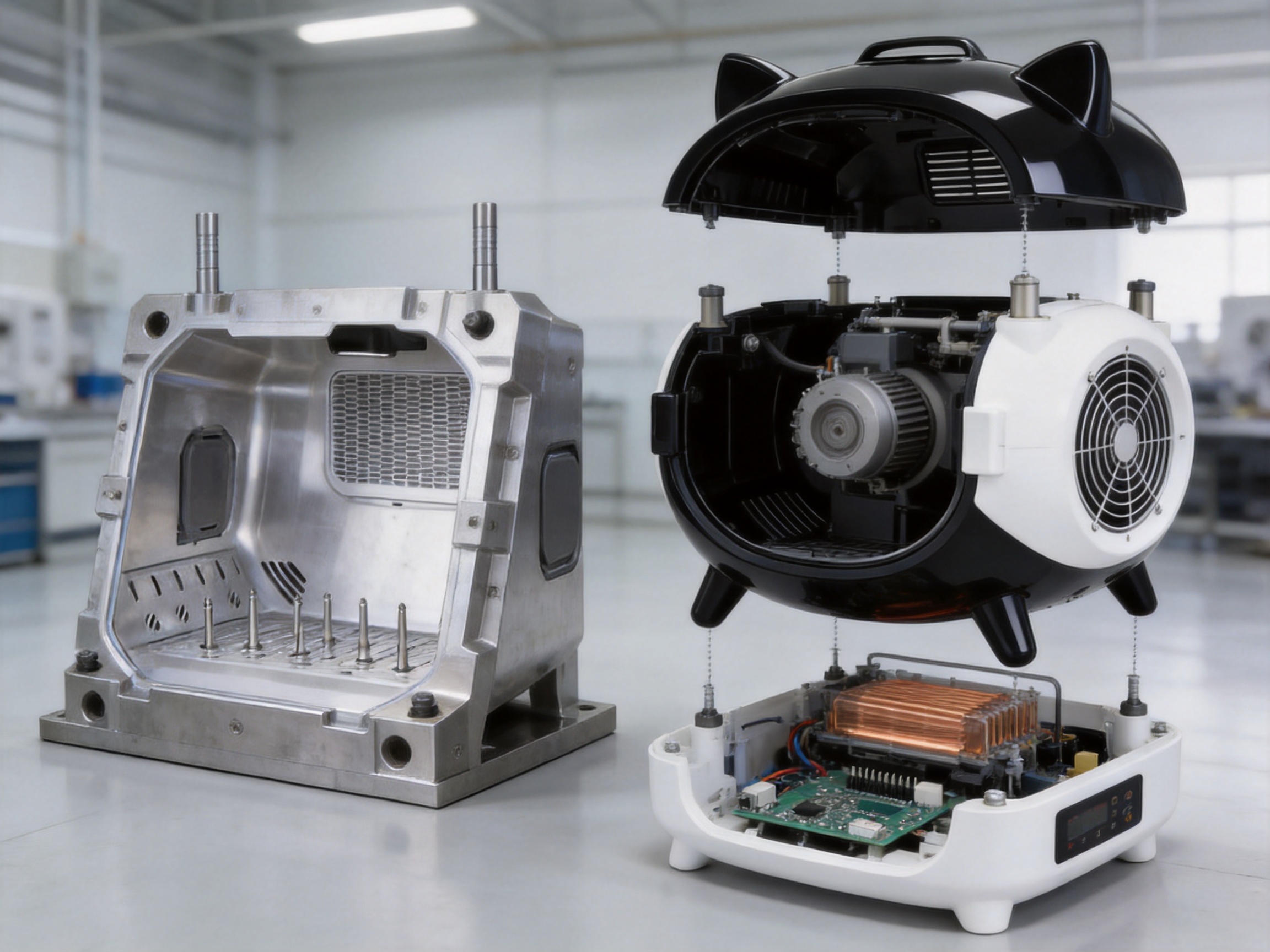
The Automatic Pet Dryer Injection Mould is developed for manufacturing plastic housings and structural components used in pet grooming dryers. It supports complex exterior forms, ventilation structures, mounting features, and internal assembly details while maintaining the dimensional accuracy required for modern electronic equipment. The mould is suitable for producing components from ABS and PC materials, making it appropriate for products that require a balance of strength, appearance, heat resistance, and processing stability.
Manufactured by Taizhou Huangyan Haiquan Plastic Mold Co., Ltd., the mould reflects the capabilities of an experienced plastic molding die maker and mould manufacturing company. The company specializes in precision injection molds for daily necessities, home appliances, automotive parts, and industrial equipment. Its production system integrates product design, mould engineering, machining, assembly, testing, quality control, and after-sales service.
For pet dryer manufacturers, the value of this tooling extends beyond the ability to form plastic parts. A well-designed mould can reduce production variation, simplify assembly, improve surface quality, support efficient cycle times, and help a finished appliance maintain its appearance throughout its service life. These benefits are particularly important in pet grooming products, where equipment is exposed to moisture, hair, cleaning chemicals, vibration, and repeated daily use.

Automatic Pet Dryer Injection Mould
1. The Role of an Injection Mould in Pet Dryer Manufacturing
A pet dryer housing is more than a decorative shell. It protects the motor, heating system, control electronics, wiring, switches, sensors, and airflow channels located inside the appliance. The housing must provide suitable structural support while also allowing air to enter and exit through carefully positioned ventilation openings. It may also need to accommodate handles, control panels, removable covers, filters, brackets, and safety-related features.
Injection moulding is well suited to this type of product because it can form complex three-dimensional components in a single production cycle. Once the mould has been designed and validated, each injection cycle can produce a repeatable housing or structural part with consistent dimensions. This repeatability is essential when the plastic component must be joined to other moulded parts or assembled with purchased electronic components.
The mould determines many of the finished product’s most important characteristics. These include wall thickness, surface texture, draft angles, parting-line location, gate position, ejector layout, cooling performance, and dimensional stability. A carefully planned mould can improve product quality before the first production batch begins, while a poorly planned mould may create persistent defects that are expensive to correct later.
For automatic pet dryers, the mould must also account for the interaction between plastic material and internal equipment. Screw bosses, clips, ribs, posts, and locating features must be positioned accurately so that motors, circuit boards, fans, heating elements, and control assemblies can be installed without unnecessary adjustment. The Automatic Pet Dryer Injection Mould is intended to support this level of integration.
2. Product Design Features for Complex Dryer Housings
The mould supports complex housing shapes with ventilation structures designed to promote airflow efficiency. Pet dryers depend on controlled air movement, and the external housing must accommodate openings and channels without compromising strength. Ventilation features therefore need to be positioned in relation to the internal fan, heating components, filters, and protective covers.
In a well-engineered housing, openings are not added randomly. Their size, spacing, and location influence airflow, noise, appearance, and safety. The mould design must reproduce these features cleanly and consistently. Small openings can be difficult to fill and eject if they are not properly engineered, particularly when the selected material contains reinforcing additives or when the component includes a large number of ribs and bosses.
The housing can also include curved surfaces, transitions, recessed control areas, snap-fit joints, and structural reinforcement. These details give the product a finished appearance while allowing the designer to achieve a strong and lightweight assembly. The mould must accommodate these details without creating excessive weld lines, sink marks, flash, distortion, or difficult ejection conditions.
Product design flexibility is another important advantage. Housing design and structural features can be modified according to product requirements. This allows a pet equipment manufacturer to adjust the appearance, control layout, mounting system, ventilation pattern, or internal support arrangement for different markets and product versions.
Such flexibility is useful when a manufacturer wants to create several models based on a common product platform. For example, the same general housing concept might be adapted for a compact household dryer, a professional salon dryer, or a higher-capacity unit. Changes to external styling or internal support features can be assessed during the engineering stage so that the mould remains practical for the intended production plan.
3. Material Compatibility: ABS and PC
The Automatic Pet Dryer Injection Mould is specified for ABS and PC product materials. These engineering plastics are widely used in appliance housings because they offer useful combinations of appearance, toughness, processability, and dimensional performance.
ABS Material Considerations
ABS, or acrylonitrile butadiene styrene, is valued for its good impact resistance, attractive surface finish, and relatively stable injection molding behavior. It can be produced in a broad range of colors and textures, making it suitable for consumer-facing pet grooming equipment. ABS is also commonly selected when the housing must achieve a balance between cost efficiency and durable daily use.
For an ABS housing, mould surface quality has a direct effect on the finished product. Polished surfaces, textured areas, logos, control recesses, and decorative transitions must be machined or finished accurately. Consistent mould temperature and balanced filling are also important for reducing visible defects on large external surfaces.
PC Material Considerations
PC, or polycarbonate, is known for high impact strength and good resistance to demanding service conditions. It may be selected for components that require additional toughness or greater resistance to heat and mechanical stress. Depending on the formulation, PC can also support transparent, translucent, or high-performance applications.
PC generally requires careful processing because its melt temperature and drying requirements can differ from those of ABS. The mould design must support suitable filling, cooling, and ejection conditions. Accurate venting is especially important for complex parts because trapped air can cause burn marks, incomplete filling, or surface defects.
Designing One Mould for Material Requirements
When a mould is intended to support ABS and PC, the engineering team must consider the processing behavior of both materials. Mold flow, shrinkage, cooling, gate design, draft, ejection force, and surface finish all influence the final result. The material selection should be confirmed by the product owner before mass production, especially if the housing will be exposed to elevated temperatures, cleaning agents, repeated impact, or continuous vibration.
Material compatibility also affects the appearance of assembly joints. If two plastic components are manufactured from different grades or have different shrinkage behavior, their dimensional relationship must be evaluated carefully. Proper mould engineering helps reduce misalignment between covers, frames, grilles, and internal supports.
4. Precision and Assembly Accuracy
High precision is a central requirement for pet dryer housings because the moulded plastic components must fit electronic and mechanical assemblies. The product may include a motor, fan, heater, circuit board, display, switch, sensor, power connection, filter, and safety guard. Even small dimensional errors can create assembly delays or lead to unwanted movement inside the finished unit.
Precision moulding supports consistent screw-boss positions, snap-fit engagement, cover alignment, component clearances, and mounting-hole locations. It also helps control the relationship between the housing and airflow components. When parts are produced consistently, assembly operators can work with predictable procedures instead of making repeated manual corrections.
Dimensional stability is influenced by more than the machining accuracy of the mould. It also depends on material shrinkage, cooling balance, injection pressure, holding pressure, cycle time, and part geometry. The mould design should therefore be evaluated as part of a complete molding process rather than as an isolated steel component.
The use of 718 and NAK80 mould steel provides a foundation for accurate and durable tooling. These steels are commonly associated with good machinability, polishability, toughness, and suitability for plastic injection mould applications. The exact steel selection for individual mould components may depend on the required surface finish, expected production volume, material characteristics, and maintenance plan.
5. Mould Steel and Expected Service Life
The stated mould steel is 718 / NAK80, and the expected mould life is 800,000 shots. This service-life specification is important for manufacturers planning regular production. A long-life mould can support larger order volumes while reducing the frequency of major tooling replacement.
718 steel is often selected for mould components where a combination of strength, polishability, and practical machining performance is required. It can be suitable for larger mould bases and cavity components, depending on the specific heat treatment and application requirements. NAK80 is recognized for its pre-hardened condition and suitability for polished or textured mould surfaces. It can be advantageous when the part requires a consistent cosmetic appearance.
A stated life of 800,000 shots does not eliminate the need for maintenance. The actual service life of any injection mould depends on material choice, machine settings, production environment, cooling-water quality, lubrication, cleaning practices, cycle frequency, and the complexity of the part. Abrasive additives, corrosive materials, excessive injection pressure, or poor maintenance can accelerate wear.
Routine maintenance may include cleaning the cavity and core surfaces, checking ejector movement, inspecting cooling channels, lubricating moving components, verifying guide systems, and removing residue from vents and slides. Preventive maintenance helps protect the mould investment and supports stable production over time.
| Item | Specification | Manufacturing Benefit |
| Mould steel | 718 / NAK80 | Supports durable tooling and quality surface finishing |
| Product material | ABS / PC | Suitable for tough, attractive appliance housings |
| Expected mould life | 800,000 shots | Supports sustained production and repeat orders |
| Primary application | Pet grooming dryers | Designed around housing and structural component requirements |
| Customization | Housing and structural features | Allows adaptation to product-specific designs |
6. Advantages Compared with Generic Pet Dryer Tooling
Many general-purpose plastic moulds can produce simple appliance covers, but pet dryer housings often require more specialized design attention. Their ventilation patterns, internal clearances, ergonomic features, and electronic interfaces create requirements that are not present in a basic enclosure.
The Automatic Pet Dryer Injection Mould offers several advantages over less specialized tooling. First, it is designed around the functional requirements of pet grooming dryers rather than only the external appearance of a plastic shell. Ventilation structures and internal assembly features are considered together, helping the mould support both airflow and component installation.
Second, the mould is intended for complex housing shapes. Complex shapes can improve the product’s ergonomic performance and visual identity, but they also increase the risk of warpage, trapped air, uneven filling, and difficult ejection. Purposeful mould engineering helps manage these challenges through appropriate parting surfaces, gates, runners, cooling layouts, and ejection arrangements.
Third, the tooling supports precision assembly. A generic mould may produce a visually acceptable cover but still require excessive manual fitting around motors, fan units, switches, or electronic boards. Precision locating features can improve assembly repeatability and reduce production labor.
Fourth, the specified mould life of 800,000 shots supports long-term manufacturing planning. Tooling with a defined production-life target gives buyers a clearer basis for evaluating cost per part, replacement risk, and capacity planning.
Fifth, the mould can be customized. Product manufacturers are not limited to one fixed appearance or one internal structure. Housing design, ventilation details, mounting points, and other structural features can be adapted to meet a particular product specification.
7. Advanced Manufacturing Process
The quality of an injection mould depends heavily on the manufacturing process used to create it. A precision tool is normally developed through several coordinated stages, beginning with product review and continuing through design, steel preparation, machining, assembly, testing, and production validation.
Product and DFM Review
The process begins with a review of the product design and its intended manufacturing conditions. Engineers assess wall thickness, draft angles, ribs, bosses, undercuts, parting lines, gate locations, ejection areas, and assembly interfaces. This design-for-manufacturing review helps identify risks before steel is cut.
For a pet dryer housing, the review should also consider airflow openings, cosmetic surfaces, handle areas, electrical clearances, fastener locations, and possible contact with heat-generating components. Early identification of difficult details can reduce later modifications and improve the overall tooling schedule.
Three-Dimensional Mould Design
After the product review, the mould structure is developed using three-dimensional design methods. The design typically includes the cavity, core, mould base, runner system, gates, cooling circuits, ejector system, guide components, and any required slides or lifters.
Parting-line selection is particularly important for a complex housing. The line should allow practical machining and ejection while limiting visible marks on important cosmetic areas. The design team must balance appearance, tooling cost, structural requirements, and production efficiency.
Steel Preparation and Heat Treatment
Selected mould steel is prepared according to the requirements of the cavity, core, mould base, and moving components. Steel condition, hardness, machining allowance, and heat-treatment requirements are considered before precision machining begins. Stable steel preparation helps reduce dimensional changes during manufacturing and use.
CNC Machining and Precision Cutting
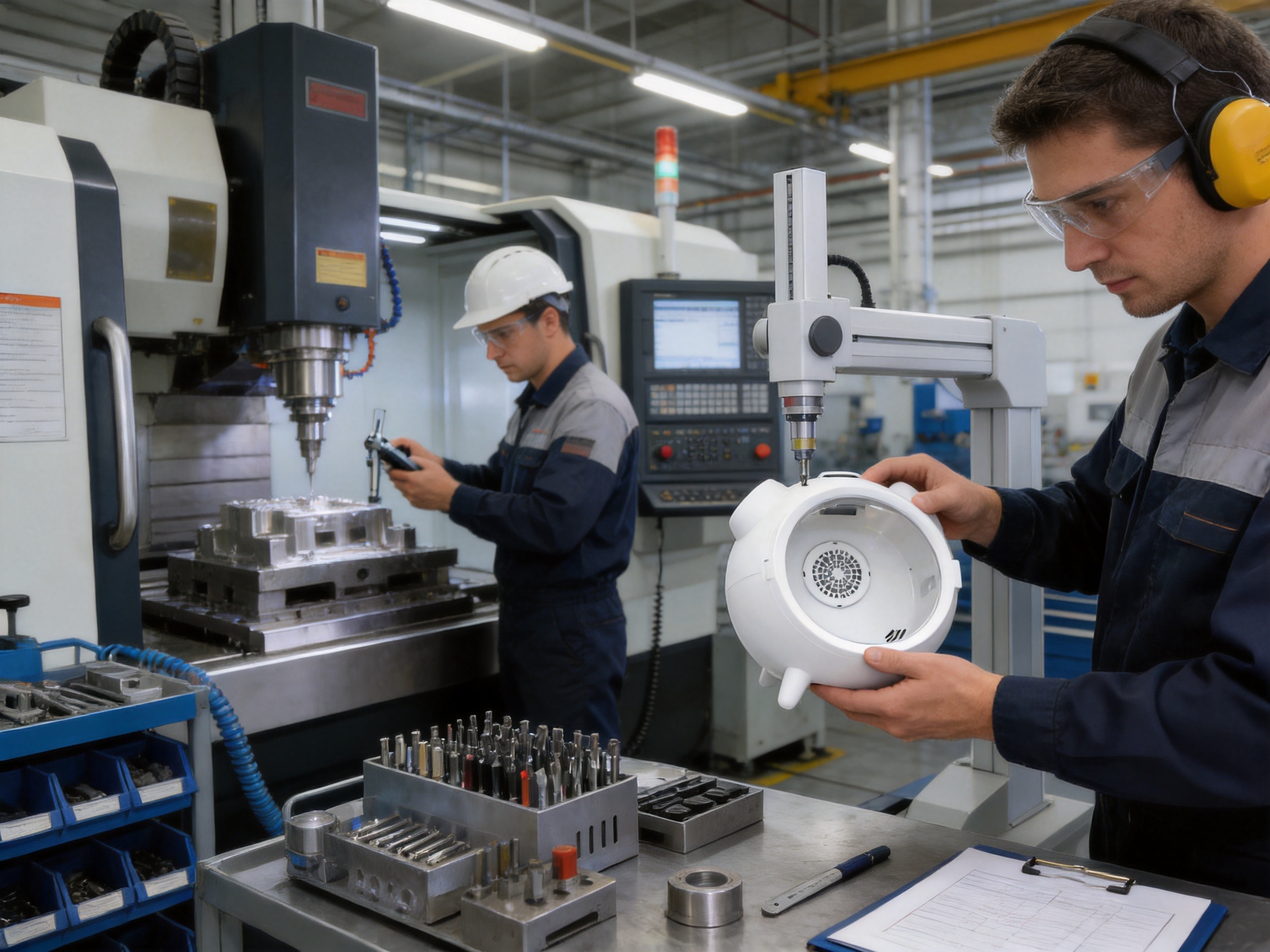
CNC machining is used to create complex cavity and core geometries with controlled dimensional accuracy. Multi-axis machining may be applied where curved surfaces, deep features, or angled details make conventional cutting inefficient. Machining strategies are chosen to reduce tool marks and leave a suitable allowance for finishing.
Fine machining is especially important for areas that affect assembly, such as mounting posts, screw bosses, locating surfaces, and joint interfaces. Cosmetic surfaces also require attention because the mould finish is transferred directly to the plastic product.
Electrical Discharge Machining
Electrical discharge machining can be used for narrow slots, sharp internal features, deep ribs, and geometries that are difficult to reach with standard cutting tools. In a pet dryer mould, EDM may support precise formation of ventilation details, connector clearances, or other intricate structural features.
Wire Cutting and Component Fitting
Wire cutting can produce accurate profiles for inserts, slides, and other mould components. After machining, components are fitted and checked to ensure that the cavity and core close correctly. Proper fitting helps prevent flash, mismatch, premature wear, and damage during production.
Polishing and Surface Texturing
Surface treatment is selected according to the product design. Glossy areas may require polishing, while textured areas may be produced through controlled texturing methods. A consistent mould surface helps improve the visual quality of the housing and provides a repeatable appearance across production batches.
Mould Assembly and Trial Testing
During assembly, the mould is checked for smooth movement, proper alignment, cooling connections, ejector travel, and safe operation. Trial molding then provides practical information about filling, packing, cooling, ejection, warpage, weld lines, sink marks, and surface appearance.
Trial results can be used to optimize processing conditions or identify mould modifications. A structured testing process is valuable because it confirms that the tool can produce a usable component rather than only meeting drawing dimensions in an unloaded condition.
8. Quality Control and Production Reliability
Quality control should cover both the mould itself and the plastic parts produced from it. For the mould, inspections may include dimensional checks, steel verification, hardness confirmation where applicable, surface-finish assessment, component alignment, cooling-channel inspection, and movement testing.
For moulded parts, quality checks may include visual inspection, critical-dimension measurement, assembly trials, functional fit checks, and evaluation of surface defects. The inspection plan should focus on features that affect the final pet dryer, including ventilation openings, screw bosses, clips, control-panel interfaces, component mounts, and housing joints.
Reliable quality control helps identify problems at the source. For example, flash around a ventilation opening may indicate an alignment or fitting issue, while warpage near a large flat panel may suggest an imbalance in cooling or packing. A professional mould manufacturing company can use trial data and inspection results to make targeted adjustments.
Production reliability also depends on documentation. Clear mould drawings, component records, maintenance instructions, inspection results, and trial reports help preserve technical knowledge throughout the tooling life. These records are especially useful when a mould is operated across different production periods or transferred between machines.
9. Benefits for Pet Grooming Equipment Manufacturers
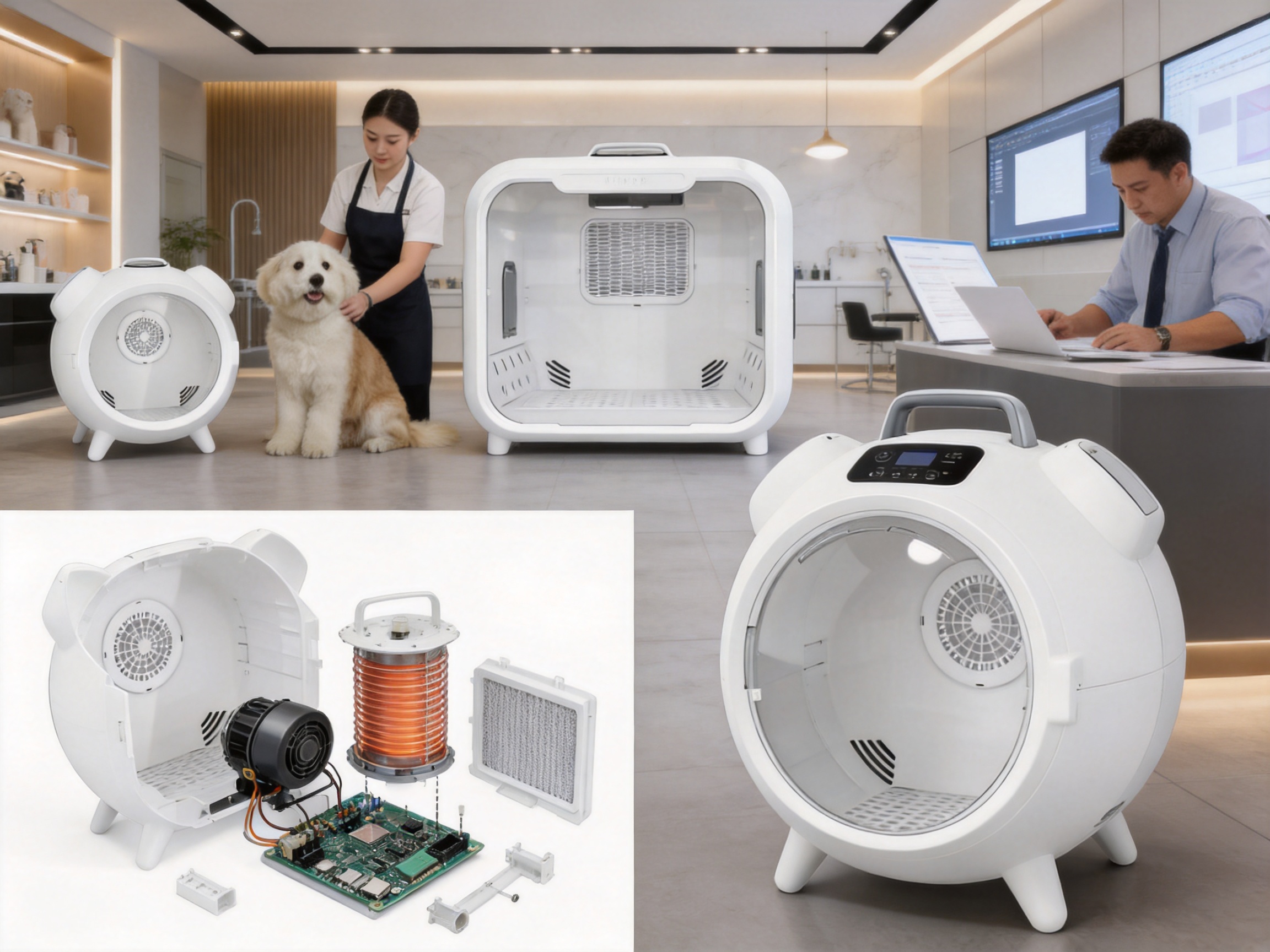
The mould is suitable for several types of pet drying products. These include professional grooming dryers used in pet salons, compact home drying devices, and other pet care equipment that requires a durable plastic enclosure.
Pet Grooming Dryers
Professional grooming dryers often operate for extended periods and may be moved frequently within a salon. Their housings must tolerate repeated handling, vibration, cleaning, and exposure to moisture. A well-designed injection mould helps produce parts with consistent structural support and reliable assembly interfaces.
Pet Salon Equipment
Pet salons often value equipment that is easy to clean and presents a professional appearance. Smooth, consistent plastic surfaces can support routine cleaning, while carefully designed joints and covers can reduce areas where hair and debris accumulate. Custom mould features can also support distinctive styling for commercial equipment brands.
Home Pet Drying Devices
Home users may prioritize compact size, low noise, intuitive controls, attractive appearance, and easy storage. The mould can be adapted for smaller housings or different ergonomic requirements. Consistent plastic part quality helps the finished product feel dependable and easy to use.
Platform-Based Product Development
Manufacturers developing several models can use mould customization to create related products with different capacities, control systems, or external styling. This approach may help shorten development cycles and establish a consistent product family while allowing each model to address a different market segment.
10. Ergonomics, Appearance, and Consumer Expectations
Pet care equipment is purchased by both professional users and pet owners, so product appearance and handling comfort can influence buying decisions. The external housing should be visually balanced, easy to hold or position, and free from distracting moulding defects.
Curved surfaces can improve handling and reduce the visual impression of bulk. Recessed buttons and control areas can make operation more intuitive, while well-positioned seams can give the product a cleaner appearance. These features must be incorporated into the mould without creating unnecessary manufacturing difficulty.
Surface texture is another important design choice. A fine texture may help conceal minor handling marks and improve grip, while a polished surface may create a premium appearance. The mould surface must reproduce the selected finish uniformly across the intended area.
Color selection and material choice also affect appearance. ABS and PC can support different colors and finishes, but the final result depends on resin grade, pigment, processing parameters, mould temperature, and surface preparation. Maintaining consistent production conditions is essential when a product must match an approved sample.
11. Airflow Structures and Functional Integration
Ventilation is one of the defining features of a pet dryer housing. The housing must support airflow while protecting internal components and preventing unacceptable contact with moving or heated parts. The design of openings and internal channels should therefore be coordinated with the fan and heating system.
Injection moulding allows ventilation features to be incorporated directly into the housing. This can reduce the need for separate grilles or additional assembly steps, provided that the openings are designed for proper filling, ejection, cleaning, and structural strength.
The mould must also account for the possibility of hair and dust entering the equipment. Depending on the product design, filters, screens, removable covers, or protective barriers may be integrated into the assembly. Accurate moulded interfaces make these components easier to install and replace.
Because the housing may surround heat-generating components, clearance and material selection deserve careful consideration. The product designer should confirm operating temperature, airflow rate, insulation requirements, and safety standards. The injection mould can provide accurate structural parts, but complete product compliance depends on the full appliance design.
12. Manufacturing Efficiency and Cost Control
A mould’s value should be evaluated over its complete production life rather than only by its initial purchase price. Tooling that produces consistent parts, minimizes rejects, supports efficient cycles, and requires limited corrective work may deliver a lower total cost of ownership.
Balanced filling and cooling can help reduce cycle variation. Efficient ejection can shorten handling time and lower the risk of part damage. Correctly positioned gates and runners can reduce cosmetic problems and improve material utilization. These details contribute to a more stable production process.
The expected life of 800,000 shots also provides a basis for calculating tooling cost per part. The actual calculation should include maintenance, machine time, resin consumption, labor, inspection, packaging, and any secondary operations. Even when the mould is used for lower annual volumes, a durable tool can provide confidence for future orders and product revisions.
Customization may also help control development costs. Instead of creating a completely new tooling concept for each product, a manufacturer can evaluate whether selected housing features or structural details can be adapted within an existing design approach. The feasibility of this strategy depends on product geometry and should be confirmed through engineering analysis.
13. Company Manufacturing Strengths
Taizhou Huangyan Haiquan Plastic Mold Co., Ltd. is a high-tech enterprise specializing in the research, development, and manufacture of precision injection molds. Its business covers four major sectors: daily necessities, home appliances, automotive parts, and industrial equipment.
This sector diversity is valuable because it exposes the engineering team to a broad range of product requirements. Daily necessities often emphasize appearance and cost efficiency. Home appliances require accurate assembly and durable housings. Automotive parts demand strict dimensional control and process discipline. Industrial equipment may involve complex structures and demanding service conditions.
The company follows a quality-first and sustainable-development philosophy. Its professional design team and scientific production management system support integrated services from design and production through after-sales support. For overseas buyers, an integrated supplier can simplify communication because product development, tooling manufacture, trial support, and technical follow-up are coordinated through one organization.
The company serves customers in Europe, the Middle East, Southeast Asia, and South America. International project experience can help a mould manufacturer understand the importance of clear technical communication, export coordination, packaging, delivery planning, and responsive service after shipment.
As a plastic mould maker and plastic moulding die maker, the company is positioned to support custom injection tooling rather than only standard products. Its capabilities are relevant to businesses seeking injection plastic parts, precision moulds, and complete tooling solutions for new or existing product designs.
14. Customization Options for Product Developers
Customization begins with the product’s intended use. A professional pet salon dryer may require a robust housing with reinforced mounting points and easy-clean surfaces. A home appliance may need a smaller body, integrated controls, and a more compact airflow system. The mould design can be reviewed according to these different priorities.
Possible customization areas include overall housing shape, wall thickness, ventilation arrangement, control-panel recesses, handle interfaces, screw-boss locations, snap-fit structures, filter frames, motor supports, and cable-routing features. Decorative details such as logos, surface texture, and contrasting panels may also be incorporated when appropriate.
Before customization is finalized, the product design should be evaluated for injection molding feasibility. Deep ribs, abrupt wall changes, insufficient draft, isolated bosses, and complex undercuts can increase tooling complexity. Early engineering communication helps the product owner understand the effect of each design decision on mould cost, production time, and part quality.
Prototype evaluation is useful when the product has a new ergonomic form or unusual airflow structure. Testing a sample housing can reveal handling, noise, access, serviceability, and assembly issues before mass-production tooling is completed. The final mould can then be refined around validated product requirements.
15. Recommended Project Workflow
A successful mould project benefits from a clear workflow. The product owner should provide three-dimensional product files, two-dimensional drawings where available, material requirements, expected annual volume, appearance standards, and assembly information. The tooling supplier can then review the design and identify key manufacturing considerations.
The next stage is design confirmation. The mould structure, parting line, gates, ejectors, cooling channels, steel selection, and estimated production cycle should be discussed before manufacturing begins. Any areas that require customer approval should be documented to reduce ambiguity.
After design approval, steel procurement and machining can proceed. During this stage, progress updates may include design review records, machining status, component inspection, mould assembly, and trial scheduling. Transparent communication is particularly important for export projects with fixed product-launch dates.
Trial samples should be evaluated against agreed criteria. The customer may review dimensions, surface finish, color, assembly fit, ventilation openings, and functional interfaces. If modifications are required, they should be recorded and verified during a subsequent trial.
Before shipment, the mould should be cleaned, protected, labeled, and accompanied by relevant documentation. Maintenance guidance and spare-part recommendations can help the customer operate the tool effectively after installation.
16. Maintenance Practices for Long-Term Performance
Regular maintenance protects both the mould and the production schedule. After molding, the cavity and core should be cleaned according to the material and surface-finish requirements. Residue around vents, gates, and parting surfaces should not be allowed to build up.
Moving components such as ejector pins, slides, lifters, and guide systems should be inspected for smooth operation. Lubrication should follow the mould manufacturer’s recommendations, since excessive or unsuitable lubricant can contaminate cosmetic surfaces or interfere with assembly.
Cooling channels should be monitored for blockage, leakage, corrosion, and reduced flow. Poor cooling performance can increase cycle time and contribute to part warpage. Water quality and temperature control should therefore be managed as part of the production process.
When the mould is stored, exposed steel surfaces should be protected from corrosion. The mould should be closed or secured in a manner appropriate to its design, and records should be kept for production shots, repairs, inspections, and replacement components.
17. Environmental and Operational Considerations
Sustainable mould manufacturing involves more than selecting a durable steel grade. A long-life mould can reduce the need for repeated tooling replacement and help minimize waste associated with rejected parts. Stable production can also reduce material consumption caused by excessive scrap.
Pet dryer manufacturers may evaluate recycled or partially recycled plastics depending on product requirements. Any alternative material should be tested for shrinkage, impact strength, heat resistance, appearance, and compatibility with the moulding process. Changes in material may require adjustments to processing parameters or additional validation.
Efficient product design can also reduce plastic weight without sacrificing strength. Ribbing, localized reinforcement, and carefully controlled wall thickness may help achieve a lighter housing. These changes must be implemented carefully because uneven walls can create sink marks, warpage, or filling problems.
Operational sustainability also benefits from durable equipment. A pet dryer that maintains structural integrity and remains easy to service may have a longer useful life. Reliable moulded components support this objective by improving the consistency of the finished product.
18. Selection Guidance for Buyers
When evaluating a pet dryer injection mould, buyers should consider more than the quoted tooling price. Important questions include whether the supplier understands appliance housing design, whether the mould supports the required material, how the ventilation structures will be formed, what mould life is expected, and how trial modifications will be managed.
The supplier’s machining capability, inspection process, design communication, export experience, and after-sales support are also relevant. A mould is a long-term production asset, so the buyer should select a partner capable of supporting both initial development and later maintenance needs.
It is also important to define acceptance criteria before production. These may include critical dimensions, cosmetic standards, assembly fit, permissible flash, ejection marks, part weight, cycle time, and sample approval procedures. Clear criteria reduce disagreements and provide a practical basis for final inspection.
For international projects, communication should cover packaging, shipping protection, documentation, spare parts, installation support, and technical contacts. Taizhou Huangyan Haiquan Plastic Mold Co., Ltd. provides integrated tooling services and has experience serving customers across multiple international regions.
19. Frequently Asked Questions
What product is the mould designed to produce?
The mould is designed for plastic housings and structural components used in automatic pet dryers, pet grooming dryers, pet salon equipment, and home pet drying devices.
Which plastic materials are supported?
The stated product materials are ABS and PC. The final resin grade should be confirmed according to the required impact strength, heat resistance, appearance, color, and operating environment.
What mould steel is specified?
The specified mould steel is 718 / NAK80. These steels are suitable for precision tooling applications requiring durable components and controlled surface finishing.
How long is the expected mould life?
The stated expected mould life is 800,000 shots. Actual service life depends on material abrasiveness, machine settings, production conditions, maintenance, and other operating factors.
Can the housing design be customized?
Yes. Housing design and structural features can be modified according to product requirements. Customization may include ventilation structures, mounting features, control areas, clips, bosses, and external styling.
Why is precision important for a pet dryer housing?
Precision is important because the housing must fit motors, fans, heating systems, circuit boards, switches, sensors, filters, and other electronic or mechanical components. Accurate parts can improve assembly consistency and reduce manual adjustments.
What types of businesses can use this mould?
Manufacturers of professional pet grooming dryers, pet salon equipment, household pet drying devices, and related pet care appliances can use this type of tooling.
What should be provided before mould design begins?
The buyer should provide product drawings or three-dimensional files, material requirements, annual volume expectations, appearance standards, assembly information, and any special functional requirements related to airflow or heat management.
Does a long-life mould eliminate maintenance?
No. Even a mould designed for 800,000 shots requires cleaning, lubrication, cooling-system checks, inspection, and preventive maintenance. Proper care helps preserve accuracy and extend practical service life.
What makes a specialized pet dryer mould different from a general enclosure mould?
A specialized pet dryer mould is developed with airflow structures, internal equipment clearances, electronic assembly interfaces, pet-care operating conditions, and product ergonomics in mind. These requirements may not be addressed adequately by a general-purpose enclosure mould.
Can the mould support different product models?
It may support related product models when the housing design and tooling structure are planned for adaptation. The feasibility depends on the degree of geometry change and should be confirmed through technical review.
What quality checks should be performed on trial parts?
Trial parts should be checked for critical dimensions, assembly fit, ventilation openings, surface finish, flash, sink marks, warpage, ejector marks, part weight, and compatibility with internal components.
20. Conclusion
The Automatic Pet Dryer Injection Mould provides a practical tooling solution for manufacturers developing reliable pet grooming and pet care equipment. Its design supports complex housings with ventilation structures, accurate electronic assembly interfaces, and customizable structural features. Compatibility with ABS and PC gives product developers flexibility in balancing appearance, toughness, processability, and service performance.
The use of 718 / NAK80 mould steel and the stated 800,000-shot life target support long-term production planning. Precision manufacturing, controlled mould assembly, trial validation, and maintenance guidance further contribute to stable production and consistent part quality.
Taizhou Huangyan Haiquan Plastic Mold Co., Ltd. combines mould design and manufacturing expertise with experience in daily necessities, home appliances, automotive parts, and industrial equipment. Its integrated services cover product review, tooling development, production, quality control, delivery, and after-sales support. For pet dryer manufacturers seeking a dependable plastic molding die maker, this combination of specialized product understanding and broad engineering capability provides a strong foundation for custom injection tooling projects.
By selecting a mould designed around airflow, structural strength, assembly precision, surface appearance, and production durability, manufacturers can improve both the development process and the final user experience. The result is a more consistent pet dryer housing that supports efficient manufacturing, dependable equipment operation, and long-term product value.
References
1. Injection Molding Handbook, principles of thermoplastic part design, mould construction, process control, and troubleshooting.
2. Plastics Engineering Fundamentals, guidance on ABS, polycarbonate, shrinkage, cooling, and dimensional stability.
3. Mold Design and Manufacturing Practice, reference material covering parting lines, gating, ejection, venting, and mould maintenance.
4. Product Design for Manufacture and Assembly, general principles for integrating plastic housings with electronic and mechanical components.
5. Industrial Injection Mould Quality Management Guidelines, recommended approaches for inspection, trial validation, documentation, and preventive maintenance.
Product: Automatic Pet Dryer Injection Mould

For exclusive deals and latest offers, sign up by entering your email address below.











 +86-18657672567
 sales@tzhqmould.com
celin@tzhqmould.com
 No. 17 Houshi Road, Beicheng Industrial Zone, Huangyan District, Taizhou City, Zhejiang Province, China
Copyright © Taizhou Huangyan Haiquan Plastic Mold Co., Ltd. All Rights Reserved
Injection Plastic Mould Maker

