

Round Airtight Plastic Lunch Bowl Injection Mould: Precision Tooling for Reliable Food Containers
Admin 2026-08-25
The Round Airtight Plastic Lunch Bowl Injection Mould is developed for manufacturers producing sealed food bowls, meal preparation containers, takeaway packaging, and reusable kitchen storage products. As consumers and food-service businesses increasingly demand lightweight, hygienic, reusable, and convenient containers, the quality of the injection mould has become a decisive factor in product performance. A bowl may appear simple, but its success depends on highly accurate dimensions, stable wall thickness, dependable lid engagement, balanced cooling, and efficient mass-production capability.
This mould is engineered around those requirements. Its primary purpose is to produce round plastic bowls with consistent geometry and reliable sealing between the container and its lid. The tooling structure supports PP, Tritan, and PET materials, while the selected mould steel, hot runner system, cavity configuration, and cooling design are coordinated to achieve repeatable production results. With 2–4 cavities, mirror-polished surfaces, and a stated service life of more than 800,000 shots, the mould is suitable for both medium-scale and high-volume manufacturing programs.
For buyers comparing suppliers, the key advantage is not simply the appearance of the finished bowl. Competitive performance is determined by how consistently the mould produces parts, how effectively it controls defects, how easily it can be maintained, and how well it supports future product variations. A properly designed airtight bowl mould can reduce leakage complaints, minimize material waste, shorten cycle times, and provide a more predictable return on tooling investment.
Why Airtight Lunch Bowl Tooling Requires Precision
Round lunch bowls are composed of several functional areas that must work together. The bowl body needs a stable circular shape, the rim must remain uniform, and the lid must engage with the rim at the correct pressure. Depending on the product concept, the closure may use a snap-fit, locking edge, flexible sealing lip, or another mechanical structure. Even a small dimensional deviation can cause loose fitting, difficult opening, incomplete sealing, or deformation during use.
The sealing area is especially important because it directly affects user confidence. Consumers expect a lunch bowl to contain sauces, soups, prepared meals, and other foods without unexpected leakage. For food-service customers, leakage can damage packaging, create hygiene concerns, and increase operating costs. Therefore, the mould must hold tight tolerances around the bowl opening and lid matching surfaces throughout its production life.
Round parts also require careful control of shrinkage and cooling. If one region of the bowl cools faster than another, the finished component may become oval, warped, or uneven around the rim. Such distortion can prevent the lid from fitting correctly, even when the individual dimensions appear close to specification. The cooling layout, steel quality, cavity balance, and moulding parameters must therefore be planned together rather than treated as separate details.
The Round Airtight Plastic Lunch Bowl Injection Mould addresses these issues through high-precision machining, optimized cooling channels, a hot runner system, and carefully controlled cavity geometry. These features are intended to provide more stable dimensions and a more consistent relationship between the bowl and lid.

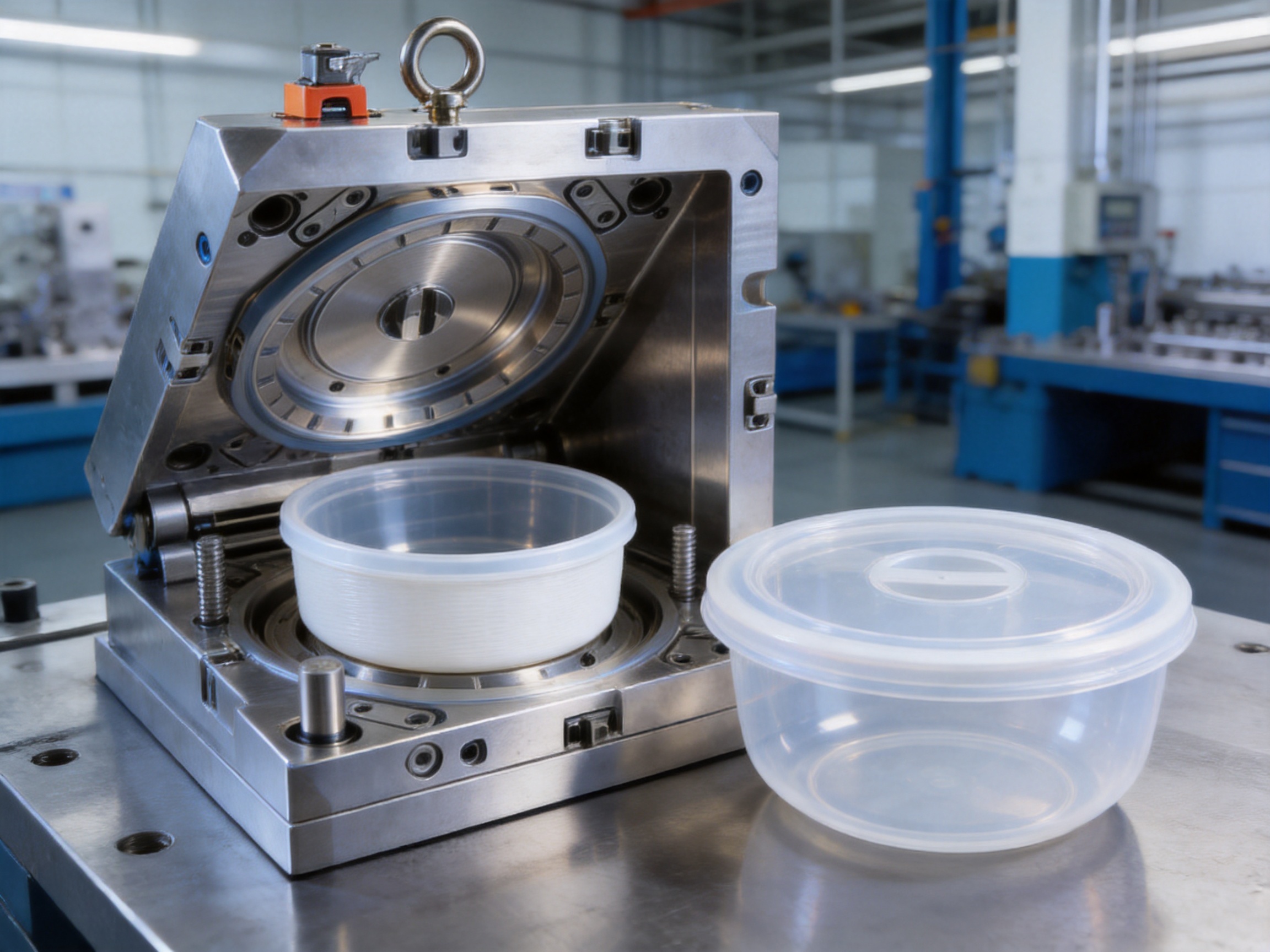
Round Airtight Plastic Lunch Bowl Injection Mould
Core Product Advantages
Reliable Bowl and Lid Matching
The most important performance feature is the accuracy of the matching surfaces. The mould is designed to maintain consistent edge dimensions around the bowl mouth and corresponding lid structure. This helps the finished parts achieve a more dependable airtight or leak-resistant connection when assembled.
Accurate matching is valuable in several ways. It improves the user experience by making the lid easier to close and open. It reduces the risk of leakage during transport. It also allows manufacturers to maintain a consistent assembly process, which is particularly important when bowls and lids are produced separately or on different production lines.
For a supplier, the ability to control matching accuracy is a major competitive advantage. Less precise tooling may produce bowls that require excessive manual sorting or adjustment. Some parts may fit too tightly, while others may be too loose. With precision machining and systematic inspection, the mould can reduce these variations and improve the percentage of acceptable parts produced during each cycle.
Optimized Cooling for Roundness and Dimensional Stability
Cooling is one of the most influential factors in injection mould performance. The plastic material enters the cavity in a molten state and must solidify evenly. If heat removal is not balanced, the product can experience uneven shrinkage, sink marks, warpage, residual stress, or deformation around the sealing edge.
The mould incorporates optimized cooling channels to support more uniform temperature control. For a round lunch bowl, this is particularly important because the circular wall and rim need to remain symmetrical. Stable cooling helps preserve the intended shape and reduces the possibility of a lid-fitting problem caused by out-of-round conditions.
Efficient cooling can also contribute to shorter and more stable cycle times. When the part reaches a suitable ejection temperature more quickly and evenly, manufacturers may improve production efficiency without compromising part quality. Actual cycle time depends on the material, wall thickness, machine, processing temperature, and product design, but a well-planned cooling system gives the processor a stronger foundation for optimization.
Support for Thin-Wall Container Design
Modern food containers are often expected to be lightweight while remaining strong enough for stacking, transport, and repeated handling. Thin-wall construction can reduce material consumption and shipping weight, but it places greater demands on mould filling, cooling, venting, and dimensional control.
This mould supports thin-wall bowl concepts by combining suitable flow planning with controlled cavity geometry. A hot runner system can help deliver molten plastic to the cavity efficiently and reduce unnecessary runner waste. The design must also account for filling balance, weld-line location, air evacuation, and pressure distribution.
Thin-wall production is not simply a matter of reducing the wall dimension in a drawing. The resin grade, melt flow, injection speed, gate position, mould temperature, and cooling conditions must all be considered. A mould manufacturer with experience in container tooling can identify potential filling or deformation risks before steel is completed, helping the customer avoid costly modifications after trial production.
Hot Runner System for Efficient Production
The mould uses a hot runner system to support efficient delivery of material into the cavity. Compared with a conventional cold runner arrangement, a properly designed hot runner may reduce runner scrap and provide more direct control over the filling process. This can be particularly useful for high-volume food container production, where even a small amount of material waste becomes significant over hundreds of thousands of cycles.
Hot runner performance depends on correct nozzle selection, temperature control, gate design, and maintenance. When these elements are properly coordinated, the system can help maintain a stable melt flow and reduce the amount of regrind or discarded runner material. It may also simplify post-moulding operations by reducing the need to remove large runners from the finished parts.
For manufacturers seeking competitive operating costs, this efficiency is an important advantage. Lower material waste, stable processing, and reduced secondary trimming can improve the overall economics of the bowl production line. The exact benefit depends on product weight, resin price, machine settings, and production volume, but the tooling configuration is designed with mass-production efficiency in mind.
Durable Mould Steel and Long Service Life
The specified mould steel options are 718 and S136. These steels are widely used in precision plastic moulding applications because they can provide a combination of strength, machinability, polishability, and corrosion resistance when correctly processed and maintained.
S136 is particularly suitable when a high-quality surface finish and improved corrosion resistance are required. This can be valuable for food container moulds because the cavity surface must support a clean and attractive product appearance. Steel selection also affects the mould’s resistance to wear, maintenance requirements, and ability to preserve dimensional accuracy during repeated operation.
The stated mould life is more than 800,000 shots. Service life is influenced by many factors, including resin additives, moulding pressure, processing temperature, maintenance quality, cooling-water treatment, and production conditions. Nevertheless, the specified life indicates that the tooling is intended for serious commercial production rather than short-run sampling alone.
Material Compatibility for Different Container Concepts
The mould supports PP, Tritan, and PET, giving manufacturers flexibility when selecting a material for a particular market or product position. Each resin has different characteristics, and the moulding process should be adjusted accordingly.
| Material | Typical Product Considerations | Important Moulding Factors |
| PP | Lightweight, practical, and widely used for reusable food containers | Shrinkage control, living hinges or snap features, filling balance, and cooling |
| Tritan | Clear, durable, and suitable for premium transparent container concepts | Surface quality, optical appearance, stress reduction, and polished cavities |
| PET | Suitable for certain clear packaging and container applications | Drying, processing temperature, filling behavior, and dimensional stability |
| 718 Steel | Balanced tooling performance for general precision mould construction | Machining accuracy, polishing, hardness treatment, and maintenance planning |
| S136 Steel | High-quality cavity finish and improved corrosion resistance | Polishing quality, cooling-channel design, and surface protection |
PP is often selected for reusable lunch bowls because it combines low weight, practical toughness, and broad processing familiarity. It can be used for containers with various locking structures and is suitable for products designed for everyday handling. However, PP has material shrinkage characteristics that must be considered during cavity and core design.
Tritan may be selected for a clearer and more premium appearance. Transparent products place strong demands on cavity polishing, mould cleanliness, venting, and process control. Surface marks, weld lines, flow marks, and internal stress may be more visible, so the moulding system must be designed and maintained to a higher cosmetic standard.
PET can be considered for selected container and packaging concepts where clarity and material performance are required. Processing PET generally requires attention to moisture control and drying. The customer’s material grade, product specifications, and regulatory requirements should be confirmed before finalizing the tool design.
Applications of the Lunch Bowl Injection Mould
Meal Preparation Bowls
Meal preparation has become increasingly popular among households, athletes, office workers, and food-delivery businesses. Meal prep bowls are expected to stack efficiently, remain easy to clean, and keep different foods contained during storage and transport. A stable round shape and dependable lid connection are essential for these uses.
The mould can be adapted for different capacities, allowing manufacturers to offer small snack bowls, standard lunch sizes, or larger meal storage containers. Capacity changes may involve adjustments to diameter, height, wall thickness, lid structure, or internal geometry. Early design review helps ensure that the chosen dimensions remain compatible with the intended material and injection machine.
Lunch Storage Containers
Lunch storage containers often move between homes, offices, schools, and outdoor environments. They may be placed in bags, refrigerators, or insulated carriers, where an unreliable closure can cause inconvenience. The airtight bowl concept is suitable for manufacturers looking to develop containers with a secure and repeatable closure.
A well-made mould also supports a consistent appearance across production batches. Uniform gloss, controlled parting lines, and stable wall dimensions help strengthen the visual quality of the finished product. This is important for private-label products and branded household goods, where customers associate surface quality with product reliability.
Food Takeaway Packaging
Food takeaway businesses require packaging that is efficient, stackable, and resistant to accidental opening. Round bowls can be used for salads, noodles, rice dishes, desserts, sauces, and prepared meals. The container design may be optimized for disposable use, reusable programs, or a hybrid model depending on the selected resin and market requirements.
For high-volume takeaway applications, cycle time and material efficiency are particularly important. A multi-cavity mould with a hot runner system can increase output per machine cycle while reducing runner waste. The production team can then evaluate the balance between cavity quantity, machine size, injection capacity, and expected annual volume.
Microwave-Suitable Bowl Concepts
Some bowl designs are intended for reheating food. Whether a product is suitable for microwave use depends on the specific resin grade, additives, wall structure, lid design, temperature resistance, and applicable testing requirements. The mould can support bowl concepts marketed for reheating when the material and finished product are properly validated.
Manufacturers should not rely on mould design alone to claim microwave suitability. Product testing, food-contact assessment, heat-resistance evaluation, and market-specific compliance documentation are necessary. During development, the mould maker can assist with design features that reduce distortion and support consistent wall thickness, while the customer remains responsible for final product validation and regulatory approval.
Customization Options for Different Market Requirements
Bowl Capacity and Geometry
Capacity customization enables manufacturers to build product families around a common design language. A brand may require several sizes for children’s meals, individual lunches, family portions, or commercial food service. The bowl diameter, height, internal radius, base structure, and rim profile can be reviewed according to the required volume.
Changing capacity can affect mould flow, cooling time, material usage, stackability, and mould dimensions. It is therefore beneficial to evaluate these factors at the beginning of the project. A professional design team can help determine whether a new size should use a completely separate mould or whether selected components can be standardized across a series.
Lid Locking Structures
The lid locking structure is central to the product’s function. Depending on customer requirements, the design may use a snap-fit edge, interference fit, flexible sealing lip, locking tabs, or another closure method. Each option affects the moulding direction, draft angles, ejection system, material selection, and expected opening force.
A strong closure is not necessarily the most effective closure. If the lid requires excessive force, consumers may find it inconvenient. If the closure is too loose, the bowl may leak or open during transport. The best result is a controlled engagement that balances sealing performance, usability, durability, and production repeatability.
During the design stage, the manufacturer can assess the locking structure through 3D modelling, tolerance analysis, mould-flow evaluation, and prototype testing. These steps help identify potential interference or deformation before final machining.
Multi-Cavity Production
The standard specification supports 2–4 cavities. Multi-cavity tooling allows manufacturers to produce several bowls during each injection cycle, increasing output while using the same machine and operator resources. It is often a practical choice for customers with established demand or planned mass production.
Cavity balance is essential. If cavities fill at different speeds or pressures, the resulting bowls may differ in weight, dimensions, appearance, or sealing performance. The runner layout, gate position, cooling arrangement, and cavity polishing must be coordinated to produce consistent parts across all cavities.
Two-cavity tooling may be suitable for moderate volumes, development programs, or machines with limited injection capacity. Four-cavity tooling can provide higher output but may require greater machine size, more complex balancing, and a larger initial investment. The appropriate configuration should be selected based on annual demand, target cycle time, product weight, available machine capacity, and expected return on investment.
Brand Logo Engraving
Custom brand logo engraving can be incorporated into the bowl or lid design. Logo details may be placed on the top surface, side wall, base, or another visible area depending on the product concept. The engraving depth, line width, position, and orientation should be reviewed to ensure that the result is clear without creating unnecessary filling or ejection problems.
Logo tooling should also consider cleaning and product appearance. A logo that is too deep may retain residue or become difficult to polish, while an overly fine design may not reproduce clearly in every production cycle. By reviewing the artwork before steel processing, the mould manufacturer can recommend a practical geometry for reliable reproduction.
Advanced Mould Manufacturing Process
Product and Tooling Feasibility Review
Every successful mould project begins with a detailed review of the product design. Engineers examine the bowl and lid drawings, material selection, wall thickness, draft angles, sealing surfaces, parting line, ejection requirements, gate location, and production volume. This review helps identify risks that may not be visible in a basic product rendering.
For an airtight bowl, special attention is given to the rim and lid interface. The design team evaluates whether the sealing features can be released from the mould without damage and whether the selected draft angles are sufficient. The team also checks whether the proposed wall thickness can be filled reliably using the customer’s intended material and machine.
3D Design and Moldflow Planning
Three-dimensional mould design is used to define the cavity, core, inserts, runner system, cooling channels, guide components, ejection arrangement, and maintenance access. A structured design process helps ensure that the mould is not only capable of producing the initial product but also practical to operate and service.
Flow analysis may be used to assess filling time, pressure distribution, weld-line locations, air traps, and potential short shots. While simulation cannot replace physical trials, it can identify high-risk areas before steel is cut. For thin-wall bowls, this early analysis is particularly useful because the process window may be narrower than that of a thicker product.
Precision CNC Machining and EDM
High-precision CNC machining is used to form the main cavity and core surfaces, while electrical discharge machining can be applied to complex details, sharp features, or areas that are difficult to produce through conventional cutting. The selected method depends on the geometry, steel condition, tolerance requirements, and surface-quality target.
Machining accuracy directly influences the dimensions of the finished bowl. Errors around the rim, parting surface, or lid interface may result in leakage, flash, uneven opening force, or poor cosmetic quality. For that reason, the mould manufacturing process must include controlled machining procedures and dimensional inspection at appropriate stages.
Polishing and Surface Treatment
The mould is specified with a mirror-polished surface finish. Polishing has both aesthetic and functional importance. A high-quality cavity surface can improve the appearance of the bowl, support easier part release, and reduce the visibility of machining marks on the finished product.
For transparent materials such as Tritan or selected PET grades, polishing quality becomes even more important. Fine marks or surface imperfections can become highly visible in the finished component. The polishing process should therefore be performed progressively, with careful inspection between stages. Different product areas may require different finishes depending on whether the customer wants a glossy, semi-gloss, textured, or functional surface.
Assembly, Trial Molding, and Validation
After machining and finishing, the mould components are assembled and checked for fit, movement, alignment, and clearances. The hot runner system, cooling circuits, ejection system, and safety features are inspected before the mould is installed for trial production.
Trial moulding allows engineers to evaluate actual filling behavior and finished-part performance. The trial process may involve adjustments to injection speed, holding pressure, melt temperature, mould temperature, cooling time, and ejection timing. Samples are measured for weight, diameter, height, wall thickness, roundness, lid engagement, and visual quality.
For airtight products, trial validation should include practical closure and leakage checks. The objective is not only to confirm that the bowl looks correct but also to determine whether the bowl and lid perform reliably under realistic handling conditions. Findings from the trial may lead to minor process adjustments or, when necessary, tooling refinement.
Final Inspection and Delivery
Before delivery, the mould should be reviewed against the approved design and technical specifications. Inspection may include cavity dimensions, core dimensions, parting-line condition, cooling-channel flow, electrical components, spare parts, and mould opening and closing performance.
Documentation and sample approval are important parts of a professional tooling project. Clear records help the customer understand the mould configuration, recommended processing conditions, maintenance requirements, and replacement components. A well-organized handover can shorten the time required to move from mould delivery to stable production.
Manufacturing Strengths and Service Capability
Taizhou Huangyan Haiquan Plastic Mold Co., Ltd. is a high-tech enterprise specializing in the research, development, and manufacturing of precision injection moulds. Its product experience covers daily necessities, home appliances, automotive parts, and industrial equipment. This cross-sector background is valuable because it exposes the engineering team to a wide range of material behaviors, product structures, tolerance requirements, and production challenges.
The company follows a quality-focused and sustainable development philosophy. Its professional design team and scientific production management system are intended to provide an integrated service that extends from product design and tooling development to manufacturing, trial production, delivery, and after-sales support.
For an international customer, integrated support can reduce communication gaps between separate design, machining, and service suppliers. A single engineering partner can coordinate product feasibility, mould construction, processing recommendations, sample evaluation, and corrective action. This may help shorten development time and make responsibility clearer when technical issues arise.
The company serves customers in Europe, the Middle East, Southeast Asia, and South America. International project experience requires attention to communication, packaging, shipping preparation, technical documentation, and differing customer expectations. Reliable delivery is especially important for mould projects because tooling delays can affect product launches, marketing schedules, and production commitments.
Another strength is the company’s focus on consistent quality. In injection moulding, quality is not limited to the initial sample. A mould must continue to produce stable parts after repeated operation, maintenance, and material changes within the approved range. Careful steel selection, controlled machining, suitable cooling, and clear maintenance planning all contribute to long-term performance.
Advantages Compared with Basic or Low-Cost Tooling
Lower Risk of Sealing Inconsistency
Low-cost moulds may appear attractive during the initial purchasing stage, but insufficient attention to sealing geometry can create greater costs later. Bowl and lid mismatch may lead to rejected parts, customer complaints, leakage claims, or repeated manual inspection. Precision control around the rim and closure structure reduces this risk.
Better Control of Warpage
Simple tooling may use cooling layouts that are adequate for basic shapes but insufficient for round, thin-wall food containers. Uneven cooling can cause ovality and lid-fitting problems. The optimized cooling approach of this mould is intended to support better roundness and more stable dimensions, particularly during extended production.
Improved Material Efficiency
A hot runner system can reduce runner waste compared with some cold runner designs. This matters when the customer uses expensive resin, produces large quantities, or wants to reduce the environmental impact associated with unnecessary scrap. The final material savings depend on the product and process, but the tooling architecture is more suitable for efficient production.
Higher Production Continuity
A durable mould with a planned service life exceeding 800,000 shots can support longer production programs and reduce the frequency of complete tooling replacement. Preventive maintenance, correct lubrication, cooling-water management, and timely replacement of wear components remain essential. Even the best mould requires proper care, but robust construction gives the customer a stronger operating platform.
Greater Product Development Flexibility
Customization options such as different capacities, lid locking structures, multi-cavity configurations, and logo engraving allow the mould to be adapted to a customer’s market position. This flexibility is preferable to buying a generic tool that produces only one basic bowl design and cannot support meaningful differentiation.
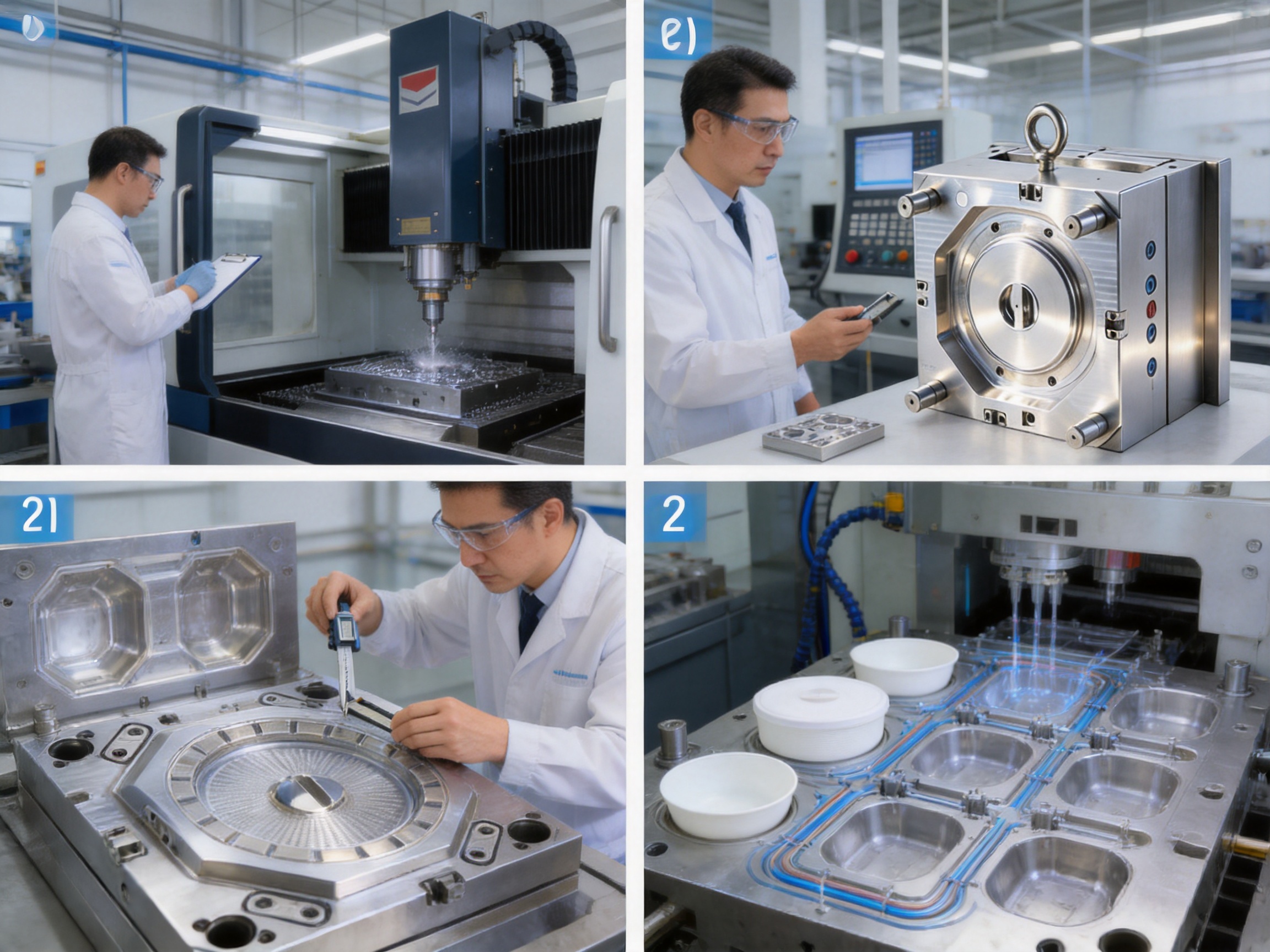
Quality Control for Airtight Bowl Production
Quality control should begin before mould manufacturing and continue throughout the mould’s operating life. During design, the customer and tooling supplier should agree on critical dimensions, acceptable tolerances, surface requirements, closure force, leakage criteria, material grade, and production conditions.
Dimensional inspection should focus on the bowl diameter, height, wall thickness, rim profile, base flatness, and lid interface. Roundness is especially important because a circular product can fail to seal even when measurements taken at only one or two points appear acceptable. Measuring equipment and inspection methods should be selected according to the required accuracy and production volume.
Visual inspection should assess flow marks, weld lines, burns, sink marks, scratches, flash, ejector marks, and color consistency. If the product is transparent, the inspection criteria may need to be more demanding. Cosmetic standards should be defined in advance so that the moulding team and customer have a common understanding of acceptable appearance.
Functional testing may include lid opening and closing cycles, inversion tests, liquid leakage tests, stacking tests, drop testing, and temperature-related evaluation. The appropriate tests depend on the final product claim and intended market. A mould provides the foundation for consistency, but finished-product testing confirms whether the complete bowl system meets its practical requirements.
Production and Maintenance Recommendations
Correct production conditions are necessary to achieve the intended performance of the mould. The processor should use the approved resin grade and follow the material supplier’s recommendations for drying, melt temperature, mould temperature, injection speed, and holding pressure. Changing to a different grade without process evaluation can affect shrinkage, filling behavior, clarity, and sealing performance.
Cooling circuits should be checked regularly for flow restrictions, contamination, and temperature imbalance. Poor-quality cooling water can cause deposits or corrosion inside the channels, reducing heat transfer and increasing cycle-time variation. A planned water-treatment and inspection program helps protect the mould and maintain stable production.
The hot runner system should be operated within its recommended temperature range. Sudden temperature changes, incorrect startup procedures, or prolonged residence time can create material degradation or gate-related defects. Operators should follow a controlled startup and shutdown procedure and maintain records of temperature alarms and maintenance activities.
The parting surfaces, guide components, ejector system, and sealing inserts should be cleaned and inspected at suitable intervals. Any unusual resistance during mould opening or ejection should be investigated rather than ignored. Early correction of a minor issue can prevent damage to the cavity, core, or closure features.
Lubrication should be applied only to the appropriate components and in the correct quantity. Excess lubricant may contaminate product areas, while insufficient lubrication can accelerate wear. Spare wear plates, seals, ejector components, and selected hot runner parts may be kept available according to the customer’s maintenance plan.
Project Development Process for Customers
Step One: Submit Product Requirements
The customer should provide the bowl and lid drawings, 3D files, intended material, target capacity, expected annual volume, machine information, surface finish requirements, and packaging application. If the product is intended for food contact, microwave reheating, or repeated reuse, those requirements should be identified at the beginning.
Step Two: Review Design Feasibility
The engineering team reviews draft angles, wall thickness, sealing features, parting lines, ejection, gate location, cooling, and cavity layout. Potential issues are discussed before the mould design is released. This stage is an opportunity to balance product performance with manufacturing practicality.
Step Three: Confirm Tooling Specifications
The customer and mould maker confirm steel grade, cavity number, runner type, surface finish, mould life target, standard components, spare parts, inspection requirements, and delivery schedule. Written confirmation reduces misunderstandings and provides a reference for later acceptance.
Step Four: Approve the Mould Design
A detailed mould design is prepared for review. The customer can check the parting line, gate position, ejection marks, cooling layout, logo location, and maintenance access. Any revisions should be completed before machining begins.
Step Five: Manufacture and Trial the Mould
After design approval, the mould is machined, polished, assembled, and tested. Trial samples are produced using the agreed material or an approved equivalent. The samples are measured and evaluated for appearance, dimensions, lid matching, and practical function.
Step Six: Complete Acceptance and Handover
Once the mould meets the agreed requirements, final inspection and sample approval are completed. The customer receives the mould together with relevant technical information and maintenance recommendations. After-sales support remains important if production conditions or product requirements change later.
Economic Value of a Precision Lunch Bowl Mould
Tooling cost should be evaluated in relation to the complete production lifecycle rather than the purchase price alone. A cheaper mould may require more frequent correction, produce more rejected parts, consume more material, or reach the end of its useful life earlier. These indirect costs can exceed the original price difference.
A precision mould can create value through higher first-pass yield, reduced material waste, stable cycle time, fewer manual adjustments, and better customer acceptance. For a bowl and lid system, consistent matching also reduces the need to sort components or pair parts manually. This can be especially beneficial when the bowl and lid are produced in separate moulds or at different times.
Multi-cavity tooling can further improve unit economics by increasing output per cycle. However, the customer should select the cavity quantity based on realistic demand. A four-cavity tool may not be the best choice for a low-volume product, while a two-cavity tool may limit output for a large established program. Engineering analysis should consider the total cost of ownership, available machine capacity, expected utilization, maintenance requirements, and projected sales.
Material efficiency is another important consideration. Lightweight containers are increasingly attractive because they reduce resin consumption and transportation weight. The mould must support the required thin-wall structure without creating excessive warpage or weakness. A balanced design can help manufacturers achieve a competitive product while maintaining functional performance.
Environmental and Sustainability Considerations
Reusable lunch bowls can contribute to waste reduction when they are designed for repeated use and properly managed. The mould supports product concepts made from durable plastic materials, including PP and Tritan, which may be selected for reusable applications according to the customer’s product strategy and applicable regulations.
Material reduction should be approached carefully. Excessively thin walls may reduce durability, create deformation, or shorten the product’s useful life. Sustainable design therefore requires a balance between lightweight construction, mechanical strength, sealing performance, and expected reuse cycles.
The hot runner system may help reduce runner waste, while multi-cavity production can improve machine utilization. Durable steel and a long service-life target can also reduce the frequency of mould replacement. These factors do not automatically make a product sustainable, but they provide practical opportunities for manufacturers to improve resource efficiency across the production process.
Customers should also consider end-of-life labeling, material identification, recycling compatibility, colorants, additives, and local waste-management systems. Final environmental claims must be based on the complete product system and verified according to the regulations of the target market.
Frequently Asked Questions
What products can this mould produce?
The mould is designed for round airtight plastic lunch bowls and related sealed food containers. Typical applications include meal preparation bowls, lunch storage containers, takeaway packaging, reusable kitchen containers, and selected reheating-oriented bowl concepts.
Which materials are compatible with the mould?
The stated material options are PP, Tritan, and PET. The final material should be selected according to the required clarity, toughness, heat performance, sealing behavior, food-contact requirements, and regulatory conditions. Processing parameters must be adjusted for the selected resin grade.
How many cavities are available?
The specification supports 2–4 cavities. The best configuration depends on the required production volume, part weight, injection machine capacity, target cycle time, and investment plan.
Why is the cooling system important for a round bowl?
Uneven cooling can cause shrinkage differences and warpage. For a round bowl, this may result in ovality or deformation around the rim, preventing the lid from fitting consistently. Optimized cooling channels help improve roundness and dimensional stability.
Does the mould include a hot runner system?
Yes. The specified runner type is a hot runner system. It is intended to support efficient filling, reduce runner waste, and improve suitability for high-volume production when properly controlled.
What mould steel is used?
The stated steel options are 718 and S136. The final selection can be confirmed according to the required surface finish, corrosion resistance, production volume, material characteristics, and customer expectations.
What is the expected mould life?
The stated mould life is more than 800,000 shots. Actual service life depends on operating conditions, resin additives, maintenance, cooling-water quality, processing settings, and replacement of wear components.
Can the bowl capacity be customized?
Yes. Capacity customization is available. The diameter, height, internal shape, wall thickness, and lid structure can be reviewed to meet a particular volume requirement. Any capacity change should be evaluated for filling, cooling, shrinkage, stackability, and machine compatibility.
Can a custom logo be added?
Yes. Custom brand logo engraving can be incorporated into the mould. The artwork, location, depth, and line detail should be reviewed before machining to ensure clear reproduction and practical moulding performance.
Can the lid locking structure be customized?
Yes. The mould design can support customized lid locking structures, including suitable snap-fit or sealing features. The closure should be evaluated for sealing performance, opening force, durability, draft, ejection, and material behavior.
Does the mould guarantee that the finished bowl is microwave-safe?
No mould alone can establish a microwave-safety claim. The product’s suitability depends on the material grade, product structure, lid design, processing conditions, and testing. The finished bowl must be validated according to the customer’s intended market and applicable requirements.
How can the mould be maintained?
Maintenance should include cleaning the parting surfaces, inspecting guide and ejector components, checking cooling channels, monitoring the hot runner system, applying appropriate lubrication, and replacing worn components when necessary. A preventive maintenance schedule is recommended for long production programs.
Conclusion
The Round Airtight Plastic Lunch Bowl Injection Mould is a precision tooling solution for manufacturers seeking reliable production of sealed food containers. Its key features include accurate bowl and lid matching, optimized cooling for roundness, support for thin-wall designs, a hot runner system, 2–4 cavity configurations, 718 or S136 mould steel, mirror polishing, and a service-life target of more than 800,000 shots.
These characteristics provide meaningful advantages over basic tooling. They can help reduce sealing inconsistencies, control warpage, improve material efficiency, support higher output, and provide flexibility for different capacities, locking structures, and branded designs. The mould is suitable for meal preparation, lunch storage, takeaway packaging, and selected reheating-oriented applications when the finished product is properly validated.
Behind the product is an integrated manufacturing capability covering product review, mould design, precision machining, polishing, assembly, trial moulding, inspection, delivery, and after-sales support. Experience across daily necessities, home appliances, automotive components, and industrial equipment strengthens the engineering foundation available for complex injection mould projects.
For customers planning a new food-container program, the most effective approach is to define the product requirements early, confirm the resin and production volume, review the sealing structure carefully, and select the cavity configuration according to realistic demand. With appropriate design coordination and disciplined maintenance, this mould can provide a dependable foundation for efficient, repeatable, and commercially competitive lunch bowl production.
References
1. General principles of injection mould design for thin-wall plastic containers.
2. Standard engineering practices for hot runner systems and multi-cavity mould balancing.
3. Technical guidance on PP, Tritan, and PET processing for food-container applications.
4. Mold steel selection principles for precision plastic injection tooling.
5. Recommended practices for cooling-channel design, warpage control, and dimensional stability.
6. Quality-control methods for plastic food packaging, bowl-and-lid fit, and leakage evaluation.
7. Preventive maintenance practices for high-cycle injection moulds.
Product: Round Airtight Plastic Lunch Bowl Injection Mould

For exclusive deals and latest offers, sign up by entering your email address below.












 +86-18657672567
 sales@tzhqmould.com
celin@tzhqmould.com
 No. 17 Houshi Road, Beicheng Industrial Zone, Huangyan District, Taizhou City, Zhejiang Province, China
Copyright © Taizhou Huangyan Haiquan Plastic Mold Co., Ltd. All Rights Reserved
Injection Plastic Mould Maker

