

Thickened Plastic Mop Bucket Cleaning Tool Mould for Durable Injection-Molded Products
Admin 2026-08-27
A reliable mop bucket is more than a simple household container. It must hold a substantial volume of water, withstand repeated handling, accommodate a wringer or other cleaning mechanism, and remain stable during daily use. For manufacturers of household cleaning products and commercial janitorial equipment, the quality of the injection mold directly influences all of these performance characteristics. A well-designed mold can improve product strength, dimensional consistency, assembly accuracy, surface quality, and production efficiency.
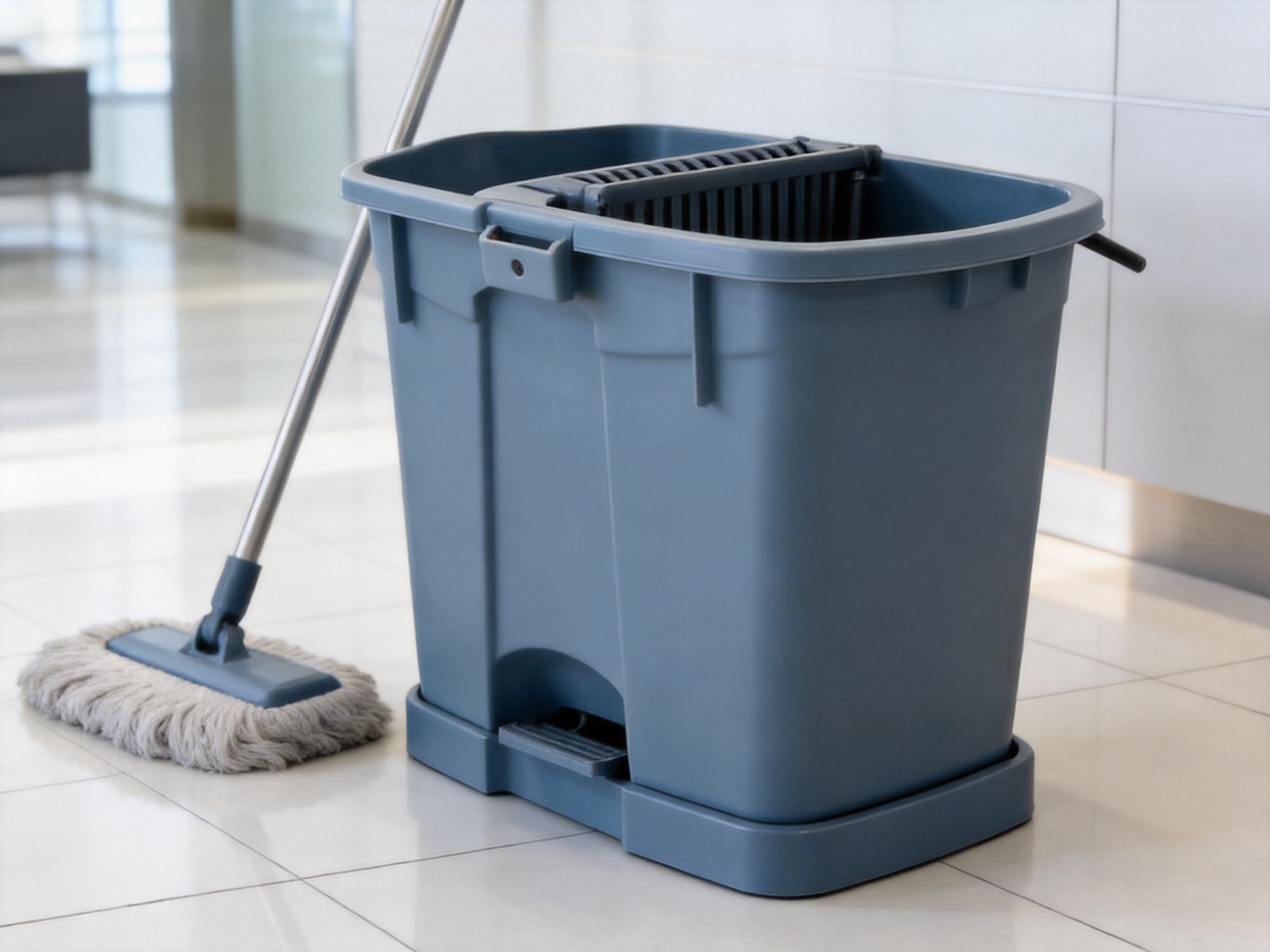
The Thickened Plastic Mop Bucket Cleaning Tool Mould is developed for producing reinforced plastic mop buckets used in homes, offices, hotels, schools, factories, hospitals, and professional cleaning operations. It is intended for polypropylene production and is configured as a one-cavity mold. Its design supports thickened bucket structures, integrated handle slots, and optional wringer components. The result is a practical tooling solution for manufacturers seeking a durable, functional, and customizable cleaning bucket.
This product belongs to the cleaning products mold category and reflects the manufacturing capabilities of Taizhou Huangyan Haiquan Plastic Mold Co., Ltd., a high-tech enterprise specializing in precision injection molds for daily necessities, home appliances, automotive parts, and industrial equipment. Through professional mold design, controlled manufacturing procedures, and organized production management, the company provides tooling from initial development through production support and after-sales service.
Why the Mop Bucket Mold Matters
Plastic mop buckets are exposed to demanding conditions. They are filled with water, lifted by their handles, pushed across floors, emptied frequently, and often stored in locations where they may be struck or stacked against other products. Commercial cleaning buckets experience even greater usage because they are repeatedly transported between rooms and work areas. If the bucket wall is too thin, the base is poorly supported, or the handle connection is not properly formed, the finished product may deform, crack, or become uncomfortable to use.
The injection mold establishes the geometry of every important feature. It determines the wall thickness, corner transitions, bottom reinforcement, handle openings, wringer mounting areas, and external appearance. It also affects how plastic flows through the cavity and how evenly the product cools. These factors make mold engineering essential for producing a bucket that is both attractive and dependable.
The Thickened Plastic Mop Bucket Cleaning Tool Mould is designed around the requirements of heavy-duty cleaning products. Rather than focusing only on a low initial tooling cost, the design emphasizes practical product performance and repeatable manufacturing. Reinforced structures can be incorporated into the bucket body, while the handle slots and wringer areas can be developed according to the buyer’s product concept.
For manufacturers, this approach provides a foundation for creating a cleaning bucket that meets market expectations without requiring an entirely new tooling strategy for every variation. Capacity, wringer structure, and selected functional details can be adjusted to suit a particular brand, sales channel, or application.
Product Overview
The mold is intended to produce plastic mop buckets made from PP, or polypropylene. Polypropylene is widely used in household and commercial products because it offers a useful balance of strength, chemical resistance, low density, processing flexibility, and cost efficiency. It is suitable for products that may come into contact with water, diluted detergents, and common household cleaning solutions.
The tooling configuration uses one cavity. A one-cavity mold can be advantageous for products that require a relatively large molding area or that are being developed for controlled production volumes. It provides a straightforward production structure and allows the mold maker to concentrate on balanced filling, cooling, ejection, and dimensional stability for one complete bucket at a time.
The mold steel options are P20 and H13. P20 is commonly used for general-purpose injection mold construction and offers a practical combination of machinability, strength, and service performance. H13 is a hot-work tool steel known for its ability to withstand demanding thermal and mechanical conditions. The selection between these materials can be considered according to production volume, expected service conditions, product requirements, and the customer’s budget.
The stated mold life is up to 700,000 shots. Actual service life depends on factors such as material selection, molding temperature, injection pressure, maintenance, cooling-water quality, operating conditions, and the use of recycled material. Nevertheless, this service-life target demonstrates that the tooling is intended for sustained commercial production rather than short-term sampling alone.
| Product | Thickened Plastic Mop Bucket Cleaning Tool Mould |
| Product Category | Cleaning Products Mold |
| Application | Household and commercial mop buckets |
| Product Material | PP |
| Cavity Configuration | 1 cavity |
| Mold Steel Options | P20 / H13 |
| Target Mold Life | 700,000 shots |
| Customization | Capacity and wringer structure can be adjusted |
| Primary Features | Reinforced bucket body, handle slots, optional wringer integration |
Reinforced Bucket Construction
The main advantage of a thickened mop bucket design is its ability to support a heavier water load and tolerate repeated handling. When a bucket is full, the sidewalls and base must resist outward pressure and bending. A reinforced structure can help reduce deformation and maintain the bucket’s shape during lifting, transport, and use.
Thickened areas may be applied to selected portions of the product rather than increasing the thickness uniformly throughout the entire bucket. This can help place material where it contributes most to strength, such as around the bottom, corners, handle connections, rim, and wringer support sections. A carefully engineered structure can improve rigidity while avoiding unnecessary material consumption.
Corner design is particularly important. Sharp internal corners can create stress concentration and may interfere with smooth plastic flow. Rounded transitions generally provide better continuity between the sidewalls and bottom. They can also support easier demolding and reduce the risk of visible molding defects. The mold design process therefore considers not only the external appearance but also how each contour affects filling, cooling, and ejection.
The bucket rim is another key structural area. A stable rim can improve the product’s resistance to opening or twisting and may provide a suitable location for attaching or supporting a wringer. The rim can also improve user comfort by providing a controlled edge for handling and cleaning. Depending on the final product concept, the rim may include additional reinforcement or a shape that supports stacking and storage.
Integrated Handle Slots and Wringer Support
Handle slots are essential to the practical use of a mop bucket. They must be positioned to provide a comfortable lifting balance while preserving the strength of the upper bucket structure. If the slot is too close to a thin wall or a sharp corner, stress may concentrate around the opening. If the slot is poorly located, the bucket may tilt when carried.
The mold can incorporate handle slots as part of the bucket body. Their dimensions, position, and surrounding reinforcement can be adjusted according to the planned handle design and product capacity. This gives manufacturers the flexibility to use a molded grip, a separate plastic handle, or another suitable carrying arrangement.
Wringer components can also be integrated into the mold design. A wringer may be used to squeeze excess water from a mop before floor cleaning. Its structure must be sufficiently supported because users may apply downward force repeatedly. The connection between the wringer and the bucket should therefore be considered during the earliest stages of product and mold development.
Customization of the wringer structure can include its position, shape, drainage openings, mounting surfaces, and relationship to the bucket rim. Depending on the customer’s design, the wringer may be molded as part of the main bucket, designed as a separate component, or supported through a combination of molded features and assembly elements.
Combining the bucket and wringer requirements during mold development can reduce later modification work. It can also help ensure that the finished product has an appropriate balance between load-bearing strength, drainage performance, user convenience, and ease of cleaning.

Thickened Plastic Mop Bucket Cleaning Tool Mould
Material Selection: Why PP Is Suitable
Polypropylene is one of the most widely used thermoplastics for household and cleaning products. It has a relatively low density, which helps keep the finished bucket light enough for everyday handling. At the same time, it can provide adequate rigidity and impact performance when the product geometry and processing conditions are correctly controlled.
PP also offers useful resistance to moisture and many commonly used household chemicals. A mop bucket may be exposed to water, diluted detergents, floor-cleaning solutions, and disinfectants. While the chemical compatibility of any specific formulation should be evaluated separately, polypropylene is generally a practical material option for this type of application.
From a manufacturing perspective, PP can be processed efficiently through injection molding. It flows into complex product features, fills large surfaces, and can be formulated in different grades according to stiffness, impact strength, appearance, and processing requirements. The selected PP grade should be matched to the bucket design, expected load, operating environment, and customer quality standards.
Material drying and handling requirements should follow the recommendations for the selected resin. Although polypropylene normally has lower moisture sensitivity than some engineering plastics, proper storage and contamination control remain important. Clean material handling helps reduce surface defects, color variation, and inconsistent molding behavior.
One-Cavity Mold Configuration
A one-cavity mold produces one complete bucket during each injection cycle. This configuration can be suitable for large-format cleaning products where the cavity size, injection volume, cooling arrangement, and machine capacity must be carefully coordinated. It also simplifies the relationship between the runner system and the product cavity.
For a large bucket, one cavity provides an opportunity to optimize the filling pattern around a single product. The gate position can be evaluated in relation to the bottom, sidewalls, rim, wringer support, and handle areas. The goal is to promote stable filling and reduce the likelihood of weld lines in highly stressed locations.
A one-cavity solution may also be suitable for brands that require moderate production volumes, frequent product changes, or a customized bucket design. It can offer greater flexibility during product development than a multi-cavity arrangement, where every cavity must maintain the same dimensions and process balance.
The most appropriate cavity count depends on the customer’s annual demand, cycle-time expectations, available injection machine, product size, and investment plan. For the specified mop bucket tooling, the one-cavity arrangement offers a focused solution for producing a large, reinforced cleaning product.
Advanced Mold Design Considerations
Parting Line Planning
The parting line divides the mold into its principal sections and must be positioned carefully. For a mop bucket, the parting line should support reliable demolding while minimizing visible flash on important surfaces. The mold maker evaluates the bucket’s shape, handle slots, rim, wringer features, draft angles, and any undercuts before selecting the most practical parting arrangement.
A well-planned parting line can make the mold easier to operate and maintain. It may also reduce the need for complicated mechanisms, shorten cycle interruptions, and support consistent product appearance. If the product contains difficult side openings or undercut features, slides, lifters, or other mold actions may be considered during the engineering stage.
Draft Angles and Demolding
Draft angles allow the molded bucket to separate from the cavity and core without excessive friction. They are especially important for tall sidewalls and deep containers. Without adequate draft, the product may stick, become scratched, or require excessive ejection force.
Draft must be balanced with the customer’s appearance and capacity requirements. Excessive draft could alter the usable volume or external proportions, while insufficient draft could harm production stability. The mold design team therefore considers the depth of the bucket, surface texture, wall thickness, shrinkage characteristics of PP, and ejection direction.
Wall Thickness and Flow Behavior
Wall thickness has a direct influence on filling, cooling, strength, weight, and cycle time. A thickened bucket must be engineered carefully because very thick areas may increase cooling time or cause sink marks. On the other hand, insufficient thickness may compromise rigidity and impact resistance.
The goal is not simply to make every area as thick as possible. Instead, the product should use a logical distribution of material that supports structural loads while maintaining suitable molding performance. Ribs, bosses, rounded transitions, and localized reinforcement can help achieve the required stiffness without creating unnecessary mass.
Plastic flow should be considered around the entire bucket. The gate and runner arrangement must deliver molten PP into the cavity in a controlled manner. The mold maker evaluates potential weld lines, air traps, hesitation, flow marks, and uneven filling. Adjustments to gate location, venting, wall geometry, and process conditions can improve the finished result.
Cooling System Design
Cooling is one of the most important parts of injection mold performance. The bucket has a relatively large surface area and may contain thickened sections that retain heat. If cooling is uneven, the finished product can warp, shrink unevenly, or lose dimensional accuracy.
A suitable cooling layout should remove heat efficiently from the sidewalls, bottom, rim, and other major features. Cooling channels must be positioned to maintain a practical balance between performance and mold strength. They should also be accessible for inspection and cleaning where possible.
Stable cooling supports more consistent cycle times and reduces variation between molded parts. It can also improve the appearance of the bucket by limiting distortion and minimizing stress-related defects. For commercial manufacturers, predictable cooling is important because it influences both output and production planning.
Venting and Air Management
Air trapped inside the cavity can lead to burn marks, short shots, poor surface quality, or incomplete formation of details. Large products with long flow paths require careful venting because air must escape as molten PP advances through the cavity.
Vents can be arranged in suitable areas near the end of fill, parting line, and other locations where air may accumulate. Vent design must be deep enough to release air but controlled enough to avoid excessive flash. Proper venting is particularly important around the bottom, corners, handle openings, and wringer support features.
Ejection System
The ejection system must remove the bucket smoothly while preserving its appearance and dimensions. Ejector locations should be selected according to the product’s structural strength and the areas that can tolerate ejection marks. For a large container, balanced ejection helps prevent tilting, sticking, and local deformation.
The bucket’s draft angles, cooling condition, and ejection force work together. If the product is still too hot or if the mold has insufficient draft, the ejectors may need to apply excessive force. This can damage the product or increase wear on the tooling. A coordinated approach to part design and mold engineering helps maintain stable demolding.
Steel Options: P20 and H13
The selection of mold steel affects machinability, wear resistance, polishing performance, maintenance requirements, and expected service life. The specified options for this mold are P20 and H13, allowing the customer to select a tooling material appropriate for the production plan.
P20 Mold Steel
P20 is widely used for injection mold components because it is practical to machine and offers reliable performance for many plastic products. It can be suitable for general production applications where the molding material and operating conditions are within normal ranges. Its balance of cost and performance makes it a common choice for household product tooling.
For a mop bucket mold, P20 may provide an economical solution when the customer requires dependable commercial production without the additional investment associated with more specialized steel grades. It can also be appropriate where the product surface requirements, annual output, and processing conditions do not demand the higher thermal performance of H13.
H13 Mold Steel
H13 is a hot-work tool steel recognized for high toughness and resistance to thermal fatigue. It can be considered for tooling exposed to demanding molding conditions, extended production cycles, or higher requirements for durability. H13 may be particularly valuable when the customer anticipates intensive use and wants additional resistance in selected mold components.
The choice between P20 and H13 should be made after reviewing product geometry, annual production, resin grade, machine conditions, maintenance arrangements, and budget. A mold manufacturer with experience in daily necessities tooling can help identify where a higher-grade steel provides meaningful value and where a standard option is sufficient.
Manufacturing Process for the Mop Bucket Mold
Advanced mold production begins long before steel is cut. The process normally starts with a review of the customer’s product concept, technical drawings, three-dimensional data, sample, or application requirements. For the mop bucket, the engineering team examines capacity, handle placement, wringer construction, wall thickness, appearance, assembly needs, and expected production volume.
Product Design Review
A product design review identifies possible molding risks before tooling begins. The team may evaluate draft angles, undercuts, wall transitions, rib thickness, shrinkage allowance, parting line position, gate location, and ejection areas. This stage is important because design changes are generally easier and less expensive before machining starts.
The review also helps determine whether the bucket should be produced as one integrated product or as a body with separately molded wringer components. If a customer wants a modified capacity or a different wringer configuration, these requirements can be considered as part of the initial mold concept.
Three-Dimensional Mold Design
After the product requirements are confirmed, the mold is developed in three-dimensional design software. The design defines the core, cavity, inserts, cooling channels, runners, gates, ejectors, slides, guide components, and other mold structures. Each component must fit into a coordinated system that can be assembled, operated, inspected, and maintained.
Digital mold design helps identify interference, insufficient clearances, difficult machining areas, and potential demolding problems. It also allows the engineering team to review the relationship between the bucket body and functional features such as the handle slots and wringer supports.
Steel Preparation and CNC Machining
Once the design is approved, the selected mold steel is prepared for machining. CNC machining is used to form the cavity, core, inserts, and other precision components. Large curved surfaces and deep bucket geometries require stable machining practices to maintain dimensional accuracy and surface continuity.
Machining parameters are selected according to the steel type, tool geometry, feature size, and required finish. Proper workholding and process control help reduce vibration and dimensional variation. The objective is to create a cavity that reproduces the approved product geometry consistently over the life of the tool.
Precision Finishing
After rough and semi-finish machining, important surfaces may undergo additional finishing. Depending on the customer’s requirements, the cavity can be polished, textured, or prepared for a specified appearance. Surface quality is especially relevant for consumer cleaning products because visual defects can affect market acceptance even when the bucket performs correctly.
Finishing must preserve the intended dimensions and edge conditions. Excessive polishing can alter details, while insufficient finishing may leave tool marks on visible surfaces. Controlled inspection during this stage supports a balanced result between appearance and functional accuracy.
Assembly and Mold Fitting
Individual components are assembled after machining and finishing. The mold maker checks alignment between the core and cavity, movement of slides or lifters, operation of the ejection system, and fit of guide components. Proper fitting is essential for preventing flash, uneven wear, and premature component damage.
Cooling connections, runners, ejector mechanisms, and other functional systems are also checked. The completed mold should open and close smoothly and provide sufficient access for cleaning, lubrication, inspection, and future maintenance.
Trial Molding and Correction
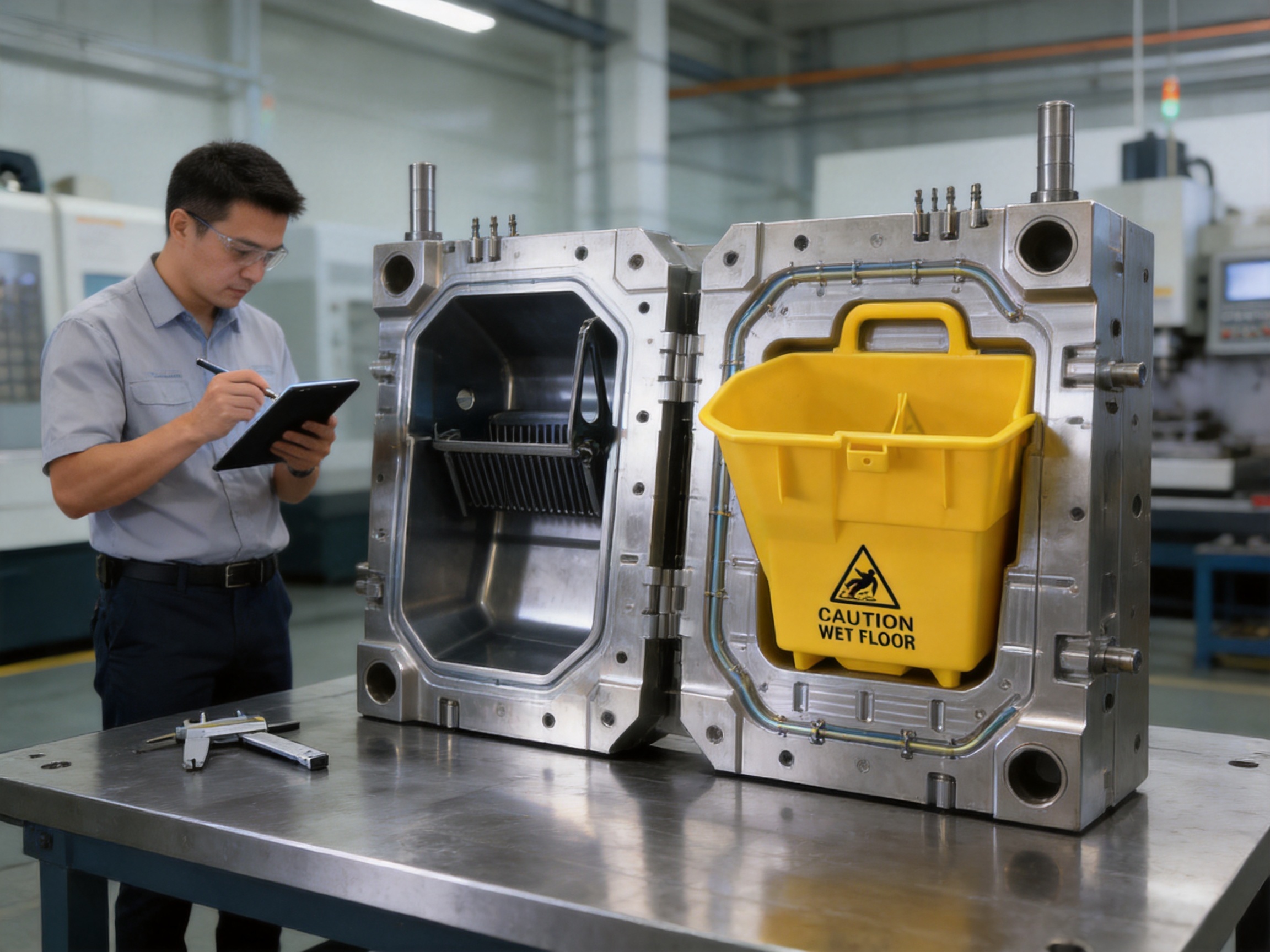
Trial molding verifies how the tooling performs with the selected PP material and a suitable injection machine. Test parts are reviewed for filling, warpage, sink marks, flash, weld lines, short shots, ejection marks, and dimensional accuracy. The team may also evaluate the bucket’s strength, handle balance, wringer fit, and overall appearance.
If adjustments are required, they may involve polishing, venting, gate refinement, cooling improvements, ejection changes, or localized geometry correction. Trial molding is a valuable stage because it connects the digital design with real production behavior. It enables the manufacturer to address practical issues before the mold enters regular production.
Advantages Compared with Basic or Underspecified Tooling
Many low-cost molds can produce a plastic container, but not every mold is appropriate for a heavy-duty mop bucket. A basic container mold may overlook handle stress, wringer forces, bottom reinforcement, cooling balance, or long-term maintenance. These omissions can create problems after the product reaches the market.
The Thickened Plastic Mop Bucket Cleaning Tool Mould offers several advantages over tooling that is designed only for initial sample production.
Improved Structural Reliability
The reinforced bucket concept supports a stronger product structure. Thickened and strategically reinforced sections can help the bucket carry heavy water loads and withstand repeated movement. This is particularly valuable for professional cleaning applications where the product may be used throughout the day.
Functional Integration
Handle slots and wringer components can be considered in the mold design rather than added as an afterthought. This improves the opportunity to create a balanced, usable product and can reduce the need for improvised attachments or secondary modifications.
Material and Steel Flexibility
The use of PP provides a practical material solution for household and commercial cleaning buckets. The availability of P20 and H13 steel options gives customers a choice based on expected output, durability requirements, and investment level. This is more flexible than a tooling package that offers only one fixed material or construction standard.
Long-Service Production Capability
A target service life of 700,000 shots indicates a focus on sustained production. Although proper maintenance remains essential, a durable mold can help reduce the risk of frequent replacement and protect the customer’s long-term tooling investment.
Customization Potential
Capacity and wringer structure can be adjusted to meet different market requirements. A household bucket may prioritize compact storage and easy handling, while a commercial bucket may require greater water capacity, stronger support, or a more robust wringer. Customizable tooling helps manufacturers respond to these differences.
Manufacturing Support
Haiquan’s mold-making services cover design, production, and after-sales support. This integrated approach can simplify communication and reduce the risk of information loss between separate design and tooling suppliers. Customers can discuss product objectives with a manufacturer that understands both mold construction and injection molding requirements.
Applications in Household and Commercial Cleaning
The mold is suitable for producing household cleaning buckets used for mopping kitchens, bathrooms, living areas, corridors, balconies, and other floors. The bucket can be developed for consumers who need a practical container that is easy to carry, drain, clean, and store.
Commercial janitorial operations represent another important application. Cleaning contractors, hotels, schools, hospitals, shopping centers, offices, and factories often require equipment that can withstand frequent use. A reinforced bucket with an integrated wringer can help improve workflow by combining water storage and mop preparation in one product.
The bucket may also be used as part of a broader floor-cleaning tool system. Product designers can coordinate the bucket with mop handles, microfiber heads, cotton mops, squeegees, or other accessories. Handle slot dimensions, wringer height, and internal clearance can be adjusted to suit the intended cleaning tool.
Retail products may emphasize color, surface texture, compactness, and user-friendly features. Institutional products may place greater emphasis on capacity, impact resistance, chemical exposure, and ease of sanitation. The mold can be adapted to the product strategy selected by the manufacturer.
Product Customization Opportunities
Customization begins with capacity. Different users may prefer a compact bucket for apartments or a larger version for professional cleaning. Increasing capacity may affect the bucket height, width, wall structure, handle position, cooling system, and machine requirements. These changes should be evaluated together rather than treated as isolated modifications.
The wringer structure is another major customization area. Some designs use a simple press or squeeze section, while others incorporate a larger mechanism intended for specific mop heads. The shape must support effective water removal without creating difficult-to-clean recesses or excessive stress on the bucket rim.
External appearance can also be adjusted. The product may include brand-specific contours, molded logos, grip surfaces, color zones, or textured panels. Surface design should be coordinated with draft and demolding requirements to preserve both appearance and production stability.
Handle options may include open slots, molded grips, separate handles, or reinforced carrying areas. The handle must be compatible with the product’s center of gravity. A full bucket should remain reasonably stable when lifted, and the grip should be comfortable for the intended user.
Drainage details may be added according to the product concept. Drain holes, pouring lips, or controlled emptying areas can improve convenience. However, each opening must be evaluated for structural effect, molding feasibility, cleaning performance, and the possibility of water retention.
Quality Control and Inspection
Quality control should cover both the mold and the molded product. During mold production, inspection can verify steel dimensions, cavity and core alignment, insert fit, cooling-channel condition, ejector movement, surface finish, and overall assembly accuracy.
During trial molding, the finished bucket should be checked for key dimensions such as overall height, width, depth, rim size, handle-slot position, wringer interface, and bottom geometry. Dimensional consistency is important for assembly and for maintaining predictable product performance.
Functional testing may include water-load evaluation, handle lifting, wringer operation, repeated opening and closing, impact checks, and stability assessment. The exact test program should be determined by the customer’s product standard and market requirements.
Appearance inspection can identify flash, sink marks, short shots, weld lines, flow marks, scratches, burn marks, and color variation. Some surface characteristics may be acceptable depending on the product finish, but visible defects in consumer-facing areas should be controlled carefully.
Process documentation also supports quality consistency. Records of mold steel, trial conditions, approved samples, correction history, and maintenance activities can help the manufacturer manage future production and respond efficiently if a problem occurs.
Maintenance and Expected Mold Life
A mold designed for up to 700,000 shots still requires regular maintenance. Preventive maintenance can include cleaning the cavity and core, checking ejector components, lubricating moving parts, inspecting cooling channels, confirming guide alignment, and removing residue from the runner or venting system.
Polypropylene processing can create deposits if the material is contaminated or if molding conditions are not controlled. Keeping the mold clean helps preserve surface quality and reduces the risk of sticking. Cooling water should also be managed carefully because scale or corrosion can restrict flow and reduce cooling performance.
Operators should monitor unusual sounds, increased ejection force, flash, changing cycle times, and dimensional variation. These signs may indicate wear, alignment problems, blocked cooling channels, or damage to a mold component. Early attention can prevent a minor issue from becoming a major production interruption.
When the mold is removed from the machine for storage, the surfaces should be cleaned and protected according to the mold maintenance procedure. Cooling channels may require appropriate treatment, and exposed steel surfaces should be protected against corrosion. Storage in a dry, organized environment helps preserve tooling condition.
Manufacturing Strengths of the Supplier
Taizhou Huangyan Haiquan Plastic Mold Co., Ltd. is based in Huangyan District, Taizhou City, Zhejiang Province, an area widely associated with plastic mold production. The company specializes in the research, development, and manufacture of precision injection molds for several product sectors.
Its four primary sectors are daily necessities, home appliances, automotive parts, and industrial equipment. This range gives the company experience with different product sizes, material requirements, structural standards, and production expectations. Knowledge gained from one sector can support problem solving in another, particularly in areas such as mold strength, cooling, precision machining, and process control.
The company describes itself as a high-tech enterprise and emphasizes a professional design team and a scientific production management system. For a large cleaning bucket mold, these capabilities are important because the tooling requires more than basic cavity machining. It requires coordinated product engineering, mold structure design, manufacturing control, testing, and support after delivery.
The company follows a quality-first and sustainable-development philosophy. In practical terms, this approach can be reflected in the selection of appropriate steel, attention to process consistency, efficient tooling design, and efforts to provide products that remain useful over an extended production period.
Haiquan supplies customers in Europe, the Middle East, Southeast Asia, and South America. International experience can help a mold manufacturer understand the importance of communication, documentation, delivery coordination, packaging, and after-sales response. Export customers may also require different product standards, appearance expectations, and production documentation.
The company provides integrated services from design and production to after-sales support. This is beneficial when a customer needs assistance with product modifications, trial-mold corrections, spare parts, maintenance guidance, or future tooling changes. A continuous relationship can be more efficient than transferring the project between unrelated suppliers.
Production Efficiency and Total Cost Considerations
The purchase price of a mold is only one part of the total cost of producing mop buckets. Other factors include cycle time, material consumption, rejected products, maintenance frequency, machine utilization, labor requirements, and mold replacement cost. A well-engineered tool can contribute to lower long-term production costs even if its initial price is not the lowest available.
Efficient cooling can shorten cycle time while supporting dimensional stability. Reliable ejection can reduce operator intervention and prevent damage. Accurate cavity surfaces can reduce the frequency of appearance-related rejects. Strong mold construction can help maintain consistent production over many cycles.
Material efficiency should also be considered. A thickened bucket requires strength, but excessive wall thickness may increase resin consumption and cooling time. Through careful structural design, reinforcing ribs and localized thickening can be used to provide performance where it is most needed. This can help create a better balance between product durability and manufacturing economics.
A one-cavity mold may be appropriate when the product is large or customized. For some production plans, one cavity can reduce the complexity of balancing multiple cavities and make tooling changes more manageable. The right choice depends on demand and output requirements, but a well-designed single-cavity mold can still support reliable commercial production.
Installation and Production Preparation
Before installing the mold, the injection molder should confirm the machine’s clamping force, platen dimensions, maximum mold height, injection volume, screw configuration, nozzle compatibility, and available cooling connections. The mold must be matched with equipment capable of filling and packing the large bucket cavity under stable conditions.
The selected PP grade should be reviewed together with its processing recommendations. Initial settings for barrel temperature, mold temperature, injection speed, holding pressure, cooling time, and screw recovery should be established during trial molding. These settings may require adjustment based on product weight, flow behavior, wall thickness, surface finish, and cycle-time targets.
Operators should inspect the mold before each production run. The cavity should be clean, moving components should operate smoothly, cooling lines should be connected correctly, and the ejection system should return to its proper position. A short dry-cycle check can help identify mechanical issues before plastic is injected.
During production, process parameters should be monitored rather than changed without documentation. Stable conditions help reduce variation in bucket weight, dimensions, appearance, and strength. If recycled PP or color masterbatch is used, the ratio and material quality should also be controlled.
Environmental and Sustainable Production Considerations
Polypropylene products can be designed with service life and material efficiency in mind. A durable bucket that remains functional over a long period may reduce the need for frequent replacement. Mold engineering that supports consistent production can also reduce rejected parts and unnecessary material waste.
Where appropriate, manufacturers may evaluate the use of recyclable PP streams, provided that the selected material meets the required performance and appearance standards. The effect of recycled content on impact strength, color, odor, shrinkage, and process stability should be tested before it is introduced into regular production.
Efficient cooling and optimized cycle times may help reduce energy consumption per product. Proper maintenance can extend mold life and reduce the environmental impact associated with producing replacement tooling. These considerations support the broader principle of sustainable development while also improving operational efficiency.
Why Professional Mold Engineering Is Important
A mop bucket may appear simple from the outside, but its manufacturing requirements are substantial. The product combines a deep container, curved walls, a reinforced base, carrying features, a possible wringer, and a surface that must often meet consumer appearance expectations. Each feature interacts with the injection process.
Professional mold engineering helps ensure that the product is not only formed but formed consistently. It considers how molten plastic enters the cavity, how air escapes, how heat is removed, how the part shrinks, and how the finished bucket is ejected. It also considers the practical realities of machine installation, cleaning, maintenance, and future repair.
For buyers comparing a specialized mold manufacturer with a general machining supplier, the difference often appears in the details. A supplier with experience in plastic molding can identify risks related to wall thickness, shrinkage, weld lines, handle stress, wringer installation, and product warpage before they become expensive production problems.
Recommended Customer Information for a Mold Project
To begin a customized mop bucket mold project, the customer should provide the intended bucket capacity, product drawings or three-dimensional files, target material grade, annual production quantity, preferred surface finish, color requirements, handle concept, wringer design, and expected market application.
Information about the injection machine is also useful. Machine specifications influence the mold dimensions, injection volume, clamping requirements, ejection arrangement, and cooling connections. Providing this data early helps the mold designer create a more practical tooling solution.
The customer should also explain whether the bucket will be sold for household or commercial use. A commercial product may require additional reinforcement, higher impact performance, stronger wringer support, and more extensive functional testing. A household product may prioritize compact dimensions, appearance, lightweight handling, and storage convenience.
Clear communication about production goals helps the supplier recommend the most suitable steel, cavity arrangement, mold actions, finishing level, and testing plan. It also improves the accuracy of quotations and delivery planning.
Q&A
What product is this mold designed to produce?
It is designed to produce thickened plastic mop buckets and related cleaning tools used in household and commercial floor-cleaning applications. The design can support a reinforced bucket body, handle slots, and integrated or customized wringer structures.
What plastic material is recommended?
The specified product material is polypropylene, or PP. PP is commonly selected for cleaning buckets because it is lightweight, processable, and generally resistant to moisture and many common cleaning substances. The final resin grade should be confirmed according to the required strength, appearance, and processing conditions.
How many cavities does the mold have?
The standard configuration is one cavity. This arrangement is suitable for a large-format bucket and allows the filling, cooling, and ejection systems to be developed around one complete product.
What mold steel options are available?
The listed steel options are P20 and H13. P20 offers a practical balance of cost, machinability, and service performance, while H13 may be selected when higher toughness and thermal-fatigue resistance are required. The best choice depends on production volume and operating conditions.
What is the expected mold life?
The stated mold life is up to 700,000 shots. Actual service life depends on maintenance, processing conditions, material quality, machine operation, cooling-water management, and other production factors.
Can the bucket capacity be changed?
Yes. Capacity can be adjusted according to the customer’s product requirements. Changes to capacity may affect the overall dimensions, wall structure, cooling layout, machine requirements, and handle position, so they should be reviewed during the initial design stage.
Can the wringer structure be customized?
Yes. The wringer structure can be adjusted to match the intended mop type, user requirements, drainage needs, and assembly method. The wringer may be integrated into the main bucket design or developed as a separate component, depending on the product concept.
Is the mold suitable for commercial cleaning equipment?
Yes. The reinforced bucket concept is suitable for commercial janitorial equipment, including products used in offices, hotels, schools, hospitals, factories, and cleaning service operations. Commercial applications may require additional testing for load capacity, impact resistance, and repeated wringer use.
Why is cooling important for this mold?
The bucket has a large surface area and may contain thickened structural sections. Uneven cooling can cause warpage, shrinkage variation, sink marks, and dimensional instability. A carefully designed cooling system helps produce more consistent parts and supports predictable cycle times.
What should be checked during a mold trial?
The trial should evaluate filling, short shots, flash, sink marks, weld lines, warpage, ejection, surface finish, bucket dimensions, handle-slot position, wringer fit, and product strength. Trial results guide any required corrections before regular production.
How can mold life be maintained?
Regular cleaning, lubrication, cooling-system inspection, alignment checks, proper storage, and timely replacement of worn components can help preserve the mold. Operators should also monitor changes in ejection force, flash, cycle time, and product dimensions.
What services does the supplier provide?
Taizhou Huangyan Haiquan Plastic Mold Co., Ltd. provides mold research and development, design, manufacturing, production support, and after-sales service. The company serves customers in daily necessities, home appliances, automotive parts, and industrial equipment.
What information should be included in an inquiry?
An inquiry should include product drawings or samples, capacity, PP grade, annual quantity, machine specifications, handle and wringer requirements, surface finish, color, target market, and delivery expectations. Complete information allows the mold maker to provide a more accurate technical recommendation.
Conclusion
The Thickened Plastic Mop Bucket Cleaning Tool Mould is a practical solution for manufacturers seeking durable injection-molded cleaning buckets. Its design supports reinforced bucket structures, integrated handle slots, and customizable wringer components. With PP as the product material, P20 or H13 as mold steel options, one-cavity construction, and a stated service life of up to 700,000 shots, it is intended for sustained production rather than temporary sampling.
The strongest advantages of this mold come from the combination of product-focused engineering and manufacturing capability. Structural reinforcement helps the bucket handle heavy water loads. Customization allows capacity and wringer details to be adjusted. Proper attention to parting lines, draft, cooling, venting, ejection, and steel selection supports reliable molding. Trial production and inspection provide opportunities to correct issues before mass production.
For manufacturers serving household, institutional, and commercial cleaning markets, the mold offers a foundation for developing products that are functional, durable, and suitable for repeated use. Supported by professional design, organized production management, international service experience, and after-sales support, the tooling can help customers build a dependable supply of injection-molded mop buckets and cleaning equipment.
References
1. Technical product information supplied for the Thickened Plastic Mop Bucket Cleaning Tool Mould.
2. Material information supplied for polypropylene injection-molded cleaning products.
3. Mold steel information supplied for P20 and H13 injection mold construction.
4. Company profile and manufacturing capability information supplied for Taizhou Huangyan Haiquan Plastic Mold Co., Ltd.
5. General injection molding principles covering mold design, cooling, venting, ejection, shrinkage, and preventive maintenance.
Product: Thickened Plastic Mop Bucket Cleaning Tool Mould

For exclusive deals and latest offers, sign up by entering your email address below.











 +86-18657672567
 sales@tzhqmould.com
celin@tzhqmould.com
 No. 17 Houshi Road, Beicheng Industrial Zone, Huangyan District, Taizhou City, Zhejiang Province, China
Copyright © Taizhou Huangyan Haiquan Plastic Mold Co., Ltd. All Rights Reserved
Injection Plastic Mould Maker

