

Round Food Storage Container Injection Mould: Precision Tooling for Efficient Plastic Container Production
Admin 2026-08-09Round food storage containers are widely used in homes, supermarkets, restaurants, food-processing facilities, meal-preparation services, and takeaway applications. Although the finished container may appear simple, producing it consistently requires a carefully engineered injection mould. The mould must create accurate circular geometry, stable wall thickness, reliable lid sealing, smooth surfaces, efficient cooling, and dependable demoulding during every production cycle.
The Round Food Storage Container Injection Mould is developed to meet these requirements. It is designed for the production of food storage containers, refrigerator boxes, meal-preparation containers, and related packaging products made from common thermoplastics such as polypropylene, polyethylene terephthalate, or polystyrene. Its structure combines precision machining, optimized gating, balanced filling, efficient cooling, and suitable surface treatment to support high-volume manufacturing.
Manufactured by Taizhou Huangyan Haiquan Plastic Mold Co., Ltd., the mould benefits from the company’s experience in precision injection tooling for daily necessities, home appliances, automotive components, and industrial equipment. The manufacturer provides a complete service covering product design assistance, mould engineering, machining, assembly, testing, delivery, and technical support after shipment.
For buyers comparing mould suppliers, the most important considerations are not limited to the initial quotation. Mould life, repeatability, cycle time, material efficiency, product appearance, sealing performance, maintenance requirements, and technical communication all influence the total cost of ownership. This article explains how the round container mould addresses those factors and why its engineering structure can offer practical advantages in demanding production environments.
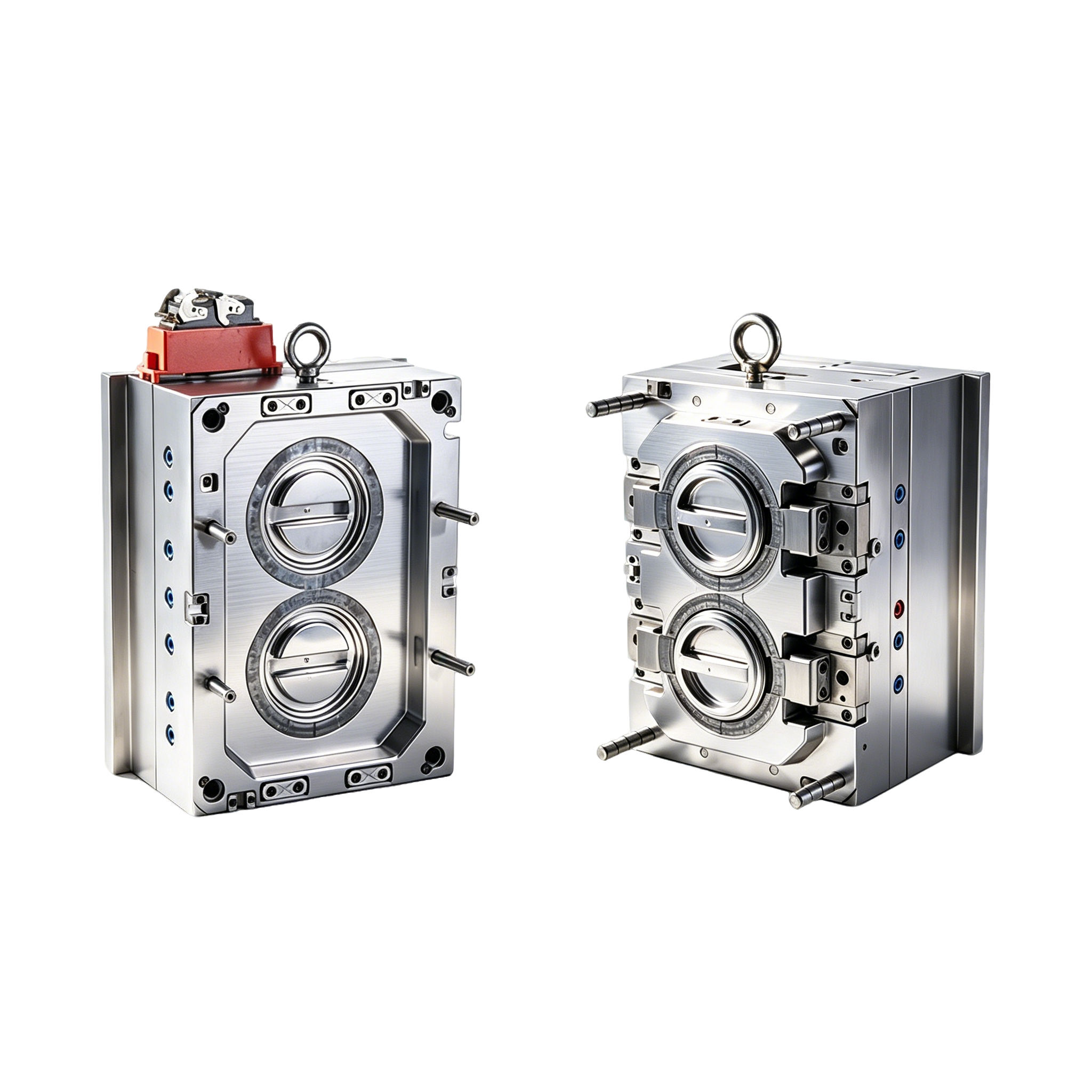
Round Food Storage Container Injection Mould
1. Product Overview
The Round Food Storage Container Injection Mould is a plastic injection mould designed to produce containers with circular or generally rounded profiles. Depending on the customer’s product concept, the mould can be configured for different diameters, heights, capacities, rim structures, base profiles, lid arrangements, and branding requirements.
The mould structure is optimized to maintain uniform wall thickness and precise roundness. These characteristics are essential because uneven walls can lead to visible distortion, weak areas, inconsistent shrinkage, and difficulty fitting the lid. A container that is not properly round may also stack poorly, occupy excessive storage space, or fail to provide a dependable seal.
High-precision machining is used for the cavity, core, parting surfaces, sealing features, and other functional areas. The result is a tooling system capable of producing containers with a smooth visual appearance and stable dimensions. Where a different appearance is required, the cavity can receive a polished, matte, textured, or customized surface treatment.
The mould can be designed as a single-cavity or multi-cavity system. A single-cavity version may be suitable for product development, small-volume manufacturing, or specialized containers. Multi-cavity tooling is generally preferred for mass production because it increases output per cycle and can reduce the moulding cost per unit when the injection machine and production plan are properly matched.
The runner system can be selected according to product size, material, cycle requirements, expected annual volume, and customer preference. Both hot-runner and cold-runner configurations are available. A well-designed runner system helps improve filling balance, control pressure distribution, reduce defects, and manage material consumption.
2. Main Product Applications
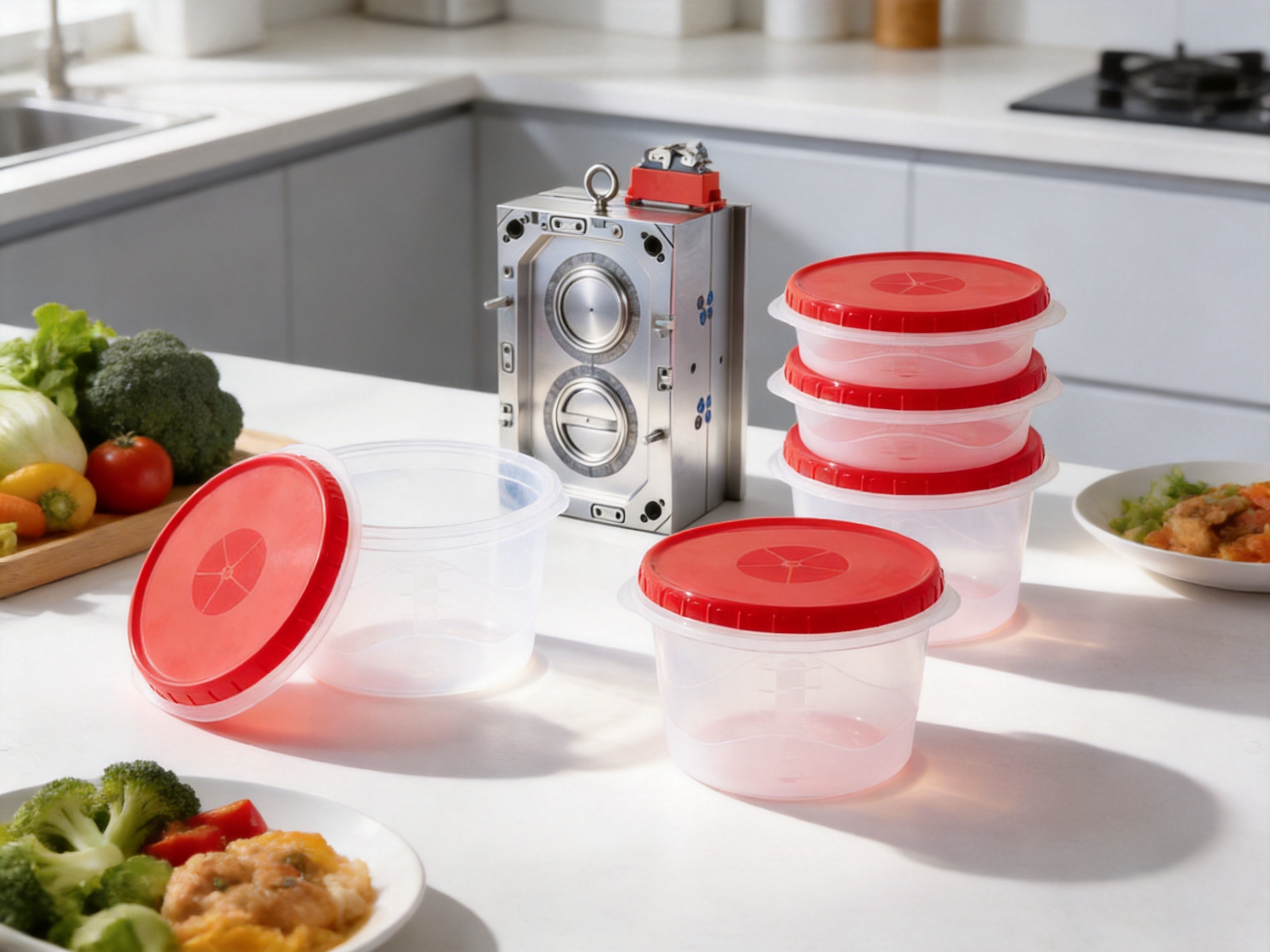
Food storage containers are used in many situations where convenience, hygiene, stackability, and reliable closure are important. The mould can support the manufacture of several product categories, including everyday household containers and professional food packaging.
Food Storage Containers
Household food storage containers are commonly used for storing cooked food, fresh ingredients, dry goods, snacks, and leftovers. Their rounded shape is convenient for cleaning and handling, while a properly designed rim and lid interface helps reduce leakage and protect the contents from external contamination.
Refrigerator Storage Boxes
Refrigerator containers require accurate dimensions so that multiple units can be placed efficiently on shelves or inside drawers. A stable circular profile allows the container to resist deformation during repeated use. Surface quality is also important because smooth internal walls are easier to clean and less likely to retain food residue.
Meal-Preparation Containers
Meal-preparation products are often manufactured in large quantities and must maintain consistent volume, weight, and appearance. Multi-cavity tooling can support efficient production for meal-preparation brands, catering companies, and food-service suppliers. The mould can also be adapted for different capacities within a product family.
Takeaway Food Packaging
Takeaway packaging must combine low unit cost with sufficient strength and reliable closure. The injection mould can be engineered for suitable ribs, stacking features, snap-fit details, and lid contact surfaces. These features help the finished products withstand transport and routine handling.
Customized Food Containers
Many brands require customized dimensions, logos, textures, colors, or lid configurations. The tooling can be adapted to include logo engraving, decorative textures, brand identification, measuring marks, or other product-specific details. Customization is considered during the design stage so that it does not compromise mould strength, cooling performance, or demoulding.
3. Engineering Design for Accurate Roundness
Round products require more than a circular outline in the CAD drawing. The cavity and core must be designed to control shrinkage, maintain concentricity, manage wall thickness, and protect the sealing interface. Any small dimensional error can become noticeable when the lid is fitted or when multiple containers are stacked together.
The mould is engineered with attention to the relationship between the cavity, core, parting line, rim, base, and lid contact area. The design process considers the selected plastic material, expected shrinkage, product thickness, injection pressure, cooling behavior, and intended use. This integrated approach helps prevent isolated design decisions from causing production problems later.
Uniform Wall Thickness
Uniform wall thickness contributes to predictable filling and cooling. If one section is significantly thicker than another, the thicker region may remain hot for longer, increasing the risk of sink marks, warpage, internal stress, and dimensional inconsistency. An uneven wall can also affect the rigidity and perceived quality of the container.
By optimizing the cavity and core geometry, the mould supports more consistent wall distribution. This makes the product easier to process and helps manufacturers establish stable injection parameters. Uniformity is especially valuable in multi-cavity production, where every cavity must create parts with closely matched dimensions.
Precise Rim and Sealing Features
The rim of a food storage container is a critical functional area. It may interact with a snap-on lid, press-fit cover, threaded lid, or sealing membrane. The mould therefore requires accurate machining and careful control of the parting surface. A well-made rim improves lid fit, reduces leakage risk, and supports a more refined user experience.
The container and lid can be developed as a matched set when the project requires both moulds. This allows the supplier to consider the assembly relationship, sealing pressure, tolerance stack-up, and opening force during the engineering stage. Such coordination is preferable to producing the container and lid as unrelated components.
Stable Base Geometry
The bottom of a container must remain stable when placed on a table, refrigerator shelf, production line, or packaging surface. A carefully engineered base can improve standing stability and reduce rocking. It may also include reinforcing features that increase rigidity without adding unnecessary material.
The base profile influences cooling and shrinkage, so it is considered together with the cooling layout and material flow. This prevents the base from becoming a concentration point for deformation or residual stress.
4. Mould Materials and Expected Service Life
The mould can be manufactured using steel grades such as P20, 718, or H13, depending on the required production volume, product material, cavity configuration, surface finish, and budget. Steel selection is an important part of mould engineering because it affects wear resistance, machinability, polishing performance, corrosion resistance, maintenance, and expected service life.
| Item | Available Specification | Production Benefit |
| Mould type | Plastic injection mould | Suitable for repeatable thermoplastic production |
| Mould steel | P20, 718, or H13 steel | Selection based on volume, wear, finish, and budget |
| Cavity configuration | Single-cavity or multi-cavity | Supports development runs or high-volume manufacturing |
| Runner system | Hot runner or cold runner | Allows material and cycle optimization |
| Surface finish | Polished or textured | Supports visual and tactile customization |
| Product materials | PP, PET, or PS | Compatible with common container applications |
| Expected mould life | Approximately 500,000 to 1,000,000 shots | Suitable for sustained commercial production when properly maintained |
P20 steel is frequently selected for general-purpose injection moulds because it offers a practical balance between machinability, strength, and cost. It may be suitable for many daily-use container applications where production conditions are controlled and the material is not excessively abrasive.
718 steel can be used where improved mechanical performance and polishing capability are required. It is often considered for moulds that need a higher level of dimensional stability or a refined surface finish.
H13 steel is suitable for demanding moulding conditions where heat resistance, toughness, and durability are important. The appropriate choice depends on the actual production plan rather than on steel grade alone. The manufacturer can recommend a material according to annual output, resin type, cavity count, surface requirements, and anticipated maintenance conditions.
The stated service-life range of approximately 500,000 to 1,000,000 shots is an engineering reference for a properly designed, manufactured, operated, and maintained mould. Actual life depends on resin formulation, additives, injection pressure, moulding temperature, cooling-water quality, maintenance intervals, machine settings, and handling practices.
5. Gating and Runner System Optimization
The gating system controls how molten plastic enters the cavity. For a round container, filling balance is especially important because an unbalanced flow pattern may create weld lines, air traps, uneven orientation, or dimensional differences around the circumference.
The mould’s gating system is carefully designed to improve filling balance and reduce unnecessary material waste. Gate location, gate size, runner dimensions, and melt-flow direction are evaluated according to the product geometry and selected resin. The objective is to fill the cavity effectively while maintaining a clean appearance and minimizing the need for excessive injection pressure.
Hot-Runner Configuration
A hot-runner system keeps the material in the runner channels at a controlled temperature. This can reduce cold-runner scrap and support faster, more automated production. It may be particularly useful for high-volume manufacturing, multi-cavity moulds, and applications where material efficiency is a major concern.
Hot-runner design must be carefully matched to the plastic material. Temperature control, nozzle selection, gate type, and maintenance access all influence performance. A properly configured system can help achieve consistent filling while reducing the amount of runner material that must be recycled or discarded.
Cold-Runner Configuration
A cold-runner system can offer a straightforward structure and may be suitable for lower-volume production, development projects, certain materials, or customers who prefer simpler maintenance. Although a cold runner creates runner material, the system can be cost-effective when the production volume and product design justify it.
The manufacturer can compare hot-runner and cold-runner options with the customer according to expected output, resin price, part weight, machine availability, and recycling policy. This makes the tooling solution more closely aligned with the customer’s actual business model.
6. Advanced Cooling Channel Design
Cooling is one of the most important factors influencing injection moulding cycle time. After the cavity is filled and packed, the plastic must cool sufficiently before the part can be ejected. If cooling is slow or uneven, production output decreases and the container may warp or lose dimensional accuracy.
The mould incorporates advanced cooling channels designed to improve heat removal from the cavity and core. The channel layout is considered in relation to the container wall, rim, base, corners, and other areas where heat may accumulate. Better cooling balance helps the product solidify more uniformly.
Reduced Cycle Time
Efficient cooling can shorten the time required before demoulding. Even a modest reduction in cycle time can create a significant productivity improvement when the mould operates continuously over multiple shifts. For high-volume products, cycle time directly affects annual output, machine utilization, labor efficiency, and energy consumption per part.
Improved Dimensional Stability
Uneven cooling can cause one area of the product to contract more than another. This may result in ovality, rim distortion, base warpage, or difficulty fitting the lid. Balanced cooling reduces these risks and supports consistent roundness from cavity to cavity.
Production Efficiency
Cooling performance contributes to more than speed. Stable thermal conditions make the injection process easier to control. Operators can establish a repeatable process window, and quality teams can monitor fewer variables during production. This supports dependable manufacturing across long production runs.
7. Surface Finish and Product Appearance
The appearance of a food storage container has a direct influence on how customers perceive quality. Smooth, glossy surfaces can communicate cleanliness and refinement, while carefully selected textures may improve grip, hide minor handling marks, or create a distinctive brand appearance.
The mould supports polished or textured cavity surfaces. Polishing is suitable for products that require a smooth and reflective appearance. A polished cavity can also support easier cleaning of the finished container and reduce the visual prominence of minor flow marks when the moulding process is properly controlled.
Texturing can be used to create matte effects, patterns, grip zones, decorative finishes, or visual differentiation. Texture depth and direction must be carefully designed because they influence demoulding force. Excessive or poorly oriented texture can cause drag marks, sticking, or damage to the product surface.
Logo engraving and customized identification can also be incorporated into the cavity. The logo may be positioned on the container wall, base, lid interface, or another suitable location. Engineering review is necessary to ensure that the engraving does not create a weak area, interfere with ejection, or collect unwanted material during moulding.
8. Smooth Demoulding and Part Protection
Demoulding is the stage in which the solidified container is removed from the cavity and core. A reliable demoulding system protects the product from scratches, distortion, stress marks, and deformation. This is particularly important for containers with thin walls, deep profiles, snap-fit rims, or high-gloss surfaces.
The mould is designed with suitable draft angles, ejector locations, parting-line arrangements, and surface finishes. These features help the container release smoothly after cooling. Ejector force is distributed as evenly as possible to prevent localized pressure marks or bending.
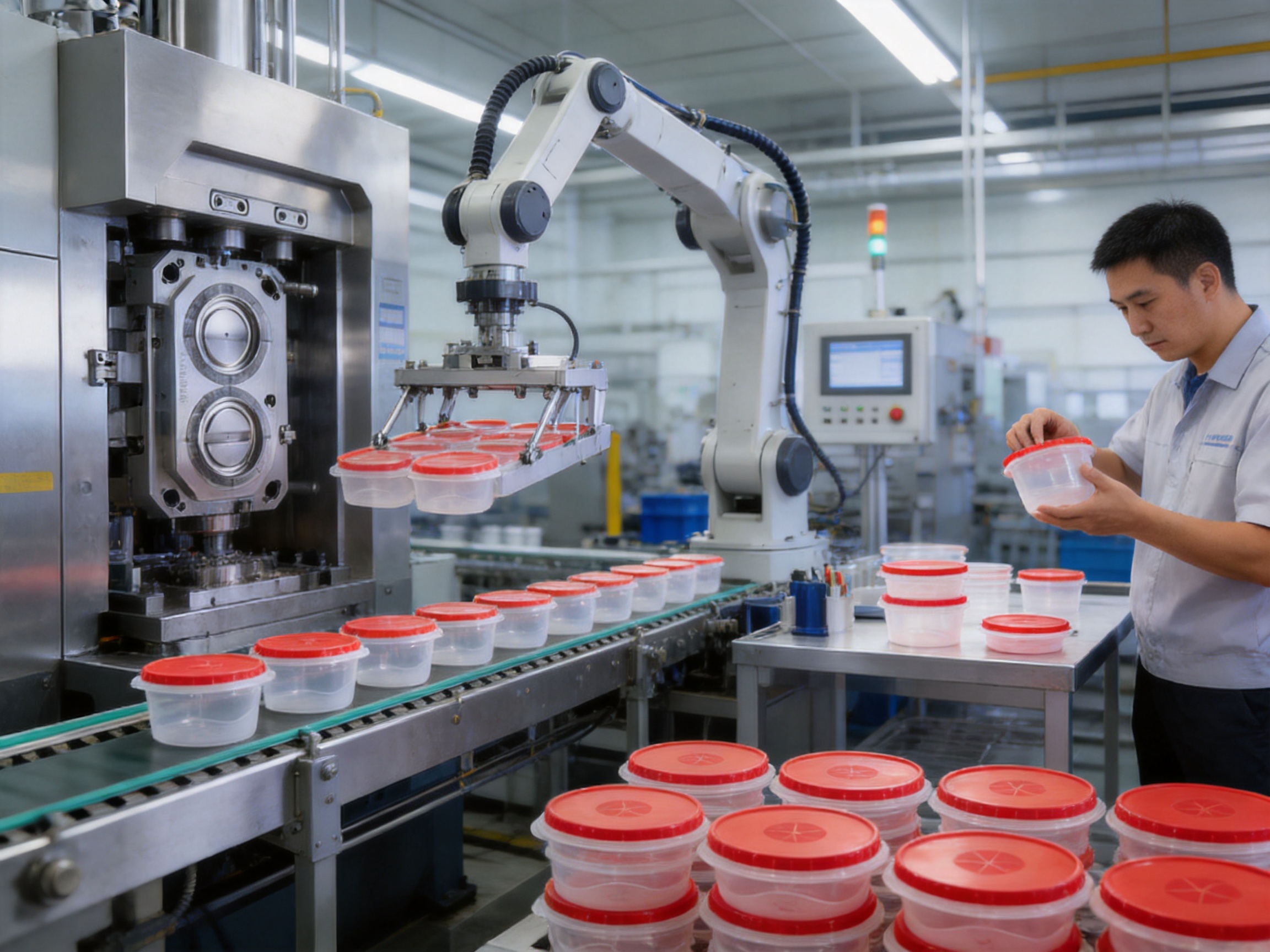
Good demoulding performance also supports automation. When products release consistently, robotic takeout systems and conveyor arrangements can operate more reliably. Reduced sticking lowers the risk of production interruptions and decreases the need for manual intervention.
The manufacturer evaluates demoulding during mould trials. If the first trial identifies sticking, whitening, deformation, or incomplete release, adjustments can be made to the process parameters or tooling details before final production approval.
9. Manufacturing Process and Quality Control
A high-quality injection mould is the result of a controlled manufacturing process rather than a single machining operation. Haiquan’s manufacturing approach combines product evaluation, mould design, material selection, precision machining, component fitting, assembly, testing, and technical communication.
Product and Mould Feasibility Review
The project begins with an assessment of the container design. Engineers review wall thickness, draft, corners, rim details, base geometry, parting lines, gate locations, ejection requirements, and cooling possibilities. This stage helps identify risks before steel is cut.
Design-for-moulding recommendations may include changes to wall transitions, reinforcement ribs, sealing features, or surface details. Early adjustments are generally less expensive than correcting a mould after production has started.
Three-Dimensional Mould Design
The cavity, core, inserts, sliders, ejector system, cooling channels, runner system, and mould base are developed in a coordinated three-dimensional design environment. The design must provide enough steel strength while allowing convenient machining, maintenance, inspection, and replacement of wear components.
For multi-cavity moulds, the arrangement must also consider cavity balance, mould size, machine platen dimensions, runner symmetry, cooling access, and product removal. A carefully planned layout helps maintain similar conditions across all cavities.
Flow Analysis and Structural Optimization
Mould flow analysis can be used to evaluate filling behavior, pressure requirements, weld-line positions, air-trap risks, cooling behavior, and probable warpage. The results help engineers optimize the gate, runner, wall structure, and processing window.
Analysis does not replace physical testing, but it can reduce design uncertainty and identify potential problems earlier. It is especially useful when the container has a complex rim, thin wall, decorative surface, unusual material, or multiple cavities.
Precision Machining
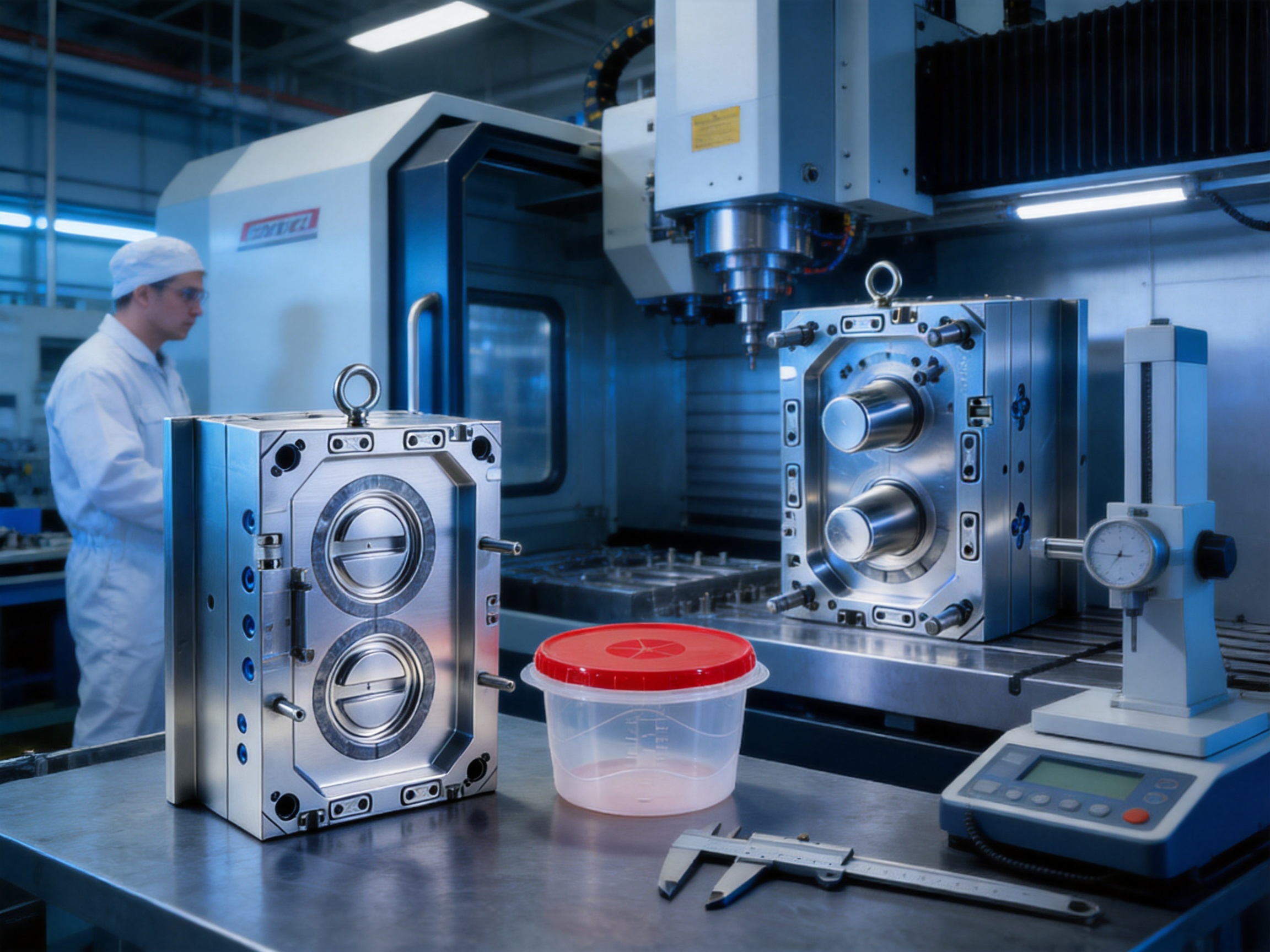
Precision machining is applied to the mould base, cavity, core, inserts, runner components, and functional surfaces. CNC machining, high-speed machining, electrical discharge machining, drilling, grinding, and polishing may be used according to the geometry and steel condition.
Critical dimensions are checked during the manufacturing process rather than only at the end. This approach helps control errors before they accumulate. Fine machining and polishing are particularly important for the sealing interface, parting surface, cavity appearance, and areas that influence demoulding.
Component Fitting and Assembly
After machining, mould components are fitted and assembled. The fitting process checks alignment, parting accuracy, ejector movement, core and cavity contact, cooling connections, runner components, and moving mechanisms. Proper fitting prevents flash, leakage, uneven wear, and premature failure.
Mould Trial and Sampling
Trial moulding is used to verify the actual behavior of the tooling. Sample containers are evaluated for dimensions, roundness, wall thickness, surface quality, lid fit, demoulding performance, filling balance, and visible defects.
Trial results may lead to minor modifications in polishing, venting, gate dimensions, ejection, cooling, or process recommendations. The goal is to deliver a mould that is ready for stable customer production rather than merely a mould that can produce one acceptable sample.
Final Inspection and Delivery
Before delivery, the mould is inspected for assembly quality, movement, cooling flow, cavity condition, surface finish, component labeling, and documentation. Technical materials may include mould drawings, spare-parts information, operating guidance, trial parameters, and maintenance recommendations.
10. Advantages Compared with Basic or Poorly Optimized Tooling
Not all injection moulds provide the same production results. A basic mould may produce a container during an initial trial but still create high costs during long-term operation. The advantages of this round container mould are associated with its attention to repeatability, efficiency, product appearance, and service support.
More Consistent Container Geometry
Accurate cavity and core machining helps maintain roundness and dimensional stability. This is important for lids, stacking, automated handling, labeling, and packaging. In comparison, poorly controlled tooling may produce oval containers or variation between cavities, leading to assembly problems and customer complaints.
Improved Sealing Performance
The lid contact area and container rim receive special attention because they determine how well the package closes. High-precision machining supports a more dependable seal and reduces the chance of leakage caused by inconsistent dimensions or parting-line mismatch.
Reduced Material Waste
A properly selected and optimized runner system can reduce unnecessary material consumption. Hot-runner configurations may minimize runner scrap, while a well-designed cold runner can reduce excess runner weight. Material savings become increasingly important when resin prices rise or production volumes are high.
Shorter and More Stable Cycles
Efficient cooling channels can reduce the time required for solidification. Stable heat transfer also makes the process less sensitive to fluctuations, supporting more predictable output. A poorly cooled mould may require longer cycles and still produce warpage or dimensional variation.
Better Surface Quality
Careful cavity preparation and controlled demoulding help produce glossy or textured surfaces with fewer scratches, drag marks, and deformation problems. Appearance consistency is particularly valuable for consumer products sold under a recognizable brand.
Greater Flexibility for Customization
The mould can be adapted for multiple capacities, cavity counts, surface treatments, logos, and product structures. This flexibility enables customers to develop a product family instead of relying on a single standard container size.
Longer Commercial Service Life
Appropriate steel selection, accurate fitting, and maintainable component design contribute to a longer working life. The approximate 500,000 to 1,000,000 shot range provides a useful basis for planning production and calculating tooling investment.
More Complete Technical Support
Tooling performance depends on communication between the customer and the mould supplier. Haiquan provides technical support from design through delivery and after-sales service. This integrated approach helps customers address product feasibility, machine matching, trial adjustments, maintenance, and future modifications.
11. Customization Options
Different markets require different container sizes, functions, and visual styles. The mould can be customized according to the customer’s product specifications and production targets.
Container Size and Capacity
Diameter, height, volume, wall thickness, base shape, and rim structure can be modified to suit the intended application. A small container may be used for sauces, snacks, or baby food, while larger versions may be designed for meal preparation, bulk storage, or food-service distribution.
Single-Cavity and Multi-Cavity Design
A single-cavity mould offers flexibility during product development and may reduce the initial investment for lower-volume projects. Multi-cavity moulds increase output and may lower the cost per part when production demand is substantial.
Cavity quantity must be selected according to the available injection machine, expected cycle time, product weight, annual volume, automation plan, and budget. Increasing the cavity count without considering these factors can create imbalance or exceed machine capacity, so the configuration should be engineered as a complete system.
Surface Texture and Logo Engraving
Customers may request a smooth polished finish, fine matte texture, grip texture, decorative pattern, or engraved brand logo. Surface details are integrated into the cavity design and reviewed for draft and demoulding requirements.
Lid and Closure Compatibility
The container can be engineered for different lid concepts, including snap-fit lids, press-fit covers, threaded closures, and sealing accessories. The closure design influences the rim profile, tolerances, ejection system, and mould assembly. Early coordination between the container and lid design improves the final user experience.
Mould Flow and Structural Optimization
For technically demanding products, flow analysis and structural review can be included in the customization process. These studies help determine suitable gate positions, wall transitions, support features, cooling layouts, and expected deformation behavior.
12. Material Compatibility
The mould is suitable for common plastic materials including PP, PET, and PS, subject to product design and processing requirements. Each resin has different flow, shrinkage, temperature, stiffness, and appearance characteristics, so the moulding process should be established according to the actual grade selected by the customer.
Polypropylene
Polypropylene is widely used for reusable food containers because it offers a practical combination of light weight, chemical resistance, toughness, and processing flexibility. It is commonly selected for refrigerator boxes, meal-preparation containers, and household storage products.
Polyethylene Terephthalate
PET can provide clarity and suitable barrier properties for certain packaging applications. Its processing conditions and mould design requirements may differ from those of polypropylene. Drying, temperature control, filling behavior, and cooling must be evaluated carefully.
Polystyrene
Polystyrene can be used where rigidity, appearance, or cost considerations are important. The appropriate grade and processing parameters should be selected according to the required impact performance, transparency, and intended use.
Although the mould is compatible with these material categories, the customer should confirm food-contact compliance, additives, colorants, recycled content, and regulatory requirements for the target market. The mould supplier can support tooling adaptation, while the resin supplier and product manufacturer remain responsible for material and finished-product compliance.
13. Production Efficiency and Total Cost Considerations
The purchase price of a mould is only one part of the total project cost. A more useful evaluation considers the relationship between tooling investment and long-term production performance. A mould that offers stable cycles, low rejection rates, efficient material use, and easy maintenance may provide better value than a cheaper mould with recurring production problems.
Cycle time has a direct influence on output. If cooling is inefficient, the manufacturer may need to keep the mould closed for longer than necessary. This reduces the number of parts produced per hour. Efficient cooling and smooth demoulding help shorten the cycle while protecting product quality.
Rejection costs must also be considered. Flash, warpage, incomplete filling, poor lid fit, scratches, and inconsistent dimensions can result in sorting, rework, recycling, or disposal. A precision-engineered mould reduces the likelihood of these issues and makes the process easier to stabilize.
Maintenance costs are influenced by steel quality, component accessibility, runner selection, cooling-water management, and the availability of replaceable components. A maintainable mould allows technicians to inspect and service the tooling without unnecessary downtime.
For high-volume products, multi-cavity production can significantly improve productivity. However, the cavity count should be justified by demand and machine capability. The best solution is not always the maximum number of cavities; it is the configuration that provides balanced filling, practical maintenance, manageable investment, and an appropriate output level.
14. Maintenance Recommendations
Regular maintenance is essential for preserving mould accuracy and extending service life. After production, the cavity and core should be cleaned to remove plastic residue, moisture, dust, and contaminants. Polished surfaces require suitable cleaning materials that do not cause scratches.
Cooling channels should be monitored for scale, corrosion, blockage, or reduced flow. Poor water quality can reduce heat-transfer performance and increase cycle time. A controlled cooling-water system helps maintain consistent thermal conditions.
Ejector pins, guide components, slides, and other moving parts should be inspected and lubricated according to the mould supplier’s recommendations. Excessive wear can affect product dimensions, create abnormal noise, or cause uneven movement.
The parting line should be checked for flash, damage, or trapped material. Even a small contaminant can prevent complete closure and create a visible defect around the container. Periodic inspection is especially important for high-volume production.
When the mould is stored, it should be dried, protected against corrosion, and kept in a suitable environment. Cooling lines should be drained where necessary, and exposed steel surfaces should receive appropriate rust protection. A clear maintenance record helps the production team plan service before a failure occurs.
15. Company Manufacturing Strengths
Taizhou Huangyan Haiquan Plastic Mold Co., Ltd. is a high-tech enterprise specializing in the research, development, and manufacture of precision injection moulds. Its product scope covers daily necessities, home appliances, automotive parts, and industrial equipment.
This multi-sector experience is valuable because it exposes the engineering team to a wide range of materials, product structures, tolerances, surface requirements, and production conditions. Experience in different industries can support more practical problem-solving when designing a new food container mould.
The company follows a quality-oriented and sustainable development philosophy. Its professional design team and scientific production management system support integrated project handling from initial design through manufacturing and after-sales assistance.
Integrated service reduces the communication gaps that can occur when design, machining, assembly, testing, and technical support are handled by unrelated suppliers. A coordinated supplier can keep the original product objectives in view throughout the project and respond more efficiently when technical changes are required.
Haiquan serves customers in Europe, the Middle East, Southeast Asia, and South America. International project experience requires attention to technical documentation, delivery coordination, communication, packaging, and customer-specific standards. Consistent quality and reliable delivery are especially important for overseas customers who may need to install and operate the mould remotely.
16. Recommended Project Workflow
A successful mould project begins with complete product information. Customers should provide a three-dimensional product file when available, two-dimensional drawings, material information, annual output requirements, surface expectations, lid details, and the target injection machine.
The supplier then evaluates the design and identifies potential moulding risks. This may include recommendations regarding draft angles, wall transitions, ribs, gate placement, parting lines, and cooling access. The customer and engineering team confirm the product design before the mould structure is finalized.
After design approval, the mould steel, cavity configuration, runner system, surface finish, and standard components are confirmed. Manufacturing proceeds through machining, fitting, assembly, and inspection.
Trial production follows mould completion. Samples are measured and evaluated for appearance, dimensions, wall distribution, roundness, lid fit, demoulding, and production stability. Any required modifications are completed before final acceptance.
Once the mould is approved, it is prepared for shipment with suitable protection and technical documentation. The customer can then install the mould on the appropriate injection machine and establish production parameters based on the trial results and material supplier recommendations.
17. Quality Factors for Buyers to Evaluate
When selecting a mould supplier, buyers should examine more than photographs or a basic price quotation. The following questions can help compare suppliers objectively.
- Does the supplier understand the product’s sealing, stacking, and handling requirements?
- Can the supplier explain the proposed gate, runner, cooling, and ejection systems?
- Will the mould be suitable for the customer’s selected injection machine?
- Can the supplier provide flow analysis or structural review when needed?
- Are the mould steel and expected service life clearly specified?
- Can the supplier support surface texture, logo engraving, and product customization?
- How will trial samples be inspected and approved?
- Are replacement parts and maintenance instructions available?
- Does the supplier provide technical support after delivery?
- Can the supplier manage international delivery and documentation?
These questions help distinguish a complete engineering solution from a basic tooling quotation. A reliable mould supplier should be able to explain not only what will be manufactured, but also how the tooling will perform in actual production.
18. Frequently Asked Questions
Q1: What products can this mould manufacture?
The mould is designed for round food storage containers, refrigerator storage boxes, meal-preparation containers, takeaway food packaging, and customized household or commercial food containers. The final product range depends on the approved product design and mould configuration.
Q2: Can the container size and capacity be customized?
Yes. Diameter, height, capacity, wall thickness, base structure, rim design, and other product dimensions can be customized. The design should be reviewed before mould manufacturing so that filling, cooling, shrinkage, and demoulding are properly considered.
Q3: Is the mould available with multiple cavities?
Yes. The mould can be configured as a single-cavity or multi-cavity tool. The correct cavity count depends on required output, product weight, injection machine capacity, cycle time, investment level, and filling balance.
Q4: Which mould steel can be used?
Available options include P20, 718, and H13 steel. The most suitable grade depends on production volume, resin type, surface finish, expected wear, maintenance plan, and budget.
Q5: Can the mould use a hot runner?
Yes. Both hot-runner and cold-runner systems can be considered. A hot runner may reduce runner waste and support high-volume production, while a cold runner may offer a simpler and more economical structure for selected applications.
Q6: Which plastic materials are supported?
The mould can be designed for PP, PET, PS, and other materials after technical review. Because each resin has different processing behavior, the final moulding parameters should be established using the customer’s actual material grade.
Q7: Can the container include a brand logo?
Yes. Logo engraving and other customized cavity details can be incorporated into the mould. The position, size, depth, orientation, and draft must be reviewed to ensure attractive appearance and smooth demoulding.
Q8: How does the mould improve production efficiency?
Optimized cooling channels can shorten cycle time, while balanced filling reduces defects and process instability. Smooth demoulding also reduces manual intervention and supports automated production.
Q9: How long can the mould operate?
The reference service life is approximately 500,000 to 1,000,000 shots when the mould is correctly designed, operated, and maintained. Actual service life varies according to material, additives, production settings, cooling-water quality, maintenance, and usage conditions.
Q10: Does the supplier provide technical support?
Yes. Haiquan provides support from product and mould design through manufacturing, trial production, delivery, and after-sales service. The company can assist with mould flow analysis, structural optimization, trial adjustments, and technical documentation.
Q11: Can the container and lid be developed together?
Yes. Developing the container and lid as a matched system is recommended when a reliable seal, controlled opening force, or snap-fit performance is required. Coordinated design helps manage tolerances and ensure compatibility.
Q12: What information should be provided for a quotation?
Customers should provide product drawings or three-dimensional files, material requirements, capacity, expected annual quantity, surface finish, logo details, lid information, cavity preferences, and available machine specifications. More complete information allows the supplier to prepare a more accurate technical proposal.
19. Conclusion
The Round Food Storage Container Injection Mould is a precision tooling solution for manufacturers that require consistent geometry, dependable lid fit, attractive surfaces, efficient cycles, and long-term production stability. Its optimized structure addresses the main challenges associated with round containers, including wall-thickness consistency, circular accuracy, filling balance, cooling uniformity, sealing performance, and smooth demoulding.
The mould can be adapted to different product sizes, capacities, materials, cavity counts, runner systems, textures, logos, and closure concepts. P20, 718, and H13 steel options provide flexibility for different production volumes and durability requirements, while the reference service life of 500,000 to 1,000,000 shots supports commercial manufacturing planning.
Compared with basic tooling, a carefully engineered mould can reduce waste, shorten cycle time, lower rejection risk, improve appearance, and make production parameters easier to stabilize. These benefits can have a meaningful effect on the total cost of ownership over the life of the mould.
With experience in precision injection moulds for daily necessities and other industrial sectors, Taizhou Huangyan Haiquan Plastic Mold Co., Ltd. offers an integrated approach from design and flow analysis to machining, assembly, testing, delivery, and after-sales support. For customers seeking dependable tooling for round food storage containers, this combination of engineering capability, customization, manufacturing control, and international service provides a strong foundation for successful production.
References
1. Injection Molding Handbook, general principles of thermoplastic mould design, runner systems, cooling, and ejection.
2. Plastics Design Guide, product wall-thickness control, draft-angle practices, shrinkage management, and structural optimization.
3. Practical Injection Mould Engineering, cavity and core construction, mould steel selection, precision machining, and mould maintenance.
4. Polymer Processing Fundamentals, flow behavior, cooling requirements, shrinkage, and dimensional stability of common thermoplastics.
5. Food Packaging Materials and Applications, general considerations for container structure, closure performance, hygiene, and product usability.
6. International mould manufacturing and quality-control practices, including trial production, dimensional inspection, surface evaluation, and preventive maintenance.
Product: Round Food Storage Container Injection Mould
For exclusive deals and latest offers, sign up by entering your email address below.
 +86-18657672567
 sales@tzhqmould.com
celin@tzhqmould.com
 No. 17 Houshi Road, Beicheng Industrial Zone, Huangyan District, Taizhou City, Zhejiang Province, China
Copyright © Taizhou Huangyan Haiquan Plastic Mold Co., Ltd. All Rights Reserved
Injection Plastic Mould Maker

