

Air Cooler and Components Injection Mould: Precision Tooling for Durable HVAC Plastic Parts
Admin 2026-08-21Air coolers are practical, energy-conscious appliances used in homes, offices, workshops, commercial spaces, and outdoor environments. Their performance depends not only on the fan, pump, cooling media, and electrical system, but also on the quality of the plastic housing and structural components that protect, support, and organize these internal parts. The Air Cooler and Components Injection Mould is designed to manufacture these essential plastic parts with repeatable accuracy, stable production performance, and efficient cycle management.
This injection mould solution is suitable for producing air cooler housings, fan covers, ventilation structures, cooling unit components, and related plastic parts. It is developed for manufacturers that require dependable tooling for large or medium-sized components made from materials such as ABS and PP. Through carefully planned mould design, suitable steel selection, accurate machining, controlled assembly, and practical production testing, the mould supports consistent part quality throughout extended manufacturing runs.
For global HVAC and home appliance manufacturers, the value of an air cooler injection mould extends beyond the tool itself. A well-engineered mould can reduce dimensional variation, improve surface consistency, simplify assembly, lower scrap rates, and help maintain stable delivery schedules. It can also support product customization, allowing manufacturers to adjust housing dimensions, mounting features, grille arrangements, ventilation openings, and internal component interfaces for different markets and product models.

Air Cooler and Components Injection Mould
Product Overview
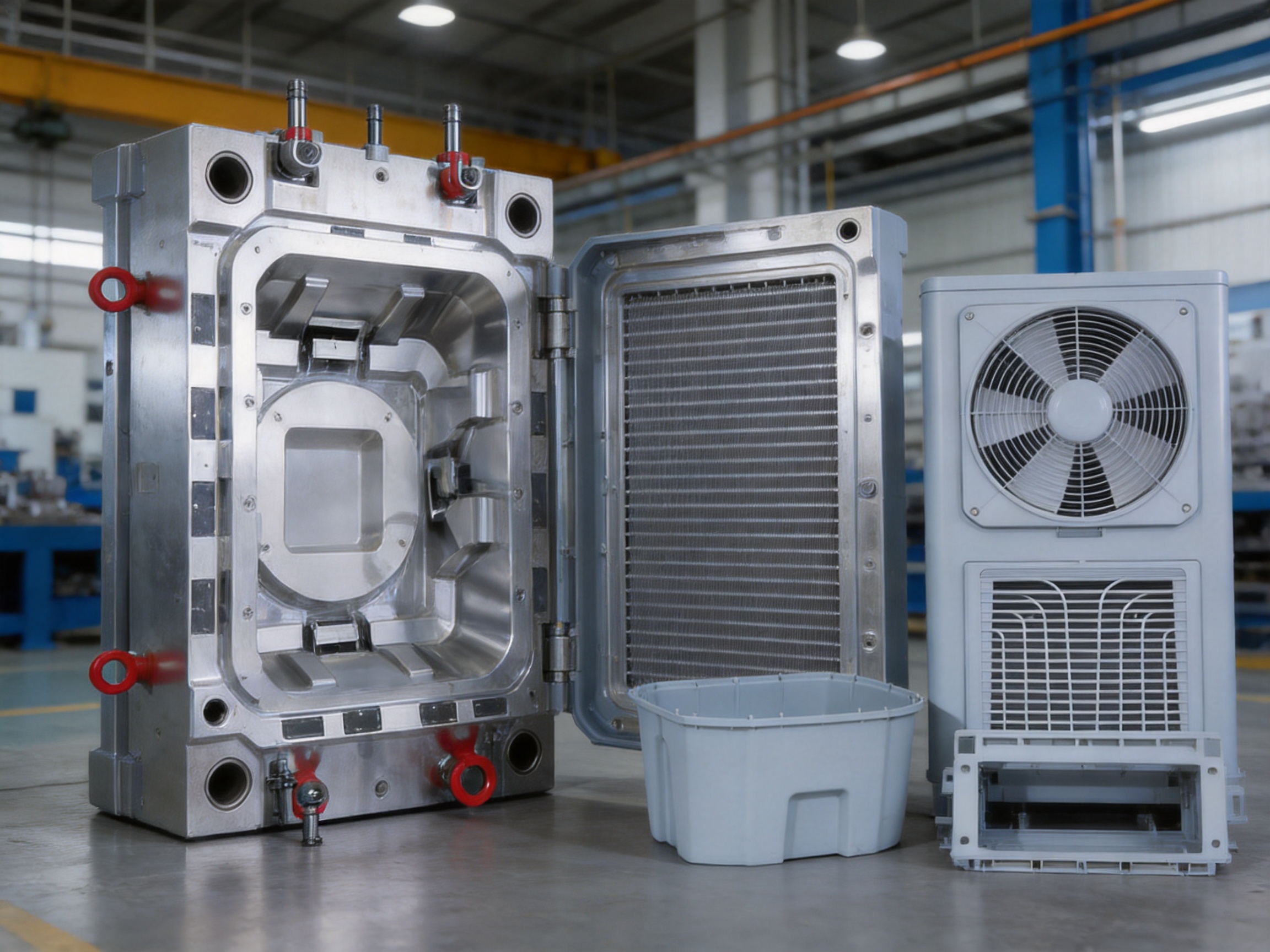
The Air Cooler and Components Injection Mould is a precision tooling system for producing injection-moulded plastic parts used in evaporative air coolers. The mould is especially appropriate for large housing parts that include ventilation structures, mounting features, access openings, ribs, bosses, and interfaces for internal components. These features must be formed accurately because they influence the strength, appearance, assembly efficiency, and operating stability of the finished appliance.
Air cooler housings are often relatively large compared with many other household appliance components. Their broad surfaces must remain visually consistent while also maintaining sufficient rigidity. The mould therefore needs to manage several technical challenges at the same time, including material flow, cooling balance, shrinkage, ejection, parting-line control, and warpage prevention. These requirements are addressed through a coordinated tooling design rather than through any single mould component.
The mould can be configured for ABS, PP, or other suitable thermoplastic materials according to the product design and required performance. ABS is often selected when a combination of surface appearance, dimensional stability, impact resistance, and structural rigidity is required. PP may be preferred for its low density, chemical resistance, fatigue performance, and cost efficiency. Final material selection should be confirmed according to the product specification, operating environment, colour requirements, and customer expectations.
In addition to complete air cooler housings, the tooling concept can support the manufacture of fan covers, air outlet structures, cooling unit components, protective grilles, and other injection-moulded parts. The design can be adapted to specific product dimensions and mounting arrangements, giving appliance manufacturers greater freedom to develop different models while maintaining a consistent mould manufacturing approach.
Primary Applications
Air Cooler Housings
The main application of the mould is the production of air cooler housings. The housing provides the external identity of the appliance and forms the protective shell around the fan, motor, water circulation system, cooling pads, control parts, and wiring. It must provide enough space for internal components while remaining sufficiently strong for transportation, installation, and everyday use.
A high-quality housing mould helps control wall thickness, corner transitions, openings, and reinforcement ribs. This control is important because large plastic panels can show sink marks, uneven shrinkage, distortion, or visible flow lines if the tooling is not properly engineered. Stable mould construction allows the manufacturer to achieve more predictable results when production conditions are maintained within the recommended range.
Fan Covers and Ventilation Structures
Fan covers and ventilation components must combine functional airflow requirements with safety and appearance considerations. The shape, spacing, and alignment of openings can influence air movement, noise performance, cleaning convenience, and protection of the rotating fan. The injection mould must reproduce these openings accurately and maintain their position over repeated cycles.
Ventilation structures can include grilles, louvers, air outlet frames, inlet panels, and decorative surfaces. These parts may contain numerous narrow openings and relatively thin sections. Proper gate positioning, filling analysis, cooling design, and ejection planning are important for reducing short shots, weld-line weakness, deformation, and difficult demoulding.
Cooling Unit Components
Air coolers contain several components that guide air, retain cooling media, direct water, or support the internal assembly. These components may include water-flow structures, pad frames, internal partitions, covers, brackets, and mounting supports. Their dimensions must be controlled so that they fit securely within the housing and remain compatible with the pump, motor, fan, and electrical system.
The mould can be customized for different mounting structures and component interfaces. This is useful for manufacturers that offer several air cooler capacities or product configurations. A modular approach to inserts, replaceable sections, or localized tooling details may help simplify future revisions, depending on the product design and production strategy.
Key Product Advantages
Accurate Formation of Large Plastic Parts
Large injection-moulded parts require careful attention to balance and stability. Even a small amount of distortion can make assembly difficult or create visible gaps between panels. The Air Cooler and Components Injection Mould is designed to support accurate formation of broad housing surfaces, structural ribs, mounting bosses, and ventilation details.
Precision machining of the cavity and core helps maintain the intended product geometry. When combined with an appropriate injection process, the mould can produce parts with consistent dimensions across repeated production cycles. This consistency benefits appliance manufacturers by reducing manual fitting, minimizing rework, and improving the interchangeability of components.
Reliable Ventilation Details
Air cooler parts frequently include many openings, grille sections, and airflow channels. These features can be difficult to mould because they create changes in material flow and may require carefully positioned ejectors. A properly designed tooling system considers these details during the early engineering stage rather than treating them as secondary features.
Accurate ventilation structures provide a cleaner appearance and help manufacturers maintain the intended airflow design. Consistent openings can also make the finished products easier to inspect and assemble. If the grille is integrated with a housing or front panel, accurate mould alignment is particularly important for maintaining uniform gaps and visual symmetry.
Stable Surface Quality
External air cooler housings are highly visible to end users. Surface defects such as flow marks, weld lines, sink marks, scratches, uneven texture, and ejector impressions can reduce perceived product quality. The mould surface finish, parting-line treatment, cooling arrangement, and filling strategy all contribute to the final appearance.
Depending on the customer’s requirements, the mould can be prepared for polished, textured, matte, or other specified surface effects. Surface treatment is selected according to the resin, product design, decoration process, and required visual standard. A suitable texture may also help reduce the visibility of minor surface variation during normal use.
Compatibility with Common Engineering Plastics
The product specification supports ABS and PP materials, which are widely used in home appliances. This provides manufacturers with practical material flexibility. ABS can support attractive exterior housings with good impact resistance and dimensional stability, while PP can provide a lightweight and economical option for suitable structural and internal components.
Material compatibility must be considered during mould design because different plastics have different shrinkage rates, flow characteristics, cooling behaviour, and processing temperatures. The tooling process should therefore be aligned with the selected resin and grade. Material data, product thickness, expected production volume, colour requirements, and surface finish should be reviewed before finalizing the mould configuration.
Long Production Service Life
The specified mould life is up to 800,000 shots. This service-life target is suitable for many air cooler programs requiring repeated production over an extended period. Actual service life depends on the material, mould maintenance, production conditions, cooling-water quality, injection pressure, cycle frequency, and replacement of wear parts.
Using suitable mould steel such as 718 or NAK80 supports the requirements of precision plastic tooling. These steels are commonly selected for their machinability, polishability, dimensional stability, and suitability for mould cavity and core applications. The final steel selection can be adjusted according to the expected production volume, surface requirements, resin characteristics, and customer budget.
Customization for Different Appliance Models
Air coolers vary significantly in capacity, exterior shape, fan diameter, water tank arrangement, control-panel layout, and internal mounting structure. A one-size-fits-all mould is therefore rarely appropriate for all product families. This tooling solution allows component dimensions and mounting structures to be adjusted according to the customer’s product design.
Customization may include changes to overall length, width, and height; ventilation opening patterns; screw-boss positions; handle interfaces; wheel or foot mounting points; motor supports; water-tank connections; control-panel openings; and internal partitions. These modifications are reviewed through product drawings, three-dimensional data, technical meetings, and mould-flow or manufacturability assessments where required.
Technical Specification
| Product | Air Cooler and Components Injection Mould |
| Primary Application | Air cooler housings, fan covers, ventilation structures, and cooling unit components |
| Recommended Product Materials | ABS and PP |
| Typical Mould Steel | 718 / NAK80 |
| Target Mould Life | Up to 800,000 shots |
| Product Type | Large and medium-sized injection-moulded plastic components |
| Customization | Component dimensions and mounting structures can be adjusted |
| Manufacturing Scope | Design, machining, mould assembly, testing, and production support |
The values in the table provide a general reference for the product. Final specifications depend on the approved part drawings, resin grade, production quantity, machine capacity, appearance standard, and customer application. A technical review is recommended before the mould structure and manufacturing schedule are confirmed.
Advanced Mould Design Process
Product Design Review
The manufacturing process begins with a review of the plastic component design. Engineers examine wall thickness, draft angles, ribs, bosses, openings, undercuts, assembly interfaces, and potential deformation areas. This review helps identify design details that could increase mould complexity or create production risks.
For large air cooler housings, the design review also considers how the component will be supported during mould filling and ejection. Broad panels may require reinforcement ribs or carefully selected ejection locations. If a product includes deep recesses, side openings, or complex ventilation structures, slides, lifters, inserts, or other mechanisms may be required.
Early feedback allows product designers to make practical changes before steel is cut. Small adjustments to corner radii, rib thickness, boss design, draft angle, or gate position can improve mouldability and reduce the possibility of later modifications. This collaborative approach helps connect product development goals with reliable mass production.
Parting-Line Planning
The parting line affects appearance, mould structure, ejection, and assembly. For visible air cooler housings, it should be positioned in a way that minimizes its visual impact and avoids creating unwanted steps or mismatch on important surfaces. At the same time, the line must allow the part to release from the mould without damage.
Engineers evaluate the product geometry and determine whether a simple two-plate structure is sufficient or whether additional slides, lifters, inserts, or multi-part tooling features are needed. The chosen arrangement should balance product quality, tooling cost, maintenance requirements, and production efficiency.
Gate and Runner Design
Gate location has a direct influence on filling balance, weld lines, packing pressure, surface appearance, and shrinkage. Large housings may require more than one gate or a carefully balanced runner system to ensure that the material reaches distant areas without excessive pressure loss.
The gate design is selected according to the plastic material, product wall thickness, cosmetic requirements, injection-machine capacity, and expected cycle time. Gate vestige must also be considered, particularly on visible external surfaces. A suitable gate arrangement can help reduce short shots and improve consistency between different sections of the component.
Cooling System Development
Cooling is one of the most important parts of injection mould design. Uneven cooling can create warpage, sink marks, dimensional variation, and prolonged cycle times. For air cooler housings and other broad components, cooling channels must be positioned to support balanced heat removal across the cavity and core.
The cooling layout is developed around the product shape, wall thickness, ribs, bosses, inserts, and other mould components. Areas with greater material concentration may require additional attention because they retain heat for longer. Efficient cooling contributes to shorter cycles, improved dimensional stability, and more consistent surface quality.
Ejection System Engineering
The ejection system must remove the part without causing deformation, whitening, scratches, or visible marks in unacceptable locations. Large housings require a balanced ejection arrangement because uneven force can twist the component or cause it to remain attached to one side of the mould.
Ejector pins, sleeves, plates, lifters, air ejection, or other suitable mechanisms may be used according to the product structure. Ejection points are planned around ribs, bosses, concealed surfaces, and areas with sufficient strength. The goal is to release the component smoothly while preserving both functional dimensions and exterior appearance.
Manufacturing Process and Quality Control
Material Preparation
Tool steel is selected according to the cavity requirements, expected production life, surface finish, and mould structure. 718 and NAK80 are suitable options for many precision injection moulding projects. The material must be traceable and prepared for the required machining and heat-treatment procedures.
Plastic resin selection is also important. ABS and PP grades may differ in shrinkage, flow, impact performance, colour stability, and processing temperature. The moulding process should be developed with the specific resin grade in mind rather than relying only on general material categories.
CNC Machining
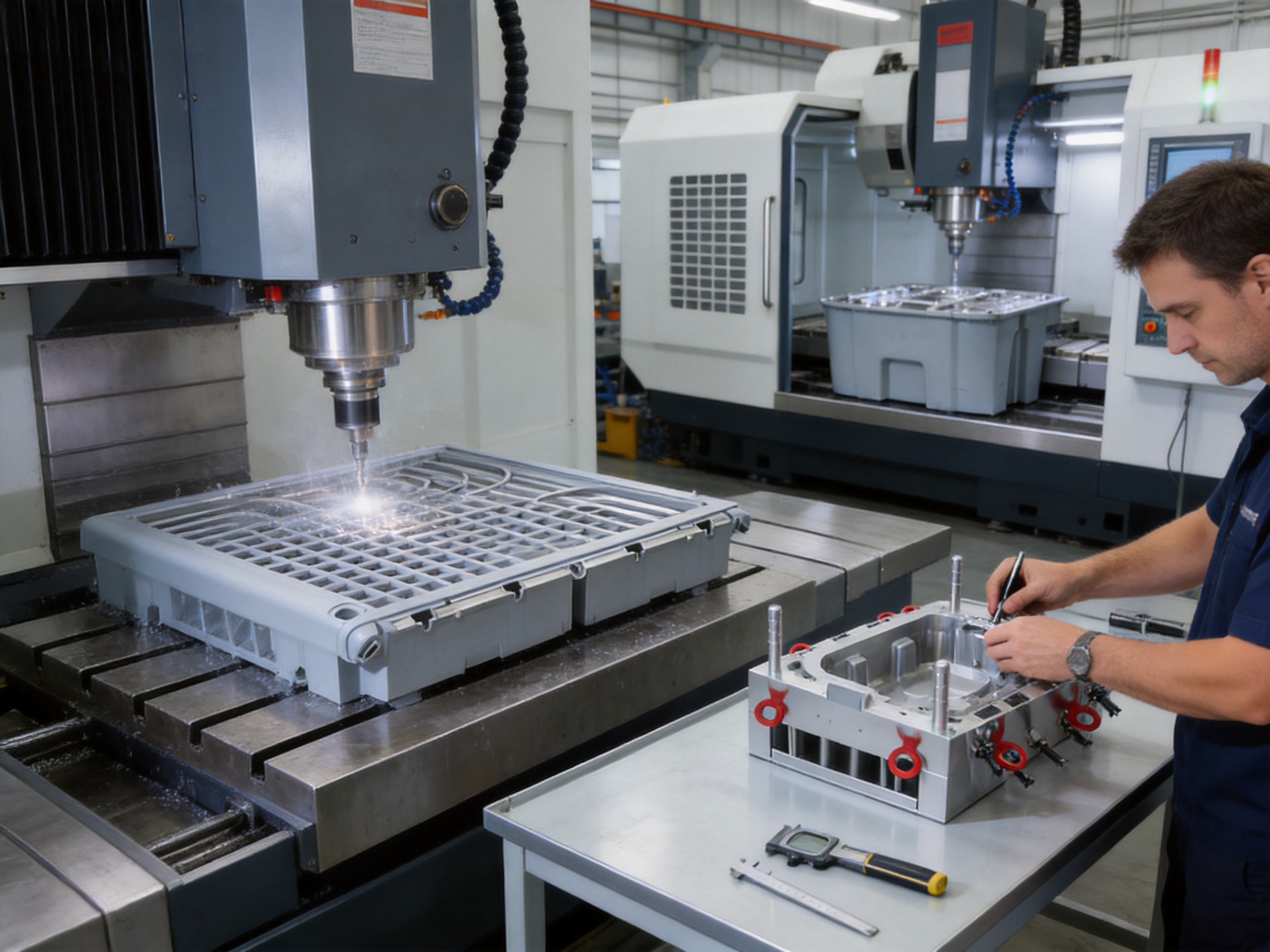
CNC machining is used to create accurate cavity, core, insert, and structural components. Modern machining equipment helps reproduce complex surfaces, ventilation details, mounting features, and parting areas with controlled dimensional accuracy. Machining strategies are planned to limit tool marks and preserve the intended geometry.
For large mould components, machining stability is especially important. The workpiece must be securely supported, and cutting conditions must be selected to reduce vibration and thermal distortion. Multiple machining stages may be used, including roughing, semi-finishing, finishing, and localized detail work.
Electrical Discharge Machining
Electrical discharge machining may be used for narrow slots, sharp internal details, deep ribs, complex corners, and other areas that are difficult to complete through conventional cutting. EDM provides a controlled method for forming detailed features in hardened or difficult-to-machine steel.
Electrode design and wear compensation are reviewed during the EDM process. The resulting features are checked against the product data to confirm that critical dimensions and transitions meet the intended requirements.
Wire Cutting and Precision Detail Work
Wire-cut electrical discharge machining can be applied to inserts, precision openings, slides, and other components requiring accurate profiles. It is particularly useful for creating controlled clearances and complex two-dimensional shapes within the mould structure.
Detail work may also include polishing, texturing, fitting, grinding, deburring, and hand finishing. These operations help prepare the mould for smooth operation and the required part appearance.
Mould Assembly
After machining, individual components are inspected, cleaned, and assembled. Assembly technicians check the fit of cavity and core sections, slides, lifters, ejector systems, guide components, cooling connections, and other mechanisms. Correct fitting is essential for preventing premature wear, flash, leakage, and alignment problems.
During assembly, the mould is evaluated for smooth movement and accessible maintenance. Moving components should operate without abnormal resistance, while shut-off surfaces and parting areas should close correctly. The assembly process also provides an opportunity to identify potential interference before the mould is installed on an injection machine.
Trial Moulding and Adjustment
Trial moulding is used to verify filling, ejection, part dimensions, surface appearance, and cycle behaviour. Initial samples are compared with the approved product data and quality expectations. If necessary, adjustments may be made to process parameters, venting, polishing, fitting, gate conditions, or other tooling details.
Trial results are especially valuable for large housings because their performance can be affected by multiple interacting factors. A balanced filling pattern, adequate packing, suitable cooling time, and controlled ejection sequence may be required to achieve stable results.
Inspection and Documentation
Quality control may include dimensional inspection, visual inspection, mould movement checks, cooling-channel testing, component verification, and sample approval. Critical dimensions are measured according to the product drawings and agreed tolerance requirements.
Documentation can include mould specifications, steel information, trial records, inspection reports, spare-part information, and maintenance recommendations. Clear documentation helps customers operate and maintain the tooling more effectively after delivery.
Why the Mould Design Matters for Air Cooler Performance
Although the mould does not directly create cooling capacity, it has a strong influence on the mechanical and functional quality of the finished appliance. A housing that is dimensionally accurate can support better alignment of the fan, motor, water system, and control components. Accurate openings can help preserve the intended ventilation arrangement, while strong mounting points can reduce vibration and assembly problems.
Consistent wall thickness can contribute to improved strength and a more predictable appearance. Properly designed ribs can reinforce broad surfaces without adding unnecessary material. Accurate interfaces can reduce the need for manual modification during assembly. These benefits make the mould an important part of the overall air cooler manufacturing system.
A reliable mould also supports consistent production across different batches. When the cavity, core, cooling system, and ejection system remain stable, manufacturers can focus on controlling resin drying, injection speed, pressure, temperature, holding time, cooling time, and other process parameters. The result is a more repeatable manufacturing environment.
Advantages Compared with Lower-Quality Tooling
Better Dimensional Consistency
Lower-quality tooling may produce parts with variation between cycles or across different areas of the same component. This can lead to poor fit, uneven panel gaps, and difficulty installing internal parts. Precision machining and careful mould assembly help reduce these problems and provide a more stable dimensional foundation.
Reduced Risk of Warpage
Large flat or curved plastic surfaces are vulnerable to warpage. An unbalanced cooling system, unsuitable gate arrangement, or poor ejection design can make the problem worse. A professionally engineered mould addresses these factors during design, helping the manufacturer reduce distortion and improve assembly performance.
Improved Surface Appearance
External appliance surfaces are often judged immediately by customers. Visible defects can affect brand perception and increase the number of rejected parts. A mould with appropriate surface preparation, venting, filling design, and parting-line control provides a stronger basis for producing attractive housings and covers.
Longer Tooling Reliability
Inexpensive tooling may use unsuitable steel, insufficient support, weak cooling connections, or poorly fitted moving parts. Such issues can result in frequent maintenance, unplanned downtime, and inconsistent parts. The use of suitable mould steel, controlled machining, and systematic assembly supports a longer and more dependable service life.
More Efficient Production Management
When a mould is stable, the production team can establish repeatable process parameters and predictable cycle times. This helps with production planning, labour allocation, material usage, and delivery scheduling. A stable mould can therefore provide value beyond its initial purchase price.
Company Manufacturing Strengths
Taizhou Huangyan Haiquan Plastic Mold Co., Ltd. specializes in the research, development, and manufacture of precision injection moulds. Its product scope covers daily necessities, home appliances, automotive parts, and industrial equipment. This industry coverage gives the company experience with different types of plastic products, tooling structures, surface requirements, and production challenges.
The company combines a professional design team with a scientific production management system. This supports an integrated workflow covering product review, mould design, machining, assembly, trial production, inspection, delivery, and after-sales support. Managing these stages within one coordinated system can improve communication and reduce the risk of information loss between separate suppliers.
Experience with home appliance tooling is particularly relevant to air cooler projects. Appliance components often require attractive surfaces, durable structures, accurate mounting features, and reliable repeatability. These requirements are addressed through a combination of design planning, engineering review, precision manufacturing, and production testing.
Haiquan serves customers in Europe, the Middle East, Southeast Asia, and South America. International projects commonly involve different product standards, communication requirements, packaging expectations, production conditions, and delivery schedules. Experience serving overseas customers can help the company organize technical communication and coordinate tooling projects for different markets.
The company follows a quality-oriented and sustainable-development philosophy. In practical terms, this means that mould production is treated as a long-term manufacturing partnership rather than a one-time machining transaction. Attention is given to tooling reliability, maintainability, customer requirements, and ongoing technical support.
Customization and Project Development
Initial Technical Information
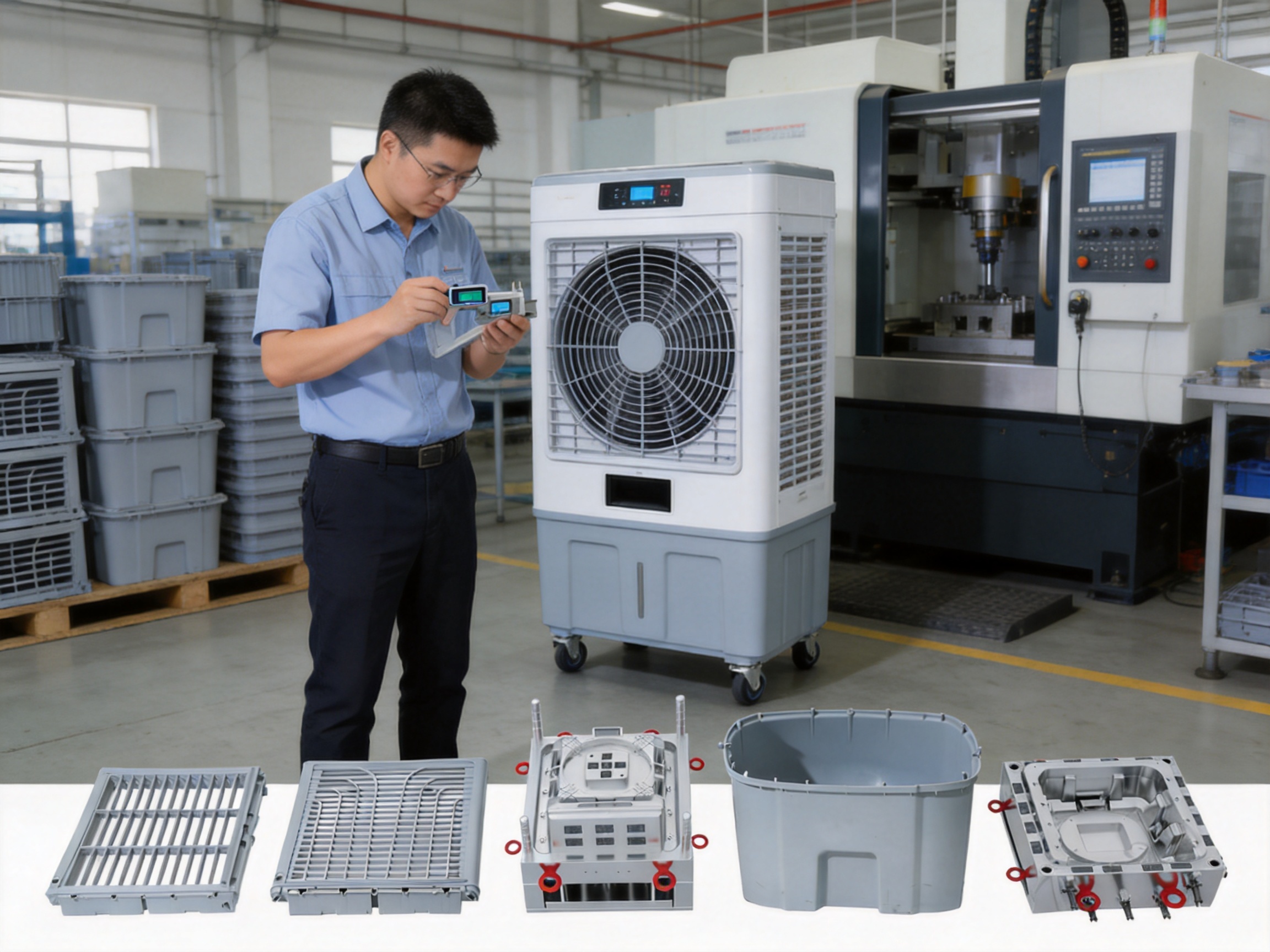
Customers normally provide three-dimensional product data, two-dimensional drawings, material information, expected annual production, appearance requirements, and the intended injection machine. If the product is still under development, preliminary drawings or concept data can be used for an initial feasibility review.
Information about the air cooler’s internal components is also useful. Fan diameter, motor position, water-pump location, control-panel arrangement, cooling-pad dimensions, handle design, and fastening method can affect housing geometry and mounting structures. Reviewing these interfaces early helps reduce later modifications.
Design Optimization
After reviewing the product, the mould engineering team can provide suggestions related to draft angles, wall thickness, ribs, bosses, corners, parting lines, gates, ejectors, and cooling. These suggestions are intended to improve manufacturability while preserving the customer’s functional and appearance objectives.
Design optimization may also address material reduction, cycle-time improvement, assembly simplification, and maintenance access. For example, a rib may be redesigned to provide adequate stiffness with less material, or a boss may be repositioned to improve ejection and reduce the risk of sink marks.
Prototype and Trial Evaluation
Trial samples allow the customer to evaluate the actual appearance, fit, and function of the moulded parts. Sample reviews may include dimensional checks, assembly trials, colour confirmation, surface inspection, and testing of interfaces with motors, fans, pumps, panels, or other components.
Any required correction should be recorded clearly and prioritized according to its effect on function, appearance, assembly, and production stability. A structured sample-approval process helps both the mould manufacturer and the customer maintain a common understanding of the project status.
Production Support
After mould delivery, production support may include recommendations for mould installation, initial machine settings, cleaning procedures, lubrication, cooling-water management, and routine inspection. Customers can also receive guidance about protecting the mould during storage and transportation.
Because mould life depends on maintenance, regular inspection is important. Operators should check for abnormal noise, leakage, flash, inconsistent ejection, rust, damaged cooling fittings, and changes in part quality. Early detection of these conditions can reduce the risk of major repairs.
Maintenance Recommendations
Proper maintenance helps the mould approach its intended service life of up to 800,000 shots. After production, the mould should be cleaned of residual plastic, oil, dust, and moisture. The cavity and core surfaces should be inspected for scratches, corrosion, deposits, and signs of wear.
Moving components such as slides, lifters, ejector pins, guide pillars, and guide bushes should be lubricated according to the recommended maintenance schedule. Excess lubricant should be removed from product-contact areas to avoid contamination or surface defects.
Cooling channels should be monitored for blockage, scale, leakage, or reduced flow. Poor cooling performance can increase cycle time and cause dimensional instability. Water quality and filtration should be managed according to the local production environment.
Parting surfaces should be kept clean and checked for damage. Flash may indicate contamination, insufficient clamping, wear, or misalignment. Continuing to operate a mould with unresolved flash can accelerate damage to shut-off surfaces and increase repair costs.
When the mould is stored, exposed steel surfaces should receive suitable rust protection. The mould should be closed or secured according to the manufacturer’s recommendation, and lifting points should be used safely. A maintenance record should include production shots, repairs, replaced components, inspection dates, and observed issues.
Production Efficiency and Cost Considerations
The total cost of an injection mould should be evaluated over its expected production life rather than only by its initial purchase price. A low-cost mould that requires frequent repairs or produces a high rejection rate may create greater expenses over time. Tooling reliability, cycle stability, material usage, labour requirements, and maintenance should all be considered.
A well-designed air cooler mould can support efficient production by reducing manual trimming, limiting dimensional variation, shortening adjustment periods, and improving part interchangeability. Stable cooling can help manage cycle time, while a balanced ejection system can reduce operator intervention and prevent damage during part removal.
Material efficiency is another consideration. Gate and runner design, product wall thickness, and moulding parameters influence resin consumption. For high-volume products, even a small reduction in scrap or excess material can produce meaningful savings. Any material-saving design change must, however, preserve structural strength and moulding stability.
Production planning should also account for the intended injection machine. The machine must provide sufficient clamping force, injection capacity, platen size, mould height, and ejection stroke. Matching the mould to a suitable machine helps prevent unnecessary stress and supports stable operation.
Application Benefits for HVAC Manufacturers
HVAC and home appliance manufacturers often need to manage multiple product models, seasonal demand, and different regional specifications. A customizable injection mould provides a practical foundation for producing consistent parts across a defined product family.
Accurate housings can simplify assembly lines because internal components fit into their intended locations with fewer manual adjustments. Consistent fan covers and ventilation structures can support a uniform product appearance. Durable mounting features can help maintain structural integrity during transportation and use.
For export-oriented manufacturers, repeatability is especially valuable. Products shipped over long distances may be exposed to vibration, handling, temperature changes, and stacking loads. A robust plastic housing with reliable structural features can help reduce damage and customer complaints related to weak panels or poor assembly.
The mould also supports product development flexibility. Manufacturers can request changes to dimensions, mounting structures, or external details when developing new models. This adaptability can reduce the time required to move from product concept to mass production, provided that design changes are evaluated carefully before tooling modification.
Q&A
What products can be made with the Air Cooler and Components Injection Mould?
The mould is intended for air cooler housings, fan covers, ventilation structures, cooling unit components, and related plastic parts. The exact product range depends on the approved mould design and the customer’s product drawings.
Which plastic materials are supported?
The stated product specification supports ABS and PP. Other thermoplastic materials may be considered after reviewing their shrinkage, processing temperature, flow behaviour, surface requirements, and effect on mould steel and tooling design.
What mould steel is used?
718 and NAK80 are listed as typical mould steel options. The final selection should be determined by production volume, surface finish, material characteristics, cavity requirements, and customer expectations.
How long can the mould last?
The target mould life is up to 800,000 shots. Actual service life depends on operating conditions, resin selection, maintenance quality, cooling-water management, injection parameters, and timely replacement of wear components.
Can the mould be customized for different air cooler models?
Yes. Component dimensions and mounting structures can be adjusted according to the product design. Customization may include housing size, ventilation openings, internal supports, screw-boss locations, control-panel interfaces, and other functional details.
How are large housing parts protected against warpage?
Warpage control depends on several factors, including wall-thickness design, rib arrangement, gate location, runner balance, cooling-channel layout, mould temperature, packing pressure, and ejection timing. These factors should be reviewed during tooling design and verified during trial moulding.
Why are mould-flow and manufacturability reviews useful?
These reviews can help identify filling imbalance, air traps, weld lines, high-pressure areas, shrinkage risks, and potential deformation before production. They are especially useful for large housings with broad surfaces, multiple openings, and complex internal structures.
What quality checks are performed during mould production?
Quality checks may include steel verification, dimensional inspection of machined components, cavity and core fitting, mechanism movement, cooling-channel testing, trial moulding, sample inspection, and comparison with approved product data.
Can the company support overseas customers?
Taizhou Huangyan Haiquan Plastic Mold Co., Ltd. exports to Europe, the Middle East, Southeast Asia, and South America. Its service scope includes design and production coordination, tooling delivery, and after-sales support for international customers.
What information should be provided when requesting a quotation?
Useful information includes three-dimensional product data, two-dimensional drawings, plastic material and grade, annual production volume, colour and surface requirements, intended injection machine, delivery expectations, and any special assembly or inspection standards.
What maintenance is required after delivery?
Routine maintenance includes cleaning, lubrication, cooling-channel inspection, rust prevention, parting-surface checks, inspection of ejector and slide mechanisms, and replacement of worn components. Production shot records should be maintained to support preventive maintenance.
What makes this mould suitable for global HVAC manufacturers?
The mould combines support for large housing parts, common ABS and PP materials, customization capability, precision tooling processes, and a target service life of up to 800,000 shots. The manufacturer’s experience in home appliance and precision injection mould production also supports international project coordination.
Conclusion
The Air Cooler and Components Injection Mould is an important production tool for manufacturers seeking reliable plastic housings and structural parts for evaporative air coolers. Its application covers air cooler housings, fan covers, ventilation structures, and cooling unit components. By supporting ABS and PP materials, customizable dimensions, and mounting structures, the mould can be adapted to different appliance models and market requirements.
Its advantages are based on coordinated engineering rather than a single feature. Accurate cavity and core machining, suitable mould steel, balanced cooling, carefully planned gates, reliable ejection, controlled assembly, and systematic trial moulding all contribute to stable production. These capabilities help reduce common problems associated with large plastic parts, including warpage, sink marks, short shots, poor fit, uneven surfaces, and excessive manual adjustment.
Taizhou Huangyan Haiquan Plastic Mold Co., Ltd. provides integrated services covering precision mould research and development, design, manufacturing, testing, delivery, and after-sales support. Its experience across daily necessities, home appliances, automotive parts, and industrial equipment provides a broad technical foundation for customized injection tooling projects.
For HVAC manufacturers evaluating an air cooler mould supplier, the most important considerations are product accuracy, long-term reliability, production stability, customization capacity, communication quality, and maintenance support. A tooling solution developed around these requirements can contribute to better appliance quality, more efficient assembly, lower production risk, and stronger competitiveness in domestic and international markets.
References
1. General principles of thermoplastic injection mould design, including gating, cooling, ejection, parting-line planning, and mould maintenance.
2. Engineering references for ABS injection moulding, covering material flow, shrinkage, surface quality, processing conditions, and dimensional stability.
3. Engineering references for polypropylene injection moulding, covering material behaviour, cooling performance, warpage control, and structural applications.
4. Tool steel technical data for 718 mould steel and NAK80 pre-hardened mould steel, including machinability, polishability, hardness, and mould-service considerations.
5. Industrial guidelines for quality control in precision plastic mould manufacturing, including component inspection, mould assembly, trial moulding, sample approval, and preventive maintenance.
Product: Air Cooler and Components Injection Mould

For exclusive deals and latest offers, sign up by entering your email address below.











 +86-18657672567
 sales@tzhqmould.com
celin@tzhqmould.com
 No. 17 Houshi Road, Beicheng Industrial Zone, Huangyan District, Taizhou City, Zhejiang Province, China
Copyright © Taizhou Huangyan Haiquan Plastic Mold Co., Ltd. All Rights Reserved
Injection Plastic Mould Maker

