

Food Grade Plastic Ice Cube Tray Container Mould: Precision, Hygiene, and Efficient Production
Admin 2026-11-01Ice is a simple household product, but manufacturing a reliable ice cube tray requires careful attention to product geometry, material behavior, mold construction, cooling efficiency, and surface quality. A tray that looks uncomplicated must still perform consistently through repeated filling, freezing, flexing, demolding, washing, and storage. For manufacturers supplying kitchens, supermarkets, beverage businesses, restaurants, bars, and household-product brands, the quality of the injection mold directly affects the appearance, usability, durability, and production cost of the finished tray.
The Food Grade Plastic Ice Cube Tray Container Mould is designed for the production of hygienic and practical ice trays used in refrigerators, beverage preparation, food-service environments, and general household applications. It supports PP and TPE materials, uses a multi-cavity configuration, and is specified with S136 mold steel, a hot runner system, mirror polishing, and a target mold life of up to 800,000 shots. These features create a balanced tooling solution for manufacturers seeking stable cycle performance, uniform ice cube cavities, smooth release, and long-term production reliability.
Unlike basic tray molds that may prioritize only low initial cost, this solution considers the entire manufacturing process. Cavity accuracy, cooling channel layout, runner performance, steel quality, polishing standards, and material compatibility work together to improve finished-product consistency. The result is a mold platform capable of producing ice trays with repeatable dimensions, clean visual quality, and user-friendly release characteristics.
Product Overview
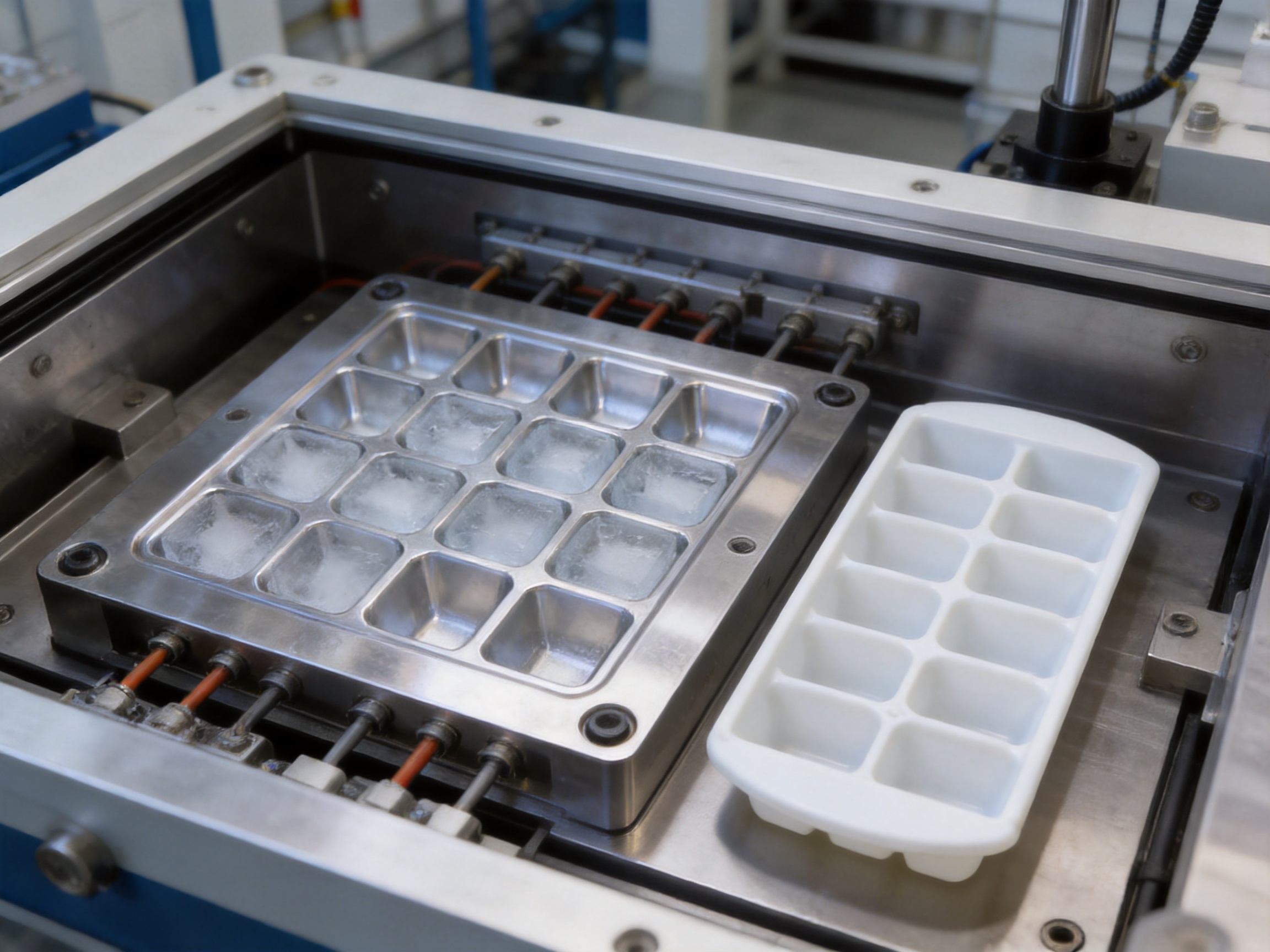
A plastic ice cube tray container mold is an injection mold used to create a tray containing multiple cavities for forming individual ice cubes. During production, molten plastic is injected into the mold, fills the runner and gate system, reaches each cavity, and is cooled until the tray obtains sufficient rigidity for ejection. The mold must reproduce the tray geometry accurately while controlling shrinkage, cooling variation, weld lines, air entrapment, and ejection stress.
The featured mold is engineered for household ice trays and related beverage ice products. Its design can accommodate traditional cube cavities, while customization options allow manufacturers to adjust cube shape, cavity quantity, tray dimensions, wall thickness, and product styling. These adjustments enable the same general tooling concept to serve different market requirements, from compact refrigerator trays to larger containers for restaurants and bars.
The design emphasizes uniform cavity formation. Each cavity must have consistent dimensions so that the finished ice cubes freeze at a similar rate and have a comparable appearance. Uneven cavity dimensions can produce irregular ice volume, inconsistent freezing times, and an unattractive final product. Accurate mold machining helps maintain balanced cavity geometry across the entire tray.
Smooth mold surfaces are also important. A polished cavity reduces friction between the plastic tray and the steel surface, helping the product release more smoothly during ejection. For TPE trays, which are valued for flexibility, a well-polished surface can further support easy demolding and reduce the risk of surface marks or deformation.
Why Mold Quality Matters in Ice Tray Manufacturing
Consumers generally expect an ice tray to be simple, clean, flexible, and easy to use. They may fill it with water, place it in a freezer, twist or flex it, and remove the ice without excessive effort. Every one of these user expectations is influenced by the mold design.
A poor-quality mold can create trays with uneven walls, incomplete filling, visible flow marks, sharp edges, difficult release, or inconsistent cavity sizes. Such problems can increase scrap rates and cause complaints after the product reaches the market. A mold that does not cool evenly may also create dimensional variation from one production cycle to another.
High-quality tooling supports the following production objectives:
Consistent tray dimensions across repeated shots.
Uniform cavity shape and ice cube volume.
Reliable filling of all cavities in a multi-cavity mold.
Efficient heat transfer and stable cycle times.
Clean surfaces that are easier to wash and maintain.
Reduced risk of sticking, deformation, and ejection damage.
Long service life under continuous injection production.
When these objectives are achieved, manufacturers can improve production planning, reduce material waste, and maintain a more stable finished-product quality level.

Food Grade Plastic Ice Cube Tray Container Mould
Key Technical Characteristics
S136 Mold Steel
The use of S136 stainless mold steel is a major advantage for ice tray tooling. S136 is commonly selected for applications requiring corrosion resistance, good polishability, and dependable dimensional performance. These properties are especially valuable for molds that require a smooth cavity finish and may be exposed to moisture during production, cleaning, or storage.
For an ice tray mold, the cavity surface directly influences product appearance and release performance. S136 can be polished to a high-quality finish, supporting the mirror-polished surfaces specified for this product. Its corrosion-resistant characteristics also help protect the mold from rust-related damage when appropriate maintenance and storage procedures are followed.
Compared with ordinary mold steels, a corrosion-resistant steel option can provide a stronger foundation for long-term production. It may reduce the risk of surface deterioration that can affect tray appearance or create additional maintenance work. The steel selection is therefore not only a material specification; it is part of the mold’s total life-cycle value.
PP and TPE Material Compatibility
The mold is designed to support polypropylene, commonly known as PP, as well as thermoplastic elastomer, commonly known as TPE. This material flexibility gives manufacturers more options when developing products for different customer groups and price levels.
PP is widely used for household plastic products because it combines low density, chemical resistance, practical stiffness, and economical processing. A PP ice tray can provide a rigid or semi-rigid structure, depending on the product design and wall thickness. It is suitable for many conventional refrigerator trays and beverage ice molds.
TPE provides a different user experience. Its flexible characteristics can make the tray easier to twist or press, helping users release frozen cubes with less effort. A TPE-compatible mold must be designed with careful attention to shrinkage, filling behavior, cooling, and demolding. The mold’s polished cavities and suitable ejection design help support the production of flexible trays without unnecessary surface damage.
Material selection should always be confirmed according to the intended application, local regulations, formulation, processing conditions, and food-contact requirements. The mold itself is designed to support the specified materials, while the final manufacturer remains responsible for selecting compliant grades and validating the finished product.
Multi-Cavity Production
A multi-cavity mold produces several ice tray cavities or multiple tray products during one injection cycle, depending on the final tooling arrangement. This increases output compared with a single-cavity solution and helps manufacturers meet larger-volume orders.
Multi-cavity tooling requires more than simply duplicating a shape. The filling system must distribute molten material evenly, and the cooling layout must control temperature across the mold. If one region fills earlier or cools differently from another, the finished trays may show variation in dimensions, weight, or appearance.
The multi-cavity design of this ice tray solution is intended to improve production efficiency while preserving repeatability. Proper balancing of the runner system, gates, cavity geometry, and cooling channels supports a more uniform injection process. This is particularly important when the product contains many small cavities that must all be filled completely.
Hot Runner System
The hot runner system helps maintain molten plastic at a controlled temperature as it moves toward the cavities. Compared with a conventional cold runner arrangement, a hot runner can reduce runner waste and support more direct material delivery to the cavity gates.
For high-volume household-product manufacturing, reduced runner waste can contribute to better material utilization. It can also simplify downstream handling because there may be less solidified runner material to separate or recycle. The system may support faster and more stable production when properly matched to the selected material and product design.
Hot runner performance depends on correct temperature control, heater reliability, nozzle design, gate configuration, and maintenance. During mold development, these elements must be evaluated together with the PP or TPE processing window. A well-designed system can improve filling balance, reduce pressure variation, and support repeatable tray quality.
Mirror-Polished Surface
The mirror-polished surface specification supports both visual quality and product release. A smooth cavity surface helps reduce friction and limits the number of surface imperfections transferred to the finished tray.
On a household ice tray, visible surface defects can make the product appear low-grade even when it remains functional. Smooth surfaces improve the clean appearance expected from kitchen products. They may also reduce areas where residue or moisture can accumulate, although the final product must still be designed and cleaned according to applicable food-contact and hygiene requirements.
Polishing is a controlled manufacturing operation rather than a purely cosmetic step. It requires suitable preparation after machining, progressive abrasives, careful inspection, and protection against over-polishing or edge rounding. The quality of polishing is especially important around cavity transitions, corners, parting lines, and other areas that can influence demolding.
Long Mold Service Life
The stated mold life is up to 800,000 shots. Actual service life depends on material grade, injection pressure, cycle conditions, maintenance, cooling-water quality, hot runner operation, and production practices. Nevertheless, the specification indicates that the mold is intended for sustained commercial production rather than short-term sampling only.
A long-life mold can distribute tooling investment across a larger number of parts. This may reduce the effective tooling cost per finished tray and make the mold more suitable for established product lines. Long service life also supports continuity of supply, which is important for retailers and brands that require stable replacement products over time.
To approach the expected service life, manufacturers should follow a preventive maintenance schedule. Key activities include cleaning the parting surfaces, checking the cooling channels, inspecting hot runner components, lubricating suitable moving parts, monitoring ejector movement, and protecting the mold against corrosion during storage.
Design Advantages Over Basic Competitor Tooling
Many low-cost ice tray molds can produce a functional sample, but commercial production demands more than initial functionality. The featured tooling concept offers several advantages over basic or poorly optimized competitor molds.
More Consistent Ice Cube Geometry
Accurate cavity machining helps produce cubes with a consistent shape and volume. This improves the visual uniformity of the frozen product and gives users a more predictable freezing and release experience. Consistency is particularly valuable for beverage-service applications where presentation matters.
Better Support for Easy Release
The combination of polished cavities and TPE compatibility gives manufacturers a pathway toward easy-release tray designs. Rigid PP products can benefit from suitable draft angles and ejection features, while flexible TPE designs can be flexed by the user to loosen the ice. The mold design can be adjusted according to the selected material and release concept.
Improved Material Efficiency
A hot runner system can reduce the amount of solidified runner material generated during production. This can improve material utilization and reduce the handling of runners after molding. For high-volume production, even a small reduction in waste may generate meaningful savings over time.
Greater Product Customization
The mold can be customized for different cube shapes, cavity numbers, and tray sizes. Competitor molds based on fixed standard dimensions may not provide the same level of flexibility. Customization allows manufacturers to create products for different refrigerator interiors, retail packaging formats, hospitality requirements, or promotional programs.
Enhanced Corrosion Resistance
S136 mold steel provides a stronger corrosion-resistant foundation than many general-purpose steel options. Because mold surfaces must remain clean and precise, protection against corrosion supports more reliable long-term performance and reduces the likelihood of surface damage caused by improper storage or moisture exposure.
Better Suitability for Export Production
A professionally engineered mold must support not only production but also repeatability across different manufacturing environments. Stable dimensions, documented specifications, and reliable tooling construction are valuable when finished products are exported to Europe, the Middle East, Southeast Asia, South America, or other international markets. Consistent tooling helps reduce variation when production is repeated for different customer orders.
Engineering Process from Concept to Mold Completion
Advanced mold manufacturing begins before steel is cut. The product concept must be translated into a practical mold structure that considers function, appearance, material, cycle time, maintenance, and production volume.
Product Design Review
The process begins with a review of the ice tray design. Engineers examine the overall tray dimensions, cavity arrangement, wall thickness, draft angles, handles, ribs, flexible zones, and any branding or decorative details. The goal is to identify features that may affect filling, cooling, ejection, or mold assembly.
For an ice tray, the connection between individual cavities is especially important. Bridges and walls must be thick enough to provide product strength while remaining economical in material usage. If the walls are too thin, filling and warpage may become difficult to control. If they are too thick, cooling time and product weight may increase unnecessarily.
Flow and Filling Evaluation
Computer-aided engineering can be used to evaluate the expected flow of PP or TPE through the runner and cavity system. Filling analysis helps engineers review gate locations, weld-line positions, pressure requirements, air-trap risks, and balance between cavities.
Although simulation cannot replace physical testing, it can identify potential problems earlier in the process. Adjustments made during the design stage are generally more efficient than changes made after the mold has been manufactured. This supports a more controlled project schedule and reduces the risk of extensive mold modification.
Cooling Channel Planning
Efficient cooling is essential for stable injection molding. The mold includes cooling channels that help remove heat from the steel and the newly molded plastic. A well-planned cooling layout supports shorter and more consistent cycles.
Ice tray geometry can contain many closely spaced cavities, making cooling-channel placement challenging. The channels must be close enough to provide effective heat transfer while remaining sufficiently separated from the cavity surfaces and other mold components. Engineers also need to consider water flow, pressure loss, connection design, and ease of cleaning.
Balanced cooling helps reduce warpage and dimensional variation. It also improves production predictability because cycle time is less likely to change as the mold reaches different thermal conditions. For high-volume manufacturing, thermal stability can be as important as the initial filling performance.
Precision CNC Machining and EDM
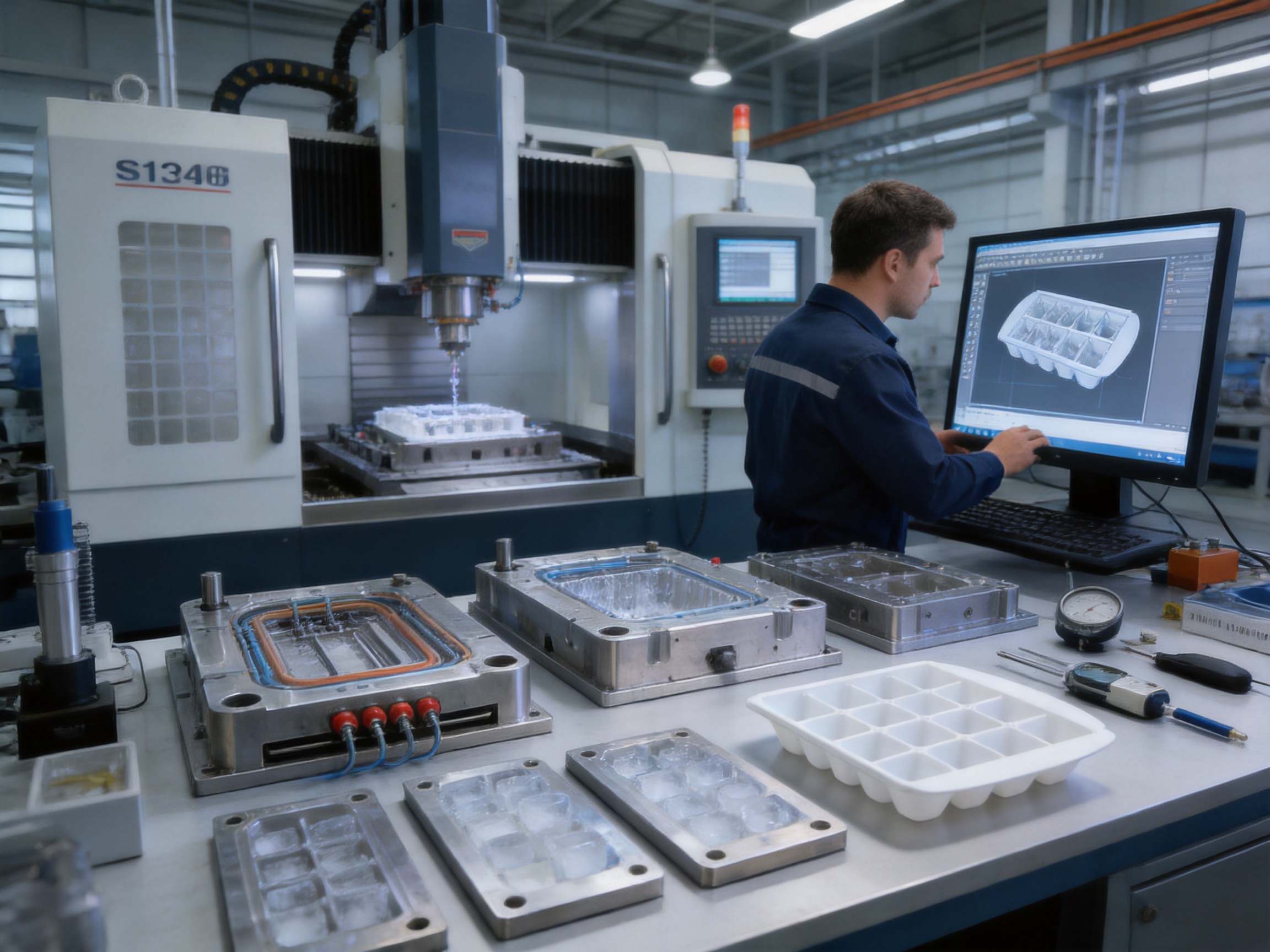
Precision machining creates the cavity blocks, core components, inserts, runner elements, and structural plates required for the mold. CNC milling is suitable for many complex surfaces, while electrical discharge machining may be used for fine details, narrow slots, deep features, or areas that are difficult to reach with conventional cutting tools.
Machining accuracy directly influences the finished tray. Small errors repeated across multiple cavities can create visible differences in cube shape or product fit. For this reason, mold components should be produced according to controlled drawings and inspected using suitable measuring equipment.
Polishing and Surface Preparation
After machining, cavity surfaces are prepared for polishing. The process may include removal of machining marks, correction of minor surface irregularities, progressive finishing, and final mirror polishing. Particular attention is required at transitions and edges because uneven polishing can affect both appearance and release.
Surface preparation must be controlled carefully. Excessive polishing may change the intended geometry, while insufficient polishing may leave marks that appear on the finished tray. Skilled technicians combine measured inspection with visual evaluation to obtain a consistent finish.
Assembly and Mold Fitting
Once individual components are completed, the mold is assembled and fitted. Parting surfaces, inserts, ejector components, guide systems, cooling lines, and hot runner elements must work together with suitable alignment.
Good fitting reduces flash, protects cavity edges, and supports smooth mold opening and closing. The ejector system must move evenly to avoid stressing the tray. Guide pins and bushes help maintain alignment over repeated cycles, while replaceable inserts can simplify future maintenance if certain areas experience higher wear.
Trial Molding and Validation
Trial molding is used to verify filling, cooling, ejection, appearance, dimensions, and cycle performance. Samples are inspected for short shots, flash, sink marks, weld lines, warpage, burn marks, flow marks, and other defects.
If necessary, engineers may adjust processing parameters or make controlled mold modifications. These can include gate tuning, vent improvement, polishing correction, ejection adjustment, or minor dimensional refinement. The purpose is to deliver a mold that performs consistently rather than merely producing one acceptable sample.
Manufacturing Strengths of the Supplier
Taizhou Huangyan Haiquan Plastic Mold Co., Ltd. is a high-tech enterprise specializing in the research, development, and manufacture of precision injection molds. Its capabilities cover daily necessities, home appliances, automotive parts, and industrial equipment. This broad sector experience is valuable because it exposes the engineering team to different product geometries, material requirements, tolerance expectations, and production challenges.
The company emphasizes an integrated service model covering design, manufacturing, and after-sales support. This approach helps maintain continuity between the customer’s product concept and the final tooling solution. Instead of treating design, machining, and service as separate activities, an integrated team can identify potential problems earlier and coordinate corrective action more efficiently.
A professional design team contributes to mold performance through product analysis, structure planning, material evaluation, and production optimization. Scientific production management supports scheduling, process control, inspection, and documentation. These elements are important for customers who require predictable delivery and consistent tooling quality.
The company’s quality philosophy is based on quality-first and sustainable development principles. In practical terms, this means giving attention to material selection, machining accuracy, surface finish, assembly quality, trial results, and long-term serviceability. Sustainable development in mold manufacturing can also include reducing material waste, improving mold life, reducing unnecessary rework, and helping customers achieve efficient production cycles.
With exports to Europe, the Middle East, Southeast Asia, and South America, the company has experience serving customers with different technical expectations and market requirements. International projects often require clear communication, careful confirmation of specifications, reliable packaging, and support across time zones. Export experience strengthens the supplier’s ability to manage these details.
The supplier’s product scope includes daily-necessity molds such as ice tray molds, crate molds, cleaning-product molds, chair and stool molds, air-cooler molds, rainwater-harvesting tank molds, and pet-dryer molds. Experience across these products develops practical knowledge in structural design, large and small mold construction, multi-cavity production, surface requirements, and different injection-molding conditions.
Application Areas
Household Ice Trays
The primary application is the household ice tray used in domestic refrigerators and freezers. These trays can be designed for compact kitchens, family use, dormitories, offices, or travel-oriented products. Cavity size and tray footprint can be adapted according to the expected freezer space.
Beverage Ice Molds
Beverage-focused ice molds may use distinctive cube shapes, larger cavities, or designs intended for cocktails, cold drinks, coffee, juice, and soft beverages. Custom cavity geometry can create round, square, elongated, or novelty ice forms. The mold can be adjusted to support the required visual identity and release behavior.
Bar and Restaurant Ice Containers
Restaurants, bars, cafés, and catering businesses may require larger ice trays or containers that support frequent use. These products must be practical to fill, freeze, clean, stack, and store. A durable mold helps manufacturers produce trays capable of meeting commercial-user expectations.
Private-Label and Promotional Products
Retail brands and promotional-product suppliers may require customized tray shapes, logos, colors, packaging sizes, or cavity arrangements. Mold customization allows the product to be differentiated from standard retail items. Such projects benefit from early design consultation because decorative features and branding details can influence the mold structure.
Customization Options
One of the strongest features of this tooling solution is its adaptability. Manufacturers can discuss a range of product variables before final mold design begins.
Cube shape is one major variable. Traditional square cubes are practical for general household use, while round or elongated forms may be chosen for specific beverage applications. Novelty shapes can support seasonal products, promotional programs, or children’s kitchen accessories.
Cavity quantity affects both product size and production output. A compact tray may contain fewer cavities to fit a small freezer, while a commercial tray may contain more cavities to maximize ice production. The mold structure should be planned around the intended tray dimensions and injection-machine capacity.
Tray size can be adapted for different refrigerator compartments and packaging requirements. Width, length, height, handle design, stacking features, and storage geometry may all be customized.
Material selection can also influence the product design. PP is suitable for many rigid or semi-rigid trays, while TPE may be chosen when flexibility and easy ice release are priorities. The final design should account for each material’s shrinkage, hardness, flow characteristics, cooling response, and expected use conditions.
Surface texture is another possible option. The standard specification emphasizes mirror polishing, but selected areas may be given a controlled texture if a particular appearance or grip characteristic is required. Any texture must be evaluated in relation to release and cleaning performance.
Color is normally determined by the selected plastic compound and production process rather than the mold itself. Manufacturers can select suitable food-contact colorants and material grades according to the target market and applicable regulations.
Quality Control Considerations
Quality control begins with incoming materials. Mold steel, copper components, hot runner parts, and other critical items should be checked against project specifications. Material certificates and dimensional records help establish traceability.
During machining, key dimensions should be measured at defined stages. Early inspection can identify deviations before they affect multiple components or require extensive rework. Critical cavity dimensions, parting surfaces, guide systems, and cooling-related features deserve particular attention.
After polishing, cavity surfaces should be inspected for machining marks, scratches, pits, and uneven finishing. The mirror-polished requirement makes surface inspection especially important because small defects may be transferred to the plastic tray.
Assembly inspection should confirm that the mold opens and closes smoothly, ejector components move correctly, cooling circuits are unobstructed, and hot runner components are correctly installed. Pressure or leakage checks may be used for cooling channels according to the manufacturer’s procedures.
Trial samples should be assessed visually and dimensionally. Important checks include tray length and width, cavity dimensions, wall thickness, product weight, flatness, edge quality, release performance, and the presence of flash or warpage. Samples should also be reviewed for user-oriented properties such as flexibility, ease of twisting, and overall handling.
Documentation is an important part of professional mold delivery. A useful mold file may include drawings, steel information, spare-part recommendations, cooling layouts, hot runner details, trial records, maintenance instructions, and approved sample information. These records help the customer operate and maintain the mold correctly over its service life.
Production Efficiency and Total Cost
The purchase price of a mold is only one part of the total cost. A lower-priced mold may become more expensive if it produces excessive scrap, requires frequent repairs, runs slowly, or creates inconsistent product quality. A properly engineered mold should be evaluated according to total production value.
The multi-cavity configuration can raise output per cycle. The hot runner system may reduce runner waste. Efficient cooling can shorten or stabilize the cycle. S136 steel and careful polishing can support longer service life and reduce the risk of cavity deterioration. Together, these factors can improve the cost per finished tray.
Reliable production also helps reduce indirect costs. Fewer defects mean less sorting, regrinding, repacking, and customer-service work. Stable cycle times make production scheduling easier. Consistent tray dimensions reduce the risk of packaging mismatch or product returns.
Manufacturers should compare tooling options using a complete evaluation that includes expected annual volume, material cost, cycle time, cavity count, maintenance requirements, projected mold life, and product-quality expectations. The right mold is not necessarily the least expensive at the quotation stage; it is the one that provides the best balance of performance, durability, and commercial return.
Operation and Maintenance Recommendations
Correct operation helps protect the mold and maintain product quality. The injection machine should be matched to the mold size, clamping requirements, shot volume, and material-processing conditions. Processing temperatures and injection parameters should be established according to the selected PP or TPE grade.
Operators should monitor filling balance, pressure, cooling time, mold temperature, and ejection behavior. Sudden changes in cycle time, product weight, or tray appearance may indicate a problem with the hot runner, cooling circuit, material supply, or mold surface.
The mold should be cleaned regularly, especially around the parting line, cavity edges, vents, and ejector areas. Residual plastic, dust, and oil can affect sealing, appearance, and movement. Cleaning materials must be compatible with the mold steel and surface finish.
Cooling channels should be checked for restricted flow, scale, corrosion, or contamination. Poor water flow can increase cycle time and create uneven cooling. Water quality management and periodic cleaning are important for maintaining thermal performance.
Hot runner systems require careful temperature control. Operators should avoid unnecessary temperature fluctuations and follow recommended start-up and shutdown procedures. Nozzles, heaters, thermocouples, and controller settings should be inspected if filling becomes unstable.
When the mold is removed from the machine, it should be cleaned, dried, protected against corrosion where appropriate, and stored in a dry environment. Moving components should be positioned safely, and the mold should be supported to prevent damage during handling.
Recommended Project Workflow for Buyers
Customers can improve project efficiency by preparing clear information before requesting a quotation. Useful inputs include product drawings or samples, 3D files, target material, annual volume, machine information, preferred cavity count, packaging dimensions, surface requirements, and delivery expectations.
The first stage is product and feasibility review. Engineers evaluate whether the proposed tray can be molded efficiently and whether any geometry should be changed to improve filling, cooling, or release.
The second stage is mold concept development. The supplier proposes the cavity arrangement, parting line, runner system, cooling structure, ejection method, steel grade, and estimated cycle approach.
The third stage is detailed design and confirmation. The customer reviews the product and mold drawings, confirms the material and appearance requirements, and approves the design before manufacturing begins.
The fourth stage is mold production. Steel preparation, CNC machining, EDM, polishing, component assembly, and inspection are completed according to the approved plan.
The fifth stage is trial molding. Samples are produced, measured, and reviewed. If adjustments are needed, they are completed before final acceptance.
The final stage is delivery and after-sales support. The customer receives the mold and related technical information, while the supplier remains available to assist with installation, operation, maintenance, and future modifications.
Technical Specification Summary
| Item | Specification | Production Benefit |
|---|---|---|
| Product Type | Plastic ice cube tray container | Suitable for household, beverage, bar, restaurant, and commercial ice applications |
| Mold Steel | S136 | Good corrosion resistance, polishability, and long-term cavity stability |
| Product Material | PP / TPE | Supports rigid or semi-rigid trays as well as flexible easy-release designs |
| Cavity Configuration | Multi-cavity | Improves output per cycle and supports volume production |
| Runner System | Hot runner | Helps reduce runner waste and supports controlled material distribution |
| Target Mold Life | Up to 800,000 shots | Designed for sustained commercial production when properly maintained |
| Surface Finish | Mirror polish | Supports smooth appearance and easier product release |
| Customization | Cube shape, cavity number, tray size | Allows adaptation to different markets, appliances, and packaging formats |

Questions and Answers
What is the main purpose of this mold?
The mold is used to manufacture plastic ice cube trays and related containers for household freezers, beverage preparation, bars, restaurants, and other applications. It forms multiple uniform cavities in a tray-shaped product.
Which materials can be used?
The specified material options are PP and TPE. PP is suitable for rigid or semi-rigid household trays, while TPE can provide greater flexibility and easier ice release. The selected grade should be confirmed according to the intended application and relevant food-contact requirements.
Why is S136 steel suitable for an ice tray mold?
S136 offers corrosion resistance and good polishability. These properties support a clean, durable cavity surface and help maintain the mold’s performance when it is properly operated, cleaned, and stored.
What is the advantage of a hot runner system?
A hot runner keeps the plastic in a controlled molten state as it moves toward the cavities. It can reduce solidified runner waste, improve material utilization, and support more stable filling when the system is correctly designed and controlled.
Can the cube shape be customized?
Yes. Cube shapes can be adjusted according to the product concept. Traditional cubes, rounded forms, elongated shapes, and special designs can be considered during the product and mold design stage.
Can the number of cavities be changed?
Yes. Cavity quantity can be customized according to the desired tray size, output requirement, injection-machine capacity, and packaging format. More cavities may increase output, while fewer cavities may support a smaller household tray.
Is the mold suitable for flexible ice trays?
The mold supports TPE, which can be used for flexible tray designs. The final ease of release depends on the TPE grade, hardness, product geometry, draft, surface finish, cooling conditions, and ejection design.
How does mirror polishing improve the finished tray?
Mirror polishing produces a smooth cavity surface that can improve product appearance and reduce friction during ejection. It also helps limit the transfer of machining marks to the finished plastic tray.
What does the 800,000-shot specification mean?
It indicates the intended service-life target of the mold under suitable operating and maintenance conditions. Actual service life may vary according to material, processing parameters, cooling-water quality, production frequency, and maintenance practices.
What information should a buyer provide for a quotation?
A buyer should provide product drawings or samples, 3D files if available, target material, tray dimensions, cavity quantity, expected production volume, machine information, surface requirements, packaging needs, and delivery schedule. Clear information helps the supplier prepare an accurate mold proposal.
Can the supplier assist with product design?
The supplier provides integrated services covering mold design and production. Engineering review can help identify draft, wall-thickness, filling, cooling, ejection, and customization issues before manufacturing begins.
Where can the finished molds be used?
The molds can support products for domestic and international markets, including Europe, the Middle East, Southeast Asia, South America, and other regions. Final product compliance and food-contact suitability should be verified for the intended destination.
Conclusion
The Food Grade Plastic Ice Cube Tray Container Mould is a specialized tooling solution for manufacturers that require more than a basic ice tray shape. Its S136 steel construction, PP and TPE compatibility, multi-cavity structure, hot runner system, mirror-polished surface, and long-life design support the central demands of modern ice tray production: hygiene-oriented product design, uniform cavities, easy release, efficient output, and consistent quality.
Its competitive value comes from the combination of material flexibility, cavity precision, cooling efficiency, surface quality, and customization potential. Manufacturers can develop household trays, beverage ice molds, commercial ice containers, and private-label products while adjusting cube shapes, cavity numbers, and tray dimensions to match specific markets.
The supplier’s strengths extend beyond mold construction. As a high-tech enterprise focused on precision injection molds for daily necessities, home appliances, automotive parts, and industrial equipment, Taizhou Huangyan Haiquan Plastic Mold Co., Ltd. offers experience across multiple product sectors. Its design capabilities, scientific production management, integrated manufacturing process, export experience, and after-sales support provide a practical foundation for customers seeking dependable tooling partnerships.
When the mold is correctly designed, manufactured, tested, and maintained, it can support stable production over a long service period. For companies developing safe, attractive, and easy-to-use plastic ice trays, this tooling solution provides a strong balance between product performance, manufacturing efficiency, customization, and total cost of ownership.
References
1. Product technical information supplied for the Food Grade Plastic Ice Cube Tray Container Mould, including material, steel, cavity, runner, mold-life, and surface-finish specifications.
2. General principles of plastic injection mold design, including cavity balancing, gate selection, cooling-channel planning, ejection, and preventive maintenance.
3. General technical information concerning S136 stainless mold steel, corrosion resistance, polishability, and applications in precision plastic tooling.
4. General processing guidance for polypropylene and thermoplastic elastomer injection molding.
5. General quality-control practices for precision injection molds, including dimensional inspection, trial molding, surface inspection, and production validation.
6. Company information supplied for Taizhou Huangyan Haiquan Plastic Mold Co., Ltd., including its product sectors, integrated services, export markets, and manufacturing philosophy.
Product: Food Grade Plastic Ice Cube Tray Container Mould

For exclusive deals and latest offers, sign up by entering your email address below.











 +86-18657672567
 sales@tzhqmould.com
celin@tzhqmould.com
 No. 17 Houshi Road, Beicheng Industrial Zone, Huangyan District, Taizhou City, Zhejiang Province, China
Copyright © Taizhou Huangyan Haiquan Plastic Mold Co., Ltd. All Rights Reserved
Injection Plastic Mould Maker

