

Plastic Dish Drainer Rack Injection Mould: Precision Tooling for Efficient Kitchen Organization
Admin 2026-09-30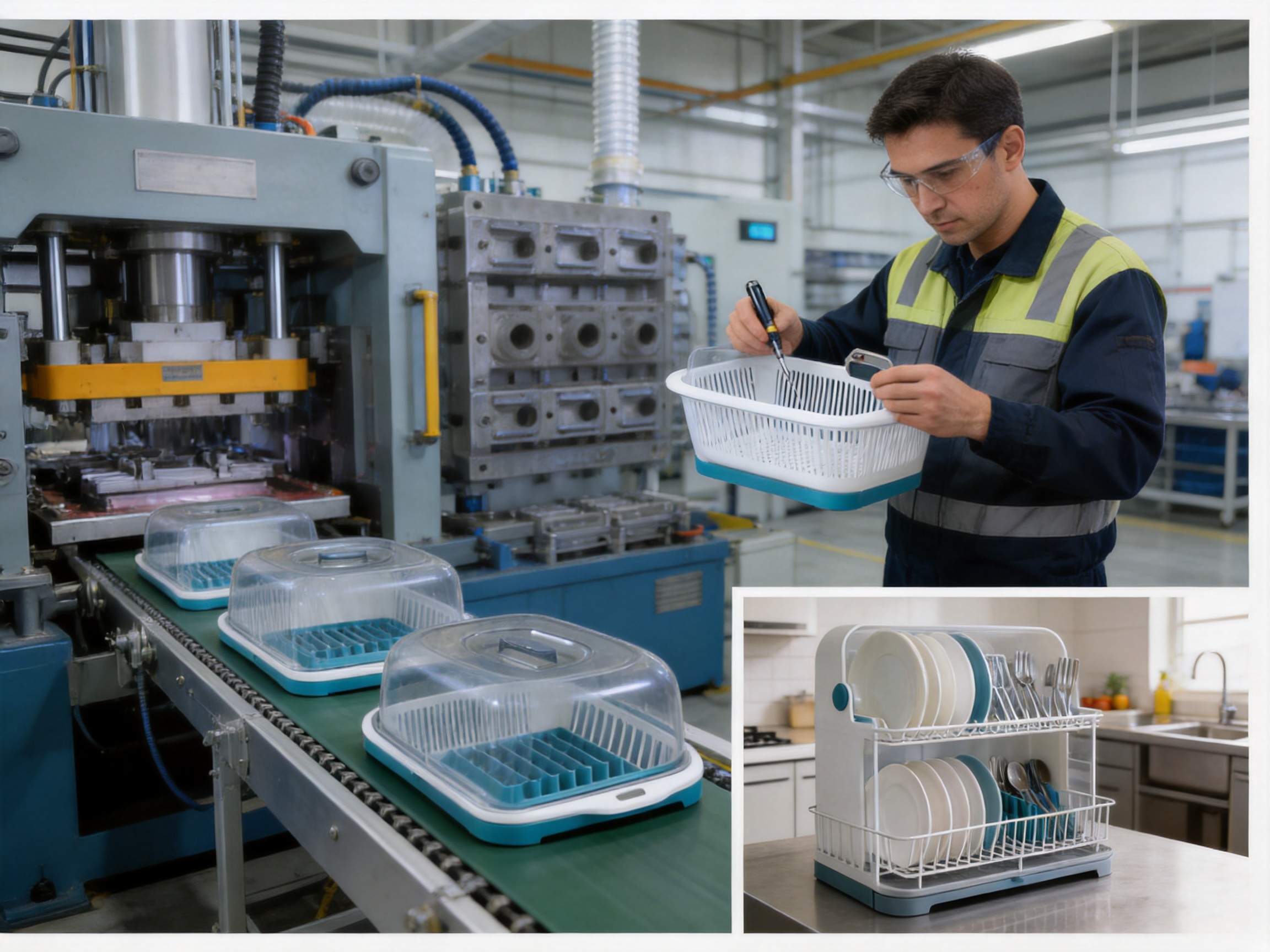
A plastic dish drainer rack is a practical household product, but manufacturing one consistently requires far more than a simple cavity and a basic runner system. The rack must support plates, bowls, cups, cutlery, and other tableware while allowing water to drain rapidly. Its structure normally includes thin ribs, vertical dividers, narrow slots, utensil compartments, reinforced feet, and sometimes integrated handles or removable components. Each feature creates a specific challenge for mold design, plastic flow, cooling, ejection, and long-term production reliability.
The Plastic Dish Drainer Rack Injection Mould is developed for manufacturers that need a dependable tool for producing durable and attractive kitchen dish racks. It is suitable for household products, restaurant accessories, commercial kitchen organizers, and private-label tableware storage systems. Its design combines balanced filling, reinforced structural areas, efficient cooling, and practical customization options to support stable injection molding at commercial production volumes.
Designed and manufactured by Taizhou Huangyan Haiquan Plastic Mold Co., Ltd., this tooling solution reflects the company’s experience in daily necessities molds, cleaning products molds, crate molds, chair and stool molds, air cooler molds, rainwater harvesting tank molds, and pet dryer molds. The company also serves home appliance, automotive parts, and industrial equipment sectors, allowing its mold engineers to apply experience from a broad range of plastic products to the development of kitchen organization tools.
Why Dish Drainer Rack Molding Requires Specialized Engineering
Dish racks appear simple when viewed as finished products. However, their open framework creates a demanding molding environment. Unlike a solid container or a relatively uniform household component, a dish drainer rack contains many interruptions in its geometry. Plate holders may be separated by narrow channels, drainage slots may run across the base, vertical supports may connect to thin ribs, and utensil sections may include deep or enclosed areas. These details affect the way molten plastic flows through the cavity.
If the runner system is poorly balanced, some sections may fill before others. Early-filled zones can begin to cool while distant ribs are still receiving material. This may cause short shots, weld lines, sink marks, warpage, uneven packing, or differences in surface appearance. A rack that does not fill correctly may also have weak joints where ribs meet the base. Such weaknesses are especially undesirable because the product must carry wet dishes repeatedly during everyday use.
The mold must also manage drainage-related geometry. Drainage slots need to remain open, clean, and dimensionally stable. If the slots are blocked by excessive flash, local deformation, or poor ejection, water may collect inside the rack. Likewise, thin vertical supports must be strong enough to retain plates while remaining visually neat. The balance between lightweight design and structural strength is therefore an important part of mold development.
Cooling is another central issue. A dish drainer rack may occupy a relatively large molding area even though much of its structure is open. Large bases, reinforced corners, and thick junctions can retain heat longer than thin ribs. Uneven cooling may lead to differential shrinkage, which can distort the rack or prevent it from sitting level on a countertop. Efficient cooling channels and appropriate mold steel selection help reduce these production risks.
Product Design and Functional Structure
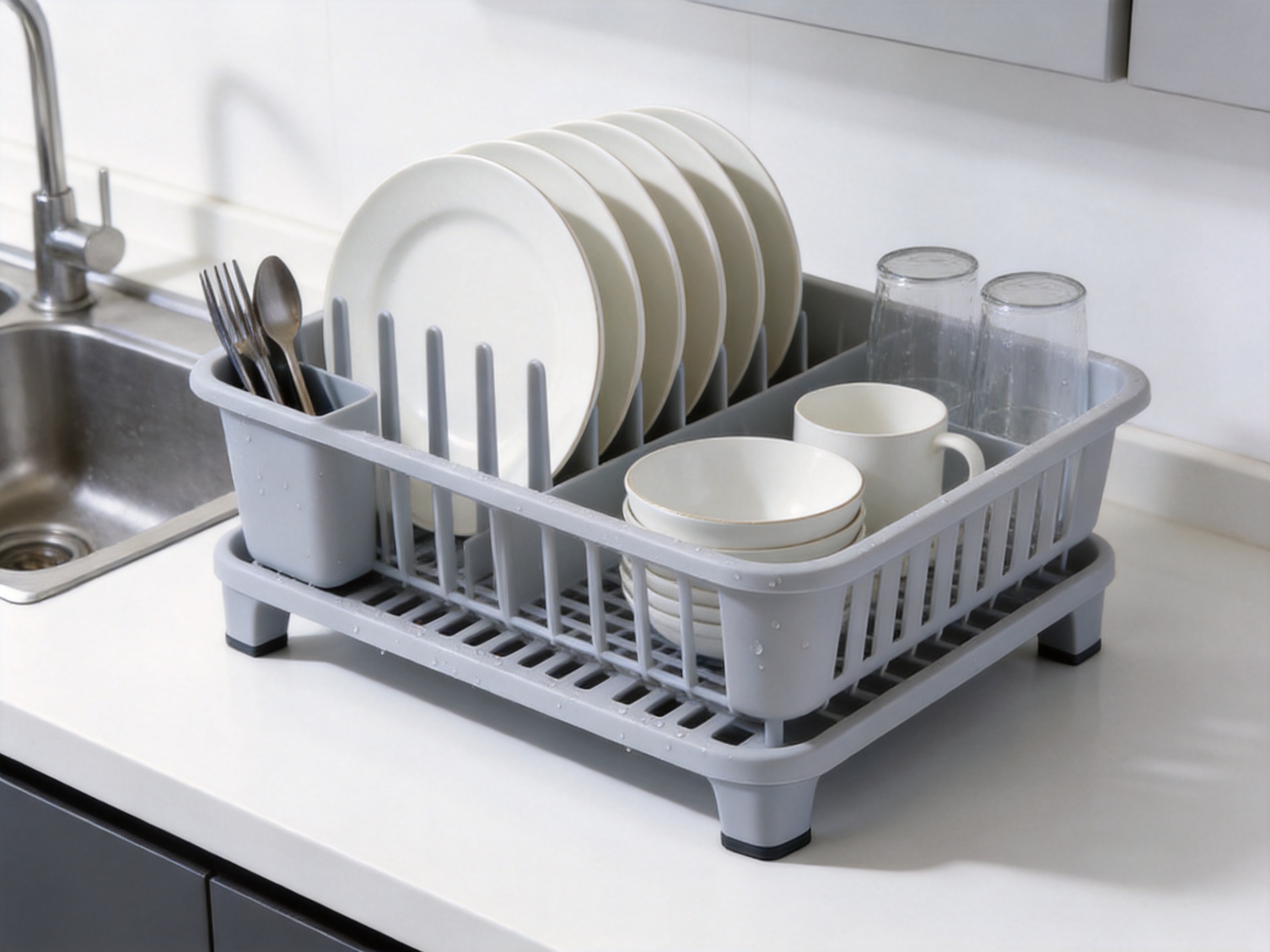
The Plastic Dish Drainer Rack Injection Mould supports the production of rack designs intended to organize plates, bowls, cups, and utensils after washing. The cavity can be developed around the customer’s required layout, dimensions, surface texture, drainage pattern, and storage capacity. This gives product designers room to create simple household racks or more specialized organizers for restaurants and commercial kitchens.
Plate holders are generally arranged to maintain separation between individual plates. Proper spacing allows air to circulate and water to drain from the tableware. The mold design must reproduce these holders with accurate alignment because inconsistent spacing can make the finished product difficult to load. A carefully engineered cavity also helps prevent sharp edges or unwanted projections that could scratch plates or interfere with stacking.
Drainage slots are integrated into the base or supporting platforms. These openings must be accurately formed and sufficiently reinforced so that the rack does not sag under the weight of wet dishes. The slot pattern can be modified according to the product’s intended use. A household rack may use a compact layout, while a restaurant accessory may require wider drainage channels and a greater load-bearing area.
Utensil compartments create another area of design flexibility. These compartments may be molded into one side of the rack or designed as a separate section within the main body. They can accommodate knives, forks, spoons, chopsticks, kitchen tools, and other narrow items. The mold can be adjusted for compartment depth, divider spacing, drainage openings, and overall capacity.
Reinforced base structures improve the rack’s ability to withstand repeated loading and unloading. A strong base reduces bending when the rack is filled with heavy plates or bowls. It also helps the product maintain a stable position on a countertop. Reinforcement must be designed carefully, because excessively thick areas can increase cycle time or create sink marks. The mold engineering process therefore considers both mechanical performance and injection molding efficiency.
Balanced Runner System for Reliable Filling
The runner system is one of the most important features of a multi-featured plastic dish rack mold. Its function is to deliver molten plastic from the injection machine nozzle to the gate locations and then into the cavity. For an open rack with thin ribs and several vertical supports, the flow path must be planned so that different regions fill in a controlled sequence.
The Plastic Dish Drainer Rack Injection Mould uses a balanced cold runner configuration. A balanced arrangement helps distribute material more evenly to the cavity, reducing the risk that one portion of the rack will be overpacked while another portion remains underfilled. This is particularly important when the product includes long ribs, narrow plate holders, or remote utensil compartments.
Cold runner tooling remains a practical option for many dish rack applications. It can be cost-effective, relatively straightforward to maintain, and suitable for common materials such as polypropylene and ABS. The runner dimensions, gate positions, and transitions can be adapted to the specific product geometry and material grade selected by the customer.
Gate placement is considered in relation to appearance, weld-line location, filling pressure, and post-molding operations. A suitable gate position can help the melt reach thin structural areas before excessive cooling occurs. It can also reduce visible marks on the product’s most prominent surfaces. For a consumer kitchen product, appearance is important because customers expect clean lines and consistent texture in addition to functional performance.
Balanced filling also supports more predictable packing. When the cavity reaches full pressure in a controlled manner, the molded rack is more likely to maintain consistent dimensions from shot to shot. This is valuable for manufacturers that supply products to retail brands, restaurant distributors, and household goods importers. Stable dimensions simplify inspection, packaging, stacking, and assembly where the rack includes additional components.
Compared with an inadequately designed competing mold, a balanced runner layout can reduce production interruptions caused by short shots, excessive flash, or repeated process adjustments. It does not eliminate the need for proper machine settings and material preparation, but it gives the molding operator a more stable foundation for process optimization.

Plastic Dish Drainer Rack Injection Mould
Material Compatibility and Mold Steel Selection
The stated product material options for this injection mold are PP and ABS. Polypropylene is widely used for household racks because it combines low density, chemical resistance, moisture resistance, and good general toughness. It can produce lightweight products that are suitable for daily contact with water and common kitchen cleaning routines. PP is also available in many grades and colors, allowing manufacturers to select a formulation that matches the required stiffness, appearance, and processing conditions.
ABS may be selected when the product requires a different balance of rigidity, surface appearance, and impact performance. It can provide a solid feel and attractive molded finish. The appropriate material depends on the product design, target market, expected loading conditions, environmental exposure, and customer specifications. Before final mold construction, the material grade should be confirmed because shrinkage, flow behavior, processing temperature, and cooling requirements can vary between formulations.
The mold steel options are 718 and P20. Both are commonly used mold steels for industrial plastic injection tooling. Steel selection affects machinability, surface treatment, durability, maintenance requirements, and expected production life. P20 is widely recognized as a practical pre-hardened mold steel for general-purpose tooling. 718 is also used for applications requiring dependable machining and a suitable balance of performance and cost.
The selected steel is matched to the expected production volume, product material, surface finish, and complexity of the cavity. Areas exposed to repeated sliding, friction, or high mechanical stress may require particular attention during design and finishing. The engineering team can evaluate parting lines, inserts, ejector locations, guide components, and wear-prone zones to create a mold structure that is easier to service throughout its working life.
The stated mold life is 600,000 shots. Actual service performance depends on material selection, molding conditions, maintenance, cooling-water quality, cleaning practices, storage, and the complexity of the production schedule. Nevertheless, this target provides a useful reference for manufacturers planning long-term production. A mold designed for hundreds of thousands of shots can support a product launch, regional distribution program, or continuing supply contract without requiring frequent replacement tooling.
Efficient Cooling and Cycle-Time Control
Cooling has a direct influence on output, dimensional stability, and product quality. During injection molding, molten plastic transfers heat into the mold. The part must remain in the cavity long enough to cool sufficiently for ejection. If the cooling system is inefficient, the cycle may need to be extended. Longer cycles increase operating costs and reduce the number of parts that can be produced per shift.
The Plastic Dish Drainer Rack Injection Mould is designed with efficient cooling in mind, particularly for large plastic components with broad base areas and multiple structural junctions. Cooling channels are planned to remove heat from critical areas as evenly as possible. The objective is not simply to cool the mold quickly, but to control temperature distribution so that the rack remains dimensionally stable after ejection.
Uniform cooling is especially important for a product that must sit level on a countertop. If one side of the base cools or shrinks differently from the other, the finished rack may rock, twist, or place unwanted stress on its legs and supports. A well-considered cooling layout helps reduce these problems and improves repeatability over continuous production.
Cooling also influences surface quality. Excessive heat can contribute to gloss differences, deformation, or visible flow-related defects. By maintaining a more consistent mold temperature, manufacturers have a better opportunity to achieve a uniform textured finish across the product. The final settings still depend on the chosen plastic material, machine, water temperature, injection speed, packing pressure, and ambient conditions.
In comparison with poorly cooled tooling, an efficiently cooled mold can offer a better balance between cycle time and product quality. Reducing the cycle by even a small amount can produce substantial savings when the mold operates for many months. Faster cycles may also improve delivery capacity during seasonal demand, promotional campaigns, or large commercial orders.
Structural Durability and Load-Bearing Performance
A dish drainer rack is expected to withstand repeated loading. Users place wet plates into the rack, remove them, add bowls or cups, and occasionally move the entire rack while it is full. Commercial kitchens may subject the same product to even more frequent handling. For this reason, the mold must reproduce structural features that support stiffness and resist deformation.
The reinforced base of the product is one of the key areas. A strong base provides a stable foundation for the dish holders and supports the weight transferred from the upper structure. The mold can incorporate ribs, cross supports, raised feet, or other reinforcement features according to the customer’s design. These details must be carefully integrated to avoid excessive wall thickness and unnecessary material consumption.
Vertical supports need to be accurately formed because they separate plates and help keep them upright. Their dimensions influence both usability and strength. If the supports are too thin, they may bend or break during use. If they are too thick, they may reduce storage space and increase cooling time. Mold design allows these features to be adjusted to the selected plastic and required load capacity.
Junctions between ribs and the base deserve special attention. These areas often receive stress when dishes are placed into the rack. Smooth transitions and appropriate radii can improve the flow of plastic and reduce stress concentration in the finished product. They also help the mold fill more effectively and reduce the chance of sharp internal corners that may be difficult to polish or release.
The result is a product platform that can be adapted to different levels of duty. A compact household rack may be optimized for light daily use and easy storage. A larger restaurant accessory may require a wider base, stronger dividers, and more robust drainage channels. The same general mold engineering principles can be applied to each version while retaining the customer’s preferred layout.
Surface Finish and Visual Quality
The standard surface finish listed for the mold is textured. A textured finish can provide a practical appearance for kitchen products and may help reduce the visibility of minor handling marks. It can also create a more distinctive product surface compared with a plain polished finish. Depending on the selected texture, it may improve perceived grip in certain areas and contribute to a more comfortable user experience.
Texture must be applied with attention to draft angles and ejection. A deep or aggressive texture can increase resistance between the molded part and the cavity surface. If draft is insufficient, the part may drag during ejection, leaving scuff marks or placing stress on thin ribs. Mold designers therefore consider the relationship between texture depth, wall direction, ejector placement, and material shrinkage.
Uniform texture across visible surfaces is important for consumer products. Inconsistent finishing may make one section appear different from another even when the product is dimensionally correct. Professional mold manufacturing includes cavity preparation, machining control, finishing inspection, and trial evaluation to help maintain a consistent result.
The surface can be customized when the application requires a different visual effect. Customers may request a finer texture, a more pronounced grain, selected polished areas, or a combination of finishes. The final choice should be confirmed before mold finishing because surface treatment can affect draft requirements, appearance, cleaning behavior, and the perception of product quality.
Customization for Different Market Requirements
One of the strongest features of this mold solution is its adaptability. Drainage structure, rack layout, and overall size can be customized. This allows manufacturers to develop products for different kitchen environments instead of relying on a single standard configuration.
Drainage customization may include the number, width, length, and location of slots. Some customers may prefer narrow slots to support small items, while others may need larger openings for fast water removal. The base can also be designed to direct water toward a collection tray, a countertop drain, or a specific outlet area if the product concept includes such a feature.
Rack layout customization covers plate-holder spacing, bowl support geometry, cup positions, utensil sections, and the relationship between the main rack and any removable accessories. A design intended for small apartments may prioritize compact dimensions and vertical storage. A restaurant rack may prioritize capacity, rapid drainage, and easy cleaning. Custom tooling makes it possible to address these different priorities.
Size customization is equally important. Kitchen counters differ widely, and retail markets may have different expectations regarding width, depth, and height. A smaller rack may fit beside a sink in a compact home. A wider model may serve a family kitchen or food-service operation. Changing the size may require adjustments to runner balance, cooling layout, ejector locations, and mold strength, which is why customization should be evaluated by experienced mold engineers rather than treated as a simple scaling exercise.
Color and material can also be coordinated with the mold design. PP and ABS are available in many colors, while additives may influence shrinkage and flow. When the customer chooses a special color, reinforced grade, or recycled-content formulation, the molding process should be reviewed to ensure that the cavity fills and cools as intended.
Customization is most effective when the product concept is evaluated before detailed mold construction. Early discussion can identify possible undercuts, difficult ejection areas, excessive wall thickness, unnecessary sharp corners, or drainage features that may be hard to clean. Resolving these issues during design is generally more efficient than modifying the mold after production has begun.
Advanced Manufacturing Process
The quality of an injection mold depends not only on the concept but also on the manufacturing process used to turn that concept into a precision tool. Haiquan’s stated business covers research and development, mold design, manufacturing, and after-sales support. This integrated approach allows the project to move through connected stages rather than treating design, machining, trial molding, and service as unrelated activities.
Product Evaluation and Design Planning
The process begins with an evaluation of the product geometry and the customer’s production objectives. Engineers review the rack’s overall dimensions, wall thickness, ribs, drainage openings, plate holders, utensil compartment, draft angles, parting line, and expected material. They also consider the intended injection machine, required output, cavity quantity, and desired surface finish.
At this stage, potential molding risks are identified. These may include thin sections, long flow paths, enclosed features, difficult ejection areas, weld-line locations, uneven shrinkage, and regions that need additional support. The product design can then be adjusted to make the mold more reliable without compromising its intended function.
Three-Dimensional Mold Design
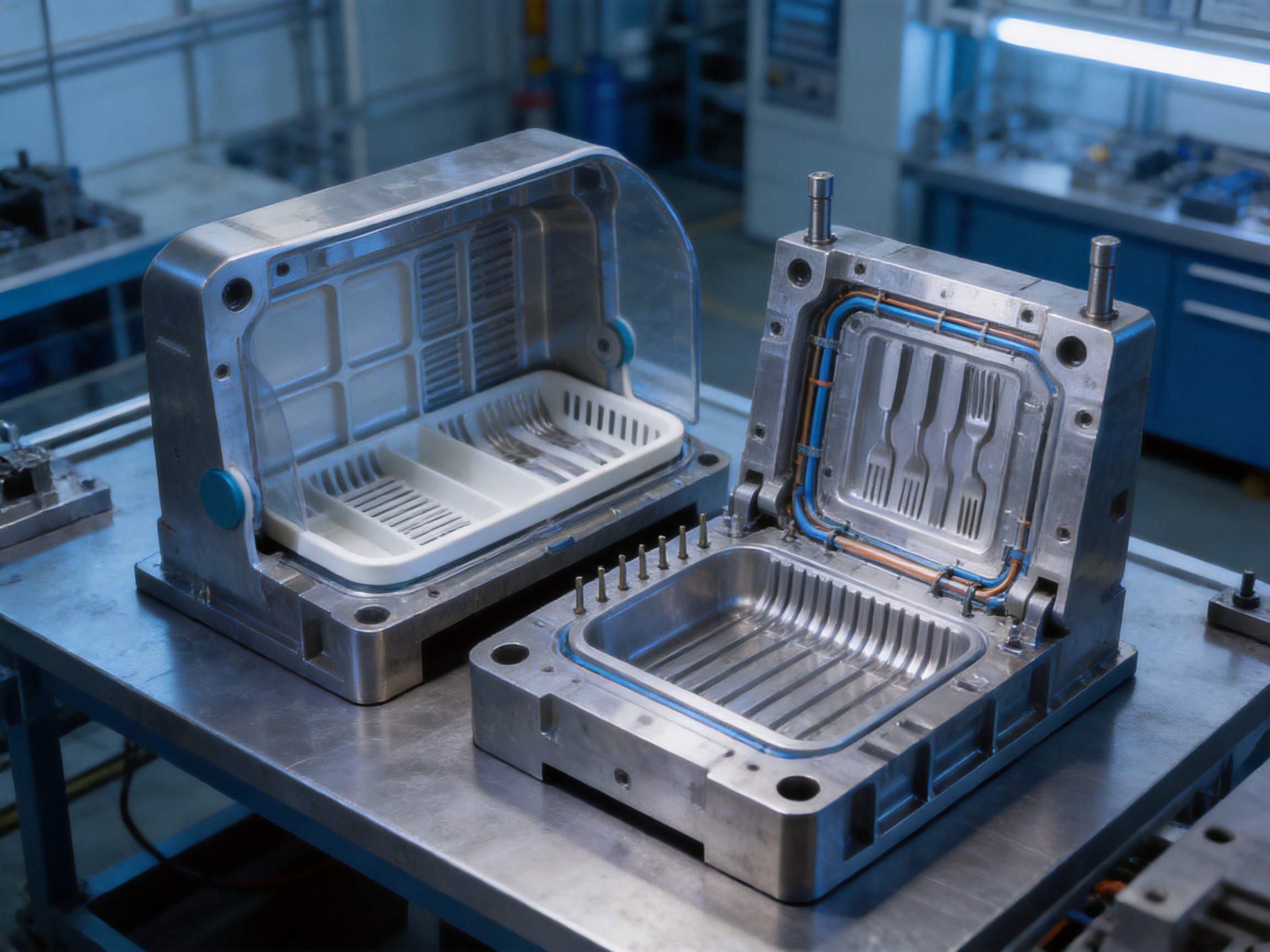
Three-dimensional mold design establishes the cavity, core, parting surfaces, runner system, gates, cooling circuits, ejector system, guide components, and mold base. For a dish rack, the design must preserve the open structure while providing enough support for thin ribs and vertical dividers.
The parting line is positioned to reduce visible flash and simplify release. Ejector pins or other ejection elements are distributed in areas that can accept force without marking important surfaces. The design also considers how the rack will be removed from the cavity after shrinkage. Proper draft and ejection balance help reduce the risk of bent ribs, drag marks, or stuck parts.
The runner system is reviewed in relation to cavity filling. With one or two cavities available for this product, the layout can be arranged to support stable production while matching the output requirements of the customer. A one-cavity design may be appropriate for a large rack or a specialized product, while a two-cavity configuration may improve output when the product size and machine capacity permit it.
Precision Machining and Component Production
After the design is approved, mold components are machined from the selected steel. CNC machining creates the primary cavity and core geometry, while additional processes may be used for fine details, holes, inserts, and complex transitions. Thin ribs and drainage slots require careful control because small dimensional errors can affect both appearance and product performance.
Machining accuracy is especially important at the interfaces between the mold base, cavity inserts, core components, slides, and ejector system. Proper alignment helps prevent mismatch lines, flash, uneven wear, and premature damage. Precision machining also supports more predictable maintenance because replacement or repair components can be manufactured to known dimensions.
Complex features may require electrical discharge machining or other specialized finishing methods. These processes can help create narrow slots, intricate corners, or difficult-to-machine details. The exact method depends on the geometry, steel, tolerance, and desired surface finish.
Fitting, Polishing, and Surface Treatment
After machining, mold components are fitted and checked for alignment. The cavity and core must close accurately so that the finished rack does not show excessive parting-line mismatch. Moving components must operate smoothly, and the ejector system must return properly after each cycle.
Surface preparation is completed according to the required textured finish. The cavity may receive texturing after machining and initial fitting, with attention to draft angles and uniformity. Areas that require a different finish are treated separately. Proper surface work improves the visual quality of the molded product and helps achieve the intended appearance across production runs.
Trial Molding and Process Verification
Trial molding is used to evaluate the mold under practical injection conditions. Engineers examine filling behavior, weld lines, air traps, ejection, cooling performance, part dimensions, surface appearance, and overall product function. The trial can reveal whether a gate requires adjustment, whether venting needs improvement, or whether a local area needs polishing or modification.
For a dish rack, trial inspection should include the flatness of the base, alignment of plate holders, openness of drainage slots, stability of vertical supports, condition of the utensil section, and absence of sharp edges or unwanted flash. The rack should also be checked after cooling because some deformation may become more visible when the part reaches room temperature.
Trial molding provides a bridge between theoretical design and production reality. It allows the manufacturer to make controlled improvements before the mold is shipped or placed into continuous operation. This stage is a major advantage over low-cost tooling approaches that minimize testing and leave the customer to discover defects during mass production.
Final Inspection and Delivery Support
Before delivery, the mold is checked for operation, component fit, cooling connections, ejection movement, and general production readiness. Documentation may include mold specifications, material recommendations, maintenance guidance, and trial information. Clear communication helps the customer install the mold correctly and establish a stable molding process.
After-sales support is part of the company’s integrated service philosophy. A mold is a long-term production asset, and technical questions may arise when the customer changes material, adjusts the machine, or introduces a new production schedule. Ongoing communication can help protect the mold’s performance and extend its useful working life.
Advantages Compared with Basic or Poorly Optimized Competing Molds
Manufacturers evaluating a dish rack injection mold often compare initial tooling price, delivery schedule, cavity count, steel grade, and expected production life. These factors are important, but the lowest purchase price does not always represent the lowest total cost. A mold that produces unstable parts, requires excessive manual trimming, or runs with long cycles can become expensive over time.
The Plastic Dish Drainer Rack Injection Mould offers several practical advantages over basic tooling that has not been optimized for the product’s open structural design. Its balanced runner system is intended to improve filling across thin ribs and vertical supports. Its reinforced structural approach supports load-bearing areas. Its efficient cooling concept addresses the large base and thick junctions that may otherwise extend the cycle or cause warpage.
A well-engineered mold can also reduce the number of rejected parts. Defects such as short shots, flash, sink marks, distortion, and uneven texture affect material consumption and labor. When a product is manufactured in large quantities, even a small reduction in rejection can have a meaningful effect on profitability. Stable production also makes it easier to meet shipment commitments and maintain consistent retail quality.
Another advantage is the availability of customization. Some competing tools may be built around a fixed standard rack design with limited opportunity to change drainage slots, rack layout, or overall dimensions. This mold is designed as a flexible platform for customer-specific requirements. The ability to customize helps brands differentiate their products and target particular consumer groups.
The stated 600,000-shot mold life is also significant for customers planning continuing production. A tool that remains reliable over a substantial number of cycles can support more predictable budgeting. It may reduce the need for premature replacement and provide a stronger return on the initial tooling investment.
The use of 718 or P20 mold steel gives customers practical material options for general-purpose production. Together with a cold runner system, one- or two-cavity configuration, and PP or ABS compatibility, the specification can be adapted to different production volumes and product positioning.
Production Efficiency and Business Value
For a household product, mold performance influences more than technical quality. It affects the manufacturer’s ability to compete on price, deliver orders, respond to seasonal demand, and introduce product variations. A stable mold can help reduce unplanned downtime and make production planning more predictable.
Cycle-time control is particularly important for large plastic components. If the rack takes too long to cool, the injection machine spends more time producing each unit. Efficient cooling can support a shorter practical cycle while protecting dimensional stability. The actual result depends on the machine, material grade, mold temperature, part thickness, and process settings, but the mold is designed to provide a suitable foundation for optimization.
Material efficiency is also relevant. A balanced runner and suitable gate design can help fill the product without excessive overpacking. PP and ABS offer different cost and performance profiles, allowing customers to select a material according to the target market. Lightweight design can lower material consumption, but it must be balanced against the need for a strong base and durable supports.
The mold’s one- to two-cavity configuration supports different output strategies. A single cavity may be suitable when the rack is large, the product is customized, or demand is moderate. Two cavities can increase output when the part dimensions, machine capacity, and cooling requirements allow it. Choosing the right cavity arrangement is a business decision as well as an engineering decision.
Reliable production also supports packaging efficiency. Consistent rack dimensions make it easier to stack products, prepare cartons, design retail packaging, and calculate container loading. For exporters, these benefits can influence shipping costs and order fulfillment. Haiquan’s experience serving customers in Europe, the Middle East, Southeast Asia, and South America indicates familiarity with the needs of international mold buyers and plastic product manufacturers.
Applications for Different Users
Household Kitchen Products
For household kitchens, the mold can produce racks that organize plates, bowls, cups, and utensils beside a sink. Designers may emphasize compact dimensions, attractive texture, easy cleaning, and a layout suitable for everyday family use. Drainage openings can be arranged to reduce water accumulation, while vertical supports can help separate dishes for faster drying.
Restaurant and Food-Service Accessories
Restaurants and food-service operations may require larger capacity, stronger supports, and faster water removal. A robust rack can help staff manage tableware during busy periods. The product may be designed for repeated handling and regular cleaning, with a surface finish and geometry that do not create unnecessary dirt-trapping areas.
Household Tableware Organizers
Some consumers use dish racks not only for drying but also for temporary storage. In these cases, the rack layout should keep plates upright and cups or bowls accessible. A separate utensil compartment can help maintain order and reduce countertop clutter. Customized dimensions may allow the rack to fit inside a cabinet, on a drainboard, or beneath a kitchen shelf.
Private-Label and Retail Programs
Retail brands may use customized molding to create a recognizable product range. Changes to size, drainage pattern, texture, color, and compartment layout can distinguish one model from another. The mold can support the development of a basic version, premium version, compact version, or commercial version using related engineering principles.
Quality Management and Long-Term Maintenance
A precision mold requires regular maintenance to preserve its performance. The mold should be cleaned according to the plastic material and production conditions. Residue around gates, parting lines, vents, and drainage-slot features can affect filling and appearance if allowed to accumulate. Cooling channels should also be monitored so that deposits do not reduce heat-transfer efficiency.
Moving components, guide systems, ejector pins, and slides should be inspected at suitable intervals. Lubrication must be compatible with the mold environment and applied according to the manufacturer’s recommendations. Excessive or unsuitable lubricant can contaminate the cavity or attract debris, so maintenance should be controlled rather than improvised.
Operators should also observe changes in the molded parts. New flash, incomplete filling, increased ejection resistance, changes in cycle time, or uneven texture may indicate wear or process drift. Early investigation can prevent a small issue from developing into extensive mold damage or a large batch of rejected products.
Storage is important when the mold is not in use. The mold should be cleaned, dried, protected against corrosion, and stored in a stable environment. Cooling passages should be handled properly to reduce the risk of residual water causing corrosion. Detailed maintenance records can help identify wear trends and schedule service before production is interrupted.
Because the mold is designed for a stated life of 600,000 shots, maintenance is a central part of achieving that objective. Proper care protects the cavity surface, runner system, cooling circuits, and ejection components. It also helps preserve the dimensional accuracy and surface quality expected from the tooling.
Technical Specification
| Product | Plastic Dish Drainer Rack Injection Mould |
| Product Category | Daily Necessities Mould |
| Typical Applications | Kitchen dish drying racks, restaurant kitchen accessories, household tableware organizers |
| Mold Steel | 718 / P20 |
| Product Material | PP / ABS |
| Cavity | 1–2 cavities |
| Runner Type | Cold runner |
| Target Mold Life | 600,000 shots |
| Surface Finish | Textured |
| Customizable Features | Drainage structure, rack layout, overall size, and related product details |
Why Work with an Experienced Plastic Mould Maker
Selecting a Plastic Molding Die Maker is a decision that affects the complete product lifecycle. The mold supplier must understand product design, steel selection, machining, injection molding, quality control, delivery, and technical support. A supplier that focuses only on machining may not identify flow or cooling issues early enough. A supplier with integrated engineering and production capabilities can make decisions based on the complete manufacturing process.
Taizhou Huangyan Haiquan Plastic Mold Co., Ltd. is a high-tech enterprise specializing in the research and development and manufacturing of precision injection molds. Its business covers daily necessities, home appliances, automotive parts, and industrial equipment. This range provides experience with different levels of structural complexity, product size, surface requirements, and production expectations.
The company states that it follows a “Quality First, Sustainable Development” philosophy and operates with a professional design team and scientific production management system. Its service scope includes design, production, and after-sales support. For an international buyer, this integrated approach can simplify communication and create a clearer path from initial product concept to production tooling.
As a Plastic Moulding Die Maker, the company can support customers that require custom injection plastic parts and related mold development. Its export experience in Europe, the Middle East, Southeast Asia, and South America also reflects an ability to work with customers from different business environments and product markets.
For this dish rack application, the company’s strengths are reflected in the attention given to balanced filling, structural reinforcement, efficient cooling, textured finishing, material compatibility, and customization. These features are directly connected to the practical challenges of manufacturing an open, load-bearing kitchen organizer.
Recommended Project Development Steps
The first step is to provide the product concept, two-dimensional drawings, three-dimensional data, or reference samples. The customer should identify the intended material, target output, product dimensions, surface finish, color, and expected market. If the design is still under development, the mold engineering team can review the concept and recommend adjustments for injection molding.
The second step is a design-for-manufacturing review. This review should examine wall thickness, draft, rib proportions, drainage slots, support locations, gate possibilities, ejection, parting lines, and cooling requirements. Any changes at this stage are generally easier to implement than modifications after the mold has been machined.
The third step is mold structure confirmation. The customer and supplier agree on steel, cavity quantity, runner type, expected mold life, surface finish, and customization scope. Production requirements should be matched with the intended injection machine so that the mold can be operated efficiently after delivery.
The fourth step is manufacturing and inspection. Cavity and core components are machined, fitted, finished, and checked. Cooling and ejection systems are reviewed before trial molding. Dimensional records and visual inspections help confirm that the tool is ready for testing.
The fifth step is trial molding and sample approval. Samples are assessed for filling, appearance, dimensions, drainage, stability, and functional performance. If required, controlled corrections are completed before final acceptance. This stage helps ensure that the mold is evaluated as a production tool rather than merely as a machined assembly.
The final step is delivery and production support. The customer receives the mold and begins production using suitable process parameters. Maintenance procedures, spare components, and technical communication can support the mold throughout its service life.
Q&A
What product is this injection mold designed to produce?
It is designed to produce plastic dish drainer racks for organizing plates, bowls, cups, utensils, and other tableware after washing. The rack can be used in household kitchens, restaurants, food-service environments, and general tableware storage applications.
Which plastic materials are compatible with the mold?
The listed material options are polypropylene, or PP, and ABS. The final material should be selected according to the required stiffness, toughness, appearance, chemical resistance, color, product weight, and processing conditions. The chosen grade should be confirmed before final mold design because different formulations may have different flow and shrinkage behavior.
How many cavities does the mold have?
The specification supports one to two cavities. The correct configuration depends on the product size, required production output, injection machine capacity, cooling requirements, and customer investment plan.
Why is a balanced runner system important for this product?
A dish drainer rack contains thin ribs, vertical supports, drainage features, and multiple structural zones. A balanced runner system helps distribute molten plastic more evenly so that these areas fill with fewer flow-related problems. It can support more consistent packing, appearance, and dimensions.
What type of runner does the mold use?
The stated runner type is a cold runner. Cold runner tooling is a practical choice for many PP and ABS household products and can offer straightforward operation and maintenance when designed correctly.
Can the drainage slots be customized?
Yes. The drainage structure is listed as a customizable feature. Slot size, spacing, pattern, and location can be adjusted according to the product concept, cleaning requirements, drying performance, and intended user group.
Can the rack layout and overall size be changed?
Yes. The rack layout and size can be customized. Possible adjustments include plate-holder spacing, utensil-compartment dimensions, support placement, width, depth, height, and overall storage capacity. Such changes should be reviewed during the mold design stage.
What surface finish is provided?
The listed surface finish is textured. Texture depth and style may be discussed according to the customer’s appearance requirements, draft conditions, cleaning expectations, and product positioning.
What mold steel options are available?
The listed steel options are 718 and P20. The final choice should consider production volume, product material, wear conditions, surface finish, maintenance expectations, and the desired balance between tooling cost and service performance.
What is the expected mold life?
The stated target mold life is 600,000 shots. Actual service life depends on material, production conditions, maintenance, cooling-water quality, operating frequency, and proper handling. Regular inspection and maintenance are important for achieving the intended service performance.
How does the mold help reduce production cycle time?
The mold is designed with efficient cooling for a large plastic component that includes reinforced bases and structural junctions. Effective heat removal can help shorten the cooling stage while limiting warpage and dimensional variation. The final cycle time depends on the machine, material, part thickness, mold temperature, and process settings.
Is the mold suitable for restaurant applications?
Yes. Dish racks produced from the mold are suitable for restaurant kitchen accessories as well as household use. For commercial applications, the layout, reinforcement, drainage capacity, and material should be selected according to the expected frequency of use and load conditions.
Why should the product design be reviewed before mold construction?
Early review can identify issues involving draft, undercuts, thin ribs, gate placement, cooling, ejection, wall thickness, and weld lines. Correcting these issues before machining is generally more efficient and helps reduce later modifications, production delays, and quality risks.
What services does the mold manufacturer provide?
Taizhou Huangyan Haiquan Plastic Mold Co., Ltd. provides integrated services covering mold research and development, design, manufacturing, and after-sales support. The company serves daily necessities, home appliances, automotive parts, and industrial equipment sectors and exports to multiple international regions.
How can a customer begin a customized project?
A customer can begin by sharing product drawings, three-dimensional data, reference samples, target material, product dimensions, expected output, and surface requirements. The mold engineering team can then evaluate the design, recommend improvements, confirm the mold structure, and prepare a manufacturing plan.
Conclusion
The Plastic Dish Drainer Rack Injection Mould is a purpose-designed tooling solution for producing practical, durable, and visually consistent kitchen organization products. Its engineering addresses the main difficulties associated with open rack structures: thin ribs, vertical supports, drainage slots, reinforced bases, uneven heat distribution, and the need for reliable ejection.
With 718 or P20 mold steel, PP or ABS material compatibility, one- to two-cavity options, a cold runner, textured finishing, and a stated target life of 600,000 shots, the mold can support a wide range of production plans. Its balanced runner system helps promote stable filling, while efficient cooling is intended to support reasonable cycle times and dimensional control.
The ability to customize drainage structure, rack layout, and overall size gives manufacturers greater freedom to serve household, restaurant, commercial, and private-label markets. Combined with an integrated design, manufacturing, trial, and after-sales process, this makes the tooling suitable for customers seeking more than a basic cavity. It provides a foundation for dependable production, product differentiation, and long-term manufacturing efficiency.
For companies searching for a Plastic Molding Die Maker, Plastic Moulding Die Maker, or experienced Plastic Mould Maker, this dish rack tooling project demonstrates how product function and mold engineering must work together. A successful mold is not simply a steel assembly; it is a production system designed to deliver consistent parts, manageable cycles, controlled maintenance, and reliable value throughout the product’s commercial life.
References
1. Taizhou Huangyan Haiquan Plastic Mold Co., Ltd. Product information for the Plastic Dish Drainer Rack Injection Mould.
2. Taizhou Huangyan Haiquan Plastic Mold Co., Ltd. Company information concerning precision injection mold research, development, manufacturing, and after-sales service.
3. Product design principles for injection-molded polypropylene and ABS household components.
4. General engineering practices for injection mold runner balancing, cooling-channel design, draft, ejection, and mold maintenance.
5. General manufacturing guidance for plastic kitchen organizers, drainage products, and structural household injection-molded parts.
Product: Plastic Dish Drainer Rack Injection Mould

For exclusive deals and latest offers, sign up by entering your email address below.











 +86-18657672567
 sales@tzhqmould.com
celin@tzhqmould.com
 No. 17 Houshi Road, Beicheng Industrial Zone, Huangyan District, Taizhou City, Zhejiang Province, China
Copyright © Taizhou Huangyan Haiquan Plastic Mold Co., Ltd. All Rights Reserved
Injection Plastic Mould Maker

