

Plastic Flower Pot Injection Mould with Various Designs for Efficient Pot Manufacturing
Admin 2026-08-15Plastic flower pots are essential products in gardening, landscaping, horticulture, nursery cultivation, home decoration, and commercial plant production. Although a flower pot may appear simple, producing it consistently at high volume requires carefully engineered tooling. The mold must form the desired shape accurately, maintain a stable wall thickness, create reliable drainage openings, support attractive surface finishes, and withstand repeated injection molding cycles. A well-designed plastic flower pot injection mould therefore has a direct influence on product quality, production efficiency, material consumption, and the overall competitiveness of a pot manufacturer.
The Plastic Flower Pot Injection Mold is developed for manufacturers seeking dependable production of round pots, square pots, nursery containers, decorative planters, balcony planters, and other plant-growing containers. It combines practical structural design with appearance flexibility, making it suitable for both standard products and customized orders. The tooling can be configured for different sizes, cavity quantities, surface textures, runner systems, and product materials according to the requirements of the project.
Taizhou Huangyan Haiquan Plastic Mold Co., Ltd. specializes in the research, development, and manufacture of precision injection molds. Its experience covers daily necessities, home appliances, automotive parts, and industrial equipment. Through professional mold design, organized production management, quality control, and after-sales support, the company provides an integrated tooling service for customers requiring consistent plastic parts and reliable delivery.
This article explains the design characteristics, manufacturing advantages, material options, applications, customization possibilities, and production considerations of the plastic flower pot injection mould. It also examines why suitable tooling is important for reducing production problems and how an experienced plastic mould maker can help manufacturers achieve stable long-term operation.

Plastic Flower Pot Injection Mould with Various Designs
Purpose of a Plastic Flower Pot Injection Mould
A plastic flower pot injection mould is a precision tool used to transform molten plastic into a finished plant container. During production, plastic material is heated until it reaches a suitable flow condition. It is then injected into the mold cavity under controlled pressure. The cavity defines the external shape, internal space, rim, base, drainage features, and surface appearance of the flower pot. After the material cools and solidifies, the mold opens and the finished product is ejected.
The mold must perform this sequence repeatedly with a high degree of accuracy. Small design errors can cause uneven walls, incomplete filling, distortion, flash, difficult demolding, poor drainage-hole formation, or visible surface defects. These problems can increase scrap rates and reduce the commercial value of the finished pots. For this reason, mold engineering is not simply a matter of copying a product shape. It requires detailed consideration of plastic flow, cooling, shrinkage, ejection, parting lines, draft angles, steel selection, and production volume.
The flower pot mold is designed to support both decorative and functional requirements. A flower pot must look attractive enough for retail or home decoration, while also remaining strong enough for handling, filling, transportation, and outdoor use. Its interior should allow convenient removal of plants when required, and its drainage system should help prevent excessive water accumulation around the roots. The mold must reproduce all these features consistently across every production cycle.
Compared with basic or poorly engineered tooling, a professionally designed flower pot mould provides greater control over dimensional accuracy and appearance. It also gives manufacturers more flexibility when developing product families with different diameters, heights, shapes, and decorative patterns.
Product Design Flexibility for Different Market Requirements
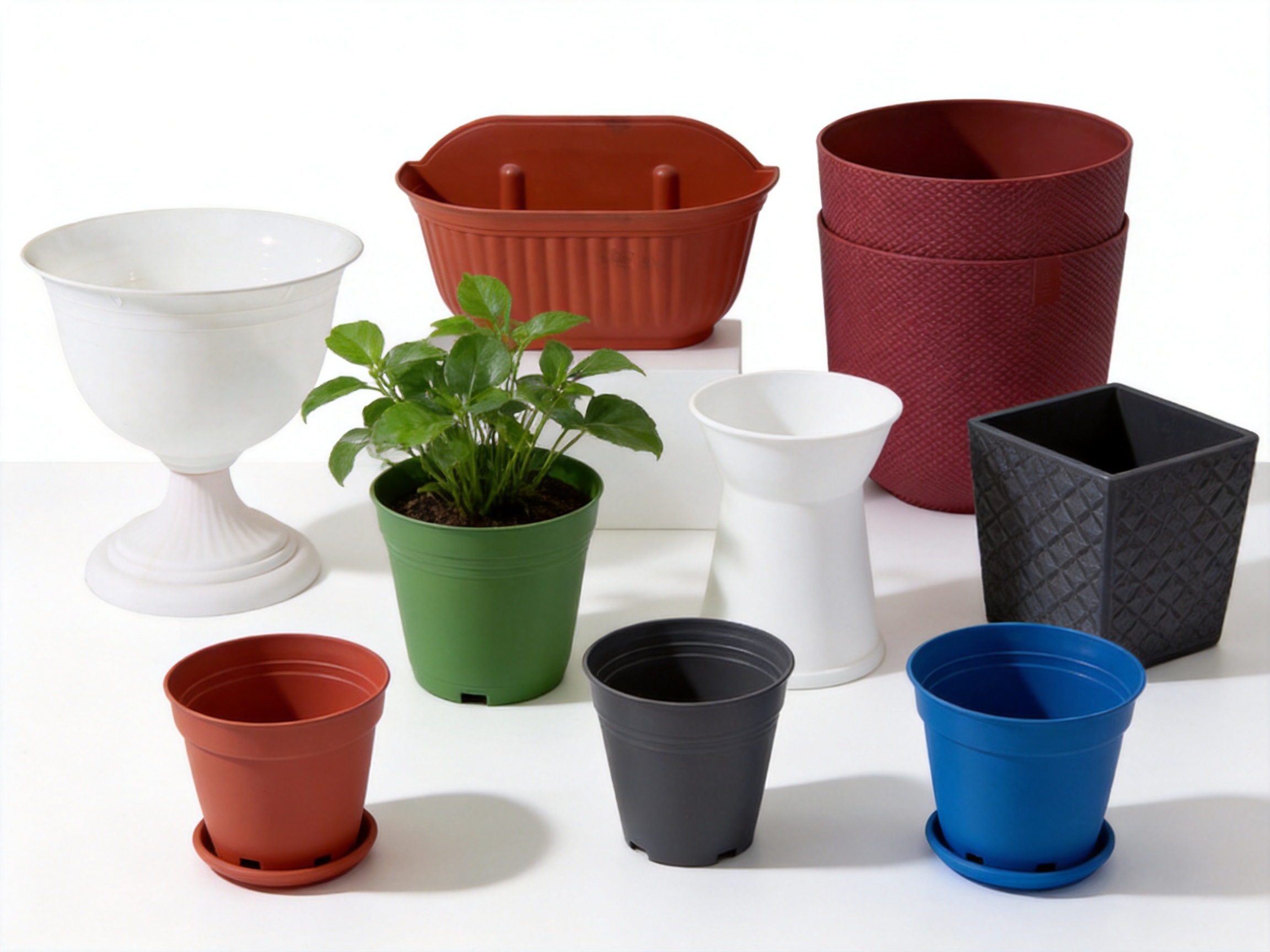
One of the principal advantages of this plastic flower pot injection mould is its support for multiple design styles. The tooling concept can be developed for round flower pots, square containers, tapered pots, decorative planters, nursery pots, and other related products. This flexibility allows manufacturers to serve different market segments without being limited to one visual style.
Round pots remain popular because they are easy to arrange, simple to manufacture, and suitable for a wide range of plants. Square and rectangular containers can make better use of shelf and greenhouse space. Decorative pots may include patterned walls, textured surfaces, shaped rims, or geometric details intended for indoor display and balcony decoration. Nursery pots generally prioritize lightweight construction, efficient stacking, and practical drainage.
The mold design can be adapted to the intended product function. A small indoor pot may require a refined polished surface and a more decorative exterior. A commercial nursery container may need a lightweight structure, fast cycle time, and easy stacking. An outdoor planter may require enhanced rigidity and a surface texture that reduces the visibility of minor handling marks.
By considering the final application during mold development, the manufacturer can select suitable wall thickness, draft angles, ejection methods, cooling arrangements, and surface finishes. This application-oriented approach helps prevent a situation in which the mold produces a visually attractive product that is difficult to manufacture or unsuitable for actual use.
Consistent Wall Thickness
Consistent wall thickness is an important characteristic of a reliable plastic pot. If one area is too thin, the product may become weak, deform during cooling, or fail during handling. If another area is too thick, it may increase material consumption, extend the cooling period, and create sink marks or uneven shrinkage.
The mold structure is engineered to support stable wall thickness throughout the pot body. This helps the finished container remain strong while avoiding unnecessary weight. A balanced design is especially valuable for manufacturers using PP, PE, or recycled plastic, because each material can respond differently to filling and cooling conditions.
Uniform thickness also contributes to more predictable cycle times. When the wall section is reasonably balanced, heat can be removed more evenly, which reduces the risk of distortion and allows the production team to establish more stable molding parameters.
Drainage Hole Integration
Drainage holes are a functional requirement for many flower pots. They allow excess water to leave the container and help create a healthier growing environment for plants. The drainage features can be integrated directly into the mold design, allowing the holes to be formed during injection molding rather than added through a separate drilling or punching operation.
Direct formation of drainage openings can reduce secondary processing, labor requirements, and handling time. It also helps maintain a consistent hole position and shape from one product to the next. The number, diameter, and arrangement of drainage holes can be reviewed during the product and mold design stages according to the intended pot size and application.
Integrated drainage systems must be designed carefully to ensure that the product can be removed from the mold without damaging the holes. The core, cavity, ejection system, and draft angles must work together. Proper engineering is particularly important when a pot has a recessed base, decorative foot, raised drainage platform, or multiple openings.
Surface Finish and Appearance Quality
Appearance is a major factor in the sale of flower pots. Indoor planters and decorative balcony containers are often selected according to their shape, color, texture, and perceived quality. A surface that contains scratches, drag marks, weld lines, or uneven gloss can reduce the attractiveness of the final product even when the pot remains functional.
High-quality polishing can be applied to mold surfaces where a smooth appearance is required. A polished inner surface can also make plant removal easier because it reduces unnecessary friction between the molded pot and the tooling surface. Smooth internal areas are useful for products that will be handled frequently in nurseries, garden centers, or household environments.
Texture and pattern finishes are also available. A textured surface can provide a distinctive decorative effect, improve visual depth, and reduce the visibility of small surface variations that may appear during handling. Patterned surfaces can be used to create a premium appearance or to distinguish one product series from another.
The appropriate finish depends on the customer’s product concept. Polished, textured, and patterned surfaces each offer different visual and practical characteristics. During mold development, the desired finish should be defined clearly because polishing level, etching, texture depth, and surface treatment can influence both the appearance and the demolding behavior of the product.
Material Compatibility
The mold supports common materials used in flower pot manufacturing, including polypropylene, polyethylene, and recycled plastic. These materials are selected according to the required balance of strength, flexibility, weight, appearance, cost, and environmental considerations.
Polypropylene
Polypropylene is widely used for injection-molded household and gardening products. It offers a useful combination of low density, chemical resistance, rigidity, and processing convenience. PP can be suitable for indoor pots, outdoor containers, nursery products, and decorative planters. Its relatively light weight helps reduce transportation and handling costs.
When PP is used, the mold design and processing conditions should account for material shrinkage and flow behavior. Gate location, cooling balance, and part geometry all contribute to dimensional stability. A properly engineered mold helps the manufacturer maintain consistent size and shape during repeated production.
Polyethylene
Polyethylene can provide useful toughness and impact resistance. Depending on the selected grade, PE may be appropriate for containers that require flexibility or resistance to routine handling. It can also be considered for certain nursery and gardening applications.
Because material grades differ, the final product specification should identify the selected PE type before mold trials. The injection parameters, cooling conditions, and ejection settings may need to be adjusted to achieve the desired surface quality and dimensional accuracy.
Recycled Plastic
Recycled plastic can help manufacturers respond to cost and sustainability objectives. Its characteristics may vary more widely than those of virgin resin, depending on the source, composition, moisture level, and processing history. For this reason, mold design should provide a practical balance between filling reliability, venting, cooling, and product appearance.
The use of recycled material should be validated through mold trials. The production team can evaluate filling behavior, color consistency, surface appearance, stiffness, and dimensional results. A suitable mold structure gives manufacturers a stronger foundation for working with different material batches, although material preparation and process control remain essential.
Runner System Options
The plastic flower pot mould can be configured with either a cold runner or a hot runner system. The correct choice depends on cavity quantity, material selection, product design, expected production volume, and the customer’s operating preferences.
Cold Runner System
A cold runner system is a practical option for many standard flower pot projects. It has a straightforward structure and can be suitable for one-cavity or lower-complexity molds. Cold runners may offer easier maintenance and a familiar operating method for manufacturers that already have conventional injection molding equipment.
When using a cold runner, the runner layout should be balanced to promote even filling. Runner size and gate position must be selected with consideration for the pot’s wall thickness and flow length. A well-designed cold runner can provide stable production while keeping the mold structure relatively accessible for servicing.
Hot Runner System
A hot runner system can be considered for higher-volume production or applications where reduced material waste and improved cycle efficiency are important. By keeping the runner material in a heated condition, the system can reduce the amount of solidified runner that would otherwise require recycling or disposal.
Hot runner tooling generally requires careful temperature control and maintenance. The design should consider heater reliability, nozzle positioning, material compatibility, cleaning procedures, and access for service. When properly engineered and operated, a hot runner can support efficient production of multiple-cavity flower pot molds.
The selection between cold runner and hot runner should be made during the engineering stage rather than after the mold has been completed. This allows the feeding system, cavity layout, cooling system, and ejection arrangement to be designed as one coordinated structure.
Cavity Configuration and Production Capacity
The mold can be designed with one to eight cavities. Cavity quantity has a direct influence on production output, equipment requirements, mold size, material consumption, cycle balance, and initial investment.
A single-cavity mold may be suitable for customized products, lower-volume orders, new product testing, or manufacturers that want to minimize initial tooling expenditure. It can also simplify product development when the design is still being evaluated in the market.
Multi-cavity tooling is more suitable for mass production. Two-, four-, six-, or eight-cavity arrangements can produce more pots per injection cycle, improving output when demand is consistent. However, increasing the number of cavities also requires more careful balancing of the runner system, cooling channels, cavity dimensions, and ejection system.
A professionally engineered multi-cavity mold should aim to fill each cavity with similar pressure and timing. If the cavities are not balanced, one product may fill correctly while another experiences short shots, flash, different weight, or inconsistent dimensions. Balanced tooling supports more uniform production and simplifies the setting of injection molding parameters.
| Item | Available or Supported Specification | Production Consideration |
| Mold type | Plastic injection mold | Suitable for repeatable production of molded flower pots |
| Mold steel | P20, 718, or H13 | Selected according to performance, durability, and project requirements |
| Product material | PP, PE, or recycled plastic | Material choice affects flow, cooling, shrinkage, and appearance |
| Runner system | Cold runner or hot runner | Chosen according to volume, efficiency, and operating preference |
| Cavity number | 1–8 cavities | Balances output requirements with tooling investment and complexity |
| Expected mold life | 500,000+ shots | Supports long-term production when properly operated and maintained |
| Surface finish | Polished, texture, or pattern | Provides flexibility for functional and decorative product designs |
Mold Steel Selection
Steel selection affects mold durability, maintenance requirements, surface quality, and long-term production performance. The available steel options include P20, 718, and H13. The final selection should be based on the expected number of shots, product complexity, resin characteristics, surface finish, production conditions, and customer budget.
P20 Steel
P20 is commonly used for general-purpose plastic injection molds. It provides a practical balance of machinability, strength, and cost. For standard flower pot designs and moderate production requirements, P20 can be a suitable option when the mold is correctly designed and maintained.
718 Steel
718 mold steel can be selected when improved polishability and dependable mechanical performance are required. It may be appropriate for flower pots with higher appearance expectations or tooling projects that require a refined cavity surface.
H13 Steel
H13 is a hot-work tool steel known for its ability to withstand demanding thermal conditions. It can be considered for applications requiring higher durability or more demanding production performance. The decision to use H13 should be evaluated in relation to the product design, production volume, material choice, and expected service conditions.
Using a suitable steel does not eliminate the need for proper mold care. Regular cleaning, lubrication where appropriate, inspection of moving components, cooling-channel maintenance, and correct machine operation all contribute to achieving the intended mold life.
Cooling System and Cycle Efficiency
Cooling is one of the most important factors in injection molding productivity. After the plastic fills the cavity, it must cool sufficiently before the mold opens and the pot is ejected. If cooling is too slow, the production cycle becomes unnecessarily long. If cooling is uneven, the pot may warp, shrink inconsistently, or lose dimensional accuracy.
The flower pot mold uses an efficient cooling design intended to shorten cycle time and support mass production. Cooling channels should be positioned to remove heat from critical areas of the mold as evenly as possible. The design must take into account wall thickness, base geometry, rim structure, decorative features, and the location of drainage holes.
Balanced cooling provides several advantages. It can improve dimensional stability, reduce deformation, support consistent product weight, and increase the number of acceptable parts produced per hour. It can also reduce the need for excessive holding or cooling time in the injection molding machine.
Cycle optimization should be verified during mold trials. Actual performance depends on the machine, resin grade, melt temperature, mold temperature, injection speed, holding pressure, cooling-water temperature, and environmental conditions. The mold provides the necessary engineering foundation, while the production team fine-tunes the process to achieve the best balance of quality and output.
Ejection and Demolding Performance
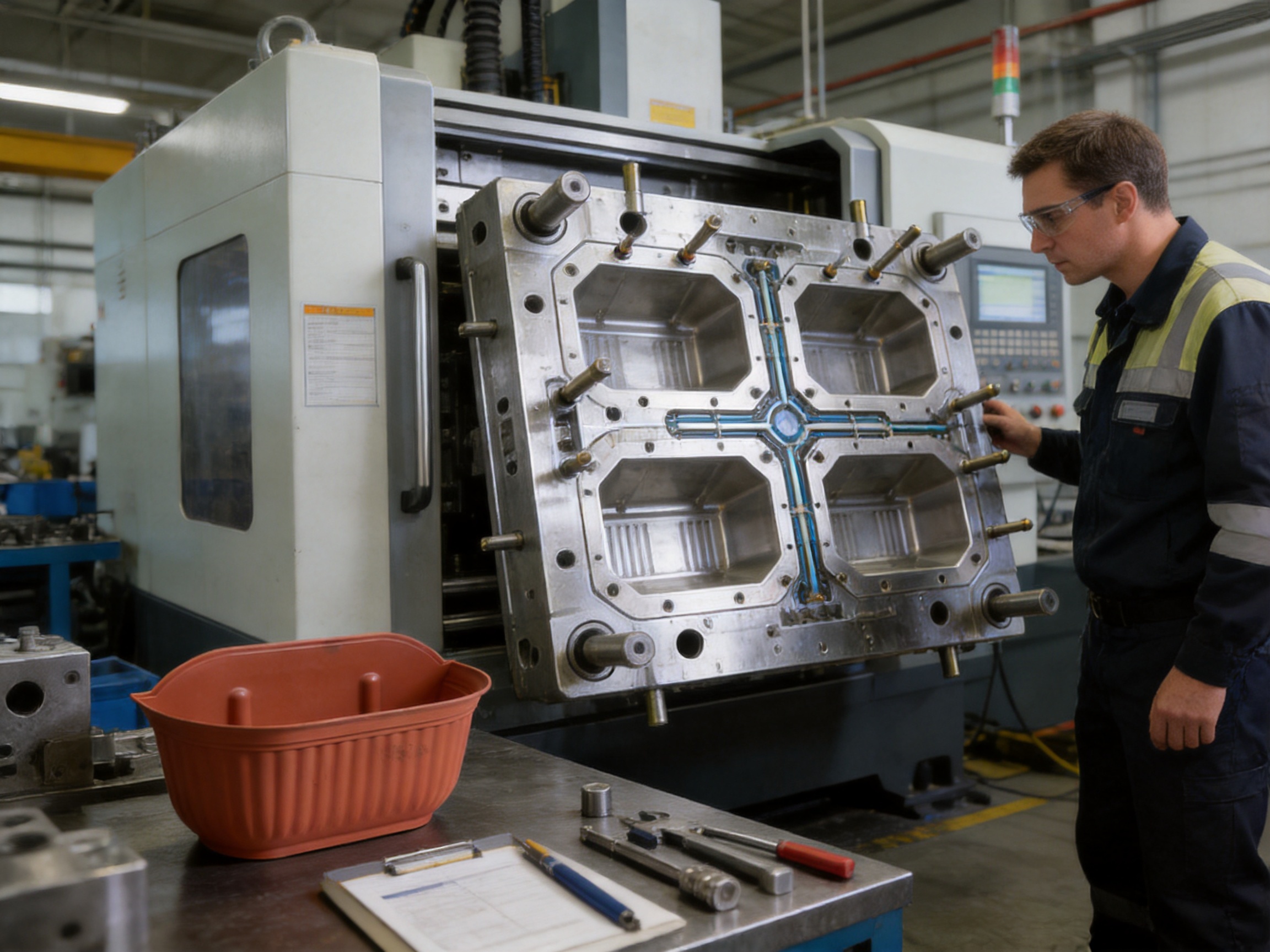
Flower pots often include tapered walls, recessed bases, drainage openings, decorative patterns, or textured surfaces. These features can make demolding more demanding. The product must be released without scratches, deformation, sticking, or damage to the rim and base.
The mold design should include suitable draft angles and an effective ejection arrangement. Draft allows the molded pot to separate from the cavity with reduced friction. Ejector pins, ejector plates, sleeves, or other mechanisms may be considered according to the product structure.
For a pot with a smooth internal surface, careful polishing can support easier release. For a textured surface, the texture depth and draft angle must be evaluated together. If the texture is too deep or the draft is insufficient, the product may grip the cavity during opening.
A well-designed ejection system also helps maintain production speed. If operators must manually remove stuck pots or inspect every part for ejection damage, the advantages of an automated injection molding process are reduced. Stable ejection contributes to reliable cycle repetition and lower labor requirements.
Manufacturing Process and Engineering Control
The quality of a plastic flower pot injection mould depends on the complete manufacturing process, not only on the final machining stage. Haiquan’s integrated approach covers design, production, quality management, and after-sales support. Each phase contributes to the reliability of the finished tooling.
Product Review and Mold Feasibility
The process begins with a review of the product concept and technical requirements. Engineers examine the pot’s overall dimensions, wall thickness, rim, base, drainage holes, decorative elements, surface finish, material, and expected output. This review helps identify potential molding risks before steel cutting begins.
Design feasibility analysis may consider parting-line location, draft angles, gate position, shrinkage allowance, ejection space, cooling access, and cavity arrangement. Early identification of these factors can reduce design changes later and help the customer understand the relationship between product appearance and manufacturing requirements.
3D Mold Design
A detailed three-dimensional mold design is developed to coordinate the cavity, core, mold base, runner system, cooling channels, guide components, ejectors, and other functional elements. The design should match the customer’s injection molding machine and production objectives as closely as possible.
For multi-cavity tooling, the layout must provide appropriate spacing and balance. The mold designer also considers maintenance access, replaceable inserts, component standardization, and the practical needs of mold assembly and future repair.
Machining and Component Production
Once the design is approved, mold components are manufactured using suitable machining processes. These may include milling, drilling, grinding, electrical discharge machining, wire cutting, and polishing, depending on the geometry and required surface finish.
Complex decorative details, drainage features, and fine surface transitions may require particularly careful machining. Dimensional control at this stage is essential because errors in the cavity or core can be reproduced on every molded pot.
Assembly and Fitting
After individual components are produced, the mold is assembled and fitted. The core and cavity must align accurately, and moving components must operate smoothly. The runner, cooling, guide, and ejection systems are checked as part of the assembly process.
Fitting work is especially important for the parting surface. Poor contact can create flash around the rim, base, or drainage area. Proper fitting helps protect product appearance and reduces the amount of trimming required after molding.
Trial Molding and Adjustment
Trial molding allows engineers to evaluate the mold under actual injection conditions. Sample pots are inspected for filling, wall thickness, shrinkage, warpage, surface quality, drainage-hole accuracy, demolding behavior, and dimensional consistency.
If necessary, adjustments are made to the gate, venting, cooling, ejection, polishing, or process parameters. Trial results provide practical information that cannot always be predicted completely through design analysis. This step is particularly valuable for new decorative products, recycled materials, and multi-cavity molds.
Final Inspection and Delivery
Before delivery, the mold is checked according to the project requirements. The inspection may include component dimensions, mold opening and closing, ejection movement, cooling passage condition, cavity surface, product samples, and general assembly quality.
Documentation and communication are also important. Clear information about mold operation, recommended processing conditions, maintenance points, spare parts, and trial results can help the customer begin production more efficiently.
Advantages Compared with Basic Competitor Tooling
Manufacturers often compare molds by price, but the lowest initial quotation does not always represent the lowest total production cost. A mold with poor cooling, unbalanced filling, weak ejection, or insufficient surface control can create ongoing expenses through scrap, downtime, maintenance, and labor.
The plastic flower pot injection mould offers several practical advantages over basic tooling approaches.
Broader Design Adaptability
The mold can support various pot shapes, sizes, textures, and patterns. This gives manufacturers greater freedom when developing product series for different customers and sales channels. Instead of relying on one standardized container, a company can create multiple designs that share similar manufacturing principles.
Integrated Functional Features
Drainage holes can be formed directly during injection molding. This reduces the need for secondary drilling or punching and helps maintain consistent hole placement. The integration of functional details into the mold also reduces product handling between operations.
More Efficient Production
Efficient cooling and suitable cavity configurations can support shorter molding cycles and higher output. Depending on the order volume, manufacturers can select a one-cavity mold for flexibility or a multi-cavity mold for mass production.
Improved Appearance Control
Polished, textured, and patterned finishes allow the final product to meet different appearance expectations. Careful surface treatment can improve the visual quality of retail products and support brand differentiation for the pot manufacturer.
Long-Term Tooling Value
With an expected mold life of 500,000 or more shots under suitable operating and maintenance conditions, the tooling can support extended production. A durable mold spreads the initial investment over a larger number of products and reduces the frequency of replacement tooling.
Material Versatility
Compatibility with PP, PE, and recycled plastic gives manufacturers more choices when balancing product performance, cost, and sustainability objectives. This versatility is useful when product lines need to respond to changes in material availability or market demand.
Applications of Molded Flower Pots
The products manufactured with this mold can serve a wide range of commercial and household applications.
Indoor Plant Pots
Indoor plant pots are often judged by appearance, surface finish, size, and ease of handling. Smooth interiors, decorative exteriors, and accurate dimensions can support attractive household and office products.
Outdoor Garden Containers
Outdoor containers must tolerate regular handling, exposure to changing weather conditions, and contact with soil and water. A balanced wall structure helps provide the strength needed for garden use while keeping the container lightweight.
Nursery Planting Pots
Nurseries require practical products that can be manufactured in large quantities. Lightweight construction, drainage holes, stacking convenience, and efficient cycle times are important considerations for this market.
Decorative Balcony Planters
Balcony planters combine function with visual appeal. They may require special shapes, surface patterns, or dimensions suitable for limited spaces. Custom mold design can help manufacturers develop products that fit specific balcony and residential gardening applications.
Commercial Horticultural Products
Plant growers, garden centers, landscaping companies, and distributors may require flower pots in several sizes and designs. A flexible mold development program can support the creation of a consistent product family for commercial supply.
Customization Services
Customization is available for pot size adjustment, cavity quantity, and surface texture patterns. These options allow customers to adapt the tooling to their sales plans, equipment, material preferences, and target market.
Size adjustment may include changes to diameter, height, base dimensions, rim profile, or internal capacity. Before changing the size, engineers should evaluate the influence on wall thickness, mold opening dimensions, injection volume, cooling time, and ejection stroke.
Cavity quantity can be selected according to expected demand. A lower cavity number may be appropriate for specialized designs or moderate production, while a higher cavity number may provide increased output for standard products with strong market demand.
Surface texture customization can create a distinctive appearance. Customers may request fine grain, geometric patterns, simulated natural textures, or other decorative effects. The selected pattern should be evaluated for draft, cleaning, demolding, and visual consistency.
Other product details can also be discussed during the engineering stage, including drainage-hole arrangements, rim structure, base design, labeling areas, and product identification features. The feasibility of each request depends on the specific geometry and production requirements.
Quality, Maintenance, and Mold Life
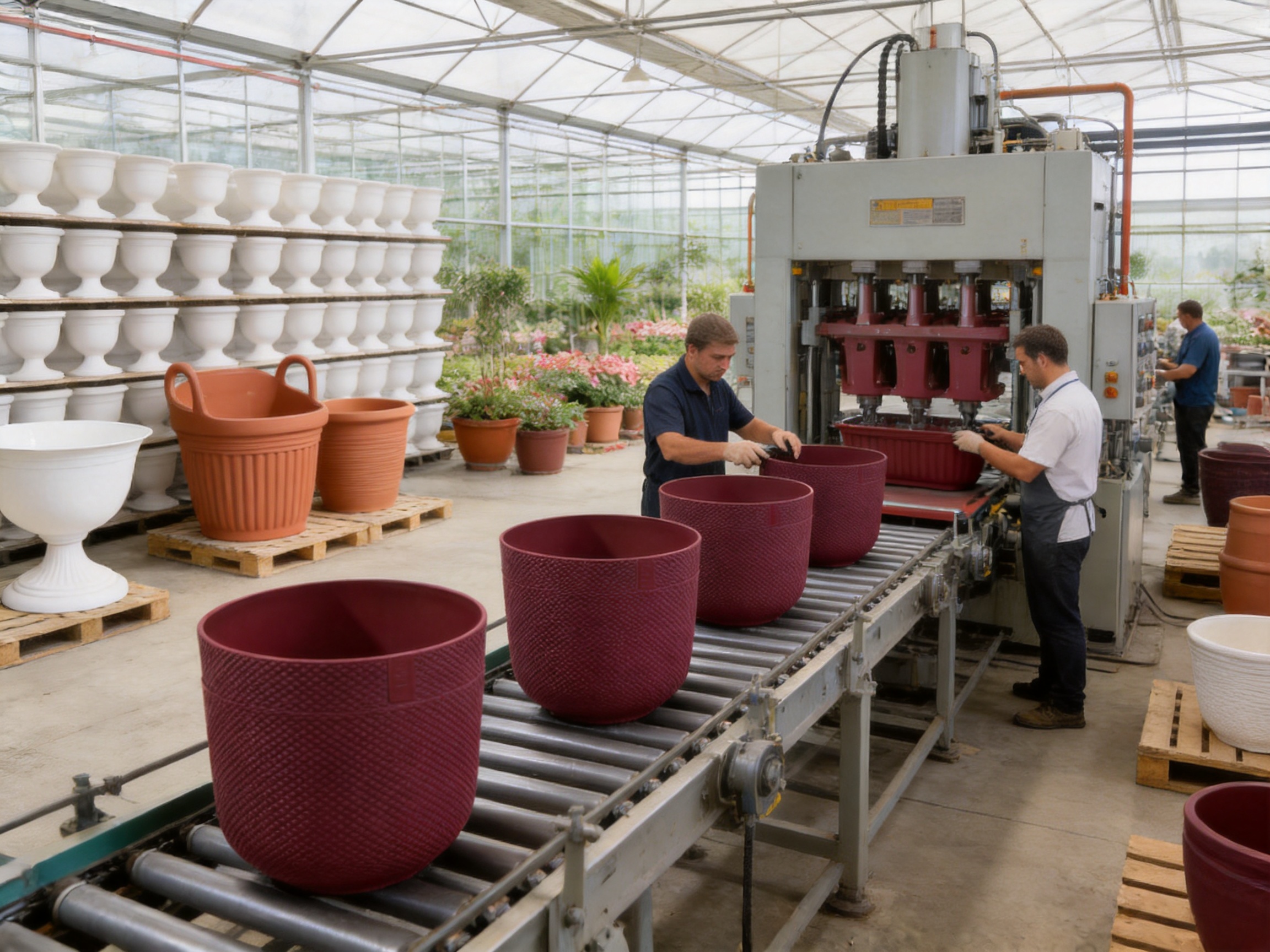
A mold designed for 500,000 or more shots can provide substantial long-term value, but actual service life depends on operating conditions and maintenance. Correct machine setup, suitable injection pressure, appropriate material preparation, and regular inspection all affect tooling performance.
After production, the mold should be cleaned to remove plastic residue, dust, and moisture. The cavity and core surfaces should be protected from corrosion where necessary. Moving parts should be inspected for wear, and lubrication should be applied according to the mold’s maintenance requirements.
Cooling channels should be monitored because deposits or restricted flow can reduce heat-transfer efficiency. A gradual decline in cooling performance may increase cycle time and lead to uneven product quality. Regular cleaning and checking of water connections can help maintain stable production.
Ejector pins, guide pillars, bushings, slides, and other moving elements should be checked periodically. Unusual noise, increased resistance, product sticking, or inconsistent ejection may indicate that maintenance is required.
Using clean and properly prepared resin is also important. Contamination can damage hot runner components, affect the surface finish, or create black spots and other defects. When recycled plastic is used, material screening and process monitoring become especially important.
Why Choose an Experienced Plastic Mould Maker
The performance of a flower pot mold depends on more than individual machines or steel grades. Engineering experience is required to connect product design, mold structure, material behavior, injection equipment, and production objectives.
Taizhou Huangyan Haiquan Plastic Mold Co., Ltd. is a high-tech enterprise focused on the research and manufacture of precision injection molds. Its product experience includes daily necessities as well as home appliance components, automotive parts, and industrial equipment. This cross-sector background provides exposure to different requirements for appearance, durability, dimensional control, and production efficiency.
The company follows a “Quality First, Sustainable Development” philosophy. Its professional design team and scientific production management system support an integrated service covering design, production, and after-sales assistance. This approach is valuable for customers that need more than a standalone mold. They may also require technical communication, design review, trial support, maintenance guidance, and response to future production questions.
Haiquan serves customers in Europe, the Middle East, Southeast Asia, and South America. International project experience requires attention to communication, specifications, delivery coordination, and consistent quality. These factors can be particularly important when the mold will be shipped to a customer’s factory and installed on equipment located in another country.
An experienced plastic mould maker can also help identify avoidable problems early. For example, an attractive design may have insufficient draft, an overly thin base, an impractical drainage feature, or a cavity arrangement that is difficult to balance. Engineering review helps convert the concept into a product that is both marketable and manufacturable.
Production Planning for OEM Customers
OEM customers should provide detailed information before mold design begins. Useful inputs include the product drawings or 3D files, material grade, target annual volume, injection molding machine information, preferred runner system, cavity requirement, color and surface finish, packaging method, and expected delivery schedule.
The customer should also clarify whether the pot is intended for indoor use, outdoor use, nursery production, decorative retail, or another application. This information helps the mold maker recommend suitable wall thickness, surface treatment, steel, cooling, and ejection design.
When the project involves multiple sizes, it may be useful to plan a product family from the beginning. The customer and mold maker can review whether separate molds, interchangeable inserts, or related cavity designs would provide the best balance between flexibility and investment.
Early communication about the injection molding machine is equally important. The machine’s injection volume, clamping force, tie-bar spacing, mold height, ejection stroke, and nozzle configuration can influence the mold dimensions and runner arrangement. Matching the mold to the available equipment helps reduce installation problems during commissioning.
Recommended Evaluation Criteria
When comparing a plastic flower pot mould supplier, buyers should evaluate the complete technical and service package rather than focusing only on the quoted price.
First, review whether the supplier understands the product application. A nursery container, indoor decorative pot, and large outdoor planter may require different engineering priorities.
Second, examine the proposed material and steel options. The supplier should be able to explain why a particular material or steel grade is appropriate for the expected production conditions.
Third, ask how the supplier will manage cavity balance, cooling, ejection, drainage holes, and surface finish. These details often have a greater effect on production performance than the general appearance of the mold.
Fourth, confirm the trial-molding and inspection process. Sample products should be evaluated for dimensions, appearance, weight, filling, demolding, and functional details.
Fifth, consider after-sales support and maintenance guidance. A supplier that remains available after delivery can help the customer resolve installation, parameter, and service questions more efficiently.
Q&A About the Plastic Flower Pot Injection Mould
What types of flower pots can this mold produce?
The mold can support round, square, and decorative flower pot designs. It can also be developed for indoor plant pots, outdoor garden containers, nursery pots, balcony planters, and other customized plant containers.
Can drainage holes be created directly during molding?
Yes. Drainage-hole forming systems can be integrated into the mold so that the openings are produced during the injection cycle. This can reduce secondary processing and improve consistency.
Which plastic materials are supported?
The listed material options include polypropylene, polyethylene, and recycled plastic. The final material grade should be confirmed during the engineering stage because different grades can have different flow, shrinkage, cooling, and appearance characteristics.
How many cavities can the mold have?
The mold can be configured from one to eight cavities. The appropriate number depends on product demand, machine capacity, mold investment, cycle requirements, and the customer’s production plan.
What runner systems are available?
Both cold runner and hot runner systems can be considered. A cold runner may be suitable for straightforward or moderate-volume production, while a hot runner may be preferred when higher output and reduced runner waste are important.
What steel grades can be used?
Available options include P20, 718, and H13. The choice should reflect the expected mold life, surface finish, production volume, material, and customer requirements.
Can the surface be polished or textured?
Yes. The supported surface finishes include polished, textured, and patterned surfaces. The finish can be selected according to the desired appearance and the functional requirements of the flower pot.
How long can the mold operate?
The stated mold life is 500,000 or more shots under suitable operating and maintenance conditions. Actual life depends on material, processing conditions, maintenance, machine operation, and the care given to the tooling.
Can the pot size be customized?
Yes. Basic customization includes pot size adjustment. The effect of any size change on wall thickness, cooling, ejection, machine requirements, and production cycle should be reviewed before finalizing the mold design.
Why is cooling design important for flower pot production?
Cooling removes heat from the molded plastic before ejection. Efficient and balanced cooling can shorten the cycle, reduce warpage, improve dimensional stability, and support higher productivity in mass production.
What information should an OEM customer provide?
Customers should provide product drawings or 3D data, material information, target volume, cavity expectations, surface finish, drainage requirements, machine details, and delivery requirements. Clear information allows the mold maker to prepare a more accurate design and quotation.
Does the supplier provide support after delivery?
The company provides integrated services covering design, production, and after-sales support. Customers can discuss installation, trial molding, maintenance, and production-related technical requirements with the supplier.
Conclusion
The Plastic Flower Pot Injection Mould with Various Designs is a practical tooling solution for manufacturers producing plant containers for gardening, horticulture, landscaping, home decoration, and nursery applications. Its support for different shapes, consistent wall thickness, integrated drainage holes, flexible surface finishes, multiple materials, and one- to eight-cavity configurations makes it suitable for a broad range of product strategies.
Efficient cooling contributes to shorter cycles and improved productivity, while careful ejection and polishing help protect the appearance and integrity of the finished pots. The availability of P20, 718, and H13 steel gives customers options for balancing tooling investment and long-term performance. Cold runner and hot runner systems can be evaluated according to production volume, material efficiency, and operating preferences.
The value of the mold is strengthened by the manufacturing capabilities of Taizhou Huangyan Haiquan Plastic Mold Co., Ltd. As a precision injection mold manufacturer serving daily necessities and several other industrial sectors, the company combines product design support, mold engineering, machining, assembly, trial molding, quality control, and after-sales service. Its international customer experience and organized production system provide a foundation for reliable OEM cooperation.
For manufacturers seeking stable, attractive, and efficient flower pot production, selecting the right mold design is a strategic decision. A properly engineered plastic pot mould can reduce secondary processing, improve product consistency, support varied designs, and deliver dependable performance over a long production life.
References
1. Injection Molding Fundamentals: Principles of Plastic Flow, Cooling, Shrinkage, and Ejection.
2. Engineering Guidelines for Plastic Part Design and Draft Angle Selection.
3. General Technical Information for P20, 718, and H13 Mold Steels.
4. Industrial Guidance on Injection Mold Cooling Channel Design and Cycle Optimization.
5. Manufacturing Specifications for Polypropylene, Polyethylene, and Recycled Plastic Products.
6. Product and technical information supplied for the Plastic Flower Pot Injection Mould with Various Designs.
7. Company information supplied for Taizhou Huangyan Haiquan Plastic Mold Co., Ltd.
Product: Plastic Flower Pot Injection Mould with Various Designs

For exclusive deals and latest offers, sign up by entering your email address below.












 +86-18657672567
 sales@tzhqmould.com
celin@tzhqmould.com
 No. 17 Houshi Road, Beicheng Industrial Zone, Huangyan District, Taizhou City, Zhejiang Province, China
Copyright © Taizhou Huangyan Haiquan Plastic Mold Co., Ltd. All Rights Reserved
Injection Plastic Mould Maker

