

Advanced Air Cooler and Components Injection Moulding for Reliable HVAC Production
Admin 2026-09-14Air coolers are practical, energy-conscious appliances used in homes, commercial buildings, workshops, warehouses, outdoor areas, and many other environments. Although the visible product appears relatively simple, its plastic housing and internal structural components must satisfy demanding requirements for dimensional accuracy, ventilation efficiency, assembly stability, appearance, strength, and long-term service. The quality of the injection mould used to manufacture these parts directly affects the performance, reliability, and commercial value of the finished air cooler.
The Air Cooler and Components Injection Mould is developed for producing large plastic housings, fan covers, cooling unit components, mounting structures, and other moulded parts used in evaporative air-cooling equipment. It is designed to support stable mass production of components made from commonly used engineering and appliance plastics, including ABS and PP. Through suitable mould design, controlled steel selection, efficient cooling, reliable ejection, and careful manufacturing management, the tooling can help HVAC manufacturers achieve repeatable production with reduced finishing work and dependable assembly performance.
This article explains the key design characteristics, production advantages, manufacturing processes, customization possibilities, quality-control methods, and application value of the air cooler injection mould. It also describes why professional mould engineering is important when producing large housings with ventilation structures, mounting features, grille openings, fan covers, and internal support areas.

Air Cooler and Components Injection Mould
Understanding the Role of an Air Cooler Injection Mould
An air cooler injection mould is a precision tool used to form molten thermoplastic material into a defined component shape. During production, plastic pellets are heated until they reach a suitable melt condition. The material is then injected into the mould cavity under controlled pressure. After the material fills the cavity, it cools and solidifies against the cavity surfaces. The mould opens, and the finished component is ejected before the cycle begins again.
For small components, the moulding process may be relatively straightforward. Large air cooler housings, however, present a more complex engineering challenge. The housing may include broad exterior panels, rounded corners, air inlet structures, ventilation openings, screw bosses, clips, ribs, handles, drain areas, motor supports, and interfaces for electrical or mechanical components. All these features must be formed in one or more moulding operations while maintaining consistent wall thickness and avoiding visible defects.
The mould must also cope with the practical conditions of high-volume production. It needs to withstand repeated opening and closing, injection pressure, temperature changes, ejection loads, and continuous contact with plastic materials. A well-designed tool therefore combines an accurate cavity, strong mould steel, carefully positioned cooling channels, an effective gating system, balanced ejection, and a robust guiding structure.
The main purpose of this air cooler mould is to provide a repeatable method for producing components with the same dimensions and appearance from one production cycle to the next. This consistency is essential for assembly. If a housing varies significantly in size or if mounting bosses shift from their intended positions, the fan, motor, water tank, control panel, grille, or electrical parts may not fit correctly. Precision tooling reduces these risks and helps manufacturers control production quality.
Product Scope and Supported Components
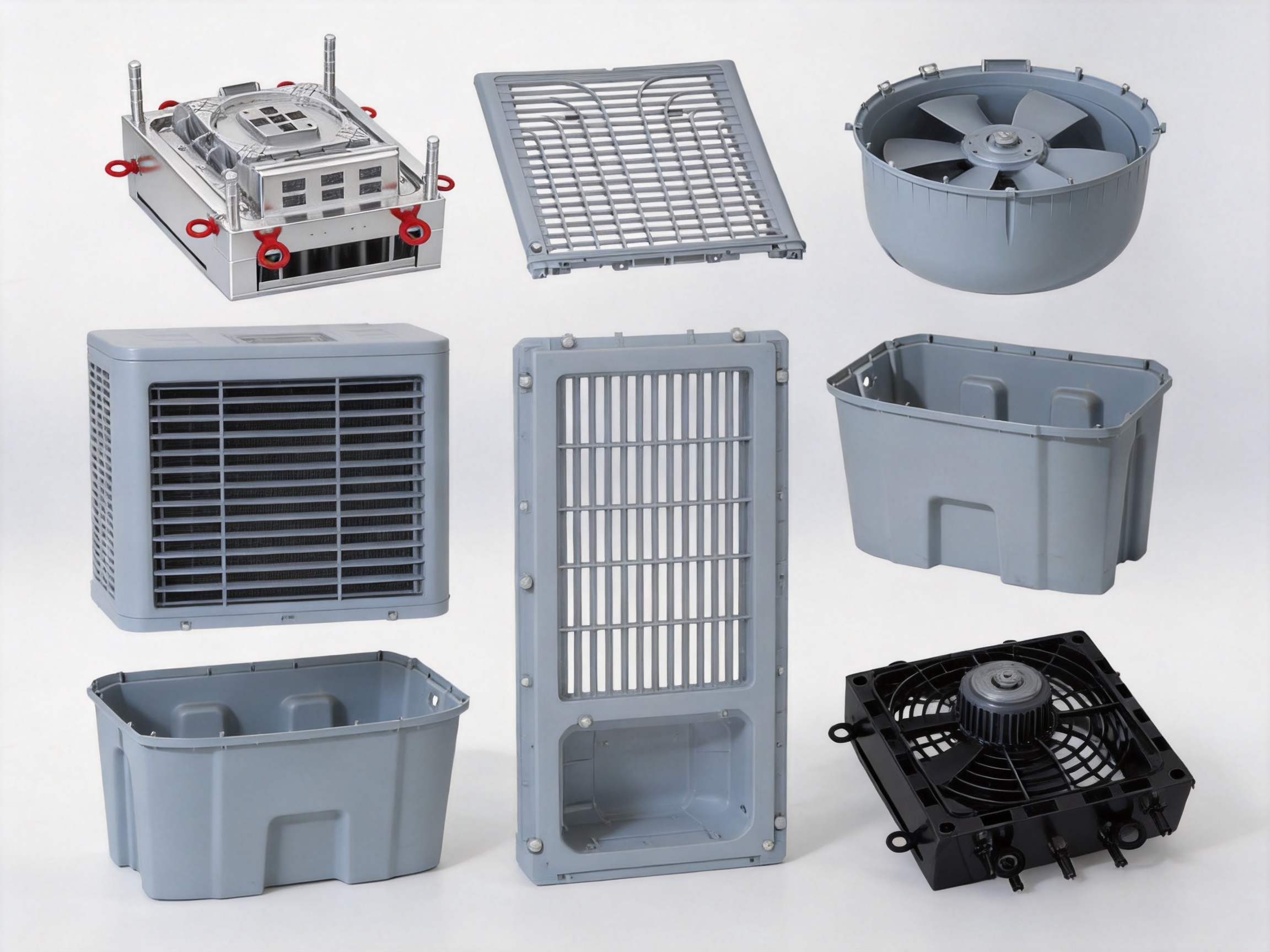
The mould is intended for air cooler housings and related structural parts. Depending on the customer’s product design, the tooling can be configured for a front housing, rear housing, side panel, top cover, water tank component, fan cover, air outlet grille, or other moulded element. The exact configuration is determined by the product drawings, material selection, production volume, assembly method, and desired surface finish.
Air cooler housings normally combine functional and aesthetic requirements. The external surface is part of the product’s visual identity, while the internal structure supports the motor, fan, water circulation system, control elements, filters, and wiring. The mould must therefore reproduce both visible surfaces and hidden functional features accurately.
Typical applications include the following:
- Complete air cooler housings
- Front and rear shell sections
- Fan covers and protective grilles
- Cooling unit components
- Air outlet frames and ventilation panels
- Motor and pump mounting structures
- Control panel surrounds
- Internal brackets and support features
- Water tank covers and related appliance panels
The tooling can be adapted for different air cooler sizes and structures. A compact household air cooler may require a relatively small mould with integrated clips and decorative surfaces, while a commercial or industrial unit may require a much larger mould with reinforced ribs, heavy-duty mounting points, and more demanding dimensional controls.
Because each air cooler model has its own airflow path and assembly arrangement, the mould design should begin with a careful review of the complete product. This includes the outer appearance, internal component layout, air movement requirements, water management, service access, screw positions, snap-fit locations, and packaging limitations.
Key Advantages Compared with Standard or Poorly Engineered Tooling
Stable Production of Large Plastic Parts
Large housings are vulnerable to warpage, sink marks, weld lines, short shots, and uneven shrinkage. A mould developed specifically for the product can address these risks through appropriate wall-thickness analysis, gate positioning, cooling layout, and structural reinforcement. This is a major advantage over generic or poorly balanced tooling, which may produce acceptable samples but become unstable during continuous production.
Stable moulding is especially important when a large housing must connect with several other components. A small dimensional deviation in a large panel can become a significant alignment problem during assembly. A properly engineered mould helps maintain the intended shape across the entire part, reducing the need for manual correction and secondary adjustment.
Improved Ventilation and Functional Accuracy
Air cooler components often include multiple ventilation openings, louvers, grilles, or curved air passages. These details are not only decorative. They influence airflow, safety, noise, and the protection of internal components. The mould must reproduce these openings cleanly and maintain the correct relationship between adjacent features.
Sharp transitions, narrow grille openings, and deep ventilation structures can make filling and ejection difficult. Professional mould design considers the direction of material flow, the draft angle of each feature, the location of ejector pins, and the possibility of trapped air. As a result, the finished component can have cleaner openings and more consistent functional dimensions.
Consistent Appearance and Surface Quality
For consumer air coolers, appearance has a direct influence on purchasing decisions. The housing may use a textured, matte, glossy, or polished finish. Any visible flow mark, weld line, burn mark, drag mark, or uneven texture can affect the perceived quality of the appliance.
High-quality mould manufacturing helps preserve the intended surface finish over long production runs. The cavity surfaces are prepared according to the product’s appearance requirements, and critical visible areas are protected during machining, polishing, assembly, and trial moulding. The result is a more consistent external finish and a lower risk of avoidable cosmetic rejection.
Reduced Secondary Operations
An efficient mould incorporates as many necessary features as possible directly into the moulded part. Screw bosses, locating points, clips, reinforcement ribs, and mounting structures can often be formed during injection moulding instead of being added later. Reducing secondary operations can lower labour costs, shorten production time, and improve dimensional repeatability.
Where a design requires complicated side features, sliders, lifters, or inserts may be used to create the geometry without damaging the part during ejection. The choice of mechanism depends on the product structure and the required production volume. A carefully planned system can produce complex components while maintaining reasonable mould maintenance requirements.
Long Service Life
The specified mould steel options include 718 and NAK80. These materials are widely used for plastic injection tooling where a good balance of machinability, hardness, polishability, corrosion resistance, and dimensional stability is required. The selected steel can be matched to the product’s surface requirements, expected production volume, plastic material, and maintenance plan.
A stated mould life of approximately 800,000 shots provides a useful production target for large-scale manufacturing. Actual service life depends on many factors, including the selected plastic, additives, processing temperature, mould maintenance, injection pressure, cycle time, and operating conditions. Proper preventive maintenance remains important even when a mould is manufactured from high-quality steel.
Adaptability for ABS and PP
The air cooler mould supports commonly used materials such as ABS and PP. ABS is often selected when a rigid part with good appearance, impact resistance, and dimensional stability is required. PP offers low density, good chemical resistance, moisture resistance, and attractive production economics. The final selection should be based on the performance requirements of the air cooler and the customer’s product specification.
Different plastics behave differently during injection moulding. Their shrinkage rates, flow characteristics, cooling behaviour, and sensitivity to processing conditions are not identical. The mould design and processing parameters should therefore be reviewed whenever the material changes. A tool that performs well with one grade may require adjustments to temperature, injection speed, holding pressure, or cooling time when another grade is introduced.
Engineering Design of the Air Cooler Housing Tool
Part Design Review
The mould development process begins with a detailed review of the part design. Engineers examine the three-dimensional model, two-dimensional drawings, material specification, tolerance requirements, surface finish, assembly method, and intended production volume. This review identifies areas that may create moulding difficulties before steel cutting begins.
Important design questions include whether the part has sufficient draft for ejection, whether the wall thickness is reasonably consistent, whether ribs are too thick, whether bosses are adequately supported, and whether the proposed parting line will leave an acceptable mark. The review also considers whether the product can be removed from the mould without deformation or mechanical interference.
If the housing includes deep internal areas, undercuts, or enclosed structures, engineers may recommend sliders, lifters, collapsible cores, split inserts, or design modifications. These solutions are selected according to the geometry, the expected cycle count, the available mould space, and the customer’s maintenance preferences.
Parting Line and Mould Layout
The parting line is the area where the mould halves separate. Its position influences the appearance, tooling complexity, flash risk, ejection method, and assembly performance. For a large air cooler housing, the parting line should be positioned in a way that protects the most visible surfaces and allows the component to release smoothly.
A well-planned mould layout also considers the size of the injection machine, mould weight, available platen space, clamping force, runner arrangement, and operator access. The tool must be compatible with the customer’s production equipment. If a mould is too large, too heavy, or poorly matched to the injection machine, production efficiency may be reduced even if the cavity itself is accurate.
Wall Thickness and Rib Design
Large plastic parts should normally be designed with practical and reasonably uniform wall thickness. Major changes in thickness can produce uneven cooling and shrinkage. Thick sections may develop sink marks, while thin sections may be difficult to fill or may become weak after moulding.
Ribs provide strength and stiffness without requiring a solid, heavy wall. However, ribs that are too thick or too tall can cause sink marks, air traps, or ejection resistance. Their connection to the main wall, draft angle, height, and spacing must be evaluated. For air cooler housings, ribs may be used around motor supports, screw bosses, fan openings, handle areas, and large flat panels.
Bosses, Clips, and Mounting Features
Mounting bosses and snap-fit clips are critical to assembly. They must be positioned accurately and designed with enough strength to withstand repeated assembly, vibration, and service operations. The mould must maintain the dimensions of these features so that screws, inserts, shafts, panels, and internal modules fit correctly.
Core pins used to form bosses should be supported adequately to prevent deflection. Ejector placement should avoid damaging delicate clips or leaving visible marks on cosmetic surfaces. Where a snap-fit is used, the release direction and draft must be considered carefully to prevent the feature from catching on the mould steel.
Material Selection and Mould Steel
718 Mould Steel
718 steel is commonly used for mould components requiring good machinability, strength, and general-purpose performance. It can be suitable for larger moulds and structural inserts, especially where the product does not require an extremely high-gloss polished surface. Its balance of performance and cost makes it practical for many appliance and industrial mould applications.
For an air cooler housing mould, 718 steel may be selected for cavity and core areas according to the expected surface texture, production volume, and material requirements. It can also be used in supporting mould structures and inserts when the engineering evaluation confirms that it meets the required service conditions.
NAK80 Mould Steel
NAK80 is valued for its pre-hardened condition, dimensional stability, machinability, and suitability for polished or textured mould surfaces. It may be selected for visible cavity areas where a higher-quality appearance is required. Its performance can be beneficial for consumer appliance housings, especially when the product includes smooth surfaces, decorative textures, or tight visual standards.
The final steel selection is not based on brand name alone. It should consider the part geometry, plastic type, mould size, projected production volume, polishing requirements, corrosion exposure, and expected maintenance schedule. A professional mould manufacturer can recommend a practical combination of materials for cavity inserts, cores, slides, wear plates, guide components, and mould bases.
Plastic Material Considerations
ABS can provide a rigid and attractive surface for external housing parts. It is often used where appearance, impact resistance, and dimensional control are important. Processing conditions must be managed carefully to prevent burn marks, flow defects, or excessive residual stress.
PP is lightweight and resistant to moisture and many chemicals. These characteristics can be useful for air cooler parts exposed to water, humidity, or cleaning processes. PP generally has a higher shrinkage rate than ABS, so the mould design must account for material-specific shrinkage and the possibility of warpage.
Material grades may also include flame-retardant, UV-resistant, reinforced, or impact-modified formulations. Such additives can change the way the plastic fills and cools. They may also increase mould wear or require different processing conditions. Material confirmation before detailed mould design is therefore essential.
Advanced Manufacturing Process
Product and Mould Analysis
Modern mould manufacturing begins with digital product analysis. The design team checks the three-dimensional model for draft, wall thickness, undercuts, parting-line options, mould-opening direction, and ejection feasibility. For large air cooler parts, flow-analysis software may be used to evaluate filling behaviour, pressure distribution, weld-line locations, air traps, cooling balance, and predicted warpage.
Digital analysis does not replace engineering experience, but it helps identify potential issues earlier. If a proposed gate position creates an undesirable weld line on a visible panel, the design can be adjusted before machining. If a cooling area is likely to remain hot, the channel layout can be revised. Early correction is generally less expensive than modifying a completed mould.
Precision CNC Machining
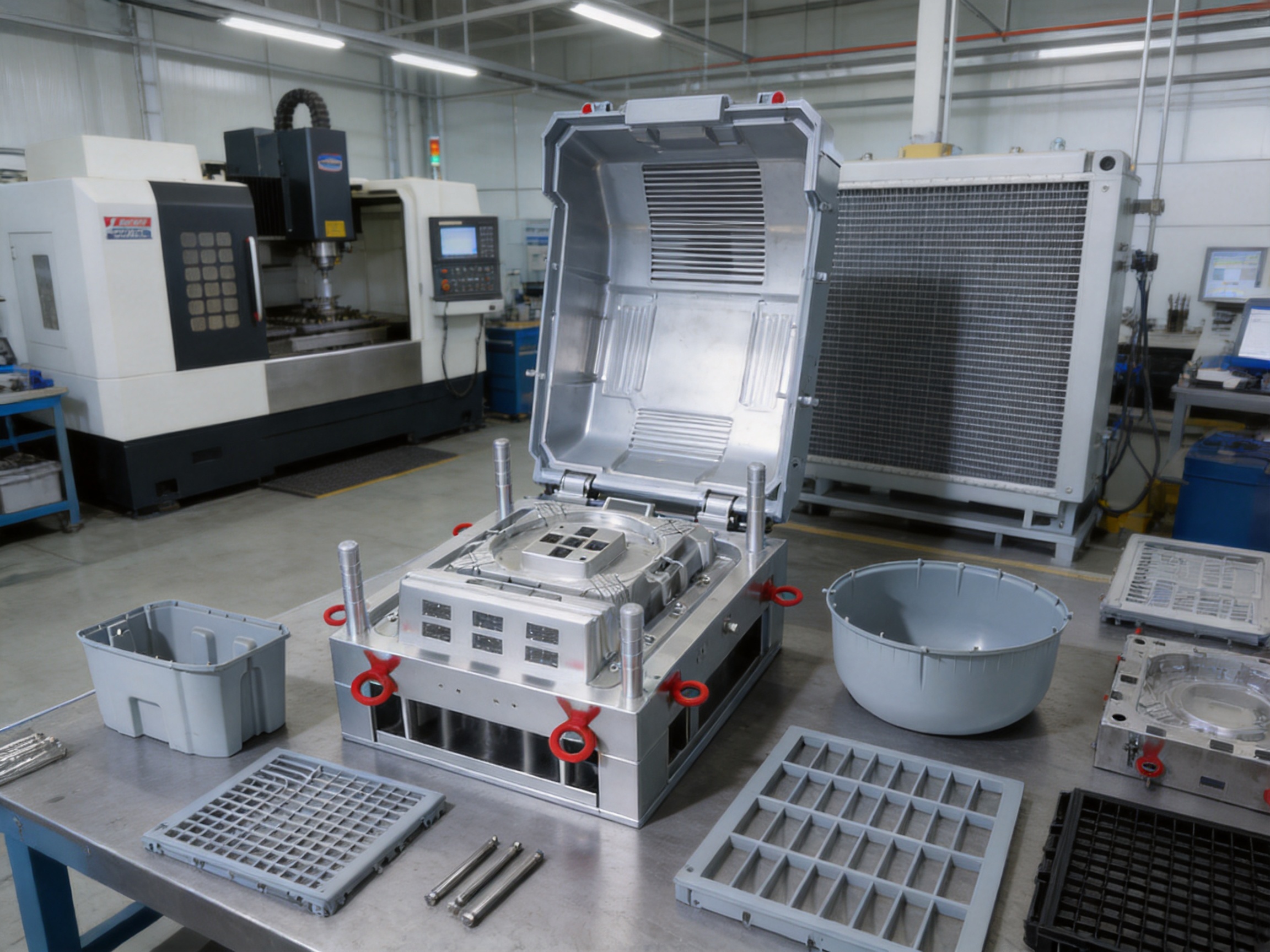
After design approval, mould components are manufactured using suitable machining processes. CNC milling is used to create cavity and core surfaces, pockets, ribs, bosses, insert locations, and structural details. Machine settings are selected according to the steel condition, geometry, required tolerance, and surface quality.
Large mould components require stable fixturing and careful control of machining deformation. The manufacturer must ensure that reference points are maintained throughout the process. If a large cavity is not supported correctly, even a high-precision machine may produce dimensional variation. Professional production planning therefore includes appropriate rough machining, stress relief where required, semi-finishing, finishing, and inspection stages.
Electrical Discharge Machining
Electrical discharge machining can be used for narrow slots, deep ribs, sharp internal details, and areas that are difficult to reach with conventional milling tools. EDM is particularly useful for forming complex features in hardened or difficult-to-machine inserts. Electrodes must be designed accurately, and the resulting surfaces must be checked for dimensional consistency and texture requirements.
Wire Cutting and Fine Feature Processing
Wire-cut electrical discharge machining is suitable for precision profiles, ejector openings, insert boundaries, and other through-cut features. It can help maintain accurate geometry where conventional cutting would be difficult. The process is especially useful for producing interchangeable inserts and accurately matching complex mould components.
Polishing and Surface Texturing
Surface preparation has a direct influence on the appearance of the moulded air cooler housing. Depending on the customer’s design, cavity surfaces may be polished to a smooth finish, prepared for a matte texture, or treated with a specific grain. Polishing must be controlled carefully because over-polishing may alter dimensions, while insufficient preparation may leave machining marks on the finished product.
Textured surfaces also require attention to draft. A component with a deep texture may need additional draft to release safely from the cavity. If the draft is insufficient, the part may drag during ejection and show scuffing or deformation. This is one reason that cosmetic requirements should be reviewed at the beginning of the project rather than after mould construction.
Mould Assembly and Fitting
After individual components are machined and inspected, the mould is assembled. Engineers check the fit between cavity, core, inserts, sliders, lifters, guide pillars, bushings, ejector plates, cooling connectors, and hydraulic or mechanical systems where applicable.
Fitting is a critical stage because the mould must open and close smoothly while maintaining alignment under injection pressure. Parting surfaces must contact correctly to minimize flash. Moving components must have suitable clearances and lubrication arrangements. Ejector pins should move evenly, and return systems should operate reliably before the mould is placed on an injection machine.
Cooling, Gating, and Ejection Performance
Cooling System Design
Cooling has a major effect on cycle time, part quality, and dimensional stability. Large air cooler housings contain broad surfaces that may cool at different rates. If one region remains hot while another solidifies early, the component may warp or develop internal stress.
Cooling channels should be positioned to provide effective heat removal near critical areas without weakening the mould structure. The design must account for cavity depth, ribs, bosses, inserts, sliders, and areas with greater material concentration. Balanced water flow is also important. A channel system with poor flow distribution may not cool all areas uniformly, even if the channel layout appears adequate on a drawing.
Efficient cooling can reduce cycle time while improving repeatability. Shorter cycles increase productivity, but they should not be achieved by removing too much cooling time. The correct balance depends on the plastic grade, part thickness, mould temperature, injection conditions, and dimensional requirements.
Gating and Runner Arrangement
The gate controls how molten plastic enters the cavity. For large components, gate position and size influence filling balance, weld lines, pressure requirements, packing behaviour, and visible marks. A gate may be positioned in a hidden area when appearance is important, or multiple gates may be used when one gate cannot fill the entire part effectively.
The runner system should deliver material consistently to the cavity. Balanced runners help ensure that different regions fill at appropriate times. The selection of cold-runner or hot-runner technology depends on product geometry, material, production volume, cost objectives, and customer preference.
When the housing contains large grille openings or complex ventilation structures, the flow path must be studied carefully. Air traps may form at the ends of flow fronts or around narrow ribs. Venting features can help release trapped air and reduce burn marks, incomplete filling, and excessive injection pressure.
Ejection System
The ejection system removes the solidified part from the mould without distortion. Ejector pins, sleeves, blades, lifters, stripper plates, or air-assist features may be selected according to the part geometry. Large housings require an adequately distributed ejection force because localized force can bend the panel or leave visible marks.
Ejector pins are normally placed on structurally strong, less visible areas such as ribs, bosses, or internal surfaces. The number and location of ejectors must be sufficient to prevent sticking. If the component has deep ribs or complicated internal structures, lifters or angled ejectors may be required.
Quality Control and Validation
Dimensional Inspection
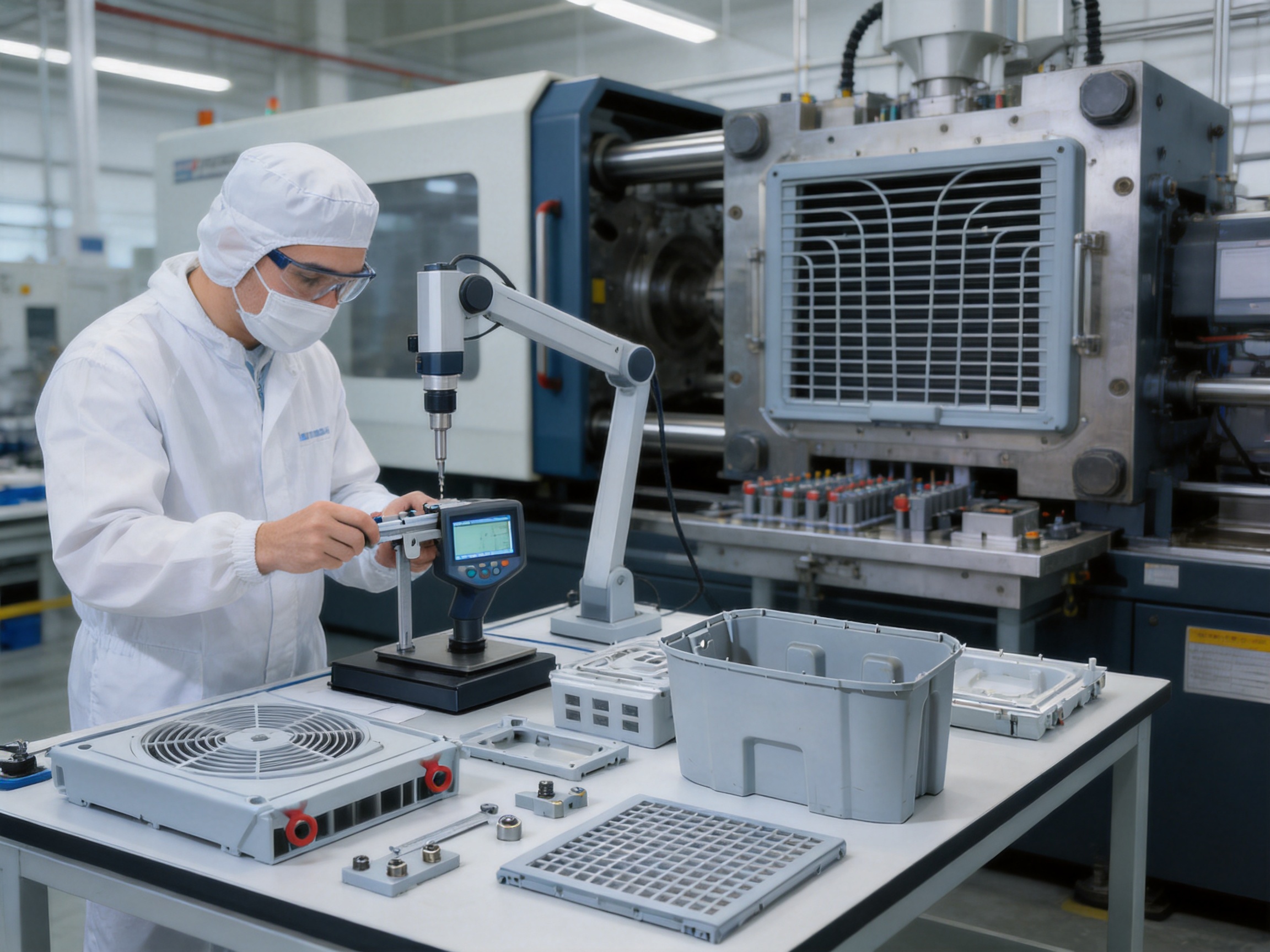
Inspection should be carried out throughout the mould manufacturing process, not only after final assembly. Steel components are checked against drawings and three-dimensional data using appropriate measuring equipment. Critical dimensions include cavity and core profiles, boss locations, hole positions, insert interfaces, slide travel, guide alignment, and parting surfaces.
Dimensional inspection helps identify errors before mould trial. If a cavity insert is out of tolerance, correcting it during machining is normally easier than repairing a finished mould after moulding defects are discovered.
Trial Moulding
Trial moulding is used to evaluate the mould under practical injection conditions. The trial checks whether the component fills completely, whether the part releases correctly, whether the cooling performance is adequate, and whether the moulded dimensions and appearance meet expectations.
Trial samples should be examined for short shots, flash, sink marks, weld lines, burn marks, warpage, flow marks, ejector marks, dimensional variation, and surface imperfections. Assembly checks are also important. The moulded housing should be tested with related components to confirm that screws, clips, panels, motors, fans, grilles, and other elements fit correctly.
Process Optimization
Injection speed, melt temperature, mould temperature, holding pressure, holding time, cooling time, and screw recovery settings may be adjusted during the trial stage. The goal is not simply to produce one good sample. The goal is to establish a repeatable process window that can be transferred to production.
A stable process window gives operators some tolerance against normal production variation. If the mould only produces acceptable parts under one extremely narrow setting, production may become difficult. Professional mould validation therefore considers both the design of the tool and the practicality of running it on the customer’s equipment.
Documentation and Corrective Action
Inspection results, trial records, adjustment notes, and approved sample information should be documented. This creates a useful reference for future production, maintenance, and troubleshooting. If a modification is required, the change should be recorded so that the mould history remains clear.
A disciplined corrective-action process also helps distinguish between mould-related issues and injection-process issues. For example, a sink mark may result from excessive local thickness, insufficient holding pressure, inadequate cooling, or a combination of these factors. Proper analysis prevents unnecessary modifications and supports efficient problem solving.
Manufacturing Strengths and Service Capability
Taizhou Huangyan Haiquan Plastic Mold Co., Ltd. specializes in the research, development, and manufacture of precision injection moulds for daily necessities, home appliances, automotive components, and industrial equipment. This broad sector experience is valuable for air cooler tooling because the product combines consumer-facing appearance requirements with functional structural details.
The company operates with a professional design team and a scientific production management system. Such an organization supports the complete development cycle, including product review, mould design, machining, assembly, trial moulding, delivery, and after-sales assistance. Managing these stages through an integrated system can reduce communication gaps and improve project coordination.
Experience in daily necessities and home appliance moulds provides practical knowledge of large plastic panels, snap-fit structures, ventilation openings, decorative surfaces, and high-volume production expectations. Experience in automotive and industrial tooling can further contribute to attention to dimensional control, material behaviour, strength, and process reliability.
The company’s stated business philosophy emphasizes quality first and sustainable development. In mould manufacturing, these principles are reflected in the selection of suitable steel, controlled processing, responsible inspection, maintainable design, and attention to long-term production value rather than only initial sample approval.
With customers in Europe, the Middle East, Southeast Asia, and South America, the company has experience supporting international projects with different technical requirements and communication expectations. Export-oriented mould production requires careful attention to drawings, units, packaging, shipping protection, spare parts, documentation, and remote technical support.
Customization Options for Different Air Cooler Models
The air cooler injection mould can be customized according to component dimensions and mounting structures. Customization begins with the customer’s product concept or existing component design. Engineers can review the intended use, target market, material, production quantity, surface finish, assembly approach, and injection-machine limitations.
Product dimensions can be adapted for compact residential air coolers, medium-sized portable units, or larger commercial appliances. The external shape may include curved panels, carrying handles, control areas, air outlets, water-level windows, and service openings. Internal structures can be modified to support different fans, motors, pumps, filters, or water distribution systems.
Mounting structures are another important customization area. Screw bosses, locating posts, snap-fits, clips, cable routes, motor supports, and grille attachments can be positioned to suit the customer’s assembly process. Where a design uses inserts or metal reinforcement, the mould can be planned to accommodate insert placement or over-moulding requirements.
Surface appearance can also be customized. A customer may request a fine matte texture, a deeper grain, a polished section, contrasting surface zones, or a finish that helps conceal minor handling marks. The mould design must connect the surface requirement with suitable steel preparation, draft, processing conditions, and quality standards.
For products intended for outdoor or humid environments, the material and moulding process may require additional review. Moisture-resistant plastics, UV-stabilized grades, and suitable drainage structures can contribute to product durability. The mould itself should include practical provisions for cleaning, inspection, and replacement of wear components.
Economic Value for HVAC Manufacturers
A quality mould is a long-term production asset. Although the initial tooling investment is important, the total economic value depends on the complete production cycle. A tool that fills consistently, cools efficiently, ejects reliably, and requires limited maintenance can reduce unit cost over its working life.
Repeatable moulding reduces material waste caused by defective parts. It can also lower labour requirements for trimming, drilling, correcting, or manually fitting components. When the housing is moulded with accurate mounting features, assembly time may decrease and the risk of line stoppages may be reduced.
Efficient cycle control contributes directly to output. If cooling and ejection are well designed, the injection machine can operate with a practical cycle time while maintaining part quality. For a high-volume air cooler program, even a small reduction in cycle time can produce a significant increase in annual capacity.
Maintenance planning also affects the cost of ownership. A mould with accessible wear components, replaceable inserts, standard fittings, clear cooling connections, and organized documentation is easier to service. This can reduce downtime and simplify preventive maintenance over the planned production period.
Recommended Technical Data
The following information summarizes the principal specifications provided for this air cooler injection mould. Final technical details should always be confirmed against the approved product drawings, material data, mould design, and customer production requirements.
| Item | Provided Specification | Production Significance |
|---|---|---|
| Product | Air Cooler and Components Injection Mould | Designed for air cooler housings and related plastic components |
| Primary application | Air cooler housing and structural parts | Supports consumer, commercial, and appliance production programs |
| Mould steel options | 718 / NAK80 | Suitable for strength, machinability, dimensional stability, and surface requirements |
| Product material | ABS / PP | Supports common rigid and lightweight appliance plastic applications |
| Target mould life | Approximately 800,000 shots | Provides a substantial production service target when properly maintained |
| Customization | Component dimensions and mounting structures can be adjusted | Allows adaptation to different air cooler models and assembly systems |
| Typical components | Housings, fan covers, cooling unit components | Supports both external and internal product structures |
Maintenance and Long-Term Reliability
Even a well-manufactured mould requires a planned maintenance program. After production, the mould should be cleaned, dried, lubricated where appropriate, and inspected for wear or damage. Water channels should be checked for blockage, leakage, or corrosion. Ejector pins and moving mechanisms should be monitored for abnormal resistance or uneven movement.
Parting surfaces should be kept free from plastic residue and foreign material. Small particles can prevent proper closing and create flash. If flash appears repeatedly in the same location, the parting surface, guide system, or mould alignment should be inspected rather than simply increasing clamping force.
Cooling performance should be reviewed periodically. Scale or contamination inside water channels can reduce heat transfer and extend cycle time. The correct cleaning method depends on the mould material, water quality, and facility maintenance system. Recording cooling-flow problems early can prevent larger production disruptions.
Wear components such as guide bushings, slide surfaces, locking blocks, ejector pins, and return springs may eventually require replacement. A maintainable mould design makes these components accessible and allows replacement without unnecessary disassembly of the entire tool.
Storage conditions also matter. When a mould is not in use, exposed steel surfaces should be protected against corrosion. The mould should be stored in a secure, dry environment, with the cavity and core surfaces protected from impact. Proper storage extends service life and supports a faster restart when the next production order begins.
Why Professional Tooling Matters for Air Cooler Production
The air cooler housing is more than an outer cover. It controls the relationship between the air inlet, fan, cooling media, water system, control panel, and protective structures. Its strength and dimensional accuracy affect the complete appliance. If the housing does not fit properly, airflow may be affected, noise may increase, vibration may occur, and the product may appear poorly assembled.
Professional tooling addresses these risks at the design and manufacturing stages. Engineers consider how the part will fill, cool, eject, assemble, and perform in service. Machinists create the mould with controlled processes, while inspection personnel verify critical dimensions and surface conditions. Trial moulding then provides practical evidence that the tool is ready for production.
This integrated approach is a significant advantage over low-cost tooling that focuses only on producing an initial sample. A low initial price may become expensive if the mould produces inconsistent parts, requires repeated repairs, has poor cooling, or cannot meet the expected production quantity. Reliable tooling should be evaluated according to total production value, not only purchase price.
Conclusion
The Air Cooler and Components Injection Mould is designed to support the efficient manufacture of plastic housings, fan covers, cooling unit components, and related structural parts. Its application involves large and often visually important components that require accurate ventilation structures, reliable mounting features, controlled wall thickness, consistent surfaces, and dependable assembly dimensions.
With 718 and NAK80 steel options, support for ABS and PP materials, and a target service life of approximately 800,000 shots, the mould provides a practical foundation for long-term HVAC appliance production. Its value is further strengthened by customization of component dimensions and mounting structures, allowing manufacturers to adapt the tooling to different air cooler models.
The manufacturing strengths of Taizhou Huangyan Haiquan Plastic Mold Co., Ltd. include experience in precision injection mould development, a professional design team, organized production management, and service coverage across daily necessities, home appliances, automotive parts, and industrial equipment. These capabilities help connect product design with practical mould construction, trial validation, delivery, and after-sales support.
For manufacturers seeking stable production, lower defect rates, efficient assembly, and dependable tooling life, a professionally engineered air cooler injection mould can provide important competitive advantages. By combining accurate design analysis, appropriate steel selection, precision machining, balanced cooling, reliable ejection, and systematic quality control, the mould becomes an essential production asset for modern air cooler manufacturing.
Questions and Answers
What products can be made with the air cooler injection mould?
The mould is designed primarily for air cooler housings, fan covers, cooling unit components, ventilation panels, and related structural parts. The precise components depend on the customer’s product design and mould configuration.
Which plastic materials are supported?
The provided specification lists ABS and PP. These materials are commonly used for appliance housings and structural components. The final material grade should be confirmed before mould design because different grades may have different shrinkage, flow, cooling, and wear characteristics.
What mould steels are available?
The listed mould steel options are 718 and NAK80. The appropriate selection depends on the required surface finish, production volume, product geometry, material, and maintenance expectations.
How long can the mould be used?
The stated target mould life is approximately 800,000 shots. Actual service life depends on plastic selection, processing conditions, maintenance, mould operation, cooling-water quality, and the replacement of normal wear components.
Can the mould be customized for a new air cooler design?
Yes. Component dimensions and mounting structures can be adjusted. Customization may include housing size, screw bosses, clips, locating posts, fan openings, internal supports, grille structures, surface texture, and other product-specific features.
Why is cooling design important for a large housing?
Large housings have broad surfaces and may contain thick bosses or reinforced regions. Uneven cooling can cause warpage, sink marks, residual stress, and dimensional instability. A balanced cooling system helps improve cycle consistency and finished-part quality.
How can the mould reduce production costs?
A well-designed mould can reduce scrap, secondary trimming, manual correction, assembly problems, and unplanned downtime. Efficient filling, cooling, and ejection may also shorten the production cycle and increase machine output.
What quality checks are performed before production?
Typical checks include steel-component inspection, mould assembly verification, parting-surface inspection, cooling-channel checks, ejector movement checks, trial moulding, dimensional inspection, appearance evaluation, and assembly testing with related components.
Does the company support international customers?
The company serves customers in Europe, the Middle East, Southeast Asia, and South America. International mould projects generally require clear technical communication, export packaging, production documentation, trial approval, and after-sales support.
What information should a customer provide for a quotation?
Useful information includes the three-dimensional product model, two-dimensional drawings, material grade, expected annual quantity, mould life requirement, injection-machine information, surface-finish requirements, preferred mould standard, number of cavities, and any special assembly or quality requirements.
References
1. Product information supplied for the Air Cooler and Components Injection Mould, including application, materials, mould steel, mould life, and customization scope.
2. Company information supplied for Taizhou Huangyan Haiquan Plastic Mold Co., Ltd., including business sectors, production capability, service philosophy, and international market coverage.
3. General principles of thermoplastic injection mould design, including parting-line planning, draft-angle requirements, gating, cooling, venting, ejection, and mould maintenance.
4. General engineering practices for ABS and PP injection moulding, including shrinkage control, processing stability, dimensional inspection, and surface-quality management.
5. General tooling-management practices for high-volume appliance component production, including preventive maintenance, trial moulding, corrective action, and production documentation.
Product: Air Cooler and Components Injection Mould

For exclusive deals and latest offers, sign up by entering your email address below.











 +86-18657672567
 sales@tzhqmould.com
celin@tzhqmould.com
 No. 17 Houshi Road, Beicheng Industrial Zone, Huangyan District, Taizhou City, Zhejiang Province, China
Copyright © Taizhou Huangyan Haiquan Plastic Mold Co., Ltd. All Rights Reserved
Injection Plastic Mould Maker

